Oracle

Oracles are essential infrastructure components that feed real-time, off-chain data (such as price feeds, weather, or sports results) into blockchain smart contracts. Without decentralized oracles like Chainlink and Pyth, DeFi could not function. In 2026, oracles have evolved to support verifiable randomness and cross-chain data synchronization. This tag covers the technical evolution of data availability, tamper-proof price feeds, and the critical role oracles play in ensuring the deterministic execution of complex decentralized applications.

5165 Articles
Created: 2026/02/02 18:52
Updated: 2026/02/02 18:52
Chainlink’s total value secured surpasses $100B

Chainlink’s total value secured surpasses $100B

The post Chainlink’s total value secured surpasses $100B appeared on BitcoinEthereumNews.com. As cryptocurrencies rallied on Sept. 12, with Bitcoin surging past $115,000 and altcoins following suit, Chainlink announced on X that its network’s total value secured (TVS) had surpassed $100 billion.This value is an all-time high, further proving the Oracle platform’s growth after surpassing TVS milestones for 2021-based stakes. TVS represents the aggregate value of assets secured by Chainlink’s decentralized infrastructure, so its growth represents a clear signpost for increased adoption and confidence among DeFi and traditional finance users. Chainlink’s TVS has more than doubled this year, from about $38 billion initially to $93 billion in mid-August before breaking through a $100 billion valuation. The growth represents the proliferation of DeFi protocols and enterprise use cases supported by Chainlink’s oracles offerings. Major partnerships fuel growth Recent developments have fueled this momentum, including Chainlink’s partnership with Intercontinental Exchange to integrate foreign exchange and precious metals data into its Data Streams and the U.S. Department of Commerce’s move to bring key economic data on-chain via Chainlink. According to DeFiLlama, lending protocol Aave accounts for the largest share of Chainlink TVS, securing more than $70.9 billion, around 70.75% of the total, across 17 chains. The top networks for Aave v3 include Ethereum, Arbitrum, and Base. Other notable contributors include Maple, Compound v3, SparkLend, and Solana-based Kamino. As TVS climbed, the network’s native token LINK also gained traction. On Sept. 12, LINK traded around $24.70, up nearly 5% on the day and 11% over the past week. Polymarket chooses Chainlink as oracle As earlier reported by Cryptopolitan, Polymarket has adopted a new approach to resolving certain markets on its platform, giving the oracle platform Chainlink power over some of its users’ price predictions. Placing more emphasis on the “accuracy and speed” of markets that depend on the performance of digital assets, Chainlink noted that it…

Author: BitcoinEthereumNews
7 Altcoins Every Investor Should Have on Their Radar

7 Altcoins Every Investor Should Have on Their Radar

The post 7 Altcoins Every Investor Should Have on Their Radar appeared on BitcoinEthereumNews.com. The crypto market of 2025 is shaping up to be one of the most competitive. We’re seeing capital flows across infrastructure chains, enterprise-oriented protocols, and speculative presales. Investors must choose from higher potential tokens, or dependable altcoins. They must have either explosive upside potential or deliver stability.  Analysts are increasingly recommending a mixed approach, holding stable assets but giving an allocation to newer businesses to accelerate growth. Among the top 100 cryptocurrencies are six altcoins with strong fundamentals and adoption trends. An emerging presale MAGACOIN FINANCE is shaping up to be the breakout story alongside them. Polkadot (DOT) Polkadot is arguably the most important interoperability project in crypto. Gavin Wood, co-founder of Ethereum, designed it so that independent blockchains or parachain can share security and signal. This multichain framework supports custom networks tailored to specific use cases, such as DeFi and gaming. Developers stay active, while the community stays engaged due to a recent strengthening of Polkadot’s parachain auctions Investors can view DOT as a long-term investment in cross-chain integration, which will continue to grow as liquidity becomes fragmented. Since it can combine different blockchain economies, Polkadot will be a key asset of the next decade. Cosmos (ATOM) Cosmos is known as the “Internet of Blockchains”, while many networks are already being linked by the inter-blockchain protocol IBC.  With its IBC technology, Cosmos enables fully programmable interoperable chains, ensuring a true network effect. The ATOM coin is required for governance and staking, and it also helps secure the network and facilitate participation. Experts believe that as Decentralized Finance moves past isolated chains, it would enter a multi-chain reality, and Cosmos is well placed. Growing institutional interest in scalable cross-chain could ensure the long-term relevance of ATOM. If you want to invest in interoperability and the internet of blockchains, then Cosmos…

Author: BitcoinEthereumNews
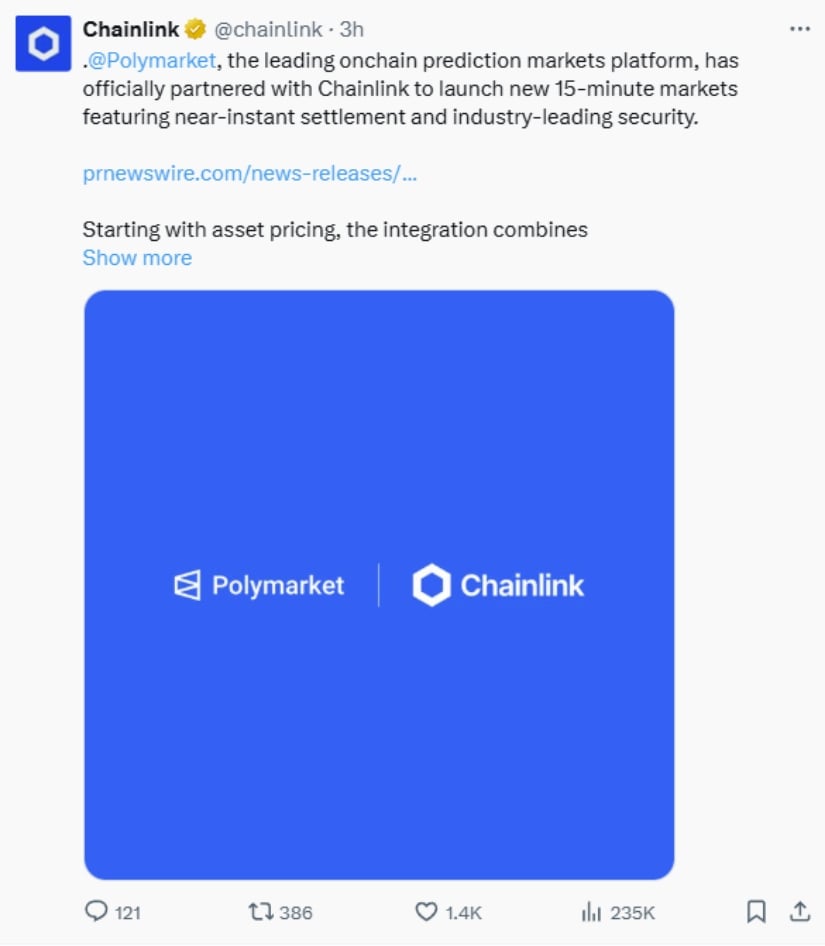
Polymarket Partners with Chainlink to Improve Market Resolution Accuracy

Polymarket Partners with Chainlink to Improve Market Resolution Accuracy

The partnership, announced on September 12, 2025, aims to make betting outcomes faster and more reliable by using automated data feeds instead of human voting.

Author: Brave Newcoin
Polymarket Integrates Chainlink to Automate Prediction Market Settlements

Polymarket Integrates Chainlink to Automate Prediction Market Settlements

Polymarket integrates Chainlink to automate, secure, and accelerate prediction market settlements, enabling real-time, trusted data on the Polygon mainnet. Polymarket, a leading decentralized prediction market platform, has officially integrated Chainlink’s powerful oracle technology to improve how it resolves markets. This new alliance was made known on Friday and is a significant move towards prediction markets […] The post Polymarket Integrates Chainlink to Automate Prediction Market Settlements appeared first on Live Bitcoin News.

Author: LiveBitcoinNews
Friday charts: Ellison is having fun again

Friday charts: Ellison is having fun again

The post Friday charts: Ellison is having fun again appeared on BitcoinEthereumNews.com. This is a segment from The Breakdown newsletter. To read more editions, subscribe “Winning. That’s my idea of fun.” ― Larry Ellison Larry Ellison will never be featured in a habits-of-billionaires listicle. In the 2000s, while running one of the most important companies in the world, he typically strolled into the office at 1:30 in the afternoon. When he did arrive, he wasn’t always fully engaged. “He had a reputation for being easily bored by the process of running a business,” according to his biographer. He was often absent for long stretches, “leaving the shop to senior colleagues.” On earnings calls, Wall Street analysts asked how much time he’d spend on boats in the coming quarter. In short, he was the antithesis of the young tech founders profiled in The Wall Street Journal this morning — so devoted to work they barely take time to eat, let alone pursue an outside interest or go on a date. Ellison, by contrast, devoted years to competitive sailing, learned to pilot airplanes, bought an island, designed Japanese-inspired homes, regularly played tennis with Rafa Nadal and did enough dating to be married five times. All while running one of the world’s most important companies. When his first marriage ended in divorce in 1978, Ellison’s ex-wife thought so little of his prospects as a founder that she sold him her claim to the one-year-old Oracle for $500. (In three subsequent divorces, he again somehow managed to avoid surrendering any part of Oracle.) And yet, Ellison passed Elon Musk to become the world’s richest man this week — for the second time. The first time was in 2000, when he briefly passed Bill Gates near the height of the dotcom bubble. By then, Oracle’s ubiquitous databases had made the company one of the three main characters in…

Author: BitcoinEthereumNews
AI Narratives Lift Tokens While Oracle Surges Past Nvidia Value

AI Narratives Lift Tokens While Oracle Surges Past Nvidia Value

The post AI Narratives Lift Tokens While Oracle Surges Past Nvidia Value appeared on BitcoinEthereumNews.com. AI-focused crypto sectors like DeFAI and DeSci led weekly market gains with strong momentum. Oracle’s $200B market surge boosted its valuation near $1T, surpassing Nvidia in investor sentiment. NFTs and lending protocols faced steep declines, contrasting with growth in utility-driven crypto sectors. AI-driven crypto categories posted the strongest gains this week, led by DeFi AI (DeFAI) with a 4.5% rise. Decentralized Science (DeSci) added 4.3%, while AI Agent projects advanced 4.0%. Privacy tokens climbed 3.2%, and centralized exchanges gained 3.0%. Broader Market Breakdown Layer 1 and Layer 2 networks rose 2.8% and 2.6% respectively. Core DeFi gained 2.2%, DePIN climbed 1.8%, and real-world assets (RWA) advanced 1.2%. Memecoins added 0.5%, while decentralized exchanges were nearly flat at 0.2%. The AI sector has been underperforming for most of the year, but now narrative is heating up. Some top #AI projects looking to launch at the end of Q3 fueling this sector. I will be sharing my research on some of them in my discord: https://t.co/HFc6FwWdFv pic.twitter.com/CkEWwXGKDZ — Rand (@crypto_rand) September 11, 2025 Lending Protocols and NFTs Lag Behind Speculative sectors saw sharp pullbacks. Lending protocols dropped 2.3%, non-fungible tokens (NFTs) slipped 1.5%, and oracle-based tokens fell 0.9%. Gaming tokens edged down 0.1%, showing limited activity. Capital Flows Rotate to Utility Tokens The divergence pushed inflows toward innovation-focused areas like DeFAI and DeSci, while speculative categories such as NFTs and lending faced pressure. Related: Memecoins and AI Tokens Control 62.8% of 2025 Crypto Market Attention — Here’s Why Oracle Market Value Surges by $200 Billion Oracle added $200 billion in market value in a single session, lifting its capitalization close to $1 trillion. The rally pushed founder Larry Ellison’s net worth up by more than $107 billion, making him the world’s wealthiest individual ahead of Elon Musk. AI Infrastructure Partnerships Drive Rally…

Author: BitcoinEthereumNews
Polymarket Taps Chainlink to Deliver Real-Time Crypto Price Resolution

Polymarket Taps Chainlink to Deliver Real-Time Crypto Price Resolution

TLDR: Polymarket now uses Chainlink Data Streams and Automation for near-instant settlement of asset pricing markets on Polygon. The partnership reduces resolution delays, improving user experience and cutting dependence on manual or social resolutions. Chainlink’s infrastructure secures nearly $100B in DeFi value and supports hundreds of protocols with trusted data. Polymarket plans to expand the [...] The post Polymarket Taps Chainlink to Deliver Real-Time Crypto Price Resolution appeared first on Blockonomi.

Author: Blockonomi
Inside AI Crypto Trading: Coinbase AgentKit, Lit’s Hustle, Vincent, and x402 Onchain Rails

Inside AI Crypto Trading: Coinbase AgentKit, Lit’s Hustle, Vincent, and x402 Onchain Rails

Artificial intelligence (AI) agents are reshaping crypto trading, decentralized finance (DeFi), and more. AI agents are no longer just a concept, but rather a common feature being leveraged for a variety of crypto-focused use cases. AI agents also differ from traditional rule-based bots. Rather than following simple prompts, agents are able to continuously learn from market movements, sentiment and liquidity conditions to execute trades with greater precision. This is why AI agents are being leveraged more often in the crypto sphere. David Sneider, CEO and co-founder of Lit Protocol, told Cryptonews that any strategy a person or organization executes manually in DeFi today can be automated through AI agents. Sneider added that beyond saving time, these models provide entirely new access. “One person can craft a strategy, while others simply enroll to benefit, removing the barrier of technical sophistication that previously limited who could participate in advanced crypto strategies,” he said. AI Agents for Trading and Yield Optimization To put this in perspective, Sneider explained how retail investors use AI agents through Lit Protocol and Vincent, an automation platform layer on Lit that powers a wide variety of crypto trading agents. “Within autonomous crypto agents, we see two broad categories: ‘user-configured’ agents and ‘set-and-forget’ agents,” Sneider mentioned. According to Sneider, user-configured agents allow crypto investors to have direct strategy input. A leading example of this is Lit’s “Agent Hustle,” where users interact through a chat interface and provide prompts like the one below:“Execute a mixed trading strategy: allocate 80% to conservative blue-chip and stablecoin yield positions, 10% to aggressive perp trading with dynamic leverage and a max 2% drawdown per trade, and 10% to trending meme tokens using sentiment and social signals. Rebalance automatically, manage risk tightly, and maximize overall portfolio performance.”“The agent drafts, refines with user feedback, and then executes the strategy,” Sneider said. Users can also leverage set-and-forget agents to run established strategies that are optimized over time. Sneider pointed out examples of these being deployed through Vincent: Perpetual futures hedging: Monitoring exposures and rebalancing leverage automatically. Yield optimization: Shifting stablecoins between lending markets and vaults to secure the best rates. Trader Agents: Executing momentum, mean reversion, options spreads, or cross-chain arbitrage strategies under a defined mandate. AI Agents for Token Discovery AI agents are also helping crypto users with token discovery. Jake Gallen, CEO at agenthustle.ai (Hustle), told Cryptonews that the platform helps users discover tokens intelligently and trade autonomously. “Hustle’s Memory, Toolbox, and Conditional trading engine are the three pillars that separate this agent from competition, making him one of the most unique products on the market,” Gallen said. “We combine these apps, leverage it with the Emblem Vault multichain wallet, and allow the Agent to interact with any blockchain.” Gallen pointed out that Hustle’s primary use cases include token discovery and automated trading. “Within a single prompt, Hustle can find a token based on the context a user presents, then buy these assets, and set up an advanced entry and exit order. From start to finish, this can be accomplished in 30 seconds,” Gallen commented. Hustle also helps with users seeking pocket analysis. “Users can combine Hustle’s memory and toolbox to utilize just his alpha aggregation, news reporting, and contextual outputs. They do not trade and use him simply as a pocket analyst,” Gallen said. AI Agents Within Crypto Exchanges While AI agents can help crypto investors trade intelligently, popular U.S.-based crypto exchange Coinbase has also started to explore these models.
Dan Kim, head of strategy at Coinbase Developer Platform, told Cryptonews that Coinbase is currently focused on building infrastructure to allow AI agents to operate safely and autonomously. “This includes giving agents wallets, the ability to transact on-chain, and tools to charge or pay for services programmatically,” Kim said. He added that the infrastructure behind these models, like x402 and AgentKit, allows AI agents to interact with DeFi, pay for services, and perform economic activities safely across Coinbase. “This is essentially preparing the groundwork for future AI-native payments,” Kim noted. AI Agents Can Make Mistakes Although the potential behind AI agents and crypto use cases is huge, these models are far from perfect. While AI agents can ensure efficiency, accessibility, and risk discipline, Sneider explained, there are downfalls to consider: Data fragility: This is where poor inputs or unreliable oracles can cascade into bad trades. Overfitting: Agents trained on narrow historical data underperform in black swan events. Execution errors: We’ve seen cases where AI models hallucinate or misinterpret instructions. For instance, Sentient recently shared an example of an AI agent getting “stuck” in a transaction loop, firing the same order over and over. Without circuit breakers, this kind of loop can spiral quickly. Latency: Agents that depend on off-chain inference sometimes miss optimal execution windows. Gallen added that the most common mistake AI agents make when it comes to trading is purchasing “fake tokens.” “When a token is pumping, there are multiple copycat tokens that pop up. Even more so, these copycat tokens are artificially inflated to appear as the organic runner. AI can be tricked to buy these because they consider the on-chain volume as real,” Gallen explained. Although there are multiple safety mechanisms set in place, as well as checks and balances, Gallen noted that these occurrences happen every so often. Additionally, Gallen mentioned that API and tooling inconsistencies can be challenging. “This can happen when someone uses one API for conditional trading to execute trades, while using another API to source real-time data. One API can consider Market Cap and FDV as the same thing, while the other provider is much more meticulous in their classifications. This can cause AI to close trades early or result in another variety of outputs that can cause these models to fail at what they were intended to accomplish.” AI Agents Won’t Replace Human Traders Yet Although the potential behind AI crypto trading agents is massive, these models are not yet ready to replace humans entirely. According to Sneider, the beginning of “agentic finance” is just now taking place. However, he said that today’s early products show both promise and pitfalls. “AI can act as a co-pilot, but it must operate inside secure rails,” he said. As such, Sneider believes that AI agents won’t replace human traders, but rather they’ll extend them. “They’ll automate execution across both DeFi and TradFi, but always anchored in user-defined authority,” Sneider said

Author: CryptoNews
Tesla chair Robyn Denholm dismisses concerns over Elon Musk's political activity

Tesla chair Robyn Denholm dismisses concerns over Elon Musk's political activity

Tesla’s board chair, Robyn Denholm, pushed back on worries that Elon Musk’s political activity has hurt the carmaker and said he is free to take part in elections as he wishes. Speaking on Friday, Denholm said that Tesla’s attention remains on its products and customers, not the chief executive’s personal views. “What he does from […]

Author: Cryptopolitan
OpenAI Oracle Deal: Unpacking the Colossal $300 Billion Agreement and its Profound Impact

OpenAI Oracle Deal: Unpacking the Colossal $300 Billion Agreement and its Profound Impact

BitcoinWorld OpenAI Oracle Deal: Unpacking the Colossal $300 Billion Agreement and its Profound Impact The recent announcement of a staggering $300 billion, five-year agreement between AI powerhouse OpenAI and cloud veteran Oracle sent ripples across Wall Street and the broader tech landscape. For many in the fast-paced world of cryptocurrency and decentralized tech, where innovation is paramount, this colossal OpenAI Oracle deal might have seemed like an unlikely pairing. Yet, as we delve deeper, it becomes clear that this strategic alliance is a testament to the evolving demands of artificial intelligence and the unexpected players shaping its future. The Unexpected Alliance: Why the OpenAI Oracle Deal Stunned Markets This week, OpenAI and Oracle indeed shocked the markets with their surprise $300 billion, five-year agreement. The news instantly sent the cloud provider’s stock skyrocketing, signaling a significant shift in market perception. But perhaps the initial surprise among industry watchers, who often cite Oracle’s ‘legacy status’ compared to cloud giants like Google, Microsoft Azure, and AWS, was misplaced. The deal serves as a potent reminder that, despite its long history, Oracle continues to play a major, often understated, role in the foundational layers of modern AI infrastructure. Chirag Dekate, a vice president at research firm Gartner, highlighted the strategic rationale for both parties. He noted that it makes immense sense for OpenAI to diversify its infrastructure providers, spreading out risk and gaining a crucial scaling advantage over competitors. For Oracle, this partnership validates its significant, albeit less publicized, investments in high-performance cloud computing. Dekate emphasized, "Over the decades, they actually built core infrastructure capabilities that enabled them to deliver extreme scale and performance as a core part of their cloud infrastructure." Oracle’s track record with hyperscalers and its foundational role in powering TikTok’s substantial U.S. business underscore its robust capabilities, making the partnership less of a shock and more of a logical progression for those familiar with its enterprise-grade offerings. Fueling the Future: The Massive Demand for AI Infrastructure OpenAI’s willingness to commit such an astronomical sum for compute resources provides a clear measurement of the startup’s insatiable appetite for processing power. In the rapidly accelerating AI arms race, access to top-tier AI infrastructure is not merely an advantage; it’s a prerequisite for survival and innovation. This agreement is a cornerstone of OpenAI’s strategy to build one of the most comprehensive global AI supercomputing foundations, enabling extreme scale and efficient inference where needed. Dekate describes this approach as "quite unique" and "exemplary of what a model ecosystem should look like," suggesting a blueprint for future AI development. The deal allows OpenAI to: Diversify Risk: By partnering with multiple cloud providers, OpenAI mitigates the risks associated with relying on a single vendor, ensuring greater resilience and operational continuity. Achieve Scaling Advantage: Access to Oracle’s specialized infrastructure provides OpenAI with the capacity to scale its models and services rapidly, outpacing competitors who might face compute bottlenecks. Optimize Performance: Oracle’s cloud infrastructure is known for its high-performance capabilities, crucial for the demanding workloads of advanced AI models. This strategic move positions OpenAI not just as a leader in AI model development, but also as a pioneer in architecting a resilient and scalable operational backbone for its ambitious future. The Burning Question: Navigating AI Compute Costs and Financial Realities While the market celebrates the strategic implications of the OpenAI Oracle deal, critical questions around payment and the sheer scale of AI compute costs remain. OpenAI has made a string of infrastructure investment announcements over the past year, each with an eye-popping price tag. Beyond the $300 billion commitment to Oracle, the company has also pledged $10 billion to develop custom AI chips with Broadcom. These figures paint a picture of extraordinary expenditure. Consider the financial context: Financial Metric Details Oracle Compute Deal $300 billion over five years (approx. $60 billion annually) Broadcom AI Chip Development $10 billion commitment Annual Recurring Revenue (ARR) ~$10 billion (up from $5.5 billion last year) Cash Burn Burning through billions of dollars annually While CEO Sam Altman has painted a rosy picture of future prospects, the company is undeniably burning through billions of dollars in cash each year. This high-stakes spending reflects the venture capital-backed model of prioritizing growth and market dominance over immediate profitability, a strategy familiar to many in the tech world. The goal is to establish an unassailable lead in AI, even if it means substantial short-term losses. OpenAI’s investors, keen on maintaining an "asset light" valuation, likely appreciate the strategy of leveraging Oracle’s existing infrastructure rather than building it all from scratch, keeping the company aligned with other software-centric AI startups. Powering Progress: The Challenge of Data Center Power Beyond financial commitments, a monumental question looms: where will the companies source the immense energy needed to run this level of compute? The demand for data center power is escalating dramatically. Industry observers predict a near-term boost for natural gas, though renewable sources like solar and batteries are arguably better positioned to deliver power sooner and at lower cost in many markets. Tech giants are also making significant bets on nuclear energy, seeing it as a stable, high-density power source for the future. The energy impact of OpenAI’s anticipated growth is not entirely unexpected. A recent report by the Rhodium Group projected that data centers could consume 14% of all electricity in the U.S. by 2040. Compute has always been a constraint for AI companies, leading investors like Andreessen Horowitz to purchase thousands of Nvidia chips, and individuals like Nat Friedman and Daniel Gross to rent access to massive GPU clusters. However, compute is effectively worthless without a reliable and abundant power supply. To ensure their data centers remain juiced, large tech companies have been actively investing: Acquiring Solar Farms: Securing direct access to renewable energy sources. Buying Nuclear Power Plants: Betting on consistent, high-capacity energy. Inking Deals with Geothermal Startups: Exploring innovative, continuous power solutions. So far, OpenAI itself has been relatively quiet on direct energy investments. While CEO Sam Altman has placed several prominent personal bets in the energy sector, including Oklo, Helion, and Exowatt, the company hasn’t directly poured money into the space like Google, Meta, or Amazon. With a 4.5 gigawatt compute deal, this stance may soon change. OpenAI may play an indirect role, relying on Oracle to handle the physical infrastructure and its associated power demands – something Oracle has extensive experience with – while Altman’s investments align with OpenAI’s future power needs. This approach helps keep OpenAI "asset light," a strategy that undoubtedly pleases investors and helps maintain its valuation as a software-centric AI innovator rather than a capital-intensive infrastructure provider. Beyond the Big Three: Oracle’s Resurgence in Cloud Computing The OpenAI Oracle deal marks a significant moment for Oracle in the competitive landscape of cloud computing. For years, the narrative has centered on the dominance of AWS, Microsoft Azure, and Google Cloud. However, Oracle Cloud Infrastructure (OCI) has been quietly building capabilities tailored for high-performance, demanding workloads, particularly in the enterprise space. Oracle’s appeal to OpenAI likely stems from several factors: Specialized Hardware: OCI offers bare-metal instances and high-performance networking that can be crucial for training massive AI models. Cost-Effectiveness: Oracle may have offered a highly competitive pricing structure for such a large-scale, long-term commitment, appealing to OpenAI’s need to manage its colossal compute costs. Strategic Diversification: For OpenAI, working with Oracle reduces its reliance on Microsoft, its primary investor and cloud partner, enhancing its strategic independence. Enterprise-Grade Reliability: Oracle’s long-standing reputation for enterprise solutions brings a level of reliability and security that is critical for mission-critical AI operations. This partnership not only provides OpenAI with the crucial compute power it needs but also elevates Oracle’s standing as a serious contender in the hyperscale cloud market, especially for specialized, high-demand AI workloads. It underscores a broader trend where companies are increasingly looking beyond the traditional ‘big three’ for niche capabilities, competitive pricing, and strategic independence in their cloud strategies. A Glimpse into the Future of AI and Tech The OpenAI Oracle deal is more than just a massive financial transaction; it’s a strategic maneuver that redefines the dynamics of the AI and cloud computing industries. It highlights the relentless demand for compute power, the complex financial balancing act of AI startups, and the critical importance of sustainable energy solutions for the future of technology. As AI continues its exponential growth, such alliances will become increasingly common, shaping how innovation is powered, funded, and scaled. This deal underscores that the future of AI is not solely about algorithms and models, but also about the underlying physical and financial infrastructure that supports them. The questions surrounding payment and power will continue to be central to the AI narrative, driving innovation not just in software, but also in hardware, energy, and sustainable practices. The implications for Wall Street, the tech sector, and even the cryptocurrency community, which often intersects with cutting-edge technological advancements, are profound and far-reaching. To learn more about the latest AI infrastructure trends and how companies are tackling immense AI compute costs, explore our article on key developments shaping AI’s future institutional adoption. This post OpenAI Oracle Deal: Unpacking the Colossal $300 Billion Agreement and its Profound Impact first appeared on BitcoinWorld.

Author: Coinstats