NFT

NFTs are unique digital identifiers recorded on a blockchain that certify ownership and authenticity of a specific asset. Moving past the "PFP" craze, 2026 NFTs emphasize utility, representing everything from IP rights and digital fashion to RWA titles and event ticketing. This tag explores the technical standards of digital ownership, the growth of NFT marketplaces, and the integration of non-fungible tech into the broader Creator Economy and enterprise solutions.

13245 Articles
Created: 2026/02/02 18:52
Updated: 2026/02/02 18:52

Ethereum Activates Fusaka Upgrade, Unlocking Real Sharding for the First Time

Ethereum Activates Fusaka Upgrade, Unlocking Real Sharding for the First Time

Ethereum has shipped its most ambitious scaling milestone in years, the Fusaka upgrade, the network’s second major update of 2025, is now live on mainnet. It activated at epoch 411392 on December 3, 2025, at roughly 21:49 UTC, marking a breakthrough moment that researchers have pursued for nearly a decade. Fusaka introduces PeerDAS, a data [...]

Author: Null TX
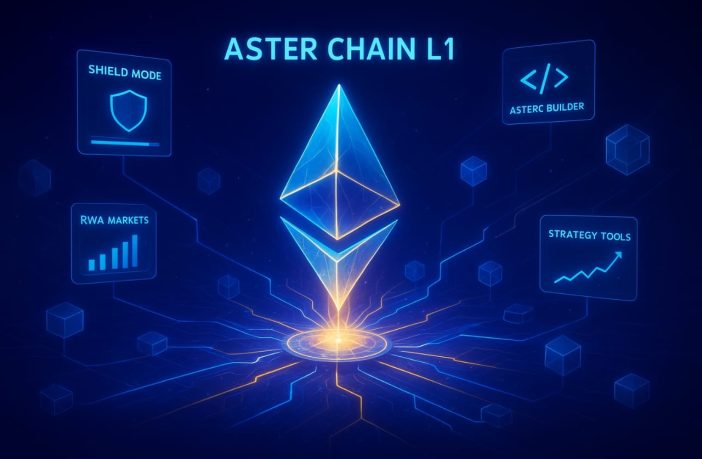
Aster Unveils 2026 H1 Roadmap, Pushing Toward L1 Launch, Staking, and True Infrastructure Expansion

Aster Unveils 2026 H1 Roadmap, Pushing Toward L1 Launch, Staking, and True Infrastructure Expansion

Aster has published its 2026 H1 roadmap, and the message lands with precision: the team is building with long-term conviction. After a breakout year in 2025, the project is shifting from rapid feature shipping to core infrastructure, the kind that defines a protocol’s future. The updated roadmap outlines the next six months of development, culminating [...]

Author: Null TX
LINK Slides to $14.05 as Traders Profits Despite CCIP & ETF

LINK Slides to $14.05 as Traders Profits Despite CCIP & ETF

The post LINK Slides to $14.05 as Traders Profits Despite CCIP & ETF appeared on BitcoinEthereumNews.com. What to Know Profit-taking hit LINK after the Base – Solana CCIP bridge launch and ETF debut. Altcoin sentiment weakened as Bitcoin dominance climbed, pulling liquidity away. LINK failed to hold key resistance at $14.39, increasing short-term downside risk.   Chainlink (LINK) fell about 5% in the last 24 hours, dropping to about $14.05. The pullback comes even after two major developments that many had hoped would ignite long-term interest: the debut of LINK’s first U.S.-listed ETF and the launch of a new cross-chain bridge linking Base and Solana secured by Chainlink’s technology. Post-Launch Profit Taking On December 4, the Base – Solana bridge went live on mainnet. The bridge is secured by Chainlink’s cross-chain system (CCIP), allowing assets from Solana like SOL and SPL tokens, to move directly to Base. This is seen as a big technical step, opening new routes for developers and users. The launch of the new bridge will help users to transact between two blockchains easily. Leading projects on Base, including the Zora NFT marketplace and the Aerodrome decentralised exchange, have already integrated support for Solana-based assets. This allows users on Base access to new pairs and markets, while providing Solana users with a gateway to the Ethereum ecosystem. But even though it was a big deal, it looks like a lot of traders used it as a reason to sell. LINK had gone up about 6% in the week before the bridge launch, probably because people were guessing what would happen. But as soon as the news came out, people started selling. Reports say that LINK’s trading volume dropped sharply, which means that traders are pulling back. Chainlink has seen the “buy the rumor, sell the news” pattern before, where big updates cause short-term price rises followed by quick drops. ETF Hype Didn’t Hold…

Author: BitcoinEthereumNews
Stablecoins Threaten Central Banks, Warns IMF as Hard-Money Narrative Fuels Bitcoin Hyper

Stablecoins Threaten Central Banks, Warns IMF as Hard-Money Narrative Fuels Bitcoin Hyper

What to Know: IMF concerns about dollar stablecoins eroding local currencies reinforce the appeal of scarce, non-sovereign assets like Bitcoin in a fragmented monetary system. Bitcoin’s base layer remains constrained by slow confirmations, fee volatility, and minimal smart contract support, creating renewed interest in specialized Layer 2 infrastructure. Competing Bitcoin scaling projects, from Lightning to sidechains, are racing to capture BTC liquidity as programmable capital for payments and DeFi. Bitcoin Hyper uses an SVM-based Layer 2 anchored to Bitcoin to deliver extremely low-latency smart contracts, targeting DeFi, gaming, and high-speed BTC payments. Stablecoins are a threat. At least that’s according to the International Monetary Fund (IMF). In a recent report, the IMF shared concerns that dollar-backed stablecoins might hollow out weaker local currencies and dilute central banks’ control over domestic liquidity. If a digital dollar reaches everyone’s smartphone, what happens to the Peruvian sol, Nigerian naira, or Turkish lira? The report also discussed the positives of stablecoins like cheaper and quicker payments, and a simpler UX, so it wasn’t all doom and gloom. However, the warning does not just read as a technocratic worry. It reinforces a deeper macro story that crypto has been circling for a decade: demand for scarce, non-sovereign assets that cannot be printed at will, especially Bitcoin. In a world of increasingly digital dollars, Bitcoin’s hard cap can look less like a curiosity and more like a hedge. That backdrop is why attention keeps shifting from ‘number goes up’ to ‘what actually gets built on top of Bitcoin.’ If you believe Bitcoin will matter more as a neutral reserve asset, then the highest-beta plays sit in the infrastructure that makes $BTC programmable, spendable, and usable in DeFi at scale. In that lane, Bitcoin Hyper ($HYPER) is trying to position itself as a key liquidity rail. It pitches itself as the first Bitcoin Layer 2 using the Solana Virtual Machine (SVM), aiming to merge Bitcoin’s hard-money appeal with Solana-style throughput and developer tooling. Why Bitcoin Layer 2 Infrastructure Is Back In Focus When a body like the IMF flags dollar stablecoins as a systemic risk for smaller economies, it implicitly admits that monetary power is splitting. You are not just choosing between local cash and a bank account anymore; you are choosing between local fiat, dollar tokens, and non-sovereign assets like Bitcoin at the tap of an app. That split has pushed capital toward Bitcoin itself, but it has also exposed how limited the base layer is for real-world usage. On-chain Bitcoin still moves with minutes-long confirmation times, variable fees, a slow 7 TPS rate, and almost no native smart contract support. Competing Bitcoin scaling efforts have rushed to fill that gap. Lightning Network pursues off-chain payment channels for instant $BTC transfers, while projects like Stacks and Rootstock lean on sidechains and alternative virtual machines to bring DeFi into the Bitcoin orbit. In that growing field, Bitcoin Hyper ($HYPER) is standing out to turn dormant $BTC liquidity into programmable capital using Solana Virtual Machine (SVM) tech and a canonical bridge. See how to buy into the action with our ‘How to Buy Bitcoin Hyper’ guide. How Bitcoin Hyper Tries To Turn $BTC Into High-Speed Capital For years, the crypto trilemma suggested you couldn’t have speed, security, and decentralization in one place. Bitcoin Hyper ($HYPER) challenges that by changing the geometry of the network. Instead of forcing Bitcoin to be fast, Bitcoin Hyper accepts Bitcoin as the heavy, secure anchor (Settlement Layer). It then attaches a Ferrari engine on top: a modular SVM Layer 2 (Execution Layer). What does this unlock? Rust-based Smart Contracts: Developers can build complex dApps (Gaming, NFT, DEXs) identical to Solana’s ecosystem. Latency: Sub-second finality that beats Solana’s own benchmarks. Security: State is periodically anchored back to $BTC, preserving the ‘hard money’ thesis. The market is voting with its wallet. The presale has breached $29M, with whales accumulating and making purchases as large as $500K. With a price point of $0.013375 and high-APY staking currently at 40%, Bitcoin Hyper is positioning itself as the execution layer for the next bull run. Our experts predict $HYPER possibly reaching $0.08625 by the end of 2026. If you invested today, that means a potential ROI of over 544%. Don’t miss the upgrade. Buy your $HYPER today. Remember, this isn’t intended as financial advice, and you should always do your own research before investing. Authored by Aaron Walker , NewsBTC — https://www.newsbtc.com/news/imf-warns-stablecoins-threaten-banks-boosting-bitcoin-hyper-layer-2

Author: NewsBTC
Crypto Wealth Builders Are Focusing on Ozak AI After Back-Testing Its 1000x Projected Profit Trajectory

Crypto Wealth Builders Are Focusing on Ozak AI After Back-Testing Its 1000x Projected Profit Trajectory

Ozak AI ($OZ) has rapidly become a focal point for wealth-focused crypto investors, especially those analyzing long-term returns from AI and DePIN protocols. Built on a combined architecture of artificial intelligence systems and decentralized physical infrastructure, Ozak AI represents a new generation of Web3 intelligence, one where predictive automation, multi-chain connectivity, and tokenized incentives converge. […] The post Crypto Wealth Builders Are Focusing on Ozak AI After Back-Testing Its 1000x Projected Profit Trajectory appeared first on Live Bitcoin News.

Author: LiveBitcoinNews
Circle Stock Aims for $100 on Crypto Sentiment Rebound, Traders Rotate to $SUBBD

Circle Stock Aims for $100 on Crypto Sentiment Rebound, Traders Rotate to $SUBBD

What to Know: Circle’s climb toward a potential $100 valuation reflects recovering crypto sentiment, renewed USDC activity, and stronger demand for regulated on-chain liquidity exposure. As risk appetite returns, capital often rotates from infrastructure equities and large caps into earlier-stage narratives with more asymmetric upside potential. AI-powered content platforms aim to fix Web2 creator pain points: high fees, opaque moderation, fragmented tools, and limited global payment options. SUBBD Token merges Web3 payments and integrated AI tools so creators can keep more earnings, automate fan engagement, and control content inside a transparent, tokenized ecosystem. Is Circle’s stock an indicator of a market rebound? Circle’s march toward a potential $100 valuation is becoming a barometer for how quickly crypto is healing after a brutal risk-off stretch. As sentiment improves and on-chain activity picks up, equity investors are treating Circle less like a speculative bet and more like an infrastructure proxy for stable, regulated liquidity. $USDC flows tell the same story. After periods of redemptions and market anxiety, on-chain volumes and stablecoin usage have started to normalize. This signals that traders want transparent, compliant rails to move capital across exchanges and DeFi. When that kind of infrastructure trade starts working again, it usually means risk appetite is quietly returning underneath. We’re already seeing that shift at the edges. Flows are rotating from ‘safe beta’ exposure like listed crypto firms and large-cap coins into earlier-stage narratives where the upside is more asymmetric. That’s especially true in sectors where real-world demand already exists. That’s the lane SUBBD Token ($SUBBD) is trying to occupy. As a Web3 and AI-powered content platform built on Ethereum, SUBBD is pitching itself as a higher-upside play on the same structural forces driving Circle. Why On-Chain Liquidity Plays Are Back in Focus Circle’s rise as a de facto equity proxy for on-chain liquidity reflects a simple narrative: if stablecoin volumes and institutional interest keep climbing, the pipes carrying that value should benefit most. That’s why regulated infrastructure names often rally first when the market starts to believe a new crypto cycle is forming. From there, capital tends to move outward along the risk curve. After stablecoin and Layer 1 exposure comes sector plays like AI-augmented creator tools, fan platforms, and tokenized media. Competing projects in this space are racing to combine AI assistants, subscription rails, and NFT access into a single, streamlined experience for creators. The problem they’re all solving is familiar. Web2 creator platforms can charge up to 70% in fees, enforce arbitrary bans, fragment AI tools across multiple subscriptions, and limit payment options based on geography. In that field, SUBBD Token ($SUBBD) is shining as a contender, positioning AI automation and Web3 payments as the upgrade path for creators who want more control and better economics. Already sold? We’ve got you covered in our ‘How to Buy SUBBD Token’ guide. How SUBBD Token Turns AI and Web3 Into Creator Infrastructure Where SUBBD Token leans in hardest is its promise to merge Web3 rails with integrated AI in one stack. Instead of creators juggling multiple apps and tools, SUBBD’s Ethereum-based ecosystem aims to bundle AI personal assistants, voice cloning, token-gated content, and NFT sales under a single token-powered model. The platform’s AI personal assistant is designed to automate interactions with fans, handle routine questions, and scale engagement without burning out the creator. On top of that, AI voice cloning and full AI influencer creation give studios and solo creators new revenue lines that are native to digital-first audiences, while token-gated access and NFTs turn exclusivity into programmable assets. Economics are central to the pitch. SUBBD targets platforms that currently take up to 70% in fees, offering crypto-native payments, global access, and on-chain governance instead. The presale has already raised over $1.3M and tokens are priced at $0.0571. See what our experts’ price prediction is for SUBBD Token. Staking rewards of 20% APY are on offer for early adopters of $SUBBD. But that’s not the only benefit for $SUBBD holders. You also get access to exclusive content, platform multipliers, discounts, and a whole heap more. If you believe the next leg of crypto growth will be driven by real products rather than pure speculation, SUBBD is framing itself as an infrastructure bet on tokenized content, AI-driven engagement, and user-owned economics. If you’re rotating out along the risk curve as Circle grinds higher, it’s one of the better plays. Join the $SUBBD presale today. Remember, this isn’t intended as financial advice, and you should always do your own research before investing. Authored by Aaron Walker , NewsBTC — https://www.newsbtc.com/news/circle-stock–eyes-100-as-crypto-sentiment-rebounds-traders-choose-subbd

Author: NewsBTC
Best Altcoins to Buy as Central Banks Hoard Gold and Quietly Eye Bitcoin Next

Best Altcoins to Buy as Central Banks Hoard Gold and Quietly Eye Bitcoin Next

The post Best Altcoins to Buy as Central Banks Hoard Gold and Quietly Eye Bitcoin Next appeared on BitcoinEthereumNews.com. Crypto Projects Takeaways: Gold purchases by central banks surged in recent months to heights not seen since last year. 254T tons of gold have been snapped up this year, with much of that going to strategic purchases. Interest in Bitcoin is also rising, as the price hovers around $91K and presents a buying opportunity. In a hard-money world where central banks favor gold and eye Bitcoin, infrastructure projects like Bitcoin Hyper, PEPENODE, and BNB are emerging as the best altcoins to buy. Central banks are buying gold at the fastest pace in decades, quietly rebuilding hard-asset reserves as faith in fiat erodes. At the same time, more monetary authorities are openly exploring Bitcoin as a future reserve asset, from research papers to pilot programs and policy debates. That shift matters. As stats pile up showing renewed, aggressive central bank interest in gold, it strengthens the ‘hard money’ narrative and pushes capital toward assets and infrastructure that sit closest to Bitcoin’s monetary premium. In other words, when sovereign balance sheets lean toward sound money, narratives tied to Bitcoin and real utility tend to outperform speculative hype. But just stacking spot $BTC isn’t the only way to express that thesis. The bigger opportunity may be in infrastructure that makes Bitcoin more programmable, more scalable, and easier to plug into global capital flows. That’s where smart Layer 2s, high-throughput chains, and new economic primitives come in. Below are three altcoins aligned with that macro backdrop: Bitcoin Hyper ($HYPER) as a Bitcoin Layer 2 built for speed and DeFi, PEPENODE ($PEPENODE) as a mine-to-earn experiment in user engagement, and BNB ($BNB) as a blue-chip smart contract token anchored in one of crypto’s largest ecosystems. 1. Bitcoin Hyper ($HYPER) – First SVM-Powered Bitcoin Layer 2 Bitcoin Hyper positions itself as the fastest-ever Bitcoin Layer 2…

Author: BitcoinEthereumNews
NFT Market Sees Massive Engagement Surge As LINK, PENGU And ICP Lead Daily Rankings

NFT Market Sees Massive Engagement Surge As LINK, PENGU And ICP Lead Daily Rankings

Today, social activity in NFT ecosystems increased significantly, and multiple projects created significant engagement in 24 hours with PENGU leading.

Author: Blockchainreporter
Next 1000x Crypto? Why HYPE and ETH Whales Are Turning To BlockchainFX Presale For Massive ROI

Next 1000x Crypto? Why HYPE and ETH Whales Are Turning To BlockchainFX Presale For Massive ROI

Every cycle brings a new wave of capital rotation, and for months, large-scale investors have been quietly positioning themselves for the next explosive run. But something unexpected is happening: Hyperliquid (HYPE) whales and high-value Ethereum (ETH) holders are now funnelling fresh capital into a project priced at just $0.03, BlockchainFX ($BFX). The shift is surprising [...] The post Next 1000x Crypto? Why HYPE and ETH Whales Are Turning To BlockchainFX Presale For Massive ROI appeared first on Blockonomi.

Author: Blockonomi
Ripple CTO Makes XRPL Hub Public A Big Move for XRP Transparency

Ripple CTO Makes XRPL Hub Public A Big Move for XRP Transparency

The post Ripple CTO Makes XRPL Hub Public A Big Move for XRP Transparency appeared first on Coinpedia Fintech News Ripple’s CTO, David Schwartz, has surprised the XRP community by making his long-running XRPL Hub fully public for the first time. This hub, which was previously used only internally, is now open for anyone to view, complete with uptime records, peer information, and traffic charts. Schwartz said the node has been running on version 2.6.2 …

Author: CoinPedia