Liquidation

Liquidation occurs when a trader’s collateral is no longer sufficient to cover their leveraged position’s losses, triggering an automated forced closure by the exchange's liquidation engine. It is a critical risk-management mechanism that ensures the solvency of lending protocols and derivative platforms. In 2026, the focus has moved toward MEV-resistant liquidation models that protect users from predatory "cascades." This tag provides essential information on maintenance margins, health factors, and how to avoid liquidation in high-volatility environments.

14461 Articles
Created: 2026/02/02 18:52
Updated: 2026/02/02 18:52
"Whales who opened long ETH after selling HYPE" stopped out their ETH long positions by 41,900 in the early morning

"Whales who opened long ETH after selling HYPE" stopped out their ETH long positions by 41,900 in the early morning

PANews reported on September 2nd that according to monitoring by on-chain analyst Yu Jin, the "whale who opened long ETH after selling HYPE" had just increased his ETH long position back to 78,500 coins after reducing his position due to stop-loss during the last decline. As a result, a wave of ETH declines this morning caused his position to be stopped out by another 41,900 coins (US$177 million). After multiple stop-loss orders, the whale lost $31 million in nine days. Now his ETH long position is reduced to only $157 million (36,500 ETH), with a liquidation price of $4,099.

Author: PANews
Urgent $104 Million Wiped Out In An Hour

Urgent $104 Million Wiped Out In An Hour

The post Urgent $104 Million Wiped Out In An Hour appeared on BitcoinEthereumNews.com. Crypto Liquidations: Urgent $104 Million Wiped Out In An Hour Skip to content Home Crypto News Crypto Liquidations: Urgent $104 Million Wiped Out in an Hour Source: https://bitcoinworld.co.in/crypto-liquidations-urgent/

Author: BitcoinEthereumNews
4,000 BTC for 96,859 ETH

4,000 BTC for 96,859 ETH

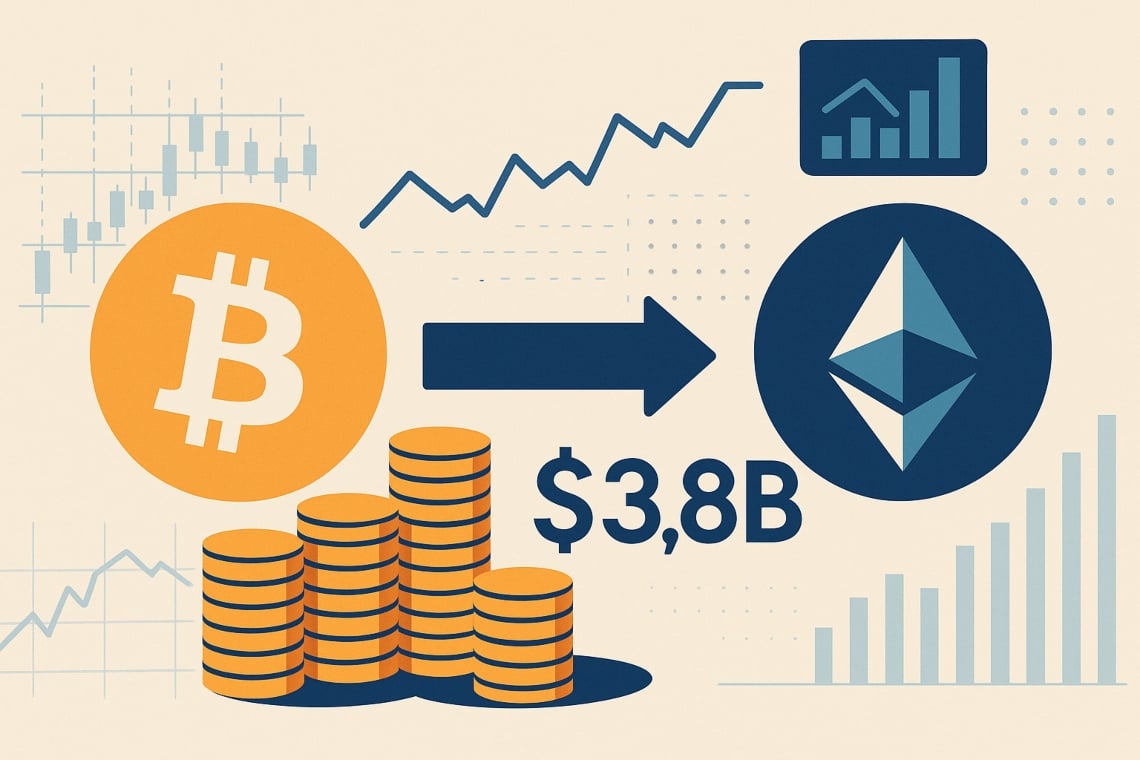
The post 4,000 BTC for 96,859 ETH appeared on BitcoinEthereumNews.com. A large on-chain entity has converted a significant portion of BTC into ETH, bringing the exposure in Ether to approximately $3.8 billion. The move, reported by industry sources, reignites the theme of rotation from Bitcoin to Ethereum and puts the spotlight back on derivatives, open interest, and volatility. Initial reports of the event were covered by industry outlets like Cointelegraph and analyses on execution mechanisms by specialized financial media like CoinDesk. According to the data collected by our on-chain team updated as of September 1, 2025, the monitored address has increased its exposure in ETH to the estimated figure of $3.8 billion. Industry analysts we collaborate with observe that similar operations, executed in short time frames, tend to be structured through OTC channels and venues with market depth to limit slippage. The professional trading desks consulted also report that spot movements of this magnitude immediately influence the monitoring of the basis and funding in the derivatives markets. Key Data (reconciled) Main swap: 4,000 BTC → 96,859 ETH, executed within a window of approximately 12 hours, as reported by Cointelegraph and BitcoinEthereumNews. Estimated value of the single conversion: ~$435 million [data to be verified], calculation derived from reported market prices; the estimate may vary based on BTC/ETH quotations at the time of the transaction (update September 1, 2025). Total address exposure in ETH: ~$3.8 billion [data to be verified] (overall position, not related to a single transaction). Related movements: deposit of 1,000 BTC on Hyperliquid after the swap, as highlighted on BitcoinEthereumNews. Note: exact BTC/ETH prices and precise transaction timestamps have not been published; on-chain verification is pending. Timeline and On‑Chain Flows Specialist reports tracked the sale of 4,000 BTC, followed by the purchase of approximately 96,859 ETH, with the Ether balance of the monitored address rising to an estimated position…

Author: BitcoinEthereumNews
Crypto Liquidations: Urgent $104 Million Wiped Out in an Hour

Crypto Liquidations: Urgent $104 Million Wiped Out in an Hour

BitcoinWorld Crypto Liquidations: Urgent $104 Million Wiped Out in an Hour The cryptocurrency market just experienced a sudden jolt, with a staggering $104 million worth of futures liquidated in a single hour. This dramatic event, part of a larger trend that saw $453 million in crypto liquidations over the past 24 hours, sends an urgent signal to traders and investors alike. What exactly are these crypto liquidations, and what do these massive figures truly mean for the volatile world of digital assets? Understanding Crypto Liquidations: What Just Happened? When we talk about crypto liquidations, we’re referring to the forced closure of a trader’s leveraged position by an exchange. This happens because the trader’s initial margin – the collateral they put up – is no longer sufficient to cover potential losses. Essentially, the market moved against their bet so significantly that the exchange had to step in to prevent further losses for the trader and the platform. This process is an inherent risk of futures trading, especially when high leverage is involved. Traders use leverage to amplify their potential gains, but it also magnifies potential losses. Therefore, a small market movement can trigger a large-scale liquidation event, as we’ve just witnessed with these substantial crypto liquidations. Why Do These Massive Crypto Liquidations Occur? Several factors contribute to such significant crypto liquidations. Primarily, market volatility plays a crucial role. Cryptocurrencies are known for their rapid price swings, which can quickly push leveraged positions into liquidation territory. A sudden price drop or surge can cascade, triggering multiple liquidations almost simultaneously. High Leverage: Many traders use high leverage, sometimes 50x or even 100x, meaning a small price change can wipe out their margin. Sudden Market Movements: Unexpected news, whale activity, or broader economic shifts can cause rapid price changes. Cascading Effect: One liquidation can trigger others as market orders from forced closures add selling pressure, leading to further price drops and more liquidations. The recent $104 million in crypto liquidations in one hour highlights how quickly these events can unfold, leaving little time for traders to react. The Devastating Impact of Crypto Liquidations on Traders For individual traders, being liquidated is a devastating experience. It means losing their entire margin, and sometimes even more, depending on the exchange’s policies and the speed of the market movement. Beyond the financial loss, there’s a significant psychological toll. Many traders enter leveraged positions hoping for quick gains, only to find themselves caught in a market downturn. These events serve as a stark reminder of the risks involved in futures trading. They underscore the importance of understanding margin requirements, liquidation prices, and implementing robust risk management strategies. Without these precautions, even experienced traders can fall victim to the market’s unpredictable nature, as evidenced by the massive crypto liquidations reported. Navigating the Volatile Landscape: Strategies to Mitigate Risk While crypto liquidations are an unavoidable part of leveraged trading, traders can adopt strategies to minimize their exposure and protect their capital. Prudent risk management is not just a recommendation; it’s a necessity in such a volatile environment. Here are some actionable insights: Use Lower Leverage: Reducing leverage significantly decreases the risk of liquidation. Implement Stop-Loss Orders: These automatically close your position if the price hits a predefined level, limiting potential losses. Manage Position Sizing: Never risk more than a small percentage of your total portfolio on a single trade. Stay Informed: Keep abreast of market news and sentiment to anticipate potential price movements. Diversify Your Portfolio: Don’t put all your eggs in one basket, even within the crypto space. By understanding the mechanics of crypto liquidations and proactively managing risk, traders can better navigate the unpredictable tides of the cryptocurrency market. Conclusion: Learning from Massive Market Shifts The recent figures of $104 million in crypto liquidations in an hour and $453 million over 24 hours are more than just numbers; they represent significant market shifts and personal losses for many traders. These events are powerful reminders of the inherent volatility and risks associated with leveraged cryptocurrency trading. While the allure of amplified gains is strong, the potential for rapid losses through liquidation is equally real. For anyone involved in crypto, understanding the dynamics of futures trading and the mechanisms behind crypto liquidations is crucial. Prioritizing robust risk management, utilizing tools like stop-loss orders, and maintaining a cautious approach are paramount to surviving and thriving in this exciting yet challenging financial frontier. Frequently Asked Questions (FAQs) What does it mean when futures are liquidated in crypto? Futures liquidation in crypto means an exchange automatically closes a trader’s leveraged position because their margin collateral is no longer sufficient to cover potential losses due to adverse market movements. Why did $104 million worth of crypto futures get liquidated so quickly? Such rapid and massive liquidations typically occur due to sudden, significant price movements in the market, amplified by traders using high leverage. This creates a cascading effect where one liquidation triggers others. How can traders avoid crypto liquidations? Traders can reduce the risk of liquidation by using lower leverage, setting stop-loss orders, managing their position sizes, and continuously monitoring market conditions to react promptly to changes. Do crypto liquidations affect the broader market? Yes, large-scale crypto liquidations can increase market volatility and contribute to price downturns, as forced selling pressure from liquidated positions adds to overall market supply. Is futures trading safe in cryptocurrency? Futures trading in cryptocurrency is inherently risky due to market volatility and the use of leverage. While it offers potential for high returns, it also carries a significant risk of substantial losses, including full liquidation of margin. To learn more about the latest crypto market trends, explore our article on key developments shaping cryptocurrency futures price action. Share Your Insights! Did these massive crypto liquidations impact your trading strategy? Share your thoughts and experiences with us on social media! Your insights help our community stay informed and resilient in the face of market volatility. Don’t forget to share this article to help others understand these crucial market dynamics. This post Crypto Liquidations: Urgent $104 Million Wiped Out in an Hour first appeared on BitcoinWorld and is written by Editorial Team

Author: Coinstats
Bitcoin Sees Labor Day Lull, but Institutional Bulls Remain Unfazed

Bitcoin Sees Labor Day Lull, but Institutional Bulls Remain Unfazed

The digital asset’s price didn’t move much on Monday after shedding more than 3% over the past seven days, but the subdued price action hasn’t dampened institutional enthusiasm. BTC Treads Water on Labor Day Weekend and Metaplanet Buys the Dip “I’ve always said that I really believe in the next several years, bitcoin hits a […]

Author: Bitcoin.com News
from 24 to 50 billion in 12 months. Regulations and institutions ignite the market

from 24 to 50 billion in 12 months. Regulations and institutions ignite the market

The post from 24 to 50 billion in 12 months. Regulations and institutions ignite the market appeared on BitcoinEthereumNews.com. The market for tokenized real assets has entered a phase of institutional scale: over twelve months, it would have risen from about $24 billion to over $50 billion – as shown by data from 21.co and confirmed by analyses from RWA.xyz – and are consistent with international reports on the subject. Among these, the BIS report published on October 17, 2024, and the IMF note on January 29, 2025, Bank for International Settlements (BIS)International Monetary Fund (IMF) – due to the arrival of large managers and greater regulatory clarity between the USA and Europe. From regulated stablecoins to on-chain government bond funds, tokenization is gradually but consistently becoming an increasingly significant liquidity infrastructure for finance. In this context, the convergence between technology and regulations generates more robust trust mechanisms and more predictable operational processes. According to the data collected by our research team on on‑chain transactions (dataset updated to July 2025), the market‑making component on tokenized assets has shown an increase in average order sizes of ~35% YoY in professional markets. Industry analysts also observe a growth in integrations between institutional custody and smart contracts on authorized platforms, with effective settlement times reduced in many cases to under 24 hours for on‑chain monetary products (learn more on Cryptonomist). What is the tokenization of real assets Tokenization converts rights to physical or financial assets into tokens on blockchain. The result is a digital unit that represents shares of real estate, bonds, credits, or money market funds, with technical properties that facilitate circulation and control. It should be noted that representation on distributed ledgers also allows for lifecycle automations (coupons, maturities) that are difficult to achieve in legacy systems. Fractionalization: access to minimum amounts and greater inclusion. Transferability: near-instant settlement, 24/7. Traceability: on-chain auditability and automated reporting. Composability: use of tokens as…

Author: BitcoinEthereumNews
Ethereum Price Forecast: ETH attracts $8 billion from Bitcoin whale rotation and institutional investors

Ethereum Price Forecast: ETH attracts $8 billion from Bitcoin whale rotation and institutional investors

Ethereum (ETH) trades around $4,300 on Monday after attracting nearly $8 billion in capital inflows across a $4 billion Bitcoin whale rotation and $3.95 billion into ETH investment products throughout August.

Author: Fxstreet
Solv and Chainlink integrate Proof of Reserve into SolvBTC

Solv and Chainlink integrate Proof of Reserve into SolvBTC

The post Solv and Chainlink integrate Proof of Reserve into SolvBTC appeared on BitcoinEthereumNews.com. Solv Protocol and Chainlink have launched a new feed that combines the market price with the on-chain verification of BTC reserves for SolvBTC, with a redemption rate anchored to the collateral and price limits designed to reduce manipulations. According to data collected by Chainlink Data, the SolvBTC feeds show public timestamps and updates accessible from the mainnet since the announcement. Industry analysts note that the PoR+price model can directly impact over 2 billion dollars in tokenized BTC, reducing the likelihood of depeg during market stress. By monitoring the official pages (Solv and Chainlink Data), it is possible to verify the operational status of the feeds on Ethereum and BOB in real-time. Solv Protocol shows data on its Bitcoin reserves collateralizing SolvBTC. Source: Solv Transparency SolvBTC: what has been launched and where it is active The new SolvBTC‑BTC feed combines the traditional exchange rate with the verification of reserves Bitcoin recorded on-chain. Unlike common price oracles, the value is anchored to the underlying collateral, enhancing transparency and consistency at the time of redemption. An interesting aspect is the immediate availability of data for public consultation. Ethereum mainnet: the Proof of Reserve (PoR) feed of SolvBTC is accessible with verifiable data and time-stamps. BOB network: the SolvBTC/BTC feed is operational for on‑chain pricing. Cross‑chain expansion: further integrations are in preparation, aiming to standardize the PoR + price model across multiple networks. Why it impacts the price of SolvBTC The feed directly integrates reserve coverage into the price calculation. This way, the redemption rate reflects not only the market spot price but also the actual availability of the BTC held, reducing possible misalignments between theoretical value and the value actually redeemable. It should be noted that the effect is particularly significant during times of volatility. How the Protection Mechanism Works The logic of…

Author: BitcoinEthereumNews
Whale shifts from Bitcoin to Ethereum: 4,000 BTC for 96,859 ETH, position at approximately $3.8 billion and spotlight on futures

Whale shifts from Bitcoin to Ethereum: 4,000 BTC for 96,859 ETH, position at approximately $3.8 billion and spotlight on futures

A large on-chain entity has converted a significant portion of BTC into ETH, bringing the exposure in Ether to approximately $3.8 billion.

Author: The Cryptonomist
Tokenized real assets: from 24 to 50 billion in 12 months. Regulations and institutions ignite the market

Tokenized real assets: from 24 to 50 billion in 12 months. Regulations and institutions ignite the market

The market for tokenized real assets has entered an institutional scale phase: within twelve months it would have risen from approximately $24 billion to over $50 billion.

Author: The Cryptonomist