CEX

CEXs are platforms managed by centralized organizations that facilitate the trading of cryptocurrencies, offering high liquidity and user-friendly fiat on-ramps. Leaders like Binance, OKX, and Coinbase serve as the primary gateways for institutional and retail entry. In 2026, the industry focus is on Proof of Reserves (PoR), enhanced regulatory compliance, and hybrid models that offer self-custody options. This tag provides updates on exchange security, listings, and global market trends.

4184 Articles
Created: 2026/02/02 18:52
Updated: 2026/02/02 18:52
Best Crypto To Buy Now Is New Altcoin Remittix Over Ethereum & Solana In September

Best Crypto To Buy Now Is New Altcoin Remittix Over Ethereum & Solana In September

Ethereum and Solana stay strong, but Remittix’s $26.3M raise, CertiK audit, CEX listings, and real-world remittance utility make RTX the best crypto to buy now.

Author: Blockchainreporter
Ripple (XRP) Latest Updates: Why XRP Holders Are Betting Big on This New Viral Crypto in 2025

Ripple (XRP) Latest Updates: Why XRP Holders Are Betting Big on This New Viral Crypto in 2025

Ripple (XRP) has long been a divisive crypto asset.  First hailed as a cross-border payment bridge, XRP gained significant institutional ties.  Despite its intrinsic qualities, the coin has struggled with volatility, resistance zones, and momentum in 2025.  According to research, many XRP investors are considering alternatives, especially in the meme sector, where viral initiatives like [...]]]>

Author: Crypto News Flash
Why Analysts Say XYZverse Could Overtake AVAX in Adoption This Cycle

Why Analysts Say XYZverse Could Overtake AVAX in Adoption This Cycle

Discover why top crypto analysts believe XYZverse is poised to surpass AVAX in user adoption this market cycle. Explore key factors driving its growth, technological advantages, and investor sentiment.

Author: Cryptodaily
Solana vs. XYZverse: Which Altcoin Could Dominate the 2025 Bull Run?

Solana vs. XYZverse: Which Altcoin Could Dominate the 2025 Bull Run?

The post Solana vs. XYZverse: Which Altcoin Could Dominate the 2025 Bull Run? appeared on BitcoinEthereumNews.com. As the crypto market gears up for what many expect to be a defining bull run in 2025, investors are weighing where the biggest opportunities may lie. On one side stands Solana, a fast-growing layer-1 blockchain with proven scalability, institutional interest, and an expanding DeFi and NFT ecosystem. On the other is XYZverse, a new meme-fueled project fueled by hype and ambitious plans to capture attention through community-driven momentum. Both coins represent vastly different approaches to growth, yet each has the potential to capture outsized gains in the months ahead. The real question is: which one is better positioned to dominate the next cycle? Solana (SOL) Source: TradingView SOL has kept traders busy. Over the last 7 days it added 7.21%. The month view shows a sharp 39% jump. Zoom back 6 months and the gain hits 91%, nearly a double. Price now swings between 213 and 258, with buy orders clustering near the top of that band. Trend signals stay balanced. The 10-day average at 246 edges above the 100-day at 240, hinting at mild upward bias. RSI reads 47, a neutral zone. A low Stochastic of 23 suggests sellers may be tiring, while a positive MACD keeps slight upward pressure alive. The first test sits at 276. A move from today’s mid-range to that mark would mean roughly 12% upside. Clearing it could unlock the higher barrier near 320, about 30% beyond current levels. On the flip side, slipping under 188 could knock 24% off the chart, and the deeper floor at 144 would erase around 42%. Given the indicator mix, odds tilt modestly toward another push higher. Undervalued $XYZ Meme Coin Gears Up for Listing on a Major CEX XYZVerse ($XYZ) is the meme coin that has grabbed headlines with its ambitious claim of rising from $0.0001…

Author: BitcoinEthereumNews
Barkmeta Reveals Secrets behind Doginal Dogs' Success and the Dark Side of Crypto Life

Barkmeta Reveals Secrets behind Doginal Dogs' Success and the Dark Side of Crypto Life

Christian Barker, a.k.a. __Bark meta, is an influential crypto leader. His popularity has grown enough to spill into mainstream culture. His latest NFT collection, Doginal Dogs, which he co-founded with another crypto entrepreneur, Shibo, is now recognized as the “1 NFT of all time across all chains”

Author: Hackernoon
Hyperliquid's success and hidden dangers

Hyperliquid's success and hidden dangers

I've been really busy lately and can't write a 10,000-word research report any more. I'll try to change my writing style and just state my opinions and reasoning. Please forgive me, dear readers. 1. Research Background I have recently researched almost all the Perps (perpetual trading platforms) on the market. The five-fold growth of the hype market proves once again that when I first researched it last year, I still overlooked its core value. Moreover, recently aster, antex, dydxV4, and even Sun Ge's sunPerps, which shook the track, have gradually brought the Perps track into a period of explosive growth. Furthermore, major exchanges are vying to list Hyper and its perpetual trading capabilities. Yesterday, news broke that Metamask, following Phantom, is planning to integrate Hyper's perpetual trading capabilities. Circle has also become a validator, addressing concerns about its core decentralization. Hyperliquid itself is also striving to improve its openness, particularly with the gradual rollout of HyperEVM and HIP2/3/4. 1.1 Three Elements of the New Track At this point, Perps basically has the three key elements of a new track. In fact, if we look back at any huge track wave in history, we can see that it is often the new leading platform, new wealth opportunities, and new narrative background. The trend gathering will bring about peaks, while the subsequent platform's airdrop strategy, the gradual development of platform complexity, and the decline in user perception of freshness will gradually bring about troughs. This process has actually gone through many waves. The typical scenarios are as follows. The following modules have been analyzed in the previous public account articles of "Fourteen Gentlemen". If you are interested, you can check it out yourself: The ICO craze of 2017 was centered on the CEX platform. It's a basic necessity, uncontroversial, and many are doing very well now. In the summer of DeFi in 2021, the corresponding platforms are Uniswap, lending and stablecoins, as above. NFTs, which have been around for 22 years, actually have protocols that existed long before, but only reached their peak thanks to OpenSea. The root of this was pricing through transactions, which then led to dissemination based on price. Its decline stemmed from arrogance, with its airdrop strategy and royalties leading to a death spiral of price increases, a self-inflicted consequence. The 23-year-old inscription, corresponding to the platform Unisat, was ultimately driven by short-sightedness. At its peak, it focused on asset issuance, not application development, resulting in a short lifespan for its narrative. When other new narratives emerged, RWA and perps dominated attention, hindering the recent Alkanes and BRC2.0 from regaining their popularity. This is a self-inflicted failure. The 24-year meme and the corresponding pump platform, as well as this year's dark horse Axiom, have made this wave exceptionally long-lasting. This is due to the advantages of the chain itself in terms of transactions, the constant influx of people who are interested in trading, and the new users brought by the wave of compliance, which has enhanced the life cycle. Finally, in 25 years, there are both RWA (focused on stocks) and Perps (led by hyperliquid). 2. Understanding the key steps in the development of hyperliquid 2.1 Current Development Status Objectively speaking, the system remains relatively centralized, theoretically capable of being disrupted by unplugging the network. Furthermore, hacker funds are siphoned off, creating significant obstacles for many exchanges in terms of compliance and attracting significant attention. However, the data is highly contradictory. Hyperliquid currently has about 10,000 to 20,000 daily active users, out of a total user base of about 600,000. A core group of 20,000 to 30,000 of these users contributes nearly $1 billion in revenue, a significant portion of which comes from the United States. The cumulative trading volume has exceeded 3 trillion US dollars, and the average daily trading volume has reached nearly 7 billion US dollars. Currently supports Perps trading of more than 100 assets. Looking at his data in this way, I can only say that it is really great. Although the number of users seems small, they are the group that can make the most money. 2.2 Major Updates and Interpretations The specific timeline is as follows March 25: HyperCore and HyperEVM were connected, theoretically allowing users to trade core tokens from the EVM (trading only at the time). April 30: Launched the read precompile feature, enabling HyperEVM smart contracts to read state from HyperCore. May 26: Small block time halved to 1 second, increasing the throughput of HyperEVM. June 26: The HyperEVM block was updated to remove the previous ordering of only published orders to improve integration with HyperCore. On July 5, HyperEVM updated a new precompiler called CoreWriter. This enables HyperEVM contracts to be written directly into HyperCore, including functions such as placing orders, transferring spot assets, managing treasury bonds, and staking HYPE. Recently, Builder core and Hip4 have also entered the data prediction market. This step of entry was completely unexpected by the market. This also means that the founders have very unique ideas in thinking about the pain points of the industry, which often leads to polarization of the platform. How do you understand this series of updates? First, compared to last year, Hyperliquid now has open core order operation capabilities. HyperEVM In particular, the dual-chain architecture based on EVM has an outrageous logic. Under the premise that HyperCore is not open (cannot be deployed), a large number of pre-compiled contracts are added through HyperEVM and connected to HyperCore. In theory, it has the access basis of wallets (phantom, metamask) and exchanges, and can theoretically realize EVM transaction operations to execute Core's order asset trading and other capabilities. The official picture shows the positioning of hyperEVM in the system It can be seen that HyperCore and HyperEVM writes and reads are uniformly confirmed by HyperBFT. The specific mechanism of the validator's confirmation information mechanism is not public, and there is no cross-chain bridge or delayed synchronization. The dynamics that can be seen through on-chain transactions are that HyperEVM can affect HyperCore by executing writes through the system contract (0x333…3333, CoreWriter.sendAction(...)), which can perform order placement, liquidation, and lending operations. The status (of the previous block) fed back by HyperCore can be read by the smart contract of HyperEVM. User data — positions, balances, and vault information Market Data — Mark Price and Oracle Price Staking data — delegation and validator information System data - L1 block count and other core metrics The information is essentially received by the EVM system contract, which generates corresponding receipts or events and records them. And in the EVM, the precompiled contract (0x000…0800) can call perp positions or oracle price (oraclePx) Secondly, the implementation of hip2 and hip3 is changing the platform positioning of Hyperliquid. Hyperliquidity This is an on-chain liquidity mechanism built into Hypercore. It automatically places buy and sell orders based on the current price of the token, maintaining a narrow spread of approximately 0.3% without manual intervention. This mechanism allows for native-level liquidity insertion operations built into the block logic without AMMs or third-party bots. For example, when the PURR/USDC spot market launched, Hyperliquidity immediately issued seed transactions with initial depth, allowing real trading before normal user liquidity arrived. Builder core This mechanism is highly valuable for the future, allowing DeFi builders (developers, quantitative teams, and aggregators) to collect additional fees as service revenue when placing orders on behalf of users. The application scenario for this system is clear, and it represents a move to open up profits and embrace ecosystem co-construction. **Quantitative strategy hosting, **The quantitative team helps users place perp position orders and collects management fees through builder fees, forming a compound profit model of "revenue sharing + builder fee" Aggregators/transaction routers, such as 1inch and Odyssey, integrate perp trading services on Hyperliquid and can charge builder fees as a routing revenue model. The initial launch has already brought over 10 million US dollars in dividend income to some projects, which shows the effect of hyper funds being deeply deposited at the platform level. In fact, the issue of opening up depth is not just Hyper. The previous Uniswapv4 also wanted to do this through hooks, but v4 did not take off, and most users are still accustomed to v2 and v3. This may be the influence of having less historical baggage and stronger centralized decision-making. 3 Summary and Comments 3.1 There are many advantages. Let’s go through them one by one. Hyperliquid's primary advantage was its strong early product capabilities, which stemmed from addressing two user pain points: The trading needs of non-compliant users are actually even more rare in this year's wave of compliance. Advanced trading users demand high leverage and high transparency. The former brings KOL exposure, while the latter is often ignored by market incumbents, that is, the dark under the light, thus catching many CEXs off guard. The second is the team background itself. Its biggest advantage here is that it has a small number of people, so the communication gap, wear and tear, and labor efficiency are all very high. With an overall staff of more than a dozen people, excluding 3-4 product operation BDs and deducting the front-end and back-end, it means that only 3-4 people can build a high-performance chain of 20Wtps. Compared with many blockchain teams of traditional large companies, which can also produce a lot of palace fighting dramas, it is much better. In the background, his market maker foundation started in 2020 actually brought good initial depth. He also felt in many details that his matching logic and other order book systems are not simply settled gradually by time and amount. However, the data is insufficient, so I will supplement it later when I do comparative analysis of multiple Perps. Then there's the trend. General projects need to adapt to the market, but when a platform reaches its peak popularity, the market can adapt to it. This is the treatment Hyperliquid is receiving now. On the one hand, the openness of the aforementioned updates creates space for diverse ecosystems to enter. This contrasts with many previous platforms, which often prioritized doing everything themselves, reaping all the benefits, single-handedly criticizing OpenSea, and even imposing mandatory royalty systems, forcing the market to follow the leading platform. Each of these platforms incurs high, fixed costs, interfering with the flow of goods and affecting market pricing, ultimately becoming a family heirloom. In Hype, he opened up EVM and all kinds of DEX PEPS APIs, so soon a bunch of derivatives appeared on the market. Hyperliquid's generosity can also be seen in the airdrop. It was impossible for it to take the compliance route from the beginning. Therefore, he will not try to embrace the so-called expectations of going public, so he will naturally release the profits. Then he will pledge the hype back through the HLP mechanism, release the profits and make profits again, so that the official tokens can be dispersed and the market will gain the most valuable decentralized evaluation and reputation. Its openness has attracted market acclaim. Phantom first integrated its perps capabilities from the perspective of a decentralized wallet. This is not difficult, mainly due to the large amount of adaptation and development costs. Recently, there are rumors that Metamask is also integrating it. From this we can also see that those decentralized wallets that have not been updated for more than half a year have also learned to seize the annual narrative after missing the inscription. Finally, he pushed for the introduction of giants such as Circle to join as validators to bring decentralized security and fill his decentralization gap, so that highly compliant CEX platforms also had the opportunity to access. 3.2 Disadvantages After the most challenging initial phase, the next issue is compliance. Even pure DEXs like Uniswap are embracing compliance, not to mention the European and American Hyperliquid, whose users have also made their fortunes. If a platform is deemed non-compliant or otherwise severely errs, existing CEX/Wallet partnerships will be severed, and former allies will part ways. In addition, the subsequent development of this system will also face the problem of development complexity. Most projects become more and more complicated as they are written, and it is difficult to simplify them and return to the first principles. In the end, novice users cannot understand how to use them and lose fresh blood. Finally, there's the single-point risk. The current claimed 20Wtps, if accessed by multiple global platforms, would create numerous information inconsistencies, placing immense pressure on the core hyperCore module. Building this high performance takes time. The official market maker background may not be able to handle the volume, and if multiple outages trigger liquidation issues (similar to the short squeeze incident in March), this could lead to significant downtime. The reputation that is accumulated with great difficulty is inherently fragile.

Author: PANews
3 Best Coins to Turn $880 into $44,000 if You Missed the Solana (SOL) and Dogecoin (DOGE) Opportunity

3 Best Coins to Turn $880 into $44,000 if You Missed the Solana (SOL) and Dogecoin (DOGE) Opportunity

The post 3 Best Coins to Turn $880 into $44,000 if You Missed the Solana (SOL) and Dogecoin (DOGE) Opportunity appeared on BitcoinEthereumNews.com. The post 3 Best Coins to Turn $880 into $44,000 if You Missed the Solana (SOL) and Dogecoin (DOGE) Opportunity appeared first on Coinpedia Fintech News This bull run of 2021-2023 revealed that early betting in tokens such as Solana (SOL) and Dogecoin (DOGE) would result in massive gains. With the crypto markets revitalized, investors are seeking the promising wave of projects that can bring them a financial increase. Here are three coins that could transform $880 into $44,000, and one in particular that may outpace even the giants. VeChain (VET): Real-World Utility Meets Web3 Scalability VeChain has always been known as a blockchain that can be used in the real world, and its newest project, the VeFounder Program, could boost adoption even more. VeChain is closing the gap between early-stage experimentation and large-scale utility by giving builders ready-made decentralized apps (dApps) that have been proven to work. With support from the big company BCG, the program already has projects that deal with important issues that affect everyone, like sustainability, nutrition, and food waste. With over 4 million existing dApp users, VeChain provides founders a launchpad that bypasses the early adoption hurdles most projects face. Participants gain complete operational control once they hit 100,000 users, along with $B3TR rewards and long-term upside. This “ready-to-scale” approach positions VeChain not just as another Layer 1, but as a foundation for real-world Web3 businesses. For investors, that’s a rare combination of proven infrastructure and growth potential. Floki (FLOKI): From Meme to Metaverse Challenger Floki is working hard to shed its “just a meme coin” image, and the upcoming Valhalla play-to-earn tournament is a bold step in that direction. The event is set for September and has doubled its prize pool to $150,000. There will be 64 winners, and the top player will get…

Author: BitcoinEthereumNews
Trump Vows To Award Medal Of Freedom

Trump Vows To Award Medal Of Freedom

The post Trump Vows To Award Medal Of Freedom appeared on BitcoinEthereumNews.com. Topline President Donald Trump said he would award Charlie Kirk the Presidential Medal of Freedom posthumously as he eulogized the late activist at a memorial Sunday, following speeches from Kirk’s wife Erika and many members of the Trump administration to tens of thousands of supporters. President Donald Trump stands with Erika Kirk, Charlie Kirk’s widow, at his memorial service in Arizona. AFP via Getty Images Key Facts Trump echoed earlier speakers, calling Kirk an “evangelist for American liberty” and a “martyr now for American freedom” as he spoke of Kirk’s childhood before detouring briefly to preview a forthcoming announcement on autism at the White House this week. Towards the end, of his remarks, Trump turned his attention to the left, who he has frequently blamed for after Kirk’s murder: “There is one part of the political community that believes they have the monopoly on truth, goodness, and virtue, and concludes they have also a monopoly on power thought and speech—well, that’s not happening anymore.” Trump said he was planning to award Kirk the Presidential Medal of Freedom in a ceremony at the White House, and called Kirk’s widow Erika back to the stage after finishing his speech. The speech concluded a five-hour-plus memorial service attended by tens of thousands of mourners who filled State Farm Stadium, the home of the Arizona Cardinals, wearing red, white, and blue clothing and singing along to Christian rock and hymns as the memorial service began Sunday afternoon. Among the more fiery speeches were Stephen Miller, who talked about fighting “enemies” and Secretary of State Marco Rubio, who last week said his department would deny visas to those celebrating Kirk’s death, according to CNN. HHS Secretary Robert F. Kennedy Jr. noted that Jesus Christ died at age 33 and “changed the trajectory of history,” and…

Author: BitcoinEthereumNews
New Crypto Projects Emerge as Europe Blocks Big Tech from FiDA

New Crypto Projects Emerge as Europe Blocks Big Tech from FiDA

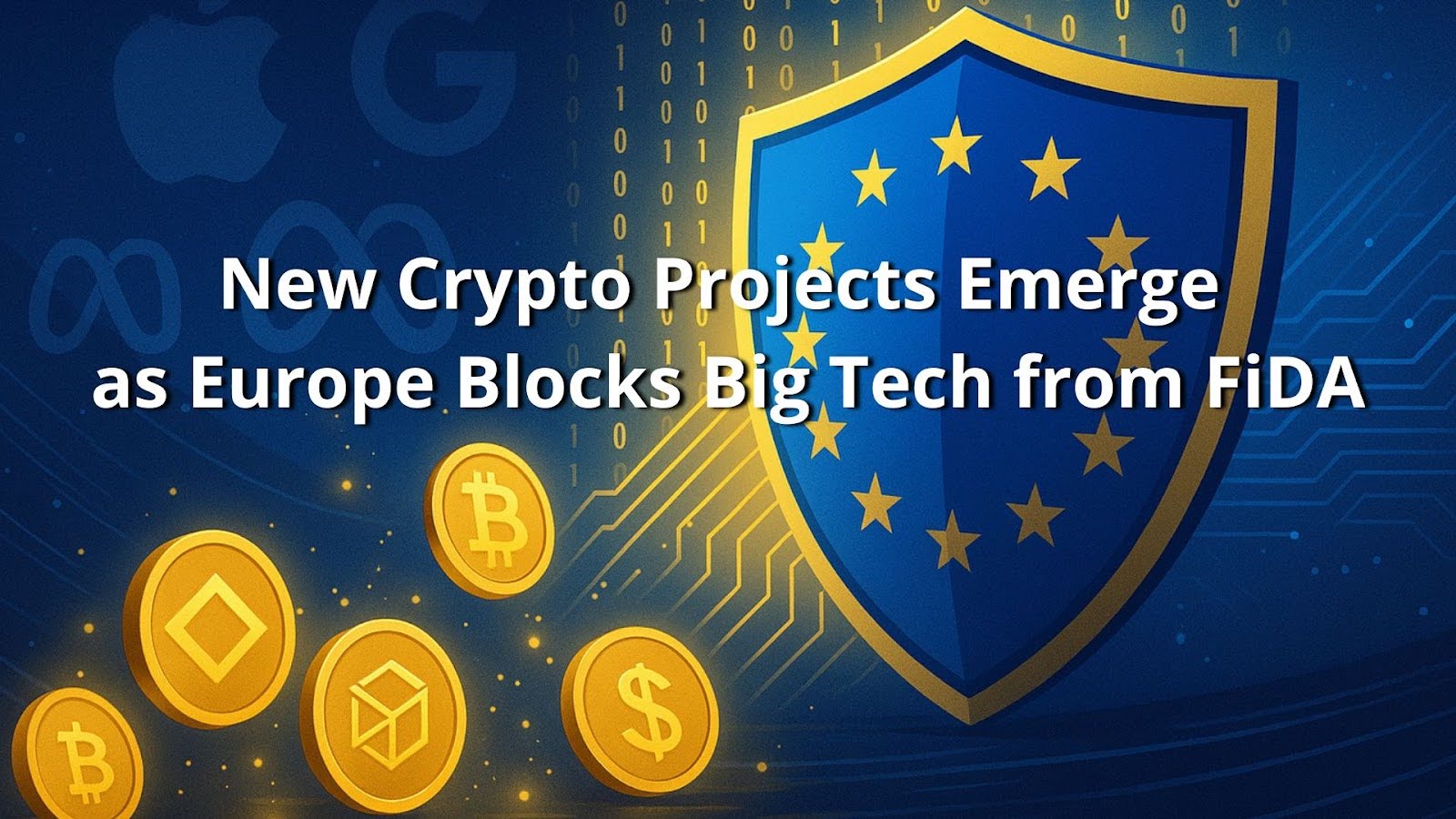
The post New Crypto Projects Emerge as Europe Blocks Big Tech from FiDA appeared on BitcoinEthereumNews.com. Crypto News 21 September 2025 | 22:17 New crypto projects rise as Europe blocks Big Tech from FiDA, opening fresh opportunities in wallets, content, and payments. When Europe moves to block Big Tech firms like Meta, Apple, Google, and Amazon from accessing the Financial Data Access (FiDA) framework, it shakes up more than just bank-tech relationships.  It opens doors for smaller crypto and fintech projects to grab the spotlight.  Projects that offer wallet services, DeFi, new crypto tools, or presale tokens may suddenly seem like more attractive alternatives, especially for users worried about privacy, data sovereignty, and innovation.  In this new playing field, new crypto projects with strong tokenomics and community trust could benefit big time. What’s FiDA & Why Big Tech Is Getting Barred FiDA is a proposed EU system that would allow licensed third-party providers to access customer data from banks and insurance firms.  The goal was to enable services like tailor-made financial advice, new apps, tools that help people manage spending, savings, etc.  But financial institutions and regulators have pushed back, saying that letting Big Tech in risks consumer data safety, digital dominance, and unfair competitive advantage.  According to the European Commission’s official proposal and analysis by industry experts, the framework is being designed with an explicit focus on sovereignty and fair competition, not Big Tech dominance.  Alt text: FiDA blocking Big Tech post on X.  Germany has explicitly pushed to exclude Big Tech to protect digital sovereignty. As negotiators close in on final legal text, Big Tech is on track to lose access under FiDA.   1. Best Wallet Token ($BEST) – The Utility Token Set to Thrive Beyond Big Tech With the EU preparing to lock Big Tech out of FiDA, attention is turning toward tokens that put control back in the hands of users.…

Author: BitcoinEthereumNews
New Crypto Projects Rise as Europe Bars Big Tech from FiDA

New Crypto Projects Rise as Europe Bars Big Tech from FiDA

When Europe moves to block Big Tech firms like Meta, Apple, Google, and Amazon from accessing the Financial Data Access […] The post New Crypto Projects Rise as Europe Bars Big Tech from FiDA appeared first on Coindoo.

Author: Coindoo