Altcoins continue to face pressure as market sentiment remains firmly in fear. Smaller assets, including meme coins, have struggled throughout the final months Altcoins continue to face pressure as market sentiment remains firmly in fear. Smaller assets, including meme coins, have struggled throughout the final months

FOMO Builds as Pepenode Token ICO Ends in 22 Days – Best Crypto to Buy Now?

FOMO Builds as Pepenode Token ICO Ends in 22 Days - Best Crypto to Buy Now?

Altcoins continue to face pressure as market sentiment remains firmly in fear. Smaller assets, including meme coins, have struggled throughout the final months of the year.

However, history shows that when fear finally shifts to greed, speculative assets tend to deliver outsized performance. This rotation repeatedly drives strong recoveries in altcoins once confidence returns.

Against this backdrop, recent analyst commentary highlights a group of emerging altcoins that could lead the next rebound.

One project receiving notable attention is Pepenode, a new entry in the meme-driven GameFi category that continues to gain traction despite challenging market conditions, positioning it as a potential candidate for the best crypto to buy now for the upcoming recovery.

Source – ClayBro YouTube Channel

Last Chance to Buy PEPENODE Token

Smart money is moving fast to grab spots in the Pepenode (PEPENODE) presale, and only 22 days remain to join the new mine-to-earn gaming project.

The raise has already passed $2.3 million, giving $PEPENODE the resources to build its mining-style game and support an economy designed to avoid the issues that hurt past GameFi projects.

Pepenode’s appeal comes not only from its easy-to-understand mining gameplay but also from tokenomics built to support long-term growth. This mix explains why more traders see it as the next major GameFi opportunity.

As the presale enters its final weeks, early pricing is running out. The token now costs $0.0011968, a level that may disappear once the presale ends and exchanges bring in more demand.
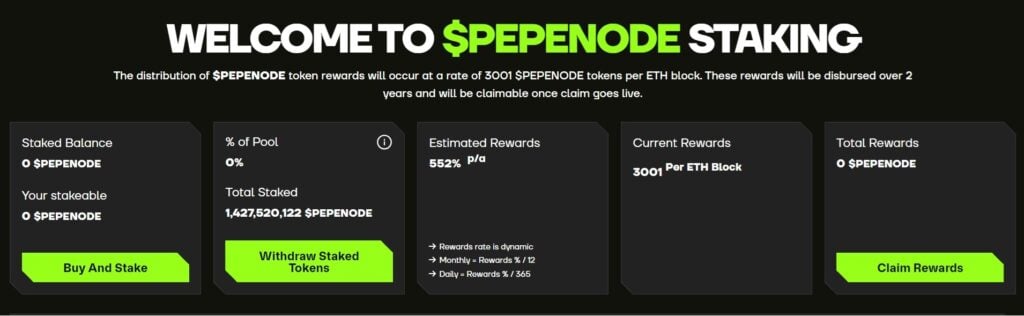
Pepenode Staking

Early buyers can stake their tokens right away and earn up to 552% APY, adding extra value while they hold. Coinsult audited the project’s smart contract, giving early users added confidence in the code’s security.

Investors who want a last-chance spot can visit the official presale site and buy $PEPENODE using ETH, BNB, USDT, or even credit and debit cards.

Buyers can connect through their preferred wallet, including Best Wallet, which many consider one of the top crypto and Bitcoin wallets. Pepenode also appears in Best Wallet’s Upcoming Tokens section, making it easy to buy, track, and claim once the token goes live.

Why Pepenode Is Becoming the Best Crypto to Buy Now in the GameFi Revival

Pepenode’s presale supports a mining game where mining is the main gameplay. Players don’t tap buttons or do small tasks to earn tokens. They build and run a virtual mining setup that acts like real mining.

The game focuses on choices. Players spend $PEPENODE to buy nodes, grow their setup, and improve efficiency. Each choice changes how much they earn. Some node combinations work well, while others work poorly, so smart decisions matter.

The game also shows real mining-style data. Players can see their hashrate, how much of the network they control, how close the next halving is, and how they rank against others. It feels like running a real system.

Over time, Pepenode plans to add more features such as heat, stability, and power management to make the experience even closer to real mining, but without the high cost.

The tokenomics support long-term gameplay. Every important action uses $PEPENODE. Players buy nodes, upgrade setups, and expand operations with the token. The game burns 70% of the $PEPENODE players spend, so the supply gets smaller as more people play.

This design keeps growth from flooding the market with new tokens. Instead, it makes $PEPENODE more scarce. Players who build strong setups unlock bigger rewards, including meme coins like Pepe (PEPE) and Fartcoin (FARTCOIN).

This gives players a reason to keep improving their setup instead of selling early. $PEPENODE becomes a tool for reaching better rewards, not just a token to cash out.

Because of these features, many analysts, including Crypto ZEUS, call $PEPENODE one of the best crypto to buy now.

Visit Pepenode

This article has been provided by one of our commercial partners and does not reflect Cryptonomist’s opinion. Please be aware our commercial partners may use affiliate programs to generate revenues through the links on this article.

Piyasa Fırsatı
FOMO.FUND Logosu
FOMO.FUND Fiyatı(FOMO)
$0.00001053
$0.00001053$0.00001053
0.00%
USD
FOMO.FUND (FOMO) Canlı Fiyat Grafiği
Sorumluluk Reddi: Bu sitede yeniden yayınlanan makaleler, halka açık platformlardan alınmıştır ve yalnızca bilgilendirme amaçlıdır. MEXC'nin görüşlerini yansıtmayabilir. Tüm hakları telif sahiplerine aittir. Herhangi bir içeriğin üçüncü taraf haklarını ihlal ettiğini düşünüyorsanız, kaldırılması için lütfen service@support.mexc.com ile iletişime geçin. MEXC, içeriğin doğruluğu, eksiksizliği veya güncelliği konusunda hiçbir garanti vermez ve sağlanan bilgilere dayalı olarak alınan herhangi bir eylemden sorumlu değildir. İçerik, finansal, yasal veya diğer profesyonel tavsiye niteliğinde değildir ve MEXC tarafından bir tavsiye veya onay olarak değerlendirilmemelidir.

Ayrıca Şunları da Beğenebilirsiniz

MoneyGram launches stablecoin-powered app in Colombia

MoneyGram launches stablecoin-powered app in Colombia

The post MoneyGram launches stablecoin-powered app in Colombia appeared on BitcoinEthereumNews.com. MoneyGram has launched a new mobile application in Colombia that uses USD-pegged stablecoins to modernize cross-border remittances. According to an announcement on Wednesday, the app allows customers to receive money instantly into a US dollar balance backed by Circle’s USDC stablecoin, which can be stored, spent, or cashed out through MoneyGram’s global retail network. The rollout is designed to address the volatility of local currencies, particularly the Colombian peso. Built on the Stellar blockchain and supported by wallet infrastructure provider Crossmint, the app marks MoneyGram’s most significant move yet to integrate stablecoins into consumer-facing services. Colombia was selected as the first market due to its heavy reliance on inbound remittances—families in the country receive more than 22 times the amount they send abroad, according to Statista. The announcement said future expansions will target other remittance-heavy markets. MoneyGram, which has nearly 500,000 retail locations globally, has experimented with blockchain rails since partnering with the Stellar Development Foundation in 2021. It has since built cash on and off ramps for stablecoins, developed APIs for crypto integration, and incorporated stablecoins into its internal settlement processes. “This launch is the first step toward a world where every person, everywhere, has access to dollar stablecoins,” CEO Anthony Soohoo stated. The company emphasized compliance, citing decades of regulatory experience, though stablecoin oversight remains fluid. The US Congress passed the GENIUS Act earlier this year, establishing a framework for stablecoin regulation, which MoneyGram has pointed to as providing clearer guardrails. This is a developing story. This article was generated with the assistance of AI and reviewed by editor Jeffrey Albus before publication. Get the news in your inbox. Explore Blockworks newsletters: Source: https://blockworks.co/news/moneygram-stablecoin-app-colombia
Paylaş
BitcoinEthereumNews2025/09/18 07:04
Optum Golf Channel Games Debut In Prime Time

Optum Golf Channel Games Debut In Prime Time

The post Optum Golf Channel Games Debut In Prime Time appeared on BitcoinEthereumNews.com. FARMINGDALE, NEW YORK – SEPTEMBER 28: (L-R) Scottie Scheffler of Team
Paylaş
BitcoinEthereumNews2025/12/18 07:21
Google's AP2 protocol has been released. Does encrypted AI still have a chance?

Google's AP2 protocol has been released. Does encrypted AI still have a chance?

Following the MCP and A2A protocols, the AI Agent market has seen another blockbuster arrival: the Agent Payments Protocol (AP2), developed by Google. This will clearly further enhance AI Agents' autonomous multi-tasking capabilities, but the unfortunate reality is that it has little to do with web3AI. Let's take a closer look: What problem does AP2 solve? Simply put, the MCP protocol is like a universal hook, enabling AI agents to connect to various external tools and data sources; A2A is a team collaboration communication protocol that allows multiple AI agents to cooperate with each other to complete complex tasks; AP2 completes the last piece of the puzzle - payment capability. In other words, MCP opens up connectivity, A2A promotes collaboration efficiency, and AP2 achieves value exchange. The arrival of AP2 truly injects "soul" into the autonomous collaboration and task execution of Multi-Agents. Imagine AI Agents connecting Qunar, Meituan, and Didi to complete the booking of flights, hotels, and car rentals, but then getting stuck at the point of "self-payment." What's the point of all that multitasking? So, remember this: AP2 is an extension of MCP+A2A, solving the last mile problem of AI Agent automated execution. What are the technical highlights of AP2? The core innovation of AP2 is the Mandates mechanism, which is divided into real-time authorization mode and delegated authorization mode. Real-time authorization is easy to understand. The AI Agent finds the product and shows it to you. The operation can only be performed after the user signs. Delegated authorization requires the user to set rules in advance, such as only buying the iPhone 17 when the price drops to 5,000. The AI Agent monitors the trigger conditions and executes automatically. The implementation logic is cryptographically signed using Verifiable Credentials (VCs). Users can set complex commission conditions, including price ranges, time limits, and payment method priorities, forming a tamper-proof digital contract. Once signed, the AI Agent executes according to the conditions, with VCs ensuring auditability and security at every step. Of particular note is the "A2A x402" extension, a technical component developed by Google specifically for crypto payments, developed in collaboration with Coinbase and the Ethereum Foundation. This extension enables AI Agents to seamlessly process stablecoins, ETH, and other blockchain assets, supporting native payment scenarios within the Web3 ecosystem. What kind of imagination space can AP2 bring? After analyzing the technical principles, do you think that's it? Yes, in fact, the AP2 is boring when it is disassembled alone. Its real charm lies in connecting and opening up the "MCP+A2A+AP2" technology stack, completely opening up the complete link of AI Agent's autonomous analysis+execution+payment. From now on, AI Agents can open up many application scenarios. For example, AI Agents for stock investment and financial management can help us monitor the market 24/7 and conduct independent transactions. Enterprise procurement AI Agents can automatically replenish and renew without human intervention. AP2's complementary payment capabilities will further expand the penetration of the Agent-to-Agent economy into more scenarios. Google obviously understands that after the technical framework is established, the ecological implementation must be relied upon, so it has brought in more than 60 partners to develop it, almost covering the entire payment and business ecosystem. Interestingly, it also involves major Crypto players such as Ethereum, Coinbase, MetaMask, and Sui. Combined with the current trend of currency and stock integration, the imagination space has been doubled. Is web3 AI really dead? Not entirely. Google's AP2 looks complete, but it only achieves technical compatibility with Crypto payments. It can only be regarded as an extension of the traditional authorization framework and belongs to the category of automated execution. There is a "paradigm" difference between it and the autonomous asset management pursued by pure Crypto native solutions. The Crypto-native solutions under exploration are taking the "decentralized custody + on-chain verification" route, including AI Agent autonomous asset management, AI Agent autonomous transactions (DeFAI), AI Agent digital identity and on-chain reputation system (ERC-8004...), AI Agent on-chain governance DAO framework, AI Agent NPC and digital avatars, and many other interesting and fun directions. Ultimately, once users get used to AI Agent payments in traditional fields, their acceptance of AI Agents autonomously owning digital assets will also increase. And for those scenarios that AP2 cannot reach, such as anonymous transactions, censorship-resistant payments, and decentralized asset management, there will always be a time for crypto-native solutions to show their strength? The two are more likely to be complementary rather than competitive, but to be honest, the key technological advancements behind AI Agents currently all come from web2AI, and web3AI still needs to keep up the good work!
Paylaş
PANews2025/09/18 07:00