This week, HackerNoon spotlights ScyllaDB - a monstrously fast NoSQL database powering real-time experiences for Discord, Starbucks, and hundreds of other companiesThis week, HackerNoon spotlights ScyllaDB - a monstrously fast NoSQL database powering real-time experiences for Discord, Starbucks, and hundreds of other companies

Meet ScyllaDB: HackerNoon Company of the Week

Welcome one, welcome all to another HackerNoon Company of the Week feature. Every week, we highlight a standout company from our Tech Company Database that’s making waves in the global tech ecosystem and positively impacting the lives of its users. Our database features everything from S&P giants to rising stars in the Startup scene.

\ Ever used Discord, ordered Starbucks through your phone, or browsed Zillow for your dream home? There's a good chance ScyllaDB was working behind the scenes. This week's pick is a monstrously fast and scalable NoSQL database that's built differently, literally. With a shard-per-core architecture that delivers predictable single-digit millisecond latencies at millions of operations per second, ScyllaDB helps companies power data-intensive applications at massive scale with lower costs and better performance. You can grab it as open source, enterprise software, or a fully-managed cloud service.

\


:::tip Want to be featured on HackerNoon’s Company of the Week?

Request Your Tech Company Page on HackerNoon Today!

:::


\

Fun Facts About ScyllaDB

From Hypervisor Hackers to Database Disruptors

ScyllaDB's origin story is rooted in deep systems expertise. The company was founded in 2012 by Avi Kivity and Dor Laor, the brilliant minds behind the KVM hypervisor - you know, that technology that basically powers most of today's cloud infrastructure. They initially set out to build OSv, a revolutionary cloud-based operating system, and were having great success improving database performance along the way. But then they hit a wall with Apache Cassandra. No matter what they tried, they couldn't push it past a certain performance ceiling due to fundamental architectural limitations.

\ So what did they do? They made the bold (some might say crazy) decision to rebuild the entire thing from scratch in C++. The result? A database that can handle 1 million transactions per second on a single server. Not too shabby for a "let's start over" moment.

\
\

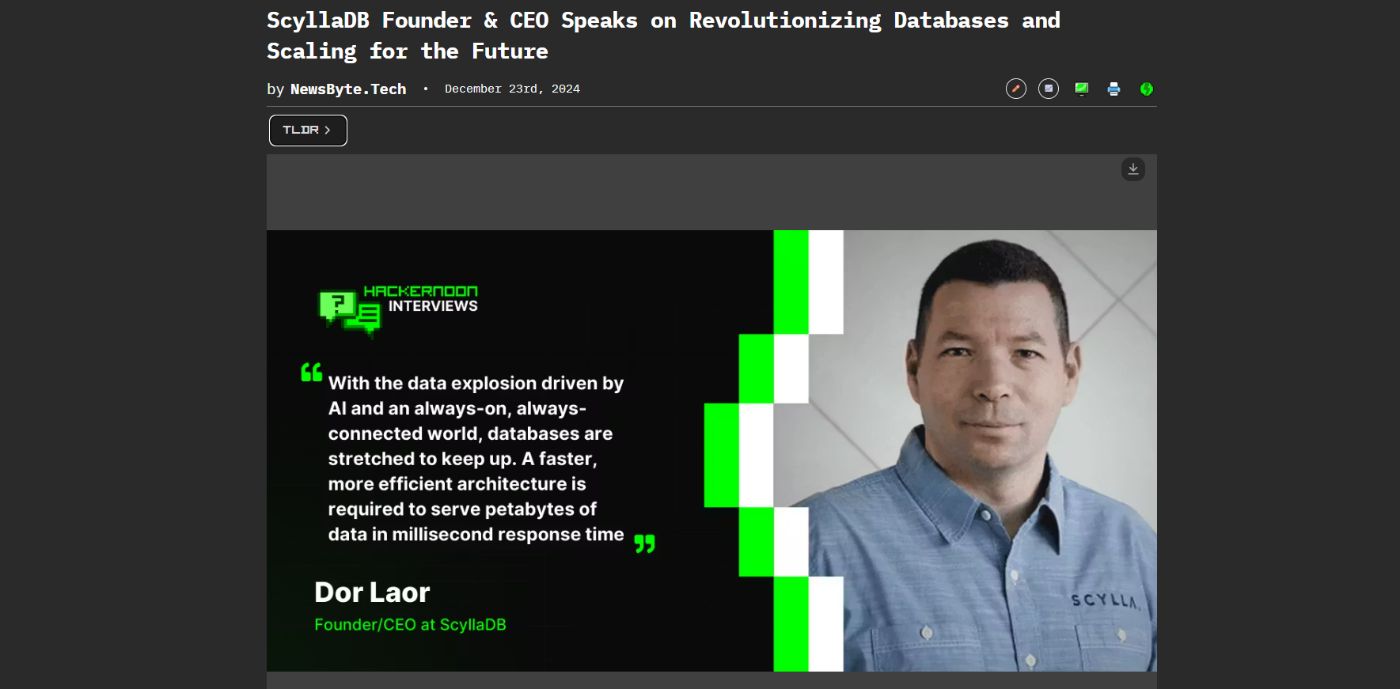
:::tip Curious about the vision behind ScyllaDB? HackerNoon interviewed founder and CEO Dor Laor last year—it's worth a read.

:::

\

The Discord Migration That Made Headlines

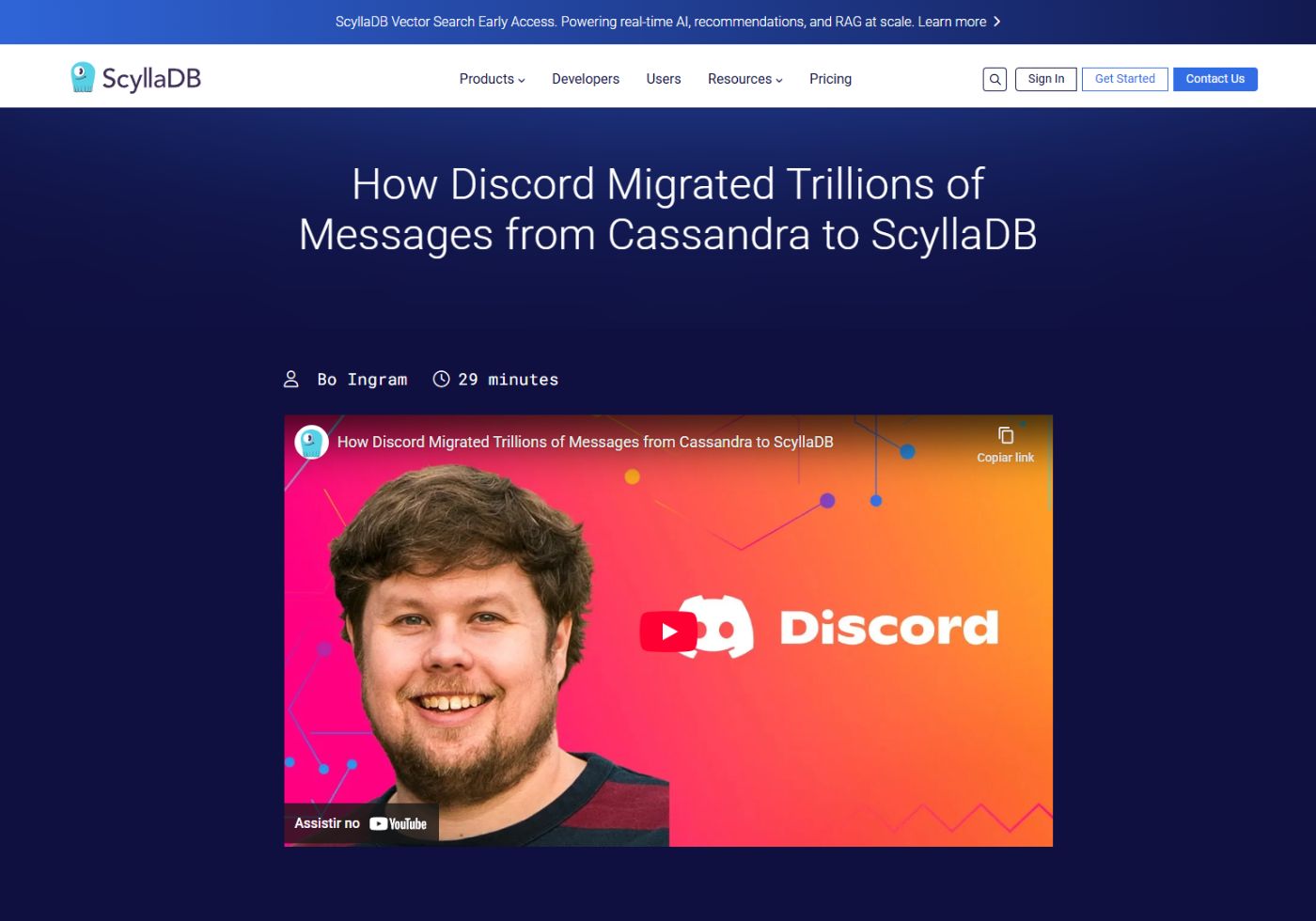
One of ScyllaDB's most famous success stories is Discord's migration of trillions of messages from Cassandra to ScyllaDB. And we're not talking about a small app here - Discord has over 350 million users who collectively send an astronomical number of messages every day, and ScyllaDB handles all of it.

\ Here's the heartwarming part: CEO Dor Laor mentioned in a recent interview that he has a special soft spot for the Discord deployment because "my son was very excited and proud about this." Even database CEOs get proud parent moments when their tech powers their kids' favorite apps.

\
\

Monster Scale in Real Numbers

When ScyllaDB says they handle "monster scale," they're not exaggerating. Check out these real-world deployments:

  • Palo Alto Networks runs over 10,000 clusters on ScyllaDB (yes, you read that right, ten thousand)
  • China Mobile operates a mind-boggling 4 petabyte, 180-server workload
  • Disney+ Hotstar uses ScyllaDB to deliver instant recommendations to hundreds of millions of viewers

\ These aren't just impressive numbers on a spec sheet, they represent the real-time experiences millions of people have every day. Whether it's your morning Starbucks mobile order, your evening Discord gaming session, or binge-watching your favorite show, there's a good chance ScyllaDB is working behind the scenes to make it all feel instant and seamless.

\

:::tip Share Your Company's Story Via HackerNoon!

:::

\ \

HackerNoon 🤝 ScyllaDB

ScyllaDB has published a series of insightful articles on HackerNoon that showcase their technical expertise in high-performance database architecture. Their pieces include deep-dives into NoSQL data modeling, performance debugging with Rust drivers, database migrations, and detailed case studies of how companies like Tripadvisor and Yieldmo leverage ScyllaDB for machine learning feature stores and real-time personalization at massive scale. As of today, ScyllaDB has amounted an impressive 4 months 7 days 14 hours and 3 minutes of reading time on their stories.

\ Check out the ScyllaDB profile here.

\
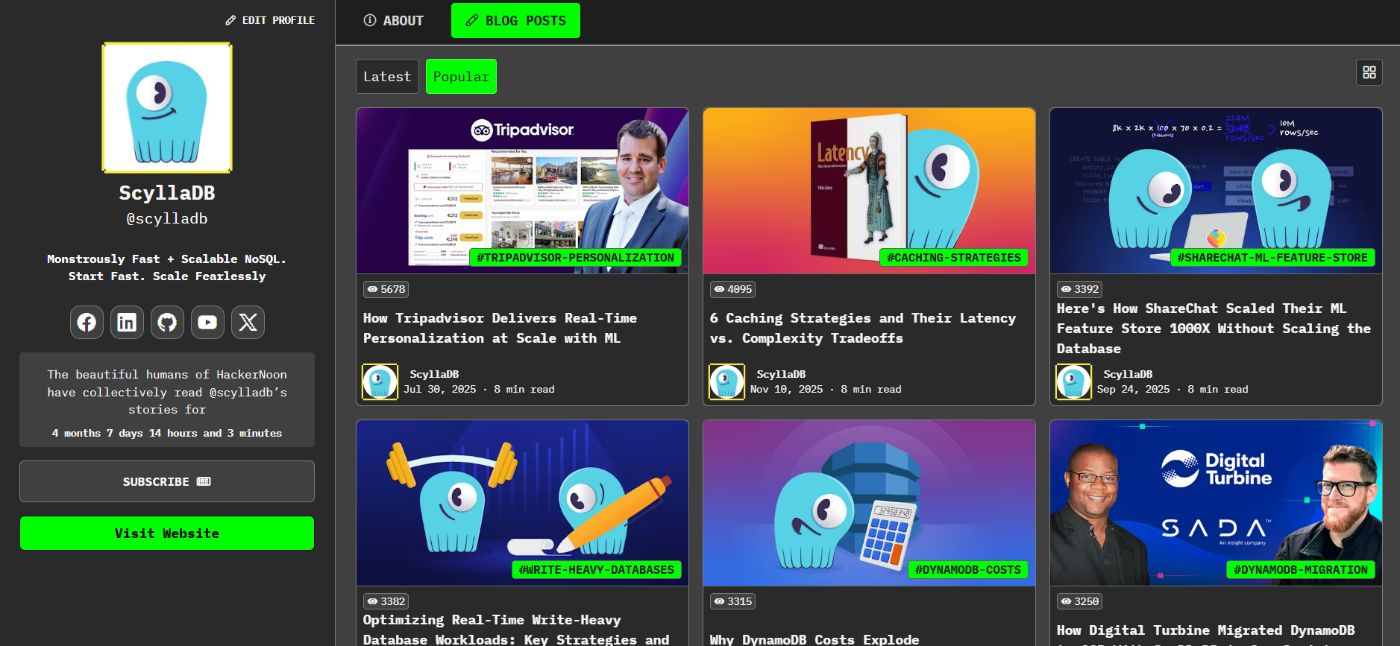
\ Here are their top 3 best performing articles on HackerNoon:

  • How Tripadvisor Delivers Real-Time Personalization at Scale with ML
  • 6 Caching Strategies and Their Latency vs. Complexity Tradeoffs
  • Here's How ShareChat Scaled Their ML Feature Store 1000X Without Scaling the Database

\ \

Join HackerNoon Business Blogging

HackerNoon’s Business Blogging Program is one of the many ways we help brands grow their reach and connect with the right audience. This program lets businesses publish content directly on HackerNoon to boost brand awareness and build SEO authority by tapping into ours.

Here’s what’s in it for you:

  • Full editorial support – we’ll help refine your story so it truly shines.
  • Multiple permanent placements – across HackerNoon, plus social media amplification.
  • Audio storytelling – your articles converted into audio format and distributed via RSS feeds.
  • Global reach – automatic translation into 12–76 languages.
  • SEO & domain authority boost – piggyback on HackerNoon’s trusted brand to strengthen your search rankings.

\


:::tip Publish Your First Story with HackerNoon Today

:::


\ And that’s all for this week, hackers.

Stay creative, Stay iconic.

HackerNoon Team

Piyasa Fırsatı
RealLink Logosu
RealLink Fiyatı(REAL)
$0.07163
$0.07163$0.07163
-2.18%
USD
RealLink (REAL) Canlı Fiyat Grafiği
Sorumluluk Reddi: Bu sitede yeniden yayınlanan makaleler, halka açık platformlardan alınmıştır ve yalnızca bilgilendirme amaçlıdır. MEXC'nin görüşlerini yansıtmayabilir. Tüm hakları telif sahiplerine aittir. Herhangi bir içeriğin üçüncü taraf haklarını ihlal ettiğini düşünüyorsanız, kaldırılması için lütfen service@support.mexc.com ile iletişime geçin. MEXC, içeriğin doğruluğu, eksiksizliği veya güncelliği konusunda hiçbir garanti vermez ve sağlanan bilgilere dayalı olarak alınan herhangi bir eylemden sorumlu değildir. İçerik, finansal, yasal veya diğer profesyonel tavsiye niteliğinde değildir ve MEXC tarafından bir tavsiye veya onay olarak değerlendirilmemelidir.

Ayrıca Şunları da Beğenebilirsiniz

MoneyGram launches stablecoin-powered app in Colombia

MoneyGram launches stablecoin-powered app in Colombia

The post MoneyGram launches stablecoin-powered app in Colombia appeared on BitcoinEthereumNews.com. MoneyGram has launched a new mobile application in Colombia that uses USD-pegged stablecoins to modernize cross-border remittances. According to an announcement on Wednesday, the app allows customers to receive money instantly into a US dollar balance backed by Circle’s USDC stablecoin, which can be stored, spent, or cashed out through MoneyGram’s global retail network. The rollout is designed to address the volatility of local currencies, particularly the Colombian peso. Built on the Stellar blockchain and supported by wallet infrastructure provider Crossmint, the app marks MoneyGram’s most significant move yet to integrate stablecoins into consumer-facing services. Colombia was selected as the first market due to its heavy reliance on inbound remittances—families in the country receive more than 22 times the amount they send abroad, according to Statista. The announcement said future expansions will target other remittance-heavy markets. MoneyGram, which has nearly 500,000 retail locations globally, has experimented with blockchain rails since partnering with the Stellar Development Foundation in 2021. It has since built cash on and off ramps for stablecoins, developed APIs for crypto integration, and incorporated stablecoins into its internal settlement processes. “This launch is the first step toward a world where every person, everywhere, has access to dollar stablecoins,” CEO Anthony Soohoo stated. The company emphasized compliance, citing decades of regulatory experience, though stablecoin oversight remains fluid. The US Congress passed the GENIUS Act earlier this year, establishing a framework for stablecoin regulation, which MoneyGram has pointed to as providing clearer guardrails. This is a developing story. This article was generated with the assistance of AI and reviewed by editor Jeffrey Albus before publication. Get the news in your inbox. Explore Blockworks newsletters: Source: https://blockworks.co/news/moneygram-stablecoin-app-colombia
Paylaş
BitcoinEthereumNews2025/09/18 07:04
Optum Golf Channel Games Debut In Prime Time

Optum Golf Channel Games Debut In Prime Time

The post Optum Golf Channel Games Debut In Prime Time appeared on BitcoinEthereumNews.com. FARMINGDALE, NEW YORK – SEPTEMBER 28: (L-R) Scottie Scheffler of Team
Paylaş
BitcoinEthereumNews2025/12/18 07:21
Google's AP2 protocol has been released. Does encrypted AI still have a chance?

Google's AP2 protocol has been released. Does encrypted AI still have a chance?

Following the MCP and A2A protocols, the AI Agent market has seen another blockbuster arrival: the Agent Payments Protocol (AP2), developed by Google. This will clearly further enhance AI Agents' autonomous multi-tasking capabilities, but the unfortunate reality is that it has little to do with web3AI. Let's take a closer look: What problem does AP2 solve? Simply put, the MCP protocol is like a universal hook, enabling AI agents to connect to various external tools and data sources; A2A is a team collaboration communication protocol that allows multiple AI agents to cooperate with each other to complete complex tasks; AP2 completes the last piece of the puzzle - payment capability. In other words, MCP opens up connectivity, A2A promotes collaboration efficiency, and AP2 achieves value exchange. The arrival of AP2 truly injects "soul" into the autonomous collaboration and task execution of Multi-Agents. Imagine AI Agents connecting Qunar, Meituan, and Didi to complete the booking of flights, hotels, and car rentals, but then getting stuck at the point of "self-payment." What's the point of all that multitasking? So, remember this: AP2 is an extension of MCP+A2A, solving the last mile problem of AI Agent automated execution. What are the technical highlights of AP2? The core innovation of AP2 is the Mandates mechanism, which is divided into real-time authorization mode and delegated authorization mode. Real-time authorization is easy to understand. The AI Agent finds the product and shows it to you. The operation can only be performed after the user signs. Delegated authorization requires the user to set rules in advance, such as only buying the iPhone 17 when the price drops to 5,000. The AI Agent monitors the trigger conditions and executes automatically. The implementation logic is cryptographically signed using Verifiable Credentials (VCs). Users can set complex commission conditions, including price ranges, time limits, and payment method priorities, forming a tamper-proof digital contract. Once signed, the AI Agent executes according to the conditions, with VCs ensuring auditability and security at every step. Of particular note is the "A2A x402" extension, a technical component developed by Google specifically for crypto payments, developed in collaboration with Coinbase and the Ethereum Foundation. This extension enables AI Agents to seamlessly process stablecoins, ETH, and other blockchain assets, supporting native payment scenarios within the Web3 ecosystem. What kind of imagination space can AP2 bring? After analyzing the technical principles, do you think that's it? Yes, in fact, the AP2 is boring when it is disassembled alone. Its real charm lies in connecting and opening up the "MCP+A2A+AP2" technology stack, completely opening up the complete link of AI Agent's autonomous analysis+execution+payment. From now on, AI Agents can open up many application scenarios. For example, AI Agents for stock investment and financial management can help us monitor the market 24/7 and conduct independent transactions. Enterprise procurement AI Agents can automatically replenish and renew without human intervention. AP2's complementary payment capabilities will further expand the penetration of the Agent-to-Agent economy into more scenarios. Google obviously understands that after the technical framework is established, the ecological implementation must be relied upon, so it has brought in more than 60 partners to develop it, almost covering the entire payment and business ecosystem. Interestingly, it also involves major Crypto players such as Ethereum, Coinbase, MetaMask, and Sui. Combined with the current trend of currency and stock integration, the imagination space has been doubled. Is web3 AI really dead? Not entirely. Google's AP2 looks complete, but it only achieves technical compatibility with Crypto payments. It can only be regarded as an extension of the traditional authorization framework and belongs to the category of automated execution. There is a "paradigm" difference between it and the autonomous asset management pursued by pure Crypto native solutions. The Crypto-native solutions under exploration are taking the "decentralized custody + on-chain verification" route, including AI Agent autonomous asset management, AI Agent autonomous transactions (DeFAI), AI Agent digital identity and on-chain reputation system (ERC-8004...), AI Agent on-chain governance DAO framework, AI Agent NPC and digital avatars, and many other interesting and fun directions. Ultimately, once users get used to AI Agent payments in traditional fields, their acceptance of AI Agents autonomously owning digital assets will also increase. And for those scenarios that AP2 cannot reach, such as anonymous transactions, censorship-resistant payments, and decentralized asset management, there will always be a time for crypto-native solutions to show their strength? The two are more likely to be complementary rather than competitive, but to be honest, the key technological advancements behind AI Agents currently all come from web2AI, and web3AI still needs to keep up the good work!
Paylaş
PANews2025/09/18 07:00