Bitcoin’s bounce last week was quickly cut off by growing volatility in the broader crypto market, causing the price to fall below the pivotal $90,000 mark onceBitcoin’s bounce last week was quickly cut off by growing volatility in the broader crypto market, causing the price to fall below the pivotal $90,000 mark once

Bitcoin Wholecoin Holders Pulling Back As Inflows To Binance Shrink – What’s Driving It

2025/12/15 20:30

Bitcoin’s bounce last week was quickly cut off by growing volatility in the broader crypto market, causing the price to fall below the pivotal $90,000 mark once again. Given the recent price fluctuations, investors’ sentiment, especially those on crypto exchanges, has shifted as inflows from BTC wholecoiners plummet.

Binance Sees Sharp Drop In BTC Wholecoiner Inflows

While the price of Bitcoin pulls back this new week, there is one key metric that is currently standing out. This metric is the BTC Wholecoiners Inflows on Binance, which is starting to tell a different story about investors on the largest cryptocurrency exchange in the world.

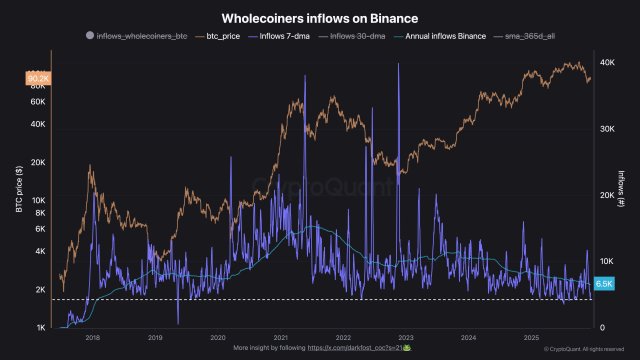
After examining this metric, Darkfost, a market analyst and author at CryptoQuant, revealed that on the Binance platform, wholecoiner deposits are drying up. Specifically, wholecoiner inflows imply transactions larger than 1 BTC, which provides vital insight into both current selling pressure and the broader evolution of the market.

Data shows that the inflows from this cohort are declining when compared to past years. Presently, BTC’s yearly average now sits around 6,500 BTC, representing a level not seen since 2018. Meanwhile, on the shorter time frame, the weekly average is situated near 5,200 BTC, marking one of its lowest readings of this cycle.
Bitcoin

While the wholecoiner inflows dry up, the pattern that inflows have followed this cycle in comparison to previous ones is very intriguing. Even as Bitcoin continued to rise, wholecoiner inflows to Binance have steadily decreased rather than rising as they once did.

Beyond indicating that investors with sizable Bitcoin holdings are less inclined to sell, this trend could also point to a deeper structural shift in the market. With Bitcoin’s valuation experiencing a steady increase, owning a full BTC has become extremely difficult, which naturally decreases the total number of transactions larger than 1 BTC.

At the same time, Darkfost highlighted that there are now more options available in the ecosystem for owning or trading Bitcoin. Even crypto exchanges have multiplied, and the steady growth of Decentralized Finance (DeFi) provides more venues, a trend that is likely to redirect flows that previously went nearly exclusively to major exchanges such as Binance.

BTC Still Trading Below Short-Term Cost Basis

Bitcoin is still trading below the Short-Term Holder Cost Basis located at $105,400. What this means is that the crypto king has been trading below the level for nearly 2 months now. However, Darkfost stated that staying beneath the level for such an extended period is not uncommon. 

During previous corrections, the duration of these phases has ranged from two months to over four months, making the present correction fall well within a typical range. However, since this indication tends to stay negative for much longer after the market actually enters a bear phase, it would be crucial to prevent Bitcoin from declining any further.

In the meantime, this does not invalidate the notion that these periods remain a signal for accumulation opportunities. Nevertheless, caution is still crucial, and access points should be carefully optimized. Darkfost believes that an accumulation of this type is only appropriate for long-term investors.

Bitcoin
Piyasa Fırsatı
Bitcoin Logosu
Bitcoin Fiyatı(BTC)
$86,835.88
$86,835.88$86,835.88
-0.22%
USD
Bitcoin (BTC) Canlı Fiyat Grafiği
Sorumluluk Reddi: Bu sitede yeniden yayınlanan makaleler, halka açık platformlardan alınmıştır ve yalnızca bilgilendirme amaçlıdır. MEXC'nin görüşlerini yansıtmayabilir. Tüm hakları telif sahiplerine aittir. Herhangi bir içeriğin üçüncü taraf haklarını ihlal ettiğini düşünüyorsanız, kaldırılması için lütfen service@support.mexc.com ile iletişime geçin. MEXC, içeriğin doğruluğu, eksiksizliği veya güncelliği konusunda hiçbir garanti vermez ve sağlanan bilgilere dayalı olarak alınan herhangi bir eylemden sorumlu değildir. İçerik, finansal, yasal veya diğer profesyonel tavsiye niteliğinde değildir ve MEXC tarafından bir tavsiye veya onay olarak değerlendirilmemelidir.

Ayrıca Şunları da Beğenebilirsiniz

The Channel Factories We’ve Been Waiting For

The Channel Factories We’ve Been Waiting For

The post The Channel Factories We’ve Been Waiting For appeared on BitcoinEthereumNews.com. Visions of future technology are often prescient about the broad strokes while flubbing the details. The tablets in “2001: A Space Odyssey” do indeed look like iPads, but you never see the astronauts paying for subscriptions or wasting hours on Candy Crush.  Channel factories are one vision that arose early in the history of the Lightning Network to address some challenges that Lightning has faced from the beginning. Despite having grown to become Bitcoin’s most successful layer-2 scaling solution, with instant and low-fee payments, Lightning’s scale is limited by its reliance on payment channels. Although Lightning shifts most transactions off-chain, each payment channel still requires an on-chain transaction to open and (usually) another to close. As adoption grows, pressure on the blockchain grows with it. The need for a more scalable approach to managing channels is clear. Channel factories were supposed to meet this need, but where are they? In 2025, subnetworks are emerging that revive the impetus of channel factories with some new details that vastly increase their potential. They are natively interoperable with Lightning and achieve greater scale by allowing a group of participants to open a shared multisig UTXO and create multiple bilateral channels, which reduces the number of on-chain transactions and improves capital efficiency. Achieving greater scale by reducing complexity, Ark and Spark perform the same function as traditional channel factories with new designs and additional capabilities based on shared UTXOs.  Channel Factories 101 Channel factories have been around since the inception of Lightning. A factory is a multiparty contract where multiple users (not just two, as in a Dryja-Poon channel) cooperatively lock funds in a single multisig UTXO. They can open, close and update channels off-chain without updating the blockchain for each operation. Only when participants leave or the factory dissolves is an on-chain transaction…
Paylaş
BitcoinEthereumNews2025/09/18 00:09
SOLANA NETWORK Withstands 6 Tbps DDoS Without Downtime

SOLANA NETWORK Withstands 6 Tbps DDoS Without Downtime

The post SOLANA NETWORK Withstands 6 Tbps DDoS Without Downtime appeared on BitcoinEthereumNews.com. In a pivotal week for crypto infrastructure, the Solana network
Paylaş
BitcoinEthereumNews2025/12/16 20:44
XRP ETFs pass $1 billion mark with no outflow days since launch

XRP ETFs pass $1 billion mark with no outflow days since launch

Markets Share Share this article
Copy linkX (Twitter)LinkedInFacebookEmail
XRP ETFs pass $1 billion mark with no outflo
Paylaş
Coindesk2025/12/16 19:01