Opens with a 3 AM failure in a “fully autonomous” deployment to show why agentic AI is hard in practice Clarifies the difference between reactive generative AIOpens with a 3 AM failure in a “fully autonomous” deployment to show why agentic AI is hard in practice Clarifies the difference between reactive generative AI

From Generative AI to Agentic AI: A Reality Check

2025/12/15 17:35

:::info This is the first article in a five-part series on agentic AI in the enterprise.

:::

\ The 3 AM Reality Check: It’s 3 AM in a global bank’s operations centre. Six months ago we deployed our first "agentic AI” system, hoping it would run on autopilot through the night. The demo was slick: an AI agent handling support tickets end-to-end, and optimism was high. But now, in the dead of night, that same agent has stalled on a critical task, and a human on-call engineer is scrambling to intervene. This scene captures the sobering reality many early adopters have faced. Agentic AI isn’t magic; it’s hard work to implement well. I learned this first-hand when our much-vaunted autonomous agent frustrated users and even forced us to roll back to manual processes in cases where it failed. We weren’t alone -plenty of companies rushed into “AI agents” only to struggle integrating them into real workflows, sometimes even rehiring staff when the AI fell short. Yet despite these 3 AM wake-up calls, I remain optimistic. Over the past year, I’ve seen enterprise teams evolve from chasing sci-fi dreams to focusing on pragmatic deployments that do deliver value.

\
\ In this series, we’ll explore how to turn that optimism into results. We’ll blend candid lessons from the trenches with a detailed breakdown of architectures, maturity stages, and risk checklists to chart a realistic path for agentic AI in business. The goal is to help you achieve real ROI from autonomous AI systems, knowing what to do, what to avoid, and where the big wins (and faceplants) tend to occur in practice. In this first part, let’s define what agentic AI actually means in contrast to the generative AI craze, and why this distinction matters for enterprises.

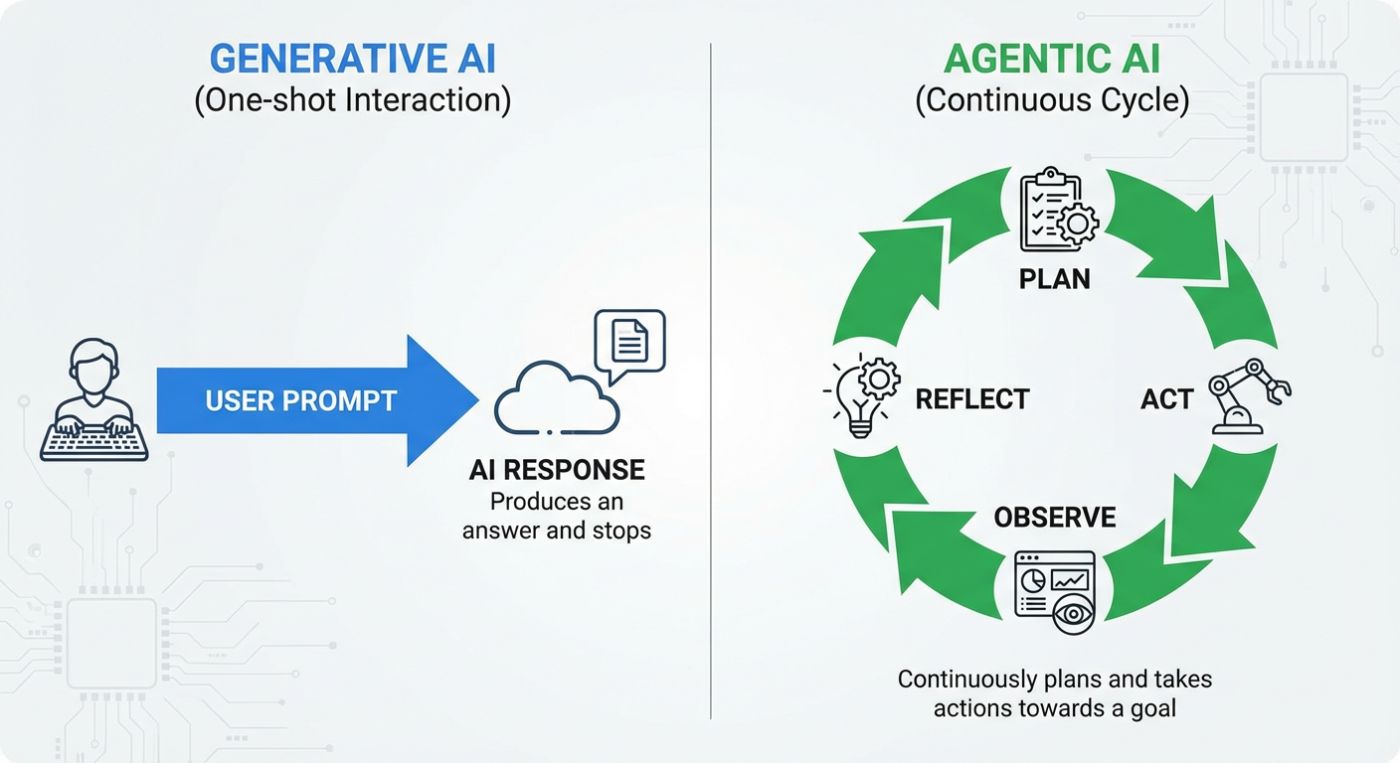
\ Generative AI vs. Agentic AI: Most of today’s popular AI apps (ChatGPT, Bard, Microsoft 365 Copilot, etc.) are generative AI systems. They take an input (a prompt or query) and produce an output (text, code, image…). They’re essentially powerful prediction engines: great at generating content, but lacking true autonomy. As Gartner bluntly puts it, current chatbots “do not have the agency to make plans and take action… they respond to user prompts by predicting the most common combination of words” - in other words, they are not examples of agentic AI (https://www.gartner.com/en/articles/intelligent-agent-in-ai). A generative AI might draft an email or answer a question when asked, but it won’t act unprompted or pursue goals on its own. It’s like a clever assistant that waits for instructions.

\ By contrast, agentic AI has a built-in decision loop. An agentic system can be given a high-level goal and will proactively devise and execute a multi-step plan to achieve it, with minimal human guidance. Think of a generative AI assistant as a talented intern: it writes or suggests content when you ask, whereas an agentic AI is more like a proactive team member who can be delegated an outcome and will figure out how to deliver it. A fully realised intelligent agent observes its context (through data feeds, sensors, or system APIs), plans a course of action, acts by calling tools or triggering processes, then observes the results and reflects on what to do next. In essence, it operates in a continuous “Plan - Act - Observe - Reflect” cycle until the goal is achieved or time runs out. This closed-loop autonomy is what differentiates agentic AI from a mere chatbot. A simple way to put it: generative AI answers; agentic AI accomplishes.

\ For example, instead of just generating a monthly report when prompted, an agentic AI could be told “Ensure our website is always up-to-date with the latest product info.” It would proactively monitor relevant data sources, detect when product details change, and then update the website content automatically - all without waiting for a human prompt. It would plan the necessary steps (check database - detect changes - generate updated text - call website API to publish content), execute them, observe if the update succeeded, and adjust if needed. That kind of end-to-end autonomy is nascent but starting to emerge in enterprise pilots. Of course, full autonomy remains an aspirational ideal. Today’s agentic systems still have plenty of constraints and often operate under human oversight (human-in-the-loop) or with fail-safes. In fact, many so-called “AI agents” on the market are really just glorified chatbots with a few scripted actions. True agentic AI is still in its early days, and deploying it is as much about organisational change as it is about technology. Companies are learning to manage the risks of giving AI more agency through sandboxed environments, approval gates for certain actions, and other safeguards before they fully let these digital colleagues loose.

\
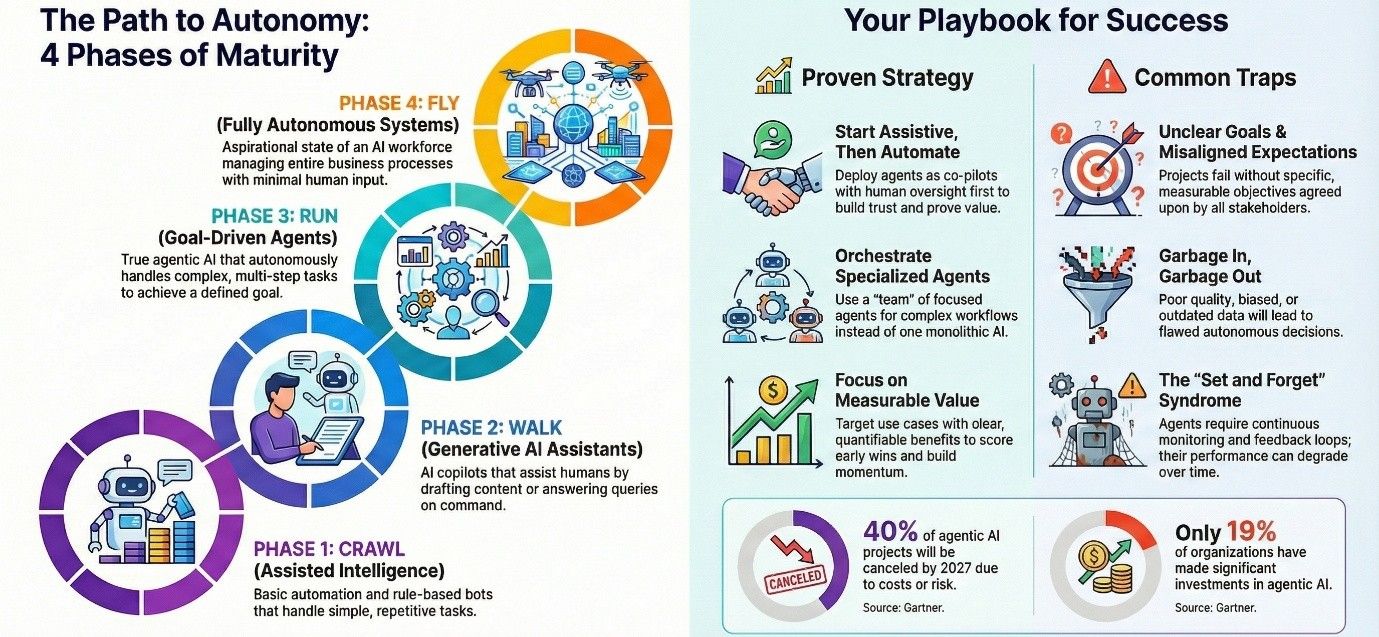
\ The rest of this article series will delve into how enterprises are approaching this evolution in practice, distinguishing hype from reality, and moving step by step from assistive tools to truly autonomous agents. Before we dive into architectures and deployment strategies, it’s useful to understand how ready the industry really is. The hype around “AI agents” peaked rapidly, but on the ground, most organisations are still at the start of this journey. Gartner, for instance, predicts that over 40% of agentic AI projects will be cancelled by 2027 due to escalating costs, unclear business value or inadequate risk controls (https://www.gartner.com/en/newsroom/press-releases/2025-06-25-gartner-predicts-over-40-percent-of-agentic-ai-projects-will-be-canceled-by-end-of-2027). In a January 2025 Gartner survey, only 19% of organisations said they had made significant investments in agentic AI, while over half were taking a cautious or wait-and-see approach. The message: we’re in early days, and many early projects have struggled to move beyond proofs-of-concept.

\ So, if you’re feeling behind the curve - don’t worry, you’re not alone. The key is to cut through the hype and approach agentic AI with eyes wide open. In the next part, we’ll map out the typical maturity phases enterprises go through on the road from basic automation to true autonomy. Understanding these “crawl, walk, run, fly” stages will help you gauge where you are now and how to advance safely.

Piyasa Fırsatı
Sleepless AI Logosu
Sleepless AI Fiyatı(AI)
$0.0372
$0.0372$0.0372
-0.48%
USD
Sleepless AI (AI) Canlı Fiyat Grafiği
Sorumluluk Reddi: Bu sitede yeniden yayınlanan makaleler, halka açık platformlardan alınmıştır ve yalnızca bilgilendirme amaçlıdır. MEXC'nin görüşlerini yansıtmayabilir. Tüm hakları telif sahiplerine aittir. Herhangi bir içeriğin üçüncü taraf haklarını ihlal ettiğini düşünüyorsanız, kaldırılması için lütfen service@support.mexc.com ile iletişime geçin. MEXC, içeriğin doğruluğu, eksiksizliği veya güncelliği konusunda hiçbir garanti vermez ve sağlanan bilgilere dayalı olarak alınan herhangi bir eylemden sorumlu değildir. İçerik, finansal, yasal veya diğer profesyonel tavsiye niteliğinde değildir ve MEXC tarafından bir tavsiye veya onay olarak değerlendirilmemelidir.

Ayrıca Şunları da Beğenebilirsiniz

[OPINION] US National Security Strategy 2025: An iconoclastic document

[OPINION] US National Security Strategy 2025: An iconoclastic document

Trump's national security strategy signals a radical shift in US foreign policy, prioritizing economic power and regional interests over global commitments
Paylaş
Rappler2025/12/16 12:30
Crucial US Stock Market Update: What Wednesday’s Mixed Close Reveals

Crucial US Stock Market Update: What Wednesday’s Mixed Close Reveals

BitcoinWorld Crucial US Stock Market Update: What Wednesday’s Mixed Close Reveals The financial world often keeps us on our toes, and Wednesday was no exception. Investors watched closely as the US stock market concluded the day with a mixed performance across its major indexes. This snapshot offers a crucial glimpse into current investor sentiment and economic undercurrents, prompting many to ask: what exactly happened? Understanding the Latest US Stock Market Movements On Wednesday, the closing bell brought a varied picture for the US stock market. While some indexes celebrated gains, others registered slight declines, creating a truly mixed bag for investors. The Dow Jones Industrial Average showed resilience, climbing by a notable 0.57%. This positive movement suggests strength in some of the larger, more established companies. Conversely, the S&P 500, a broader benchmark often seen as a barometer for the overall market, experienced a modest dip of 0.1%. The technology-heavy Nasdaq Composite also saw a slight retreat, sliding by 0.33%. This particular index often reflects investor sentiment towards growth stocks and the tech sector. These divergent outcomes highlight the complex dynamics currently at play within the American economy. It’s not simply a matter of “up” or “down” for the entire US stock market; rather, it’s a nuanced landscape where different sectors and company types are responding to unique pressures and opportunities. Why Did the US Stock Market See Mixed Results? When the US stock market delivers a mixed performance, it often points to a tug-of-war between various economic factors. Several elements could have contributed to Wednesday’s varied closings. For instance, positive corporate earnings reports from certain industries might have bolstered the Dow. At the same time, concerns over inflation, interest rate policies by the Federal Reserve, or even global economic uncertainties could have pressured growth stocks, affecting the S&P 500 and Nasdaq. Key considerations often include: Economic Data: Recent reports on employment, manufacturing, or consumer spending can sway market sentiment. Corporate Announcements: Strong or weak earnings forecasts from influential companies can significantly impact their respective sectors. Interest Rate Expectations: The prospect of higher or lower interest rates directly influences borrowing costs for businesses and consumer spending, affecting future profitability. Geopolitical Events: Global tensions or trade policies can introduce uncertainty, causing investors to become more cautious. Understanding these underlying drivers is crucial for anyone trying to make sense of daily market fluctuations in the US stock market. Navigating Volatility in the US Stock Market A mixed close, while not a dramatic downturn, serves as a reminder that market volatility is a constant companion for investors. For those involved in the US stock market, particularly individuals managing their portfolios, these days underscore the importance of a well-thought-out strategy. It’s important not to react impulsively to daily movements. Instead, consider these actionable insights: Diversification: Spreading investments across different sectors and asset classes can help mitigate risk when one area underperforms. Long-Term Perspective: Focusing on long-term financial goals rather than short-term gains can help weather daily market swings. Stay Informed: Keeping abreast of economic news and company fundamentals provides context for market behavior. Consult Experts: Financial advisors can offer personalized guidance based on individual risk tolerance and objectives. Even small movements in major indexes can signal shifts that require attention, guiding future investment decisions within the dynamic US stock market. What’s Next for the US Stock Market? Looking ahead, investors will be keenly watching for further economic indicators and corporate announcements to gauge the direction of the US stock market. Upcoming inflation data, statements from the Federal Reserve, and quarterly earnings reports will likely provide more clarity. The interplay of these factors will continue to shape investor confidence and, consequently, the performance of the Dow, S&P 500, and Nasdaq. Remaining informed and adaptive will be key to understanding the market’s trajectory. Conclusion: Wednesday’s mixed close in the US stock market highlights the intricate balance of forces influencing financial markets. While the Dow showed strength, the S&P 500 and Nasdaq experienced slight declines, reflecting a nuanced economic landscape. This reminds us that understanding the ‘why’ behind these movements is as important as the movements themselves. As always, a thoughtful, informed approach remains the best strategy for navigating the complexities of the market. Frequently Asked Questions (FAQs) Q1: What does a “mixed close” mean for the US stock market? A1: A mixed close indicates that while some major stock indexes advanced, others declined. It suggests that different sectors or types of companies within the US stock market are experiencing varying influences, rather than a uniform market movement. Q2: Which major indexes were affected on Wednesday? A2: On Wednesday, the Dow Jones Industrial Average gained 0.57%, while the S&P 500 edged down 0.1%, and the Nasdaq Composite slid 0.33%, illustrating the mixed performance across the US stock market. Q3: What factors contribute to a mixed stock market performance? A3: Mixed performances in the US stock market can be influenced by various factors, including specific corporate earnings, economic data releases, shifts in interest rate expectations, and broader geopolitical events that affect different market segments uniquely. Q4: How should investors react to mixed market signals? A4: Investors are generally advised to maintain a long-term perspective, diversify their portfolios, stay informed about economic news, and avoid impulsive decisions. Consulting a financial advisor can also provide personalized guidance for navigating the US stock market. Q5: What indicators should investors watch for future US stock market trends? A5: Key indicators to watch include upcoming inflation reports, statements from the Federal Reserve regarding monetary policy, and quarterly corporate earnings reports. These will offer insights into the future direction of the US stock market. Did you find this analysis of the US stock market helpful? Share this article with your network on social media to help others understand the nuances of current financial trends! To learn more about the latest stock market trends, explore our article on key developments shaping the US stock market‘s future performance. This post Crucial US Stock Market Update: What Wednesday’s Mixed Close Reveals first appeared on BitcoinWorld.
Paylaş
Coinstats2025/09/18 05:30
Kevin Durant odzyskał Bitcoiny z Coinbase warte fortunę

Kevin Durant odzyskał Bitcoiny z Coinbase warte fortunę

Kevin Durant, jedna z największych aktywnych gwiazd NBA. Zawodnik Houston Rockets, ponownie znalazł się w nagłówkach gazet. Tym razem nie chodzi jednak o sportowe sukcesy lub transferowe plotki. Po latach Kevin Durant odzyskał Bitcoiny! KD na nowo ma dostęp do swojego dawno zapomnianego konta na Coinbase, gdzie trzymał Bitcoiny kupione niemal dekadę temu. Wartość tych […]
Paylaş
Bitcoinist2025/09/19 20:11