Dragonfly managing partner Haseeb Qureshi has sharpened his defense of Ethereum’s valuation, arguing that critics are using the wrong financial framework and that ETH should be analyzed more like an early-stage Amazon than a mature “value” stock. Speaking on the Milk Road Show on 9 December 2025, Qureshi revisited his now-viral valuation clash with investor Santiago “Santi” Santos, hosted by ThreadGuy, which reignited the debate over how to price layer 1 blockchains. At the core of Qureshi’s thesis is a simple but controversial claim: fee revenue on Ethereum is effectively pure margin and should be treated as profit, not as “revenue” in the traditional corporate sense. “Blockchains don’t have revenue. They have profit,” he said. “When chains charge fees, that’s profit. There’s no expenses for a chain. Chains don’t pay expenses, right? There’s no AWS hosting cost for Ethereum.” Qureshi Pushes Back On Claims Ethereum Is Overvalued Santos had argued that Ethereum is trading at “300 plus” times sales, calling these price-to-sales (P/S) levels “embarrassing” relative to traditional companies and suggesting valuations are “way ahead of their skis.” Qureshi did not contest the magnitude of the multiples but rejected P/S as the right lens. Related Reading: Ethereum Sees Largest Binance Inflow Since 2023 – Warning Sign? “He was insisting in the debate that the right way to look at these things is price of sales. So if you look at price sales for Ethereum, it’s something like 380. If you look at Amazon, I think Amazon topped out at price of sales of 42. And this was during the bubble,” Qureshi said. He countered that for a blockchain, what equity investors would call “sales” is closer to the GDP or GMV of the on-chain economy, which is not directly measured at the protocol level. The only clean, observable line is fee income, which he treats as net income. “The sales in some sense is like the GDP of the blockchain which we’re not measuring,” he argued. “The right thing to understand for a chain is the profit… The right thing to understand is what is the profit of Ethereum relative to the profit of Amazon.” That opens the door to the Amazon analogy. Qureshi emphasized that Amazon delayed profitability for almost two decades to prioritize growth, yet public markets still assigned it extremely high earnings multiples. “Amazon literally made no profit, no profit until basically about 20 years in as a business,” he said. “In the year I think it was 2013… Amazon had a PE ratio… over 600 whereas today the PE ratio of Ethereum of course is something like 380.” Because Ethereum’s P/S and P/E converge under his “fees = profit” assumption, Qureshi’s argument is that investors should compare ETH’s 300–380x multiple to Amazon’s P/E history, not to its much lower P/S, if they are going to use a single headline ratio at all. The broader context, he stressed, is that Ethereum and other L1s are still in an exponential build-out phase, more akin to early internet or e-commerce infrastructure than to late-cycle dividend payers. Related Reading: Ethereum Inches Toward A Critical Decision Point: Bullish Break Or Deeper Dive? “This technology has been getting bigger and bigger over time. It’s gobbling up the entire world of finance from where it started,” he said, referencing his essay “In Defense of Exponentials.” “None of [these technologies] started printing a bunch of profit immediately in the first five or even 10 years.” Despite choppy price action and underperformance of altcoins versus AI equities and gold, Qureshi said his conviction in the long-dated Ethereum thesis has increased, not weakened, through the public debate. “If anything, I have become more confident in my view,” he said, adding that nothing material had changed in the last months to justify a major portfolio rethink. “What exactly has changed in the last 2 months between, you know, ETH going to like $4,800 and ETH being at $3,000? The answer is basically nothing.” Shared some post-debate reflections on my L1 debate with @santiagoroel, my rebuttal against the “crypto is all a big casino” doomers, and where I think we are in the crypto macro cycle 👇 https://t.co/9uMJFuLVrX — Haseeb >|< (@hosseeb) December 9, 2025 For Qureshi, a genuine repositioning would require a clear invalidation of core assumptions—such as a quantum break of cryptography or a structural collapse in on-chain stablecoin demand. Short-term swings, in his view, are simply the pendulum of sentiment moving around a still-fixed fundamental anchor. His message to skeptics is that if markets tolerated Amazon at 600x earnings while it scaled into a dominant platform, dismissing Ethereum at roughly 300–380x on a “too high on P/S” argument alone is analytically inconsistent. At press time, ETH traded at $3,325. Featured image created with DALL.E, chart from TradingView.comDragonfly managing partner Haseeb Qureshi has sharpened his defense of Ethereum’s valuation, arguing that critics are using the wrong financial framework and that ETH should be analyzed more like an early-stage Amazon than a mature “value” stock. Speaking on the Milk Road Show on 9 December 2025, Qureshi revisited his now-viral valuation clash with investor Santiago “Santi” Santos, hosted by ThreadGuy, which reignited the debate over how to price layer 1 blockchains. At the core of Qureshi’s thesis is a simple but controversial claim: fee revenue on Ethereum is effectively pure margin and should be treated as profit, not as “revenue” in the traditional corporate sense. “Blockchains don’t have revenue. They have profit,” he said. “When chains charge fees, that’s profit. There’s no expenses for a chain. Chains don’t pay expenses, right? There’s no AWS hosting cost for Ethereum.” Qureshi Pushes Back On Claims Ethereum Is Overvalued Santos had argued that Ethereum is trading at “300 plus” times sales, calling these price-to-sales (P/S) levels “embarrassing” relative to traditional companies and suggesting valuations are “way ahead of their skis.” Qureshi did not contest the magnitude of the multiples but rejected P/S as the right lens. Related Reading: Ethereum Sees Largest Binance Inflow Since 2023 – Warning Sign? “He was insisting in the debate that the right way to look at these things is price of sales. So if you look at price sales for Ethereum, it’s something like 380. If you look at Amazon, I think Amazon topped out at price of sales of 42. And this was during the bubble,” Qureshi said. He countered that for a blockchain, what equity investors would call “sales” is closer to the GDP or GMV of the on-chain economy, which is not directly measured at the protocol level. The only clean, observable line is fee income, which he treats as net income. “The sales in some sense is like the GDP of the blockchain which we’re not measuring,” he argued. “The right thing to understand for a chain is the profit… The right thing to understand is what is the profit of Ethereum relative to the profit of Amazon.” That opens the door to the Amazon analogy. Qureshi emphasized that Amazon delayed profitability for almost two decades to prioritize growth, yet public markets still assigned it extremely high earnings multiples. “Amazon literally made no profit, no profit until basically about 20 years in as a business,” he said. “In the year I think it was 2013… Amazon had a PE ratio… over 600 whereas today the PE ratio of Ethereum of course is something like 380.” Because Ethereum’s P/S and P/E converge under his “fees = profit” assumption, Qureshi’s argument is that investors should compare ETH’s 300–380x multiple to Amazon’s P/E history, not to its much lower P/S, if they are going to use a single headline ratio at all. The broader context, he stressed, is that Ethereum and other L1s are still in an exponential build-out phase, more akin to early internet or e-commerce infrastructure than to late-cycle dividend payers. Related Reading: Ethereum Inches Toward A Critical Decision Point: Bullish Break Or Deeper Dive? “This technology has been getting bigger and bigger over time. It’s gobbling up the entire world of finance from where it started,” he said, referencing his essay “In Defense of Exponentials.” “None of [these technologies] started printing a bunch of profit immediately in the first five or even 10 years.” Despite choppy price action and underperformance of altcoins versus AI equities and gold, Qureshi said his conviction in the long-dated Ethereum thesis has increased, not weakened, through the public debate. “If anything, I have become more confident in my view,” he said, adding that nothing material had changed in the last months to justify a major portfolio rethink. “What exactly has changed in the last 2 months between, you know, ETH going to like $4,800 and ETH being at $3,000? The answer is basically nothing.” Shared some post-debate reflections on my L1 debate with @santiagoroel, my rebuttal against the “crypto is all a big casino” doomers, and where I think we are in the crypto macro cycle 👇 https://t.co/9uMJFuLVrX — Haseeb >|< (@hosseeb) December 9, 2025 For Qureshi, a genuine repositioning would require a clear invalidation of core assumptions—such as a quantum break of cryptography or a structural collapse in on-chain stablecoin demand. Short-term swings, in his view, are simply the pendulum of sentiment moving around a still-fixed fundamental anchor. His message to skeptics is that if markets tolerated Amazon at 600x earnings while it scaled into a dominant platform, dismissing Ethereum at roughly 300–380x on a “too high on P/S” argument alone is analytically inconsistent. At press time, ETH traded at $3,325. Featured image created with DALL.E, chart from TradingView.com
Ethereum Should Be Valued Like Amazon, Says Dragonfly’s Qureshi

2025/12/11 10:00

Dragonfly managing partner Haseeb Qureshi has sharpened his defense of Ethereum’s valuation, arguing that critics are using the wrong financial framework and that ETH should be analyzed more like an early-stage Amazon than a mature “value” stock.

Speaking on the Milk Road Show on 9 December 2025, Qureshi revisited his now-viral valuation clash with investor Santiago “Santi” Santos, hosted by ThreadGuy, which reignited the debate over how to price layer 1 blockchains. At the core of Qureshi’s thesis is a simple but controversial claim: fee revenue on Ethereum is effectively pure margin and should be treated as profit, not as “revenue” in the traditional corporate sense.

“Blockchains don’t have revenue. They have profit,” he said. “When chains charge fees, that’s profit. There’s no expenses for a chain. Chains don’t pay expenses, right? There’s no AWS hosting cost for Ethereum.”

Qureshi Pushes Back On Claims Ethereum Is Overvalued

Santos had argued that Ethereum is trading at “300 plus” times sales, calling these price-to-sales (P/S) levels “embarrassing” relative to traditional companies and suggesting valuations are “way ahead of their skis.” Qureshi did not contest the magnitude of the multiples but rejected P/S as the right lens.

“He was insisting in the debate that the right way to look at these things is price of sales. So if you look at price sales for Ethereum, it’s something like 380. If you look at Amazon, I think Amazon topped out at price of sales of 42. And this was during the bubble,” Qureshi said.

He countered that for a blockchain, what equity investors would call “sales” is closer to the GDP or GMV of the on-chain economy, which is not directly measured at the protocol level. The only clean, observable line is fee income, which he treats as net income.

“The sales in some sense is like the GDP of the blockchain which we’re not measuring,” he argued. “The right thing to understand for a chain is the profit… The right thing to understand is what is the profit of Ethereum relative to the profit of Amazon.”

That opens the door to the Amazon analogy. Qureshi emphasized that Amazon delayed profitability for almost two decades to prioritize growth, yet public markets still assigned it extremely high earnings multiples.

“Amazon literally made no profit, no profit until basically about 20 years in as a business,” he said. “In the year I think it was 2013… Amazon had a PE ratio… over 600 whereas today the PE ratio of Ethereum of course is something like 380.”

Because Ethereum’s P/S and P/E converge under his “fees = profit” assumption, Qureshi’s argument is that investors should compare ETH’s 300–380x multiple to Amazon’s P/E history, not to its much lower P/S, if they are going to use a single headline ratio at all.

The broader context, he stressed, is that Ethereum and other L1s are still in an exponential build-out phase, more akin to early internet or e-commerce infrastructure than to late-cycle dividend payers.

“This technology has been getting bigger and bigger over time. It’s gobbling up the entire world of finance from where it started,” he said, referencing his essay “In Defense of Exponentials.” “None of [these technologies] started printing a bunch of profit immediately in the first five or even 10 years.”

Despite choppy price action and underperformance of altcoins versus AI equities and gold, Qureshi said his conviction in the long-dated Ethereum thesis has increased, not weakened, through the public debate.

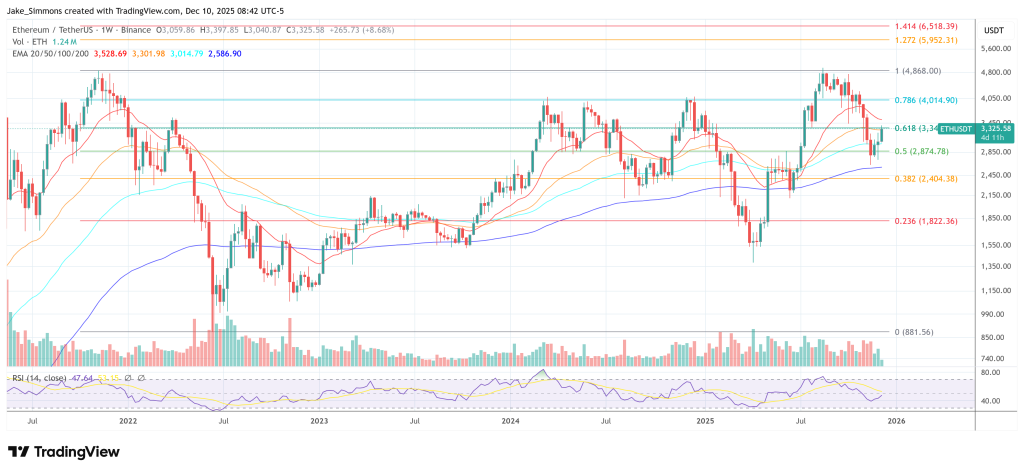
“If anything, I have become more confident in my view,” he said, adding that nothing material had changed in the last months to justify a major portfolio rethink. “What exactly has changed in the last 2 months between, you know, ETH going to like $4,800 and ETH being at $3,000? The answer is basically nothing.”

For Qureshi, a genuine repositioning would require a clear invalidation of core assumptions—such as a quantum break of cryptography or a structural collapse in on-chain stablecoin demand. Short-term swings, in his view, are simply the pendulum of sentiment moving around a still-fixed fundamental anchor.

His message to skeptics is that if markets tolerated Amazon at 600x earnings while it scaled into a dominant platform, dismissing Ethereum at roughly 300–380x on a “too high on P/S” argument alone is analytically inconsistent.

At press time, ETH traded at $3,325.

Ethereum price
Sorumluluk Reddi: Bu sitede yeniden yayınlanan makaleler, halka açık platformlardan alınmıştır ve yalnızca bilgilendirme amaçlıdır. MEXC'nin görüşlerini yansıtmayabilir. Tüm hakları telif sahiplerine aittir. Herhangi bir içeriğin üçüncü taraf haklarını ihlal ettiğini düşünüyorsanız, kaldırılması için lütfen service@support.mexc.com ile iletişime geçin. MEXC, içeriğin doğruluğu, eksiksizliği veya güncelliği konusunda hiçbir garanti vermez ve sağlanan bilgilere dayalı olarak alınan herhangi bir eylemden sorumlu değildir. İçerik, finansal, yasal veya diğer profesyonel tavsiye niteliğinde değildir ve MEXC tarafından bir tavsiye veya onay olarak değerlendirilmemelidir.

Ayrıca Şunları da Beğenebilirsiniz

Big U.S. banks cut prime rate to 7.25% after Fed’s interest rate cut

Big U.S. banks cut prime rate to 7.25% after Fed’s interest rate cut

The post Big U.S. banks cut prime rate to 7.25% after Fed’s interest rate cut appeared on BitcoinEthereumNews.com. Big U.S. banks have lowered their prime lending rate to 7.25%, down from 7.50%, after the Federal Reserve announced a 25 basis point rate cut on Wednesday, the first adjustment since December. The change directly affects consumer and business loans across the country. According to Reuters, JPMorgan Chase, Citigroup, Wells Fargo, and Bank of America all implemented the new rate immediately following the Fed’s announcement. The prime rate is what banks charge their most trusted borrowers, usually large companies. But it’s also the base for what everyone else pays; mortgages, small business loans, credit cards, and personal loans. With this cut, borrowing gets slightly cheaper across the board. Inflation still isn’t under control. It’s above the 2% goal, and the impact of President Donald Trump’s tariffs remains uncertain. Fed reacts to rising unemployment concerns Richard Flynn, managing director at Charles Schwab UK, said jobless claims are at their highest in almost four years, despite the Fed originally planning to keep rates unchanged through the summer. “Although the summer began with expectations of holding rates steady, the labor market has shown more signs of weakness than anticipated,” Flynn said. Hiring has slowed because of uncertainty around Trump’s trade policy. Companies are hesitating to add staff, which is why job growth has nearly stalled. As fewer people are hired, spending starts to shrink. And that’s when things start to unravel. That’s what the Fed is trying to get ahead of with this rate cut. The cut also helps banks directly. Lower rates mean more people may qualify for loans again. During the previous rate hikes, lending standards got tighter. Now, with cheaper credit, smaller businesses could get approved again. If well-funded businesses feel confident, they may hire again. That could eventually help the consumer side of the economy bounce back, but that’s…
Paylaş
BitcoinEthereumNews2025/09/18 16:32