Thailand’s Securities and Exchange Commission (SEC) and the Cyber Crime Investigation Bureau (CCIB) have raided a Worldcoin-linked iris scanning center in Bangkok, arresting suspects accused of running an unlicensed digital asset exchange. The joint operation, announced Friday, is part of Thailand’s growing crackdown on unregulated crypto services amid global scrutiny of Worldcoin’s controversial biometric identity system. Has Worldcoin Crossed the Line in Thailand’s Crypto Crackdown?Source: Thailand SEC According to the SEC’s statement, investigators discovered that the iris scanning hub was providing “WLD exchange services” without the required authorization under the Emergency Decree on Digital Asset Businesses B.E. 2561 (2018). The operators were allegedly facilitating token exchanges linked to Worldcoin’s native cryptocurrency, WLD, in violation of licensing laws. The SEC said the arrests were made under Section 26 of the decree, which prohibits the operation of digital asset businesses without a license, with penalties prescribed under Section 66. The law enforcement officials said the move was intended to protect users from potential scams and prevent money laundering through unregulated crypto exchanges. At the joint press briefing, SEC Deputy Secretary-General Jomkwan Kongsakul said the operation marks a broader effort to tighten oversight of unlicensed digital asset activity. “This collaboration will enhance the effectiveness of law enforcement in prosecuting and suppressing unlicensed digital asset businesses, while protecting users from a lack of legal protection and mitigating risks of scams and money laundering,” she stated. The raid followed weeks of surveillance by the SEC’s monitoring unit, which has been tracking several unlicensed operators across Thailand. The agency had previously issued public warnings against exchanging WLD tokens with unlicensed providers and urged the public to verify operator licenses through the official SEC website and its Check First application. Officials reiterated that users dealing with unauthorized operators are not covered by legal protection and face high risks of fraud and data misuse. Worldcoin Faces Mounting Global Scrutiny as Thailand Joins Enforcement Wave Worldcoin, now rebranded as World Network, was launched in 2023 by OpenAI CEO Sam Altman and Alex Blania as a biometric identity verification project that rewards users with WLD tokens for verifying their “humanness” through iris scans. The verification process, carried out using a chrome sphere device known as the Orb, captures iris images to generate a unique digital ID, or World ID. The platform operates over 1,100 Orb devices globally, including more than 100 locations across Thailand.Source: World website Users receive WLD tokens after completing verification, which they can exchange through the World App. According to the World website, it only issues WLD tokens to users who complete verification in regions where such activity is legally permitted. The project notes that eligibility for token distribution depends on several factors, including location and age restrictions. However, some local sites have reportedly gone further, providing token exchange services without the necessary licenses, an activity now under investigation. Thailand’s enforcement action places it among a growing list of countries confronting Worldcoin’s practices. Regulators in Spain, Portugal, Brazil, and Kenya have suspended or restricted the project’s operations, citing violations of data protection laws and concerns about the handling of sensitive biometric information. In Kenya, a High Court ruling in May ordered the deletion of all biometric data collected from citizens, describing Worldcoin’s consent practices as “invalid” due to monetary inducements. European regulators have also intervened. Portugal’s data protection commission followed with a 90-day ban, while Germany imposed corrective measures to bring the project in line with EU privacy regulations under the General Data Protection Regulation (GDPR). In Brazil, authorities banned the exchange of biometric data for crypto rewards in early 2024, ruling that such incentives compromise users’ ability to give free and informed consent. Also, France, Portugal, Spain, Hong Kong, and South Korea have all launched investigations into the project’s data practices. Worldcoin Rolls Out New Security and ID Tools—But Can It Regain Confidence? Worldcoin’s parent company, Tools for Humanity, has responded by developing a new Secure Multi-Party Computation (SMPC) system in 2024 that splits and encrypts iris data across multiple storage points. In October 2024, the project also unveiled a redesigned version of its Orb device that integrates 5G connectivity and enhanced AI processing powered by NVIDIA’s Jetson chipset. It also features 30% fewer parts and a removable SD card for inspection, a change intended to improve transparency and address privacy concerns. To reduce reliance on biometric verification, World Network introduced a non-biometric option that allows users to verify identity using passports with NFC, confirming details like nationality and age without sharing personal data. The company claims the system eliminates the risk of decryption from a single source and says old iris codes are being deleted as part of a privacy upgrade. Despite growing regulatory resistance, Worldcoin’s global presence continues to expand. The project recently launched its World ID service in the United States and the Philippines; currently, it has now surpassed 100 million verifications across 160 countries. The World App now counts more than 37 million users, with over 1,000 Orb devices active worldwide.WLD Token Source: CoinGecko Still, Worldcoin’s token has struggled to maintain market confidence amid ongoing legal challenges. WLD, which once traded as high as $11.74 in March 2024, currently hovers around $0.88, down over 90% from its peakThailand’s Securities and Exchange Commission (SEC) and the Cyber Crime Investigation Bureau (CCIB) have raided a Worldcoin-linked iris scanning center in Bangkok, arresting suspects accused of running an unlicensed digital asset exchange. The joint operation, announced Friday, is part of Thailand’s growing crackdown on unregulated crypto services amid global scrutiny of Worldcoin’s controversial biometric identity system. Has Worldcoin Crossed the Line in Thailand’s Crypto Crackdown?Source: Thailand SEC According to the SEC’s statement, investigators discovered that the iris scanning hub was providing “WLD exchange services” without the required authorization under the Emergency Decree on Digital Asset Businesses B.E. 2561 (2018). The operators were allegedly facilitating token exchanges linked to Worldcoin’s native cryptocurrency, WLD, in violation of licensing laws. The SEC said the arrests were made under Section 26 of the decree, which prohibits the operation of digital asset businesses without a license, with penalties prescribed under Section 66. The law enforcement officials said the move was intended to protect users from potential scams and prevent money laundering through unregulated crypto exchanges. At the joint press briefing, SEC Deputy Secretary-General Jomkwan Kongsakul said the operation marks a broader effort to tighten oversight of unlicensed digital asset activity. “This collaboration will enhance the effectiveness of law enforcement in prosecuting and suppressing unlicensed digital asset businesses, while protecting users from a lack of legal protection and mitigating risks of scams and money laundering,” she stated. The raid followed weeks of surveillance by the SEC’s monitoring unit, which has been tracking several unlicensed operators across Thailand. The agency had previously issued public warnings against exchanging WLD tokens with unlicensed providers and urged the public to verify operator licenses through the official SEC website and its Check First application. Officials reiterated that users dealing with unauthorized operators are not covered by legal protection and face high risks of fraud and data misuse. Worldcoin Faces Mounting Global Scrutiny as Thailand Joins Enforcement Wave Worldcoin, now rebranded as World Network, was launched in 2023 by OpenAI CEO Sam Altman and Alex Blania as a biometric identity verification project that rewards users with WLD tokens for verifying their “humanness” through iris scans. The verification process, carried out using a chrome sphere device known as the Orb, captures iris images to generate a unique digital ID, or World ID. The platform operates over 1,100 Orb devices globally, including more than 100 locations across Thailand.Source: World website Users receive WLD tokens after completing verification, which they can exchange through the World App. According to the World website, it only issues WLD tokens to users who complete verification in regions where such activity is legally permitted. The project notes that eligibility for token distribution depends on several factors, including location and age restrictions. However, some local sites have reportedly gone further, providing token exchange services without the necessary licenses, an activity now under investigation. Thailand’s enforcement action places it among a growing list of countries confronting Worldcoin’s practices. Regulators in Spain, Portugal, Brazil, and Kenya have suspended or restricted the project’s operations, citing violations of data protection laws and concerns about the handling of sensitive biometric information. In Kenya, a High Court ruling in May ordered the deletion of all biometric data collected from citizens, describing Worldcoin’s consent practices as “invalid” due to monetary inducements. European regulators have also intervened. Portugal’s data protection commission followed with a 90-day ban, while Germany imposed corrective measures to bring the project in line with EU privacy regulations under the General Data Protection Regulation (GDPR). In Brazil, authorities banned the exchange of biometric data for crypto rewards in early 2024, ruling that such incentives compromise users’ ability to give free and informed consent. Also, France, Portugal, Spain, Hong Kong, and South Korea have all launched investigations into the project’s data practices. Worldcoin Rolls Out New Security and ID Tools—But Can It Regain Confidence? Worldcoin’s parent company, Tools for Humanity, has responded by developing a new Secure Multi-Party Computation (SMPC) system in 2024 that splits and encrypts iris data across multiple storage points. In October 2024, the project also unveiled a redesigned version of its Orb device that integrates 5G connectivity and enhanced AI processing powered by NVIDIA’s Jetson chipset. It also features 30% fewer parts and a removable SD card for inspection, a change intended to improve transparency and address privacy concerns. To reduce reliance on biometric verification, World Network introduced a non-biometric option that allows users to verify identity using passports with NFC, confirming details like nationality and age without sharing personal data. The company claims the system eliminates the risk of decryption from a single source and says old iris codes are being deleted as part of a privacy upgrade. Despite growing regulatory resistance, Worldcoin’s global presence continues to expand. The project recently launched its World ID service in the United States and the Philippines; currently, it has now surpassed 100 million verifications across 160 countries. The World App now counts more than 37 million users, with over 1,000 Orb devices active worldwide.WLD Token Source: CoinGecko Still, Worldcoin’s token has struggled to maintain market confidence amid ongoing legal challenges. WLD, which once traded as high as $11.74 in March 2024, currently hovers around $0.88, down over 90% from its peak

World Still Not Off the Hook: Thai SEC Raids Iris Scanning Hub Over WLD Token Breach

2025/10/25 01:54

Thailand’s Securities and Exchange Commission (SEC) and the Cyber Crime Investigation Bureau (CCIB) have raided a Worldcoin-linked iris scanning center in Bangkok, arresting suspects accused of running an unlicensed digital asset exchange.

The joint operation, announced Friday, is part of Thailand’s growing crackdown on unregulated crypto services amid global scrutiny of Worldcoin’s controversial biometric identity system.

Has Worldcoin Crossed the Line in Thailand’s Crypto Crackdown?
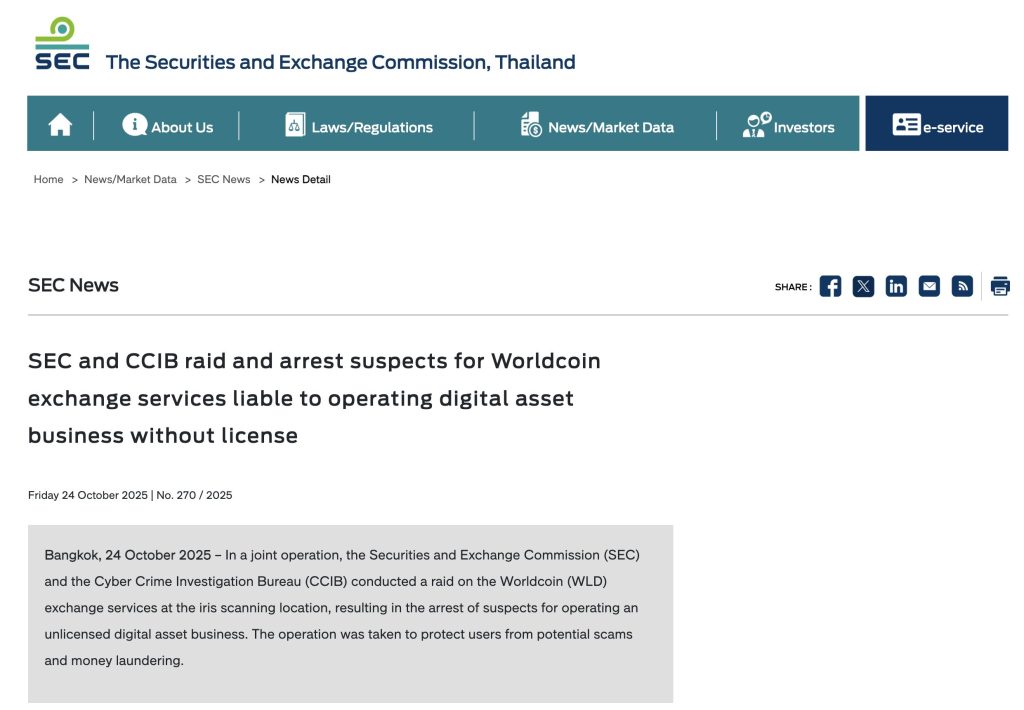
Source: Thailand SEC

According to the SEC’s statement, investigators discovered that the iris scanning hub was providing “WLD exchange services” without the required authorization under the Emergency Decree on Digital Asset Businesses B.E. 2561 (2018).

The operators were allegedly facilitating token exchanges linked to Worldcoin’s native cryptocurrency, WLD, in violation of licensing laws.

The SEC said the arrests were made under Section 26 of the decree, which prohibits the operation of digital asset businesses without a license, with penalties prescribed under Section 66.

The law enforcement officials said the move was intended to protect users from potential scams and prevent money laundering through unregulated crypto exchanges.

At the joint press briefing, SEC Deputy Secretary-General Jomkwan Kongsakul said the operation marks a broader effort to tighten oversight of unlicensed digital asset activity.

“This collaboration will enhance the effectiveness of law enforcement in prosecuting and suppressing unlicensed digital asset businesses, while protecting users from a lack of legal protection and mitigating risks of scams and money laundering,” she stated.

The raid followed weeks of surveillance by the SEC’s monitoring unit, which has been tracking several unlicensed operators across Thailand.

The agency had previously issued public warnings against exchanging WLD tokens with unlicensed providers and urged the public to verify operator licenses through the official SEC website and its Check First application.

Officials reiterated that users dealing with unauthorized operators are not covered by legal protection and face high risks of fraud and data misuse.

Worldcoin Faces Mounting Global Scrutiny as Thailand Joins Enforcement Wave

Worldcoin, now rebranded as World Network, was launched in 2023 by OpenAI CEO Sam Altman and Alex Blania as a biometric identity verification project that rewards users with WLD tokens for verifying their “humanness” through iris scans.

The verification process, carried out using a chrome sphere device known as the Orb, captures iris images to generate a unique digital ID, or World ID.

The platform operates over 1,100 Orb devices globally, including more than 100 locations across Thailand.

Source: World website

Users receive WLD tokens after completing verification, which they can exchange through the World App.

According to the World website, it only issues WLD tokens to users who complete verification in regions where such activity is legally permitted.

The project notes that eligibility for token distribution depends on several factors, including location and age restrictions.

However, some local sites have reportedly gone further, providing token exchange services without the necessary licenses, an activity now under investigation.

Thailand’s enforcement action places it among a growing list of countries confronting Worldcoin’s practices.

Regulators in Spain, Portugal, Brazil, and Kenya have suspended or restricted the project’s operations, citing violations of data protection laws and concerns about the handling of sensitive biometric information.

In Kenya, a High Court ruling in May ordered the deletion of all biometric data collected from citizens, describing Worldcoin’s consent practices as “invalid” due to monetary inducements.

European regulators have also intervened. Portugal’s data protection commission followed with a 90-day ban, while Germany imposed corrective measures to bring the project in line with EU privacy regulations under the General Data Protection Regulation (GDPR).

In Brazil, authorities banned the exchange of biometric data for crypto rewards in early 2024, ruling that such incentives compromise users’ ability to give free and informed consent.

Also, France, Portugal, Spain, Hong Kong, and South Korea have all launched investigations into the project’s data practices.

Worldcoin Rolls Out New Security and ID Tools—But Can It Regain Confidence?

Worldcoin’s parent company, Tools for Humanity, has responded by developing a new Secure Multi-Party Computation (SMPC) system in 2024 that splits and encrypts iris data across multiple storage points.

In October 2024, the project also unveiled a redesigned version of its Orb device that integrates 5G connectivity and enhanced AI processing powered by NVIDIA’s Jetson chipset.

It also features 30% fewer parts and a removable SD card for inspection, a change intended to improve transparency and address privacy concerns.

To reduce reliance on biometric verification, World Network introduced a non-biometric option that allows users to verify identity using passports with NFC, confirming details like nationality and age without sharing personal data.

The company claims the system eliminates the risk of decryption from a single source and says old iris codes are being deleted as part of a privacy upgrade.

Despite growing regulatory resistance, Worldcoin’s global presence continues to expand. The project recently launched its World ID service in the United States and the Philippines; currently, it has now surpassed 100 million verifications across 160 countries.

The World App now counts more than 37 million users, with over 1,000 Orb devices active worldwide.

WLD Token Source: CoinGecko

Still, Worldcoin’s token has struggled to maintain market confidence amid ongoing legal challenges. WLD, which once traded as high as $11.74 in March 2024, currently hovers around $0.88, down over 90% from its peak.

Piyasa Fırsatı
Notcoin Logosu
Notcoin Fiyatı(NOT)
$0.000532
$0.000532$0.000532
-1.66%
USD
Notcoin (NOT) Canlı Fiyat Grafiği
Sorumluluk Reddi: Bu sitede yeniden yayınlanan makaleler, halka açık platformlardan alınmıştır ve yalnızca bilgilendirme amaçlıdır. MEXC'nin görüşlerini yansıtmayabilir. Tüm hakları telif sahiplerine aittir. Herhangi bir içeriğin üçüncü taraf haklarını ihlal ettiğini düşünüyorsanız, kaldırılması için lütfen service@support.mexc.com ile iletişime geçin. MEXC, içeriğin doğruluğu, eksiksizliği veya güncelliği konusunda hiçbir garanti vermez ve sağlanan bilgilere dayalı olarak alınan herhangi bir eylemden sorumlu değildir. İçerik, finansal, yasal veya diğer profesyonel tavsiye niteliğinde değildir ve MEXC tarafından bir tavsiye veya onay olarak değerlendirilmemelidir.

Ayrıca Şunları da Beğenebilirsiniz

The Channel Factories We’ve Been Waiting For

The Channel Factories We’ve Been Waiting For

The post The Channel Factories We’ve Been Waiting For appeared on BitcoinEthereumNews.com. Visions of future technology are often prescient about the broad strokes while flubbing the details. The tablets in “2001: A Space Odyssey” do indeed look like iPads, but you never see the astronauts paying for subscriptions or wasting hours on Candy Crush.  Channel factories are one vision that arose early in the history of the Lightning Network to address some challenges that Lightning has faced from the beginning. Despite having grown to become Bitcoin’s most successful layer-2 scaling solution, with instant and low-fee payments, Lightning’s scale is limited by its reliance on payment channels. Although Lightning shifts most transactions off-chain, each payment channel still requires an on-chain transaction to open and (usually) another to close. As adoption grows, pressure on the blockchain grows with it. The need for a more scalable approach to managing channels is clear. Channel factories were supposed to meet this need, but where are they? In 2025, subnetworks are emerging that revive the impetus of channel factories with some new details that vastly increase their potential. They are natively interoperable with Lightning and achieve greater scale by allowing a group of participants to open a shared multisig UTXO and create multiple bilateral channels, which reduces the number of on-chain transactions and improves capital efficiency. Achieving greater scale by reducing complexity, Ark and Spark perform the same function as traditional channel factories with new designs and additional capabilities based on shared UTXOs.  Channel Factories 101 Channel factories have been around since the inception of Lightning. A factory is a multiparty contract where multiple users (not just two, as in a Dryja-Poon channel) cooperatively lock funds in a single multisig UTXO. They can open, close and update channels off-chain without updating the blockchain for each operation. Only when participants leave or the factory dissolves is an on-chain transaction…
Paylaş
BitcoinEthereumNews2025/09/18 00:09
SOLANA NETWORK Withstands 6 Tbps DDoS Without Downtime

SOLANA NETWORK Withstands 6 Tbps DDoS Without Downtime

The post SOLANA NETWORK Withstands 6 Tbps DDoS Without Downtime appeared on BitcoinEthereumNews.com. In a pivotal week for crypto infrastructure, the Solana network
Paylaş
BitcoinEthereumNews2025/12/16 20:44
Crucial Fed Rate Cut: October Probability Surges to 94%

Crucial Fed Rate Cut: October Probability Surges to 94%

BitcoinWorld Crucial Fed Rate Cut: October Probability Surges to 94% The financial world is buzzing with a significant development: the probability of a Fed rate cut in October has just seen a dramatic increase. This isn’t just a minor shift; it’s a monumental change that could ripple through global markets, including the dynamic cryptocurrency space. For anyone tracking economic indicators and their impact on investments, this update from the U.S. interest rate futures market is absolutely crucial. What Just Happened? Unpacking the FOMC Statement’s Impact Following the latest Federal Open Market Committee (FOMC) statement, market sentiment has decisively shifted. Before the announcement, the U.S. interest rate futures market had priced in a 71.6% chance of an October rate cut. However, after the statement, this figure surged to an astounding 94%. This jump indicates that traders and analysts are now overwhelmingly confident that the Federal Reserve will lower interest rates next month. Such a high probability suggests a strong consensus emerging from the Fed’s latest communications and economic outlook. A Fed rate cut typically means cheaper borrowing costs for businesses and consumers, which can stimulate economic activity. But what does this really signify for investors, especially those in the digital asset realm? Why is a Fed Rate Cut So Significant for Markets? When the Federal Reserve adjusts interest rates, it sends powerful signals across the entire financial ecosystem. A rate cut generally implies a more accommodative monetary policy, often enacted to boost economic growth or combat deflationary pressures. Impact on Traditional Markets: Stocks: Lower interest rates can make borrowing cheaper for companies, potentially boosting earnings and making stocks more attractive compared to bonds. Bonds: Existing bonds with higher yields might become more valuable, but new bonds will likely offer lower returns. Dollar Strength: A rate cut can weaken the U.S. dollar, making exports cheaper and potentially benefiting multinational corporations. Potential for Cryptocurrency Markets: The cryptocurrency market, while often seen as uncorrelated, can still react significantly to macro-economic shifts. A Fed rate cut could be interpreted as: Increased Risk Appetite: With traditional investments offering lower returns, investors might seek higher-yielding or more volatile assets like cryptocurrencies. Inflation Hedge Narrative: If rate cuts are perceived as a precursor to inflation, assets like Bitcoin, often dubbed “digital gold,” could gain traction as an inflation hedge. Liquidity Influx: A more accommodative monetary environment generally means more liquidity in the financial system, some of which could flow into digital assets. Looking Ahead: What Could This Mean for Your Portfolio? While the 94% probability for a Fed rate cut in October is compelling, it’s essential to consider the nuances. Market probabilities can shift, and the Fed’s ultimate decision will depend on incoming economic data. Actionable Insights: Stay Informed: Continue to monitor economic reports, inflation data, and future Fed statements. Diversify: A diversified portfolio can help mitigate risks associated with sudden market shifts. Assess Risk Tolerance: Understand how a potential rate cut might affect your specific investments and adjust your strategy accordingly. This increased likelihood of a Fed rate cut presents both opportunities and challenges. It underscores the interconnectedness of traditional finance and the emerging digital asset space. Investors should remain vigilant and prepared for potential volatility. The financial landscape is always evolving, and the significant surge in the probability of an October Fed rate cut is a clear signal of impending change. From stimulating economic growth to potentially fueling interest in digital assets, the implications are vast. Staying informed and strategically positioned will be key as we approach this crucial decision point. The market is now almost certain of a rate cut, and understanding its potential ripple effects is paramount for every investor. Frequently Asked Questions (FAQs) Q1: What is the Federal Open Market Committee (FOMC)? A1: The FOMC is the monetary policymaking body of the Federal Reserve System. It sets the federal funds rate, which influences other interest rates and economic conditions. Q2: How does a Fed rate cut impact the U.S. dollar? A2: A rate cut typically makes the U.S. dollar less attractive to foreign investors seeking higher returns, potentially leading to a weakening of the dollar against other currencies. Q3: Why might a Fed rate cut be good for cryptocurrency? A3: Lower interest rates can reduce the appeal of traditional investments, encouraging investors to seek higher returns in alternative assets like cryptocurrencies. It can also be seen as a sign of increased liquidity or potential inflation, benefiting assets like Bitcoin. Q4: Is a 94% probability a guarantee of a rate cut? A4: While a 94% probability is very high, it is not a guarantee. Market probabilities reflect current sentiment and data, but the Federal Reserve’s final decision will depend on all available economic information leading up to their meeting. Q5: What should investors do in response to this news? A5: Investors should stay informed about economic developments, review their portfolio diversification, and assess their risk tolerance. Consider how potential changes in interest rates might affect different asset classes and adjust strategies as needed. Did you find this analysis helpful? Share this article with your network to keep others informed about the potential impact of the upcoming Fed rate cut and its implications for the financial markets! To learn more about the latest crypto market trends, explore our article on key developments shaping Bitcoin price action. This post Crucial Fed Rate Cut: October Probability Surges to 94% first appeared on BitcoinWorld.
Paylaş
Coinstats2025/09/18 02:25