Sooho․IO and Chainlink launch Project Namsan to cut foreign exchange costs with a stablecoin-based voucher system in Korea. Pilot with Grand Korea Leisure shows tourists saved over 30% on exchange fees using digital won vouchers backed by stablecoins. Project Namsan has been launched in Korea by Sooho․IO in partnership with Chainlink to test a stablecoin [...]]]>Sooho․IO and Chainlink launch Project Namsan to cut foreign exchange costs with a stablecoin-based voucher system in Korea. Pilot with Grand Korea Leisure shows tourists saved over 30% on exchange fees using digital won vouchers backed by stablecoins. Project Namsan has been launched in Korea by Sooho․IO in partnership with Chainlink to test a stablecoin [...]]]>

Chainlink and Sooho․IO Power Korea’s Stablecoin FX Innovation Under Project Namsan

2025/09/23 12:55
  • Sooho․IO and Chainlink launch Project Namsan to cut foreign exchange costs with a stablecoin-based voucher system in Korea.
  • Pilot with Grand Korea Leisure shows tourists saved over 30% on exchange fees using digital won vouchers backed by stablecoins.

Project Namsan has been launched in Korea by Sooho․IO in partnership with Chainlink to test a stablecoin system that can reduce the cost of foreign exchange. The project has already carried out a live pilot with foreign tourists who exchanged dollar-based stablecoins for Korean won vouchers, cutting costs by more than 30% compared to traditional channels.

Project Namsan Pilot and Early Results

The pilot program began in July and was supported by Grand Korea Leisure (GKL), a public corporation that runs the “Seven Luck” casinos, which cater to international visitors. GKL welcomes about 1.5 million foreign guests each year and was chosen as a key partner to test how the vouchers work in real settings.

Tourists taking part deposited U.S. dollar stablecoins and received Korean won vouchers that could be used for payments. This test showed that using stablecoins as the base currency can lower the high fees usually tied to money exchange. 
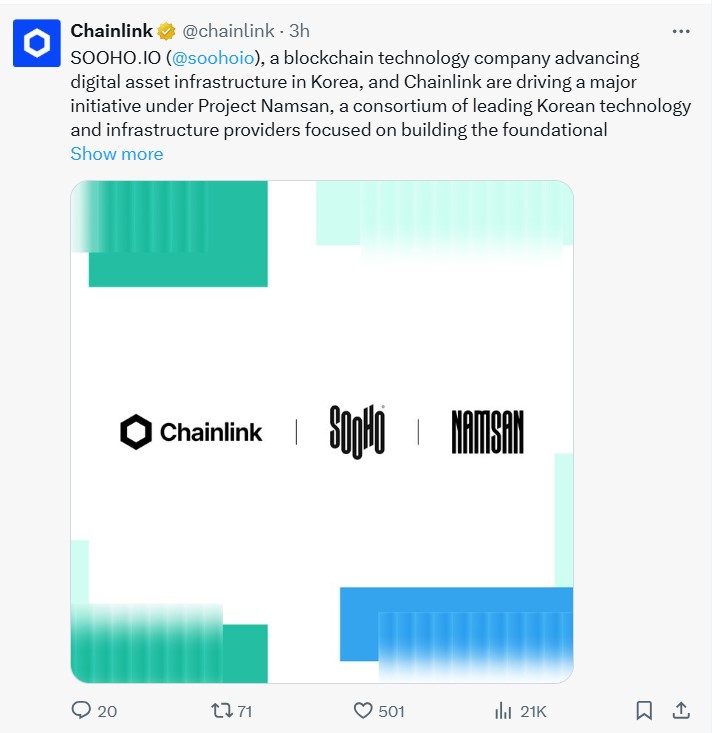
Chainlink and Sooho.IOChainlink and Sooho.IO Partnership | Source: Chainlink

Interestingly, Sooho․IO has been active in building digital money systems in Korea, including earlier work with the Bank of Korea on Purpose Bound Money, which sets rules on how digital tokens can be used. Project Namsan extends that work, with Chainlink providing the technical systems needed for security and reliability.

It is worth mentioning that this partnership coincides with Chainlink co-founder’s recent comments on digital assets. As noted in our earlier post, Sergey Nazarov stated that the U.S. Securities and Exchange Commission is shifting its stance on the crypto market. 

It also comes in the season of major news for the project. As we reported last week, the Saudi Awwal Bank has selected the Chainlink network to deploy on-chain applications in Saudi Arabia.

Chainlink’s Cross-Chain Interoperability Protocol (CCIP) connects Project Namsan to different blockchains, while its Proof of Reserve service checks that stablecoin reserves exist before vouchers are issued. This ensures that every Korean won voucher is backed by actual stablecoins, creating a system of trust for both users and institutions. 

According to the update, the model is known as Delivery-vs-Payment, which means transactions are only completed once reserves are confirmed. Chainlink’s tools already support global decentralized finance networks and have verified trillions of dollars in value since 2022. 

In addition, by applying these systems in Korea, the project sets a clear path for stablecoin use in real markets. Jisu Park, CEO of Sooho․IO, said the collaboration proves that Korean technology is gaining global recognition and stressed the role of the company as a clearing and settlement partner for Asia-Pacific institutions. 

Also, Niki Ariyasinghe, Chainlink’s Head of Business Development for Asia-Pacific and the Middle East, said the project shows how verifiable data and interoperability can support stablecoin use in Korea’s financial system.

With the pilot completed, Project Namsan is being viewed as an early step toward broader use of stablecoins in Korea and across Asia. Notably, while this partnership adds to the recent growth of the project ecosystem, CNF reported that Chainlink, through buybacks, has added more than 43,000 LINK to reserves, boosting market confidence.

]]>
Piyasa Fırsatı
IO Logosu
IO Fiyatı(IO)
$0.168
$0.168$0.168
+1.20%
USD
IO (IO) Canlı Fiyat Grafiği
Sorumluluk Reddi: Bu sitede yeniden yayınlanan makaleler, halka açık platformlardan alınmıştır ve yalnızca bilgilendirme amaçlıdır. MEXC'nin görüşlerini yansıtmayabilir. Tüm hakları telif sahiplerine aittir. Herhangi bir içeriğin üçüncü taraf haklarını ihlal ettiğini düşünüyorsanız, kaldırılması için lütfen service@support.mexc.com ile iletişime geçin. MEXC, içeriğin doğruluğu, eksiksizliği veya güncelliği konusunda hiçbir garanti vermez ve sağlanan bilgilere dayalı olarak alınan herhangi bir eylemden sorumlu değildir. İçerik, finansal, yasal veya diğer profesyonel tavsiye niteliğinde değildir ve MEXC tarafından bir tavsiye veya onay olarak değerlendirilmemelidir.

Ayrıca Şunları da Beğenebilirsiniz

The Channel Factories We’ve Been Waiting For
The Channel Factories We’ve Been Waiting For

The post The Channel Factories We’ve Been Waiting For appeared on BitcoinEthereumNews.com. Visions of future technology are often prescient about the broad strokes while flubbing the details. The tablets in “2001: A Space Odyssey” do indeed look like iPads, but you never see the astronauts paying for subscriptions or wasting hours on Candy Crush.  Channel factories are one vision that arose early in the history of the Lightning Network to address some challenges that Lightning has faced from the beginning. Despite having grown to become Bitcoin’s most successful layer-2 scaling solution, with instant and low-fee payments, Lightning’s scale is limited by its reliance on payment channels. Although Lightning shifts most transactions off-chain, each payment channel still requires an on-chain transaction to open and (usually) another to close. As adoption grows, pressure on the blockchain grows with it. The need for a more scalable approach to managing channels is clear. Channel factories were supposed to meet this need, but where are they? In 2025, subnetworks are emerging that revive the impetus of channel factories with some new details that vastly increase their potential. They are natively interoperable with Lightning and achieve greater scale by allowing a group of participants to open a shared multisig UTXO and create multiple bilateral channels, which reduces the number of on-chain transactions and improves capital efficiency. Achieving greater scale by reducing complexity, Ark and Spark perform the same function as traditional channel factories with new designs and additional capabilities based on shared UTXOs.  Channel Factories 101 Channel factories have been around since the inception of Lightning. A factory is a multiparty contract where multiple users (not just two, as in a Dryja-Poon channel) cooperatively lock funds in a single multisig UTXO. They can open, close and update channels off-chain without updating the blockchain for each operation. Only when participants leave or the factory dissolves is an on-chain transaction…
Paylaş
BitcoinEthereumNews2025/09/18 00:09
XRP Price Prediction: Can Ripple Rally Past $2 Before the End of 2025?

XRP Price Prediction: Can Ripple Rally Past $2 Before the End of 2025?

The post XRP Price Prediction: Can Ripple Rally Past $2 Before the End of 2025? appeared first on Coinpedia Fintech News The XRP price has come under enormous pressure
Paylaş
CoinPedia2025/12/16 19:22
BlackRock boosts AI and US equity exposure in $185 billion models

BlackRock boosts AI and US equity exposure in $185 billion models

The post BlackRock boosts AI and US equity exposure in $185 billion models appeared on BitcoinEthereumNews.com. BlackRock is steering $185 billion worth of model portfolios deeper into US stocks and artificial intelligence. The decision came this week as the asset manager adjusted its entire model suite, increasing its equity allocation and dumping exposure to international developed markets. The firm now sits 2% overweight on stocks, after money moved between several of its biggest exchange-traded funds. This wasn’t a slow shuffle. Billions flowed across multiple ETFs on Tuesday as BlackRock executed the realignment. The iShares S&P 100 ETF (OEF) alone brought in $3.4 billion, the largest single-day haul in its history. The iShares Core S&P 500 ETF (IVV) collected $2.3 billion, while the iShares US Equity Factor Rotation Active ETF (DYNF) added nearly $2 billion. The rebalancing triggered swift inflows and outflows that realigned investor exposure on the back of performance data and macroeconomic outlooks. BlackRock raises equities on strong US earnings The model updates come as BlackRock backs the rally in American stocks, fueled by strong earnings and optimism around rate cuts. In an investment letter obtained by Bloomberg, the firm said US companies have delivered 11% earnings growth since the third quarter of 2024. Meanwhile, earnings across other developed markets barely touched 2%. That gap helped push the decision to drop international holdings in favor of American ones. Michael Gates, lead portfolio manager for BlackRock’s Target Allocation ETF model portfolio suite, said the US market is the only one showing consistency in sales growth, profit delivery, and revisions in analyst forecasts. “The US equity market continues to stand alone in terms of earnings delivery, sales growth and sustainable trends in analyst estimates and revisions,” Michael wrote. He added that non-US developed markets lagged far behind, especially when it came to sales. This week’s changes reflect that position. The move was made ahead of the Federal…
Paylaş
BitcoinEthereumNews2025/09/18 01:44