

Is Quantum Computing A Threat To Bitcoin? ARK Invest Breaks It Down

A new research paper from ARK Invest and Unchained examines one of the most persistent questions in Bitcoin: whether advances in quantum computing could eventually break it’s cryptography.
The authors conclude that while the technology represents a legitimate long-term concern, it does not pose an immediate threat to the network. Published March 11 and authored by Dhruv Bansal, Tom Honzik and David Puell, the report argues that current quantum systems remain far from the capabilities required to compromise Bitcoin’s cryptographic foundations.
Bitcoin Quantum Threat Is Distant, Not Immediate
The paper’s central thesis is straightforward: quantum computing represents a real but gradual risk.
“Our two central arguments are as follows,” the authors write. “Quantum is a long-term risk but not an imminent threat. The community must continue to research and make plans for protecting the network as quantum computers improve.”
They add that even if breakthroughs occur, exploiting them against Bitcoin would be costly and slow. “If quantum computing were to affect Bitcoin’s cryptography, the process would be protracted and undertaken at meaningful cost to the attacker.”
In practical terms, the report notes that today’s machines fall well short of the scale needed to attack the elliptic-curve cryptography used by Bitcoin keys. Current devices operate in what researchers call the “NISQ era,” characterized by limited logical qubits and high error rates.
Breaking Bitcoin’s cryptography would require significantly more advanced systems. “To do so would require at least 2,330 logical qubits and tens of millions to billions of quantum gates,” the authors write, far beyond the roughly hundred-qubit systems typical today.
Rather than a sudden technological shock, the paper outlines a staged progression toward any meaningful threat. The authors describe a series of milestones in quantum development. Early stages involve experimental systems with limited commercial usefulness. Later phases would see applications in fields like chemistry or materials science long before cryptographic attacks become viable.
Only in more advanced stages would quantum computers become capable of breaking elliptic-curve cryptography — and even then the process could take longer than Bitcoin’s roughly 10-minute block interval. The researchers emphasize that this gradual progression would create numerous warning signals. “In our view, quantum development will be a gradual technological progression—not a sudden ‘Q-day’ event—giving markets and the Bitcoin network time to adapt.”
The implication is that the broader internet security ecosystem would likely face disruption before Bitcoin specifically becomes vulnerable. “Meaningful breakthroughs would disrupt internet security first,” the paper states, “triggering coordinated responses well beyond Bitcoin.”
The report also estimates how much bitcoin could theoretically be vulnerable if large-scale quantum attacks became feasible. According to the analysis, roughly 1.7 million BTC stored in older P2PK address types are considered exposed but likely lost. Another 5.2 million BTC sit in address formats that could be migrated if necessary.
Combined, the authors estimate that roughly 35% of the total outstanding supply could theoretically face quantum exposure in its current form. However, because many of those coins are inactive or capable of being moved to safer address types, the researchers frame the issue as manageable rather than catastrophic.
Governance And Upgrades Remain Open Questions
While the technical threat may be distant, the report highlights governance challenges that could emerge if the ecosystem eventually needs to adopt post-quantum cryptography. Upgrading Bitcoin’s cryptographic primitives would require consensus changes, meaning coordination across developers, miners, node operators, and the broader community.
The authors also raise unresolved questions around coins whose public keys are already exposed on-chain. “There is no consensus about protecting coins that remain vulnerable to quantum,” the report notes, pointing to ongoing debates about whether such coins should be migrated, restricted, or treated as recoverable by quantum attackers.
The researchers ultimately frame the issue as a long-range engineering problem rather than a near-term existential risk. “Quantum risk will evolve over an extended period of time, with many intermediate warning signals and decision points,” the authors conclude. “An abrupt single point of failure is unlikely.”
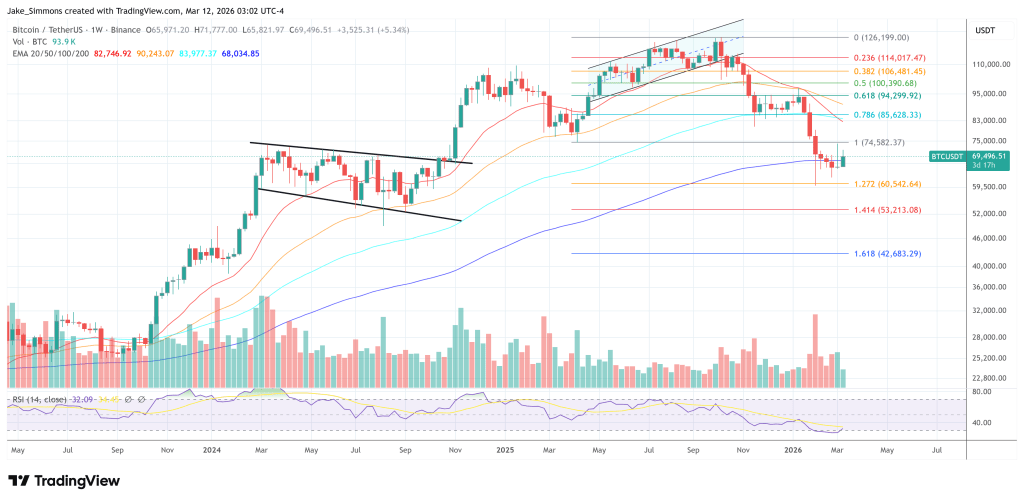
At press time, Bitcoin traded at $69,496.
You May Also Like

Tether Backs Ark Labs’ $5.2 Million Bet on Bitcoin’s Stablecoin Revival

Why LYNO’s Presale Could Trigger the Next Wave of Crypto FOMO After SOL and PEPE
