

Crude Prices Spike Past $100 Mark Following Iraq Tanker Strikes and Oman Terminal Shutdown
TLDR
- Brent crude temporarily exceeded $101/barrel on Thursday before closing near $98, gaining 6.6% for the session
- Tanker strikes in Iraqi territorial waters of the Persian Gulf resulted in at least one fatality
- Oman conducted a precautionary evacuation of all ships from its Mina Al Fahal export facility
- Beijing implemented a March ban on refined petroleum product exports to secure domestic supplies
- The IEA unveiled an unprecedented 400 million barrel strategic reserve deployment to stabilize markets
Crude benchmarks experienced another sharp rally on Thursday as fresh tanker strikes and terminal shutdowns intensified concerns over Middle Eastern petroleum supplies.
Brent crude climbed to an intraday peak of $101.59 per barrel during early trading before retreating to approximately $98. West Texas Intermediate advanced more than 6% to reach $92.61. These moves follow earlier weekly highs approaching $120 for both contracts.
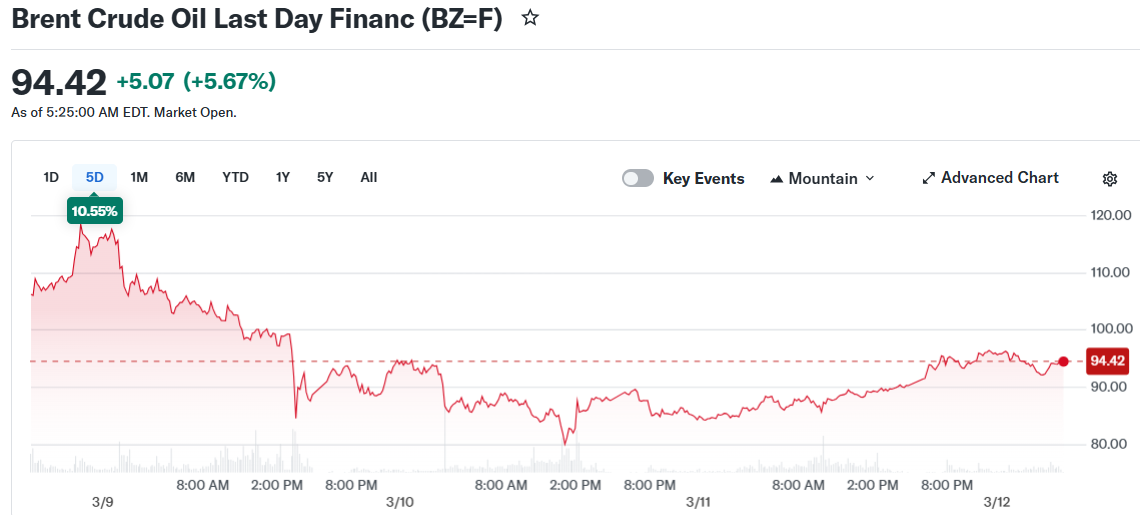 Brent Crude Oil Last Day Financ (BZ=F)
Tanker strikes occurred in the northern Persian Gulf within Iraqi territorial waters. Footage circulating on social media platforms depicted the vessels engulfed in flames. According to Iraqi port director Farhan al-Fartousi speaking with The Wall Street Journal, the attacks claimed one sailor’s life while emergency crews worked to extract remaining personnel. Baghdad subsequently suspended operations at all its petroleum export facilities.
Separately, Muscat ordered a complete evacuation of vessels from its Mina Al Fahal export facility as a protective measure following the series of regional maritime incidents. The terminal represents one of the limited remaining channels for Middle Eastern petroleum to access international markets. Normal operations resumed later.
The Strait of Hormuz, a critical chokepoint handling approximately 20% of worldwide petroleum flows, remains essentially impassable. Tehran has declared that no crude shipments will transit the waterway. The blockade has compelled Gulf producers such as Iraq, Kuwait, and Saudi Arabia to reduce production levels.
China Tightens Fuel Export Curbs
Beijing imposed an immediate prohibition on refined petroleum product exports throughout March. Chinese refining operations have also begun withdrawing from previously agreed gasoline and diesel export contracts. The nation’s leading processors had already received instructions to halt negotiations for new supply agreements.
Goldman Sachs cautioned that oil prices might surpass the 2008 record of $147.50 per barrel should Hormuz restrictions persist into late March.
ANZ research analysts argued that markets continue to underestimate the probable length of supply interruptions. “After a conflict moves past its immediate shock period, petroleum markets typically transition from uncertainty pricing to endurance pricing,” their analysis stated.
Emergency Reserve Releases Limit Further Gains
The International Energy Agency is coordinating an unprecedented deployment of 400 million barrels from member nation strategic stockpiles. President Donald Trump announced Wednesday that America would contribute 172 million barrels from the Strategic Petroleum Reserve.
The regional confrontation reached its thirteenth straight day on Thursday without clear resolution prospects. Tehran stated that any ceasefire arrangement would necessitate commitments from both Washington and Tel Aviv against further military action targeting Iran. The United States has not accepted those conditions.
Weekly U.S. petroleum inventory figures published Wednesday revealed a larger-than-forecast increase of 3.8 million barrels during the previous reporting period.
The post Crude Prices Spike Past $100 Mark Following Iraq Tanker Strikes and Oman Terminal Shutdown appeared first on Blockonomi.
You May Also Like

U.S. Dollar Surges: Critical Analysis as Oil Prices Skyrocket Past $100 a Barrel

Virginia Financial Educators Council Selects Ramona Jones, CEO of Jeunibe Financial Advisory, as Advisory Board Member
