Personal Loan Industry Statistics 2026: Growth Insights

In recent years, the personal loan industry has undergone a significant transformation, driven by the need for accessible credit, rising consumer demand, and advancements in digital lending. Personal loans have become a crucial financial tool for many, enabling individuals to meet various needs, from debt consolidation to major purchases.
Understanding the current state of the personal loan industry is essential for consumers, lenders, and financial strategists alike. This article dives deep into the latest statistics, trends, and insights shaping this evolving landscape.
Editor’s Choice
- Total outstanding personal loan debt in the United States is $276 billion, about 1.5% of all consumer debt.
- The average personal loan balance per borrower is $11,699.
- Average personal loan interest rates are 13.14% for 3-year terms and 17.33% for 5-year terms.
- About 26.4 million Americans currently hold a personal loan.
- Personal loan balances grew 10.0% year-over-year, from $251 billion to $276 billion.
- Personal loan debt represents 5.3% of all nonhousing consumer debt.
- The delinquency rate (60+ days past due) for personal loans is 3.99%, up from 3.57% a year earlier.
Recent Developments
- The global peer-to-peer lending market is projected to grow 24.68% annually from $222.9 billion in 2026 to $1,602.5 billion by 2035.
- The U.S. peer-to-peer lending market is set to expand at a 24.55% CAGR, from $41.6 billion in 2025 to $373.6 billion by 2035.
- Banks extending green and sustainable loan incentives can exceed the standard single borrower limit by an additional 15%, supporting more climate-focused lending.
- Consumer credit overall is growing at an annual rate of 1.9%, with revolving credit up 4.3% and nonrevolving credit up 0.5%.
- AI-driven fraud models have delivered up to a 260% uplift in fraud-detection rates versus traditional rules-based systems.
- AI-enabled systems now automatically approve about 83% of low-risk transactions while doubling fraud detection in the highest-risk segments.
- Overall, consumer credit delinquencies rose to about 1.13%, nearly matching the 1.15% pre-pandemic level and prompting tighter lending standards.
Personal Loans Market Size
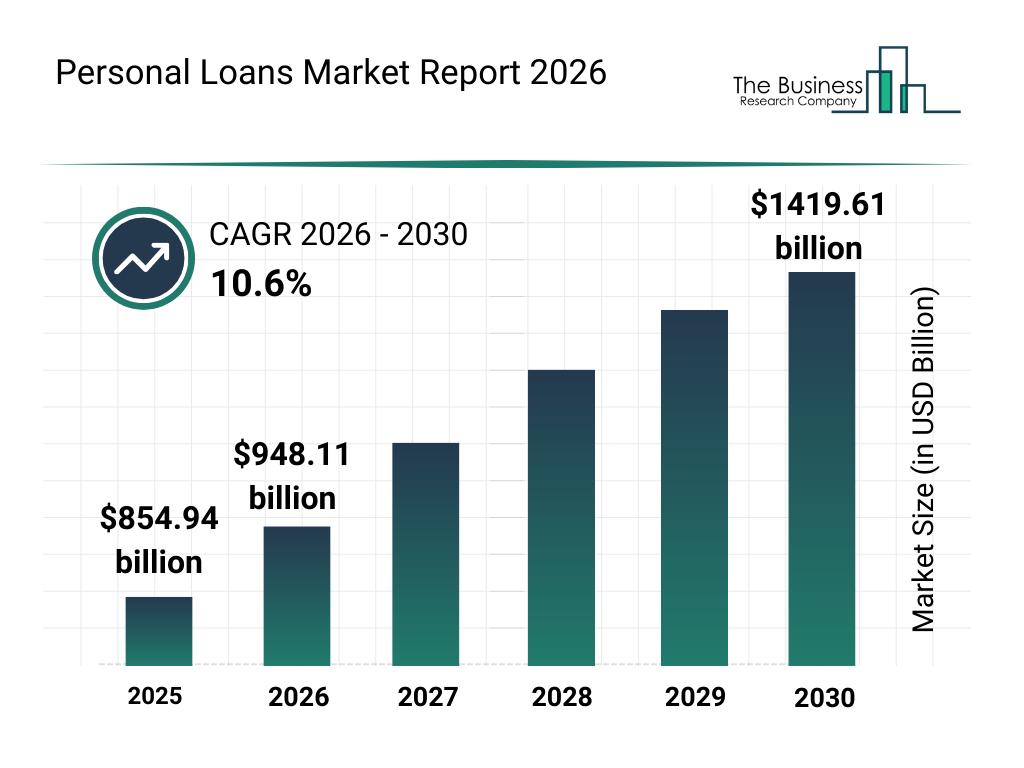
- The global personal loans market reached $854.94 billion in 2025, showing strong demand for consumer lending services worldwide.
- The market is expected to grow to $948.11 billion in 2026, reflecting the rising adoption of digital lending platforms and personal finance tools.
- By 2027, the personal loans market may reach $1,048.61 billion, crossing the $1 trillion milestone for the first time.
- The market could expand further to about $1,159.78 billion in 2028, driven by increased borrowing for consolidation, emergencies, and large purchases.
- In 2029, the industry may grow to around $1,282.71 billion, as fintech lenders continue expanding access to credit globally.
- By 2030, the global personal loans market may reach $1,419.61 billion, highlighting strong long-term growth in consumer lending.
- Overall, the market is projected to grow at a 10.6% CAGR from 2026 to 2030, indicating steady expansion across banks, fintech platforms, and digital lenders.
 (Reference: The Business Research Company)
Breakdown of Outstanding Consumer Debt
- Mortgages total $13.46 trillion, accounting for about 72% of U.S. consumer debt.
- Auto loans stand at $1.685 trillion, roughly 9% of total consumer debt.
- Student loans are about $1.33 trillion, or approximately 7% of total consumer debt.
- Credit card balances reach $1.12 trillion, representing around 6% of total consumer debt.
- Personal loan debt is $154.3 billion, accounting for about 1% of total consumer debt.
- All other consumer debts combined make up the remaining 5–6% of outstanding balances.
Total Personal Loan Debt Over Time
- Outstanding personal loan debt in the U.S. reached $276 billion in Q4 2025, a 10.0% year-over-year increase from $251 billion.
- Total unsecured personal loan debt hit a record $276 billion in Q4 2025, up sharply from pandemic-era lows in 2020–2021.
- The average personal loan balance per borrower is $11,699, up from $11,116 in Q4 2022.
- Personal loans account for 1.5% of total outstanding consumer debt and 5.3% of nonhousing consumer debt.
- About 26.4 million Americans have a personal loan, up from 24.5 million a year earlier.
- Around 3.99% of personal loan accounts are 60+ days past due, up from 3.57% a year earlier.
- Average unsecured personal loan balances are $11,690 in early 2026, compared with $11,608 a year prior.
- The average interest rate on a 24‑month personal loan from commercial banks is 11.65%.
Personal Loan Borrower Credit Score
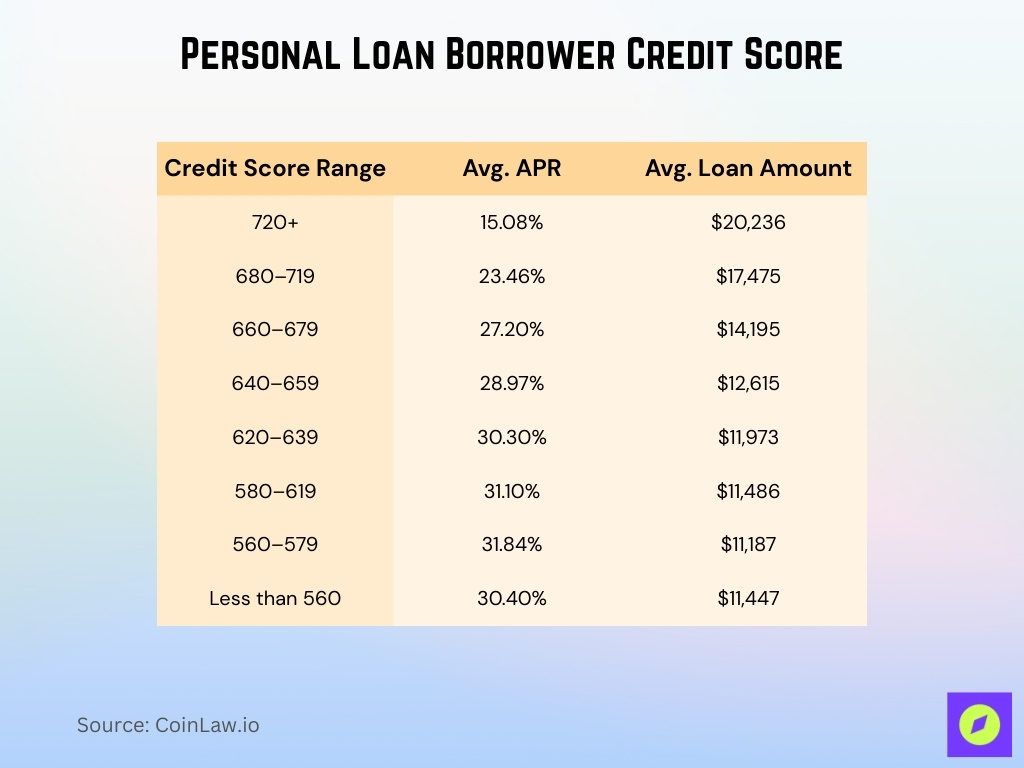
- Borrowers with a credit score of 720+ receive the lowest average APR of 15.08% and borrow about $20,236 on average, the highest loan amount among all credit groups.
- Consumers with a credit score of 680–719 pay an average APR of 23.46% and take personal loans averaging around $17,475.
- Borrowers in the 660–679 credit score range face an average APR of 27.20% and typically borrow about $14,195.
- People with a credit score of 640–659 pay roughly 28.97% average APR, with an average loan size of $12,615.
- Individuals with a 620–639 credit score see average interest rates of 30.30% APR and borrow about $11,973 on average.
- Borrowers with a 580–619 credit score pay around 31.10% APR and take loans averaging $11,486.
- Consumers with credit scores of 560–579 experience the highest average APR at 31.84%, with an average loan amount of $11,187.
- Borrowers with credit scores below 560 still receive personal loans with an average APR of 30.40% and an average loan size of $11,447.
 (Reference: Lending Tree)
Average Personal Loan Interest Rates
- The current average personal loan interest rate is 12.26% for a 3-year loan to a borrower with a 700 FICO score.
- The median lowest advertised rate across major lenders is 8.38%, with the lowest available rate at 6.20%.
- Personal loan APRs on major marketplaces generally range from about 6.25% to 36%, depending on credit profile and term.
- Average personal loan rates on 3-year marketplace loans are 13.14% APR, down from 14.02% a year ago.
- Average personal loan rates on 5-year marketplace loans are 17.33% APR, down from 18.79% a year ago.
- Commercial bank personal loans average 12.06% APR for a 3-year unsecured term.
- The average APR on a 24‑month personal loan at commercial banks is 11.65%.
- Excellent-credit borrowers tend to secure rates around 10–15% APR on 3‑ and 5‑year loans, while bad‑credit borrowers often face 32–36% APR.
Key Considerations in Choosing Between Secured and Unsecured Loans
- 47% of personal loan borrowers say interest rate is the single most important factor when choosing a loan.
- Around 28% of borrowers prioritize repayment tenure and monthly affordability over other loan features.
- About 15% of borrowers highlight brand trust and lender reputation as a key deciding factor.
- Roughly 6% of borrowers focus primarily on fees and processing charges when comparing loans.
- An estimated 4% of borrowers say collateral and asset-risk considerations are their main concern.
- Only about 3% of borrowers cite formal credit score requirements as the top factor in their loan decision.
Loan Balances and Debt Levels
- The average personal loan balance per borrower is $11,699, up from $11,607 a year earlier.
- Super-prime borrowers carry average personal loan balances of $17,577.
- The average unsecured personal loan balance across all borrowers is $11,690.
- More than 51.4% of borrowers use personal loans primarily to consolidate debt or refinance credit cards.
- New unsecured personal loan accounts open with an average balance of about $6,700.
- Prime and prime‑plus borrowers average personal loan balances of $13,249 and $16,811, respectively.
- Near-prime borrowers have average balances of $9,376, while all borrowers together average $11,690.
Personal Loan Statistics by State
- Total U.S. personal loan debt is $276 billion, with California, Texas, and Florida together accounting for about 30% of outstanding balances.
- Average personal loan balances rose the fastest in West Virginia (32.4%), Indiana (19.7%), and Kansas (19.1%) year-over-year.
- Washington’s average personal loan balance climbed 14.1%, from $3,618 to $4,128, between Q3 2024 and Q3 2025.
- Nebraska and Kentucky saw strong growth, with average balances up 12.4% and 9.9%, respectively.
- Florida’s average personal loan balance increased 8.3%, while Texas posted a 3.8% rise over the same period.
- California’s average personal loan balance increased 4.2%, from $3,773 to $3,933.
- New Jersey and Michigan recorded notable declines in average personal loan balances of 8.4% and 9.4%, respectively.
- Louisiana’s average personal loan balance edged up 2.1% to $5,275, among the highest dollar amounts nationwide.
Personal Loan Statistics by Age and Generation
- Baby Boomers hold the highest average personal loan balance at about $22,551, up from $20,370 two years earlier.
- Generation X average balances are around $22,259, rising from $18,922 in 2021.
- Millennials carry balances averaging $16,669, up from $13,418 in 2021.
- Gen Z maintains the lowest average balances at approximately $8,710, up from $6,658 in 2021.
- The average unsecured personal loan balance across all generations is $11,699, up from a peak of $11,829 in early 2024.
- About 26.4 million consumers hold an unsecured personal loan balance, with Gen Z showing the fastest growth in participation.
Major Reasons for Personal Loan Use
- 38% of borrowers cite debt consolidation or refinancing high-interest debt as their primary reason for taking a personal loan.
- About 15% plan to use a personal loan for home improvement or renovation projects.
- Roughly 12% use personal loans mainly to cover emergency or everyday expenses such as bills and cash-flow gaps.
- Around 10% borrow to finance large planned purchases, including appliances, electronics, or furniture.
- Approximately 8–9% of personal loan users report using funds for auto-related expenses, including repairs or down payments.
- Medical bills, weddings, vacations, and other lifestyle events together account for about 10–12% of anticipated personal loan use.
Loan Delinquency and Default Rates
- Personal loan delinquency (60+ days past due) is 3.49% in 2025.
- Subprime borrowers show significantly higher delinquency rates compared to the overall average.
- States such as Louisiana and West Virginia record delinquency rates near 5%.
- The overall default rate for personal loans has improved, supported by better risk assessment tools.
- Digital lenders report slightly lower delinquency at around 2.9%.
- Longer-term loans over 48 months carry higher default risks than shorter-term loans.
- Unsecured personal loans have delinquency rates of about 3.5%, compared with 2% for secured loans.
Technological Advancements and Digitalization of Loan Products
- The global digital lending market is valued at about $566.52 billion, up from $507.27 billion a year earlier.
- The global digital lending platform segment alone is projected to grow from $19.27 billion to $23.8 billion year-over-year, a 23.5% CAGR.
- Consumer loans account for about 60.78% of digital lending volume, with SMEs the fastest‑growing segment at a 16.08% CAGR.
- The global digital lending platform market is forecast to reach $55.87 billion by 2030, nearly 2.3 times its current size.
- AI- and ML-enabled digital lending platforms help cut loan processing costs by 35–50% and reduce decision time from 5–10 days to 24–48 hours.
- Advanced AI underwriting can reduce credit losses by 15–25% through earlier delinquency prediction and targeted interventions.
- About 67% of retail lenders have implemented or will implement generative AI strategies in lending workflows by year‑end.
- The digital lending platform market is projected to grow to about $39.8 billion by 2033, with North America holding more than 31.2% of the share.
Frequently Asked Questions (FAQs)
Americans owe a record $276 billion in unsecured personal loan debt as of Q4 2025.
About 26.4 million Americans have a personal loan as of Q4 2025.
The average unsecured personal loan balance per borrower is $11,699 in early 2026.
Personal loans account for about 1.5% of total outstanding consumer debt and 5.3% of nonhousing consumer debt.
Conclusion
The personal loan industry today is marked by steady growth, technological advancement, and enhanced accessibility. Borrowers today have diverse options tailored to their financial needs, whether it’s for debt consolidation, home improvements, or emergency expenses. Meanwhile, lenders continue to innovate with digital tools, AI, and flexible offerings that cater to changing consumer behaviors.
With a competitive landscape shaped by both traditional banks and digital platforms, the industry is poised to provide more accessible, efficient, and customer-centric solutions. As the market evolves, borrowers and lenders alike must stay informed about trends and emerging options to make the most of personal loan products in a rapidly shifting financial environment.
The post Personal Loan Industry Statistics 2026: Growth Insights appeared first on CoinLaw.
You May Also Like

Unlimit Appoints Irene Skrynova as CEO, Global Payments

Economic policies are chasing investors away from US – Mercer