Flashbots, a leading research group focused on MEV ( Maximal Extractable Value ), has issued a new warning that spam from MEV bots is quickly becoming the main barrier to blockchain scalability. In a thesis published this week, Flashbots said that “MEV has become the dominant limit to scaling blockchains,” pointing to rising inefficiencies across Ethereum rollups and Solana. The group stated that current scaling efforts by major blockchains are being neutralized by increasingly dominant MEV-driven activity. Flashbots Exposes Scaling Illusion on Rollups As layer-1 and layer-2 networks race to boost throughput, the report finds that wasteful on-chain activity from MEV bots is consuming a growing share of available capacity. On Solana, MEV bots are now responsible for 40% of all blockspace . On Ethereum’s OP-Stack rollups like Base and OP Mainnet, spam bots account for over half of all gas usage while paying just a fraction of the network’s fees. Failed transactions consume a disproportionate share of network Compute Units (CUs) relative to the fees they generate. Arb bots are a key factor: their failed txs make up ~40% of _all_ CUs used but only ~7% of total fees paid pic.twitter.com/RJl2O65l2n — chris (@chrischang43) May 17, 2025 The report noted that between November 2024 and February 2025, Base added 11 million gas units per second of throughput, nearly triple the Ethereum mainnet. However, most of that additional capacity was devoured by bots running repetitive, low-value trades. This activity creates artificially high fees for users and renders technical scaling efforts less effective. Flashbots introduced a new metric, “effective gas throughput,” to show the difference. Despite Base increasing its total gas capacity by 11 million gas per second over several months, the throughput available to real users barely changed. Almost all new capacity was eaten up by bots. The report identified spam as a specific kind of wasteful behavior, mostly DEX queries that never result in token transfers. These could be done off-chain, but instead they clog networks and raise the computational load on nodes. On Base, bots were responsible for 56% of gas usage and 26% of L1 data availability usage, but paid just 14% of fees. Spam is also driving up user fees. Flashbots explained that despite technical progress in reducing costs on rollups, fees stay artificially high due to bots continuously bidding for blockspace. “The promise of scaling is to drive fees near zero,” the report stated. “But what we’re seeing is a fee floor created by spam—not user demand.” The report also showed that this spam is highly concentrated. Just two searchers are behind over 80% of all spam on Base. According to Flashbots, the structure of the current market makes spam more profitable than participating in a fair auction, leading to inefficient and wasteful outcomes. “Spam bots are flooding blocks, not to serve users, but to extract MEV,” the report said. “It’s a structural issue, not just a technical one.” Flashbots Proposes MEV Auction Fix Amid Rising Exploits Flashbots has proposed a new framework to address growing concerns around MEV exploitation in Ethereum and other blockchain networks. Rather than relying on gas-heavy spam auctions, Flashbots suggests a shift toward explicit MEV auctions, allowing searchers to bid directly for transaction ordering rights. This, they argue, would reduce network congestion and wasted fees while preserving efficiency for traders and validators. The organization is also advocating for “programmable privacy,” a model that allows bots to view live blockchain state and plan profitable trades without the ability to front-run users or leak sensitive data. Flashbots is currently testing this concept using Trusted Execution Environments (TEEs), which allow secure transaction backrunning without the back-run transactions to abuse. “We’ve proven this on Ethereum L1,” Flashbots wrote in its latest report. “And we’re actively adapting it for L2s.” The proposal comes at a key time as concerns over MEV-related abuse continue to mount. According to EigenPhi data, more than 33,000 users were victims of sandwich attacks in March 2025, orchestrated by just 101 entities. These attacks now account for nearly $1 billion in weekly trading volume on Ethereum-based DEXs. In 2023, a single MEV searcher earned over $1 million in one day using sandwich attacks on Ethereum. On that day alone, the address accounted for 7% of total gas usage across the network. The same operator continued to profit into 2024 with improved strategies. The issue isn’t limited to Ethereum. On Solana, a well-known MEV bot named “arsc” exploited users through similar tactics, generating around $30 million in just two months. MEV allows validators to extract profits by reordering or inserting transactions. While it can boost DeFi efficiency, it also drives up fees and undermines fairness, especially for beginners unfamiliar with blockchain mechanics. Critics warn that unchecked MEV practices could deter user adoption and erode trust in decentralized finance .Flashbots, a leading research group focused on MEV ( Maximal Extractable Value ), has issued a new warning that spam from MEV bots is quickly becoming the main barrier to blockchain scalability. In a thesis published this week, Flashbots said that “MEV has become the dominant limit to scaling blockchains,” pointing to rising inefficiencies across Ethereum rollups and Solana. The group stated that current scaling efforts by major blockchains are being neutralized by increasingly dominant MEV-driven activity. Flashbots Exposes Scaling Illusion on Rollups As layer-1 and layer-2 networks race to boost throughput, the report finds that wasteful on-chain activity from MEV bots is consuming a growing share of available capacity. On Solana, MEV bots are now responsible for 40% of all blockspace . On Ethereum’s OP-Stack rollups like Base and OP Mainnet, spam bots account for over half of all gas usage while paying just a fraction of the network’s fees. Failed transactions consume a disproportionate share of network Compute Units (CUs) relative to the fees they generate. Arb bots are a key factor: their failed txs make up ~40% of _all_ CUs used but only ~7% of total fees paid pic.twitter.com/RJl2O65l2n — chris (@chrischang43) May 17, 2025 The report noted that between November 2024 and February 2025, Base added 11 million gas units per second of throughput, nearly triple the Ethereum mainnet. However, most of that additional capacity was devoured by bots running repetitive, low-value trades. This activity creates artificially high fees for users and renders technical scaling efforts less effective. Flashbots introduced a new metric, “effective gas throughput,” to show the difference. Despite Base increasing its total gas capacity by 11 million gas per second over several months, the throughput available to real users barely changed. Almost all new capacity was eaten up by bots. The report identified spam as a specific kind of wasteful behavior, mostly DEX queries that never result in token transfers. These could be done off-chain, but instead they clog networks and raise the computational load on nodes. On Base, bots were responsible for 56% of gas usage and 26% of L1 data availability usage, but paid just 14% of fees. Spam is also driving up user fees. Flashbots explained that despite technical progress in reducing costs on rollups, fees stay artificially high due to bots continuously bidding for blockspace. “The promise of scaling is to drive fees near zero,” the report stated. “But what we’re seeing is a fee floor created by spam—not user demand.” The report also showed that this spam is highly concentrated. Just two searchers are behind over 80% of all spam on Base. According to Flashbots, the structure of the current market makes spam more profitable than participating in a fair auction, leading to inefficient and wasteful outcomes. “Spam bots are flooding blocks, not to serve users, but to extract MEV,” the report said. “It’s a structural issue, not just a technical one.” Flashbots Proposes MEV Auction Fix Amid Rising Exploits Flashbots has proposed a new framework to address growing concerns around MEV exploitation in Ethereum and other blockchain networks. Rather than relying on gas-heavy spam auctions, Flashbots suggests a shift toward explicit MEV auctions, allowing searchers to bid directly for transaction ordering rights. This, they argue, would reduce network congestion and wasted fees while preserving efficiency for traders and validators. The organization is also advocating for “programmable privacy,” a model that allows bots to view live blockchain state and plan profitable trades without the ability to front-run users or leak sensitive data. Flashbots is currently testing this concept using Trusted Execution Environments (TEEs), which allow secure transaction backrunning without the back-run transactions to abuse. “We’ve proven this on Ethereum L1,” Flashbots wrote in its latest report. “And we’re actively adapting it for L2s.” The proposal comes at a key time as concerns over MEV-related abuse continue to mount. According to EigenPhi data, more than 33,000 users were victims of sandwich attacks in March 2025, orchestrated by just 101 entities. These attacks now account for nearly $1 billion in weekly trading volume on Ethereum-based DEXs. In 2023, a single MEV searcher earned over $1 million in one day using sandwich attacks on Ethereum. On that day alone, the address accounted for 7% of total gas usage across the network. The same operator continued to profit into 2024 with improved strategies. The issue isn’t limited to Ethereum. On Solana, a well-known MEV bot named “arsc” exploited users through similar tactics, generating around $30 million in just two months. MEV allows validators to extract profits by reordering or inserting transactions. While it can boost DeFi efficiency, it also drives up fees and undermines fairness, especially for beginners unfamiliar with blockchain mechanics. Critics warn that unchecked MEV practices could deter user adoption and erode trust in decentralized finance .

MEV Bots Now Clog Blockchains Faster Than They Can Scale, Flashbots Warns – Is Raw Throughput Obsolete?

4 min read

Flashbots, a leading research group focused on MEV (Maximal Extractable Value), has issued a new warning that spam from MEV bots is quickly becoming the main barrier to blockchain scalability.

In a thesis published this week, Flashbots said that “MEV has become the dominant limit to scaling blockchains,” pointing to rising inefficiencies across Ethereum rollups and Solana.

The group stated that current scaling efforts by major blockchains are being neutralized by increasingly dominant MEV-driven activity.

Flashbots Exposes Scaling Illusion on Rollups

As layer-1 and layer-2 networks race to boost throughput, the report finds that wasteful on-chain activity from MEV bots is consuming a growing share of available capacity.

On Solana, MEV bots are now responsible for 40% of all blockspace. On Ethereum’s OP-Stack rollups like Base and OP Mainnet, spam bots account for over half of all gas usage while paying just a fraction of the network’s fees.

The report noted that between November 2024 and February 2025, Base added 11 million gas units per second of throughput, nearly triple the Ethereum mainnet. However, most of that additional capacity was devoured by bots running repetitive, low-value trades.

This activity creates artificially high fees for users and renders technical scaling efforts less effective. Flashbots introduced a new metric, “effective gas throughput,” to show the difference.
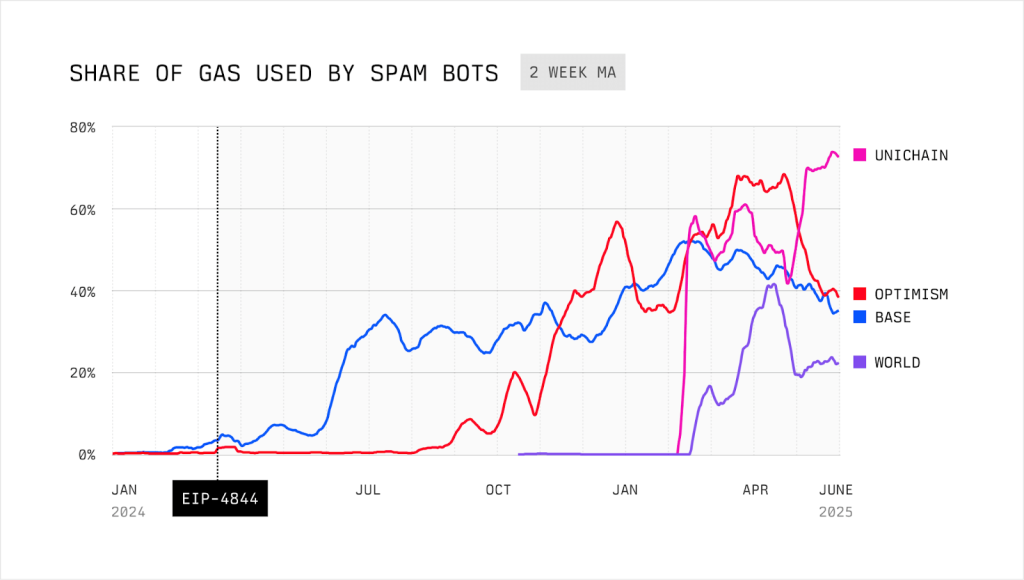
Despite Base increasing its total gas capacity by 11 million gas per second over several months, the throughput available to real users barely changed. Almost all new capacity was eaten up by bots.

The report identified spam as a specific kind of wasteful behavior, mostly DEX queries that never result in token transfers. These could be done off-chain, but instead they clog networks and raise the computational load on nodes.

On Base, bots were responsible for 56% of gas usage and 26% of L1 data availability usage, but paid just 14% of fees.

Spam is also driving up user fees. Flashbots explained that despite technical progress in reducing costs on rollups, fees stay artificially high due to bots continuously bidding for blockspace.

“The promise of scaling is to drive fees near zero,” the report stated. “But what we’re seeing is a fee floor created by spam—not user demand.”

The report also showed that this spam is highly concentrated. Just two searchers are behind over 80% of all spam on Base.

According to Flashbots, the structure of the current market makes spam more profitable than participating in a fair auction, leading to inefficient and wasteful outcomes.

“Spam bots are flooding blocks, not to serve users, but to extract MEV,” the report said. “It’s a structural issue, not just a technical one.”

Flashbots Proposes MEV Auction Fix Amid Rising Exploits

Flashbots has proposed a new framework to address growing concerns around MEV exploitation in Ethereum and other blockchain networks. Rather than relying on gas-heavy spam auctions, Flashbots suggests a shift toward explicit MEV auctions, allowing searchers to bid directly for transaction ordering rights.

This, they argue, would reduce network congestion and wasted fees while preserving efficiency for traders and validators.

The organization is also advocating for “programmable privacy,” a model that allows bots to view live blockchain state and plan profitable trades without the ability to front-run users or leak sensitive data.

Flashbots is currently testing this concept using Trusted Execution Environments (TEEs), which allow secure transaction backrunning without the back-run transactions to abuse.

“We’ve proven this on Ethereum L1,” Flashbots wrote in its latest report. “And we’re actively adapting it for L2s.”

The proposal comes at a key time as concerns over MEV-related abuse continue to mount. According to EigenPhi data, more than 33,000 users were victims of sandwich attacks in March 2025, orchestrated by just 101 entities.

These attacks now account for nearly $1 billion in weekly trading volume on Ethereum-based DEXs.

In 2023, a single MEV searcher earned over $1 million in one day using sandwich attacks on Ethereum. On that day alone, the address accounted for 7% of total gas usage across the network. The same operator continued to profit into 2024 with improved strategies.

The issue isn’t limited to Ethereum. On Solana, a well-known MEV bot named “arsc” exploited users through similar tactics, generating around $30 million in just two months.

MEV allows validators to extract profits by reordering or inserting transactions. While it can boost DeFi efficiency, it also drives up fees and undermines fairness, especially for beginners unfamiliar with blockchain mechanics.

Critics warn that unchecked MEV practices could deter user adoption and erode trust in decentralized finance.

Market Opportunity
NEAR Logo
NEAR Price(NEAR)
$1.16
$1.16$1.16
+1.13%
USD
NEAR (NEAR) Live Price Chart
Disclaimer: The articles reposted on this site are sourced from public platforms and are provided for informational purposes only. They do not necessarily reflect the views of MEXC. All rights remain with the original authors. If you believe any content infringes on third-party rights, please contact service@support.mexc.com for removal. MEXC makes no guarantees regarding the accuracy, completeness, or timeliness of the content and is not responsible for any actions taken based on the information provided. The content does not constitute financial, legal, or other professional advice, nor should it be considered a recommendation or endorsement by MEXC.

You May Also Like

Securities Fraud Investigation Into Corcept Therapeutics Incorporated (CORT) Announced – Shareholders Who Lost Money Urged To Contact Glancy Prongay Wolke & Rotter LLP, a Leading Securities Fraud Law Firm

Securities Fraud Investigation Into Corcept Therapeutics Incorporated (CORT) Announced – Shareholders Who Lost Money Urged To Contact Glancy Prongay Wolke & Rotter LLP, a Leading Securities Fraud Law Firm

LOS ANGELES–(BUSINESS WIRE)–Glancy Prongay Wolke & Rotter LLP, a leading national shareholder rights law firm, today announced that it has commenced an investigation
Share
AI Journal2026/02/05 04:00
Microsoft Corp. $MSFT blue box area offers a buying opportunity

Microsoft Corp. $MSFT blue box area offers a buying opportunity

The post Microsoft Corp. $MSFT blue box area offers a buying opportunity appeared on BitcoinEthereumNews.com. In today’s article, we’ll examine the recent performance of Microsoft Corp. ($MSFT) through the lens of Elliott Wave Theory. We’ll review how the rally from the April 07, 2025 low unfolded as a 5-wave impulse followed by a 3-swing correction (ABC) and discuss our forecast for the next move. Let’s dive into the structure and expectations for this stock. Five wave impulse structure + ABC + WXY correction $MSFT 8H Elliott Wave chart 9.04.2025 In the 8-hour Elliott Wave count from Sep 04, 2025, we saw that $MSFT completed a 5-wave impulsive cycle at red III. As expected, this initial wave prompted a pullback. We anticipated this pullback to unfold in 3 swings and find buyers in the equal legs area between $497.02 and $471.06 This setup aligns with a typical Elliott Wave correction pattern (ABC), in which the market pauses briefly before resuming its primary trend. $MSFT 8H Elliott Wave chart 7.14.2025 The update, 10 days later, shows the stock finding support from the equal legs area as predicted allowing traders to get risk free. The stock is expected to bounce towards 525 – 532 before deciding if the bounce is a connector or the next leg higher. A break into new ATHs will confirm the latter and can see it trade higher towards 570 – 593 area. Until then, traders should get risk free and protect their capital in case of a WXY double correction. Conclusion In conclusion, our Elliott Wave analysis of Microsoft Corp. ($MSFT) suggested that it remains supported against April 07, 2025 lows and bounce from the blue box area. In the meantime, keep an eye out for any corrective pullbacks that may offer entry opportunities. By applying Elliott Wave Theory, traders can better anticipate the structure of upcoming moves and enhance risk management in volatile markets. Source: https://www.fxstreet.com/news/microsoft-corp-msft-blue-box-area-offers-a-buying-opportunity-202509171323
Share
BitcoinEthereumNews2025/09/18 03:50
Over 80% of 135 Ethereum L2s record below 1 user operation per second

Over 80% of 135 Ethereum L2s record below 1 user operation per second

The post Over 80% of 135 Ethereum L2s record below 1 user operation per second  appeared on BitcoinEthereumNews.com. Ethereum’s L2s are not doing too well. Data
Share
BitcoinEthereumNews2026/02/05 03:52
