The post The 2025 Spam Wars Are Becoming a ‘Serious Threat’ to Bitcoin appeared on BitcoinEthereumNews.com. If you’ve been in Bitcoin for more than a minute, you’ve probably heard people compare today’s “Spam Wars” to the infamous Blocksize Wars almost a decade ago. The energy, the vitriol, the tribalism; it’s all back in force, only this time, instead of arguing over block sizes, the battlefield is OP_RETURN and the growing divide between Bitcoin Core and Knots. How the Spam Wars Began The roots of the Spam Wars date back to 2023. That’s when Ordinals burst onto the scene. They enabled anyone to embed digital art, NFTs, and other types of data right onto Bitcoin’s blockchain. Many heralded Ordinals for unleashing all kinds of innovations on Bitcoin. Some foresaw the problem of spam and bloat on the chain driving up transaction fees for everyday users. In early 2025, the Spam Wars moved up another gear. Bitcoin Core developers unveiled plans to scrap the 80-byte OP_RETURN limit in their upcoming v30 release. They were hoping to make Bitcoin more versatile for new kinds of on-chain activity. To many on the Core side, as long as transaction fees are paid, any use of Bitcoin is fair game. But not everyone shares that vision. Luke Dashjr, long-time Bitcoin developer and lead maintainer of Bitcoin Knots, sees the shift less as open experimentation and more as a massive red flag. To him, lifting the limits is an open invitation for spam, which would turn Bitcoin into a data dumpster for non-financial junk and threaten its role as money. Knots is quickly becoming the rallying point for critics who believe Core is surrendering Bitcoin’s neutrality, and as tensions rise, more node operators are starting to flock over: Knots’ share of the network has hit 18.5%. What’s Really at Stake At its heart, the Spam Wars are not about one line of code… The post The 2025 Spam Wars Are Becoming a ‘Serious Threat’ to Bitcoin appeared on BitcoinEthereumNews.com. If you’ve been in Bitcoin for more than a minute, you’ve probably heard people compare today’s “Spam Wars” to the infamous Blocksize Wars almost a decade ago. The energy, the vitriol, the tribalism; it’s all back in force, only this time, instead of arguing over block sizes, the battlefield is OP_RETURN and the growing divide between Bitcoin Core and Knots. How the Spam Wars Began The roots of the Spam Wars date back to 2023. That’s when Ordinals burst onto the scene. They enabled anyone to embed digital art, NFTs, and other types of data right onto Bitcoin’s blockchain. Many heralded Ordinals for unleashing all kinds of innovations on Bitcoin. Some foresaw the problem of spam and bloat on the chain driving up transaction fees for everyday users. In early 2025, the Spam Wars moved up another gear. Bitcoin Core developers unveiled plans to scrap the 80-byte OP_RETURN limit in their upcoming v30 release. They were hoping to make Bitcoin more versatile for new kinds of on-chain activity. To many on the Core side, as long as transaction fees are paid, any use of Bitcoin is fair game. But not everyone shares that vision. Luke Dashjr, long-time Bitcoin developer and lead maintainer of Bitcoin Knots, sees the shift less as open experimentation and more as a massive red flag. To him, lifting the limits is an open invitation for spam, which would turn Bitcoin into a data dumpster for non-financial junk and threaten its role as money. Knots is quickly becoming the rallying point for critics who believe Core is surrendering Bitcoin’s neutrality, and as tensions rise, more node operators are starting to flock over: Knots’ share of the network has hit 18.5%. What’s Really at Stake At its heart, the Spam Wars are not about one line of code…

The 2025 Spam Wars Are Becoming a ‘Serious Threat’ to Bitcoin

If you’ve been in Bitcoin for more than a minute, you’ve probably heard people compare today’s “Spam Wars” to the infamous Blocksize Wars almost a decade ago.

The energy, the vitriol, the tribalism; it’s all back in force, only this time, instead of arguing over block sizes, the battlefield is OP_RETURN and the growing divide between Bitcoin Core and Knots.

How the Spam Wars Began

The roots of the Spam Wars date back to 2023. That’s when Ordinals burst onto the scene. They enabled anyone to embed digital art, NFTs, and other types of data right onto Bitcoin’s blockchain.

Many heralded Ordinals for unleashing all kinds of innovations on Bitcoin. Some foresaw the problem of spam and bloat on the chain driving up transaction fees for everyday users.

In early 2025, the Spam Wars moved up another gear. Bitcoin Core developers unveiled plans to scrap the 80-byte OP_RETURN limit in their upcoming v30 release.

They were hoping to make Bitcoin more versatile for new kinds of on-chain activity. To many on the Core side, as long as transaction fees are paid, any use of Bitcoin is fair game.

But not everyone shares that vision. Luke Dashjr, long-time Bitcoin developer and lead maintainer of Bitcoin Knots, sees the shift less as open experimentation and more as a massive red flag.

To him, lifting the limits is an open invitation for spam, which would turn Bitcoin into a data dumpster for non-financial junk and threaten its role as money.

Knots is quickly becoming the rallying point for critics who believe Core is surrendering Bitcoin’s neutrality, and as tensions rise, more node operators are starting to flock over: Knots’ share of the network has hit 18.5%.

What’s Really at Stake

At its heart, the Spam Wars are not about one line of code or a technical tweak. They’re about philosophy.

Is Bitcoin supposed to remain a pure monetary settlement layer, laser-focused on censorship resistance and decentralization?

Or should it embrace a wider role, serving as a canvas for experiments, art, and data, so long as users pay the costs?

Bitcoin Core’s side argues for maximum freedom. As Core developer and Libertarian Jameson Lopp posted:

Knots’ side argues that without rules to preserve Bitcoin’s monetary function, the network risks bloat and centralization. Luke Dashjr has warned:

And it’s not just Luke waving the warning flag. Samson Mow, former CSO at Blockstream and founder of Jan3, has also taken Knots’ side.

He issues a warning that allowing unbounded spam is a slippery slope that could erode Bitcoin’s resilience as a store of value.

A Serious Risk to Bitcoin?

The longer the Spam Wars drag on, the louder the voices are getting, and not all of them are aligned neatly with one camp.

Adam Back, CEO of Blockstream and a long-time Core supporter, broke ranks in tone if not substance on Friday. He cautioned that dismissing spam risk outright was the wrong move. He wrote:

Back’s comments are notable not just because of his standing but also because they hint at what’s being missed.

This isn’t just about two codebases in a vacuum but about the global perception of Bitcoin’s neutrality and purpose.

Peter Todd, another long-standing Core-aligned developer, struck an even harsher tone on Saturday, placing the blame not on Core but on Knots supporters for escalating tensions:

Where It Goes From Here

October 2025 looms large, with Bitcoin Core’s v30 release scheduled to roll out the OP_RETURN change.

How miners, node operators, and exchanges react will determine whether this remains a loud but contained civil war or tips into another chain-splitting crisis reminiscent of 2017.

The Spam Wars are no longer a niche developer squabble. With big voices weighing in, rising tribalism, and the October deadline ticking closer each day, Bitcoin may soon face its biggest ideological test since the Blocksize Wars.

Source: https://www.thecoinrepublic.com/2025/09/07/the-2025-spam-wars-are-becoming-a-serious-threat-to-bitcoin/
Market Opportunity
Gearbox Logo
Gearbox Price(GEAR)
$0.0004402
$0.0004402$0.0004402
+7.15%
USD
Gearbox (GEAR) Live Price Chart
Disclaimer: The articles reposted on this site are sourced from public platforms and are provided for informational purposes only. They do not necessarily reflect the views of MEXC. All rights remain with the original authors. If you believe any content infringes on third-party rights, please contact service@support.mexc.com for removal. MEXC makes no guarantees regarding the accuracy, completeness, or timeliness of the content and is not responsible for any actions taken based on the information provided. The content does not constitute financial, legal, or other professional advice, nor should it be considered a recommendation or endorsement by MEXC.

You May Also Like

Hadron Labs Launches Bitcoin Summer on Neutron, Offering 5–10% BTC Yield

Hadron Labs Launches Bitcoin Summer on Neutron, Offering 5–10% BTC Yield

Hadron Labs launches 'Bitcoin Summer' on Neutron, BTC vaults for WBTC, eBTC, solvBTC, uniBTC and USDC. Earn 5–10% BTC via maxBTC, with up to 10x looping.
Share
Blockchainreporter2025/09/18 02:00
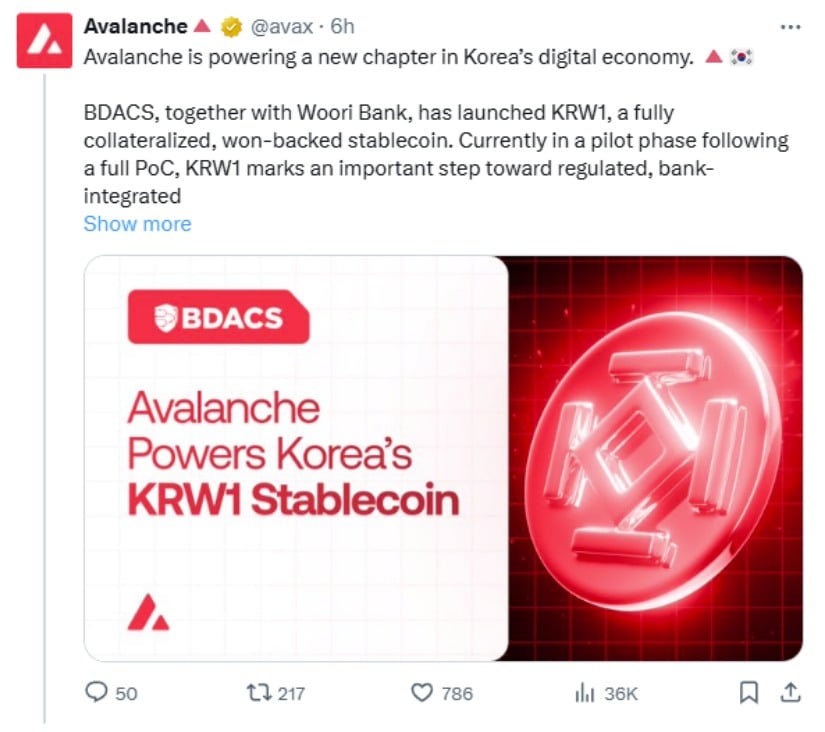
South Korea Launches First Won-Backed Stablecoin KRW1 on Avalanche

South Korea Launches First Won-Backed Stablecoin KRW1 on Avalanche

South Korea made history this week by launching its first Korean won-backed stablecoin.
Share
Brave Newcoin2025/09/19 03:15
Curve Finance votes on revenue-sharing model for CRV holders

Curve Finance votes on revenue-sharing model for CRV holders

The post Curve Finance votes on revenue-sharing model for CRV holders appeared on BitcoinEthereumNews.com. Curve Finance has proposed a new protocol called Yield Basis that would share revenue directly with CRV holders, marking a shift from one-off incentives to sustainable income. Summary Curve Finance has put forward a revenue-sharing protocol to give CRV holders sustainable income beyond emissions and fees. The plan would mint $60M in crvUSD to seed three Bitcoin liquidity pools (WBTC, cbBTC, tBTC), with 35–65% of revenue distributed to veCRV stakers. The DAO vote runs from up to Sept. 24, with the proposal seen as a major step to strengthen CRV tokenomics after past liquidity and governance challenges. Curve Finance founder Michael Egorov has introduced a proposal to give CRV token holders a more direct way to earn income, launching a system called Yield Basis that aims to turn the governance token into a sustainable, yield-bearing asset.  The proposal has been published on the Curve DAO (CRV) governance forum, with voting open until Sept. 24. A new model for CRV rewards Yield Basis is designed to distribute transparent and consistent returns to CRV holders who lock their tokens for veCRV governance rights. Unlike past incentive programs, which relied heavily on airdrops and emissions, the protocol channels income from Bitcoin-focused liquidity pools directly back to token holders. To start, Curve would mint $60 million worth of crvUSD, its over-collateralized stablecoin, with proceeds allocated across three pools — WBTC, cbBTC, and tBTC — each capped at $10 million. 25% of Yield Basis tokens would be reserved for the Curve ecosystem, and between 35% and 65% of Yield Basis’s revenue would be given to veCRV holders. By emphasizing Bitcoin (BTC) liquidity and offering yields without the short-term loss risks associated with automated market makers, the protocol hopes to draw in professional traders and institutions. Context and potential impact on Curve Finance The proposal comes as Curve continues to modify…
Share
BitcoinEthereumNews2025/09/18 14:37