Rising tensions around the Strait of Hormuz are once again forcing crypto traders to look beyond blockchain fundamentals and toward global macro risk. Roughly 20Rising tensions around the Strait of Hormuz are once again forcing crypto traders to look beyond blockchain fundamentals and toward global macro risk. Roughly 20

How an Oil Shock Could Trigger Bitcoin’s Next Liquidity Selloff

2026/03/02 02:02
3 min read

Rising tensions around the Strait of Hormuz are once again forcing crypto traders to look beyond blockchain fundamentals and toward global macro risk.

Roughly 20% of the world’s oil supply passes daily through the narrow maritime corridor between Iran and Oman. While no full closure has been confirmed, escalating military activity in the region has already pushed war-risk insurance premiums sharply higher.

Oil, Yields, and $2 Trillion in Liquidity: Why Crypto Could Be First to Crack

Premiums on oil tankers have surged more than 50%. At the same time, insurance costs for a $100 million vessel jumped from approximately $250,000 to $375,000 per voyage.

The spike in shipping risk alone, even without a formal blockade, has been enough to raise fears of supply disruption. Several analysts have suggested that crude oil could surge to $120–$130 per barrel under a prolonged disruption scenario.

For crypto markets, the implications go far beyond energy.

The Inflation-to-Liquidity Transmission

An oil spike of that magnitude would likely reignite inflation expectations just as markets have been positioning for policy easing.

Higher crude prices feed directly into transportation, manufacturing, and consumer goods costs, putting upward pressure on CPI data globally.

If inflation expectations rise, central banks, including the US Federal Reserve, may be forced to delay or scale back anticipated rate cuts. That repricing would likely push Treasury yields higher.

And yields are where crypto risk begins.

Rising yields tighten global liquidity conditions. When government bonds offer increasingly attractive returns, capital often rotates away from speculative assets. Trillions in rate-sensitive capital across bonds and equities could be repriced if yields rise materially amid renewed inflation fears.

Bitcoin has historically traded as a high-beta liquidity asset during tightening cycles. During prior periods of rising real yields, digital assets have tended to underperform as leverage unwinds and funding costs climb.

In other words, crypto does not need a geopolitical catastrophe to fall. It only needs liquidity to tighten.

Social Media Warnings Amplify Volatility

Several prominent crypto commentators have warned of an imminent spike in volatility. Posts from accounts such as DeFiTracer and 0xNobler framed the Strait of Hormuz situation as a potential macro “turning point,” outlining a chain reaction:
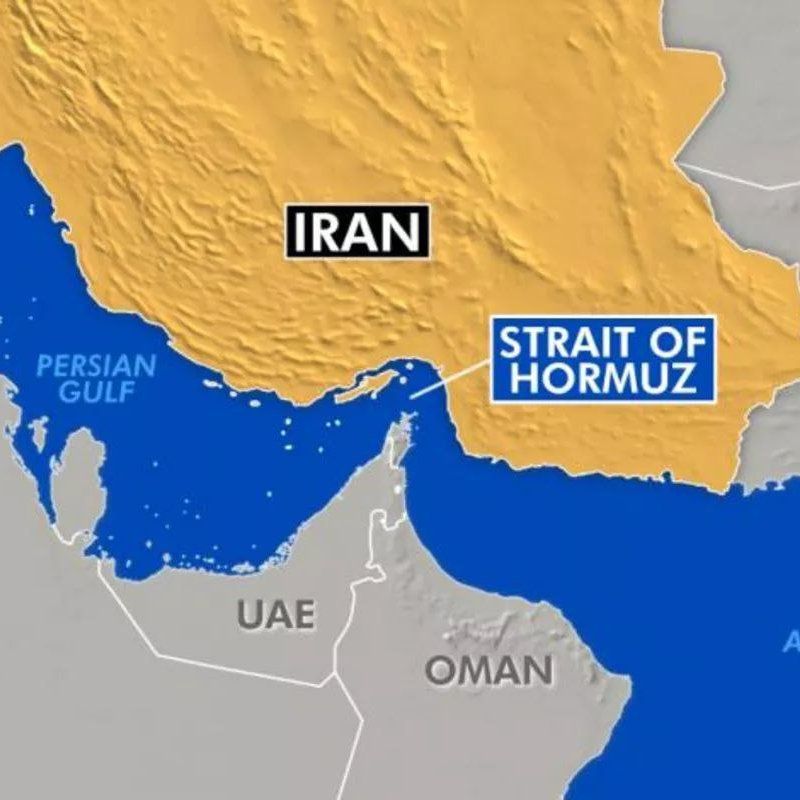
Map showing the Strait of Hormuz chokepointThe Strait of Hormuz between Iran and Oman represents a critical chokepoint for global energy supplies (CryptoRover)

Meanwhile, Merlijn the Trader introduced a secondary risk. The analyst cites a potential hashrate shock if energy infrastructure in Iran, reportedly a hub for low-cost Bitcoin mining, were disrupted.

While speculative, such narratives add to broader uncertainty around supply dynamics and network stability.

Still, not all political voices share the alarm. President Donald Trump publicly commented that he is “not concerned” about the Strait of Hormuz situation.

Markets, however, tend to respond more directly to bond yields than to political reassurance.

Crypto’s Deleveraging Risk

The structure of crypto derivatives markets adds another layer of fragility. Leverage tends to build during periods of calm, and sudden macro shocks can trigger cascading liquidations.

If Treasury yields spike alongside oil, leveraged positions across Bitcoin and altcoins could unwind quickly.

High-risk assets, including small-cap equities, high-growth tech stocks, and cryptocurrencies, are typically the first to feel pressure when liquidity tightens.

Unlike traditional markets, crypto trades 24/7, meaning reactions can be immediate and amplified.

It explains why traders are already watching crude futures and bond markets as leading indicators. A temporary de-escalation could stabilize oil and restore risk appetite.

A sustained disruption, however, could transform what begins as an energy shock into a broader liquidity event.

The coming sessions, starting Monday, may determine whether this remains geopolitical noise or becomes crypto’s next macro-driven selloff.

Market Opportunity
Notcoin Logo
Notcoin Price(NOT)
$0.0003485
$0.0003485$0.0003485
-1.77%
USD
Notcoin (NOT) Live Price Chart
Disclaimer: The articles reposted on this site are sourced from public platforms and are provided for informational purposes only. They do not necessarily reflect the views of MEXC. All rights remain with the original authors. If you believe any content infringes on third-party rights, please contact crypto.news@mexc.com for removal. MEXC makes no guarantees regarding the accuracy, completeness, or timeliness of the content and is not responsible for any actions taken based on the information provided. The content does not constitute financial, legal, or other professional advice, nor should it be considered a recommendation or endorsement by MEXC.

You May Also Like

Is Putnam Global Technology A (PGTAX) a strong mutual fund pick right now?

Is Putnam Global Technology A (PGTAX) a strong mutual fund pick right now?

The post Is Putnam Global Technology A (PGTAX) a strong mutual fund pick right now? appeared on BitcoinEthereumNews.com. On the lookout for a Sector – Tech fund? Starting with Putnam Global Technology A (PGTAX – Free Report) should not be a possibility at this time. PGTAX possesses a Zacks Mutual Fund Rank of 4 (Sell), which is based on various forecasting factors like size, cost, and past performance. Objective We note that PGTAX is a Sector – Tech option, and this area is loaded with many options. Found in a wide number of industries such as semiconductors, software, internet, and networking, tech companies are everywhere. Thus, Sector – Tech mutual funds that invest in technology let investors own a stake in a notoriously volatile sector, but with a much more diversified approach. History of fund/manager Putnam Funds is based in Canton, MA, and is the manager of PGTAX. The Putnam Global Technology A made its debut in January of 2009 and PGTAX has managed to accumulate roughly $650.01 million in assets, as of the most recently available information. The fund is currently managed by Di Yao who has been in charge of the fund since December of 2012. Performance Obviously, what investors are looking for in these funds is strong performance relative to their peers. PGTAX has a 5-year annualized total return of 14.46%, and is in the middle third among its category peers. But if you are looking for a shorter time frame, it is also worth looking at its 3-year annualized total return of 27.02%, which places it in the middle third during this time-frame. It is important to note that the product’s returns may not reflect all its expenses. Any fees not reflected would lower the returns. Total returns do not reflect the fund’s [%] sale charge. If sales charges were included, total returns would have been lower. When looking at a fund’s performance, it…
Share
BitcoinEthereumNews2025/09/18 04:05
Siren Token Sheds 16.4% After 54% Retreat From All-Time High

Siren Token Sheds 16.4% After 54% Retreat From All-Time High

Siren token experienced a sharp 16.4% decline in the past 24 hours, trading at $0.247 as the market cap contracted by $34.4 million. Our analysis of on-chain metrics
Share
Blockchainmagazine2026/03/02 05:03
Chorus One and MEV Zone Team Up to Boost Avalanche Staking Rewards

Chorus One and MEV Zone Team Up to Boost Avalanche Staking Rewards

The post Chorus One and MEV Zone Team Up to Boost Avalanche Staking Rewards appeared on BitcoinEthereumNews.com. Through the partnership with MEV Zone, Chorus One users will earn extra yield automatically. The Chorus One Avalanche node has a total stake of over 1.7 million, valued at around $55 million. This collaboration will introduce MEV Zone to both public nodes and Validator-as-a-Service. The Avalanche network stands to benefit from fairer and more efficient markets due to enhanced transparency. Chorus One, a highly decorated institutional-grade staking provider, has inked a strategic partnership with MEV Zone to enhance yield generation on the Avalanche (AVAX) network. The Chorus One partnered with MEV Zone to increase the AVAX staking yields, while simultaneously contributing to the general growth of the Avalanche network. “At Chorus One, we see this as an important step in our ongoing journey to provide robust infrastructure and innovative yield strategies for our partners and clients,” the announcement noted.  Why Did Chorus One Partner With MEV Zone? The Chorus One platform has grown to a top-tier institutional-grade staking ecosystem, with more than 40 blockchains, since 2018. In a bid to evolve with the needs of crypto investors and the supported blockchains, Chorus One has inked several strategic partnerships in the recent past, including MEV Zone. In the recent past, MEV Zone has specialized in addressing the Maximal Extractable Value (MEV) challenges on the Avalanche network. The MEV Zone will help Chorus One’s AVAX node validator to use Proposer-Builder Separation (PBS). As such, Chorus One’s AVAX node will seamlessly select certain transactions that are more profitable when making blocks. For instance, MEV Zone will help Chorus One’s AVAX node validator to capture arbitrage and liquidation transactions more often since they are more profitable.  How will Chorus One’s AVAX Stakers Benefit Via This Partnership? The Chorus One AVAX node has grown over the years to more than 1.77 million coins staked, valued…
Share
BitcoinEthereumNews2025/09/18 03:19