BitcoinWorld Crypto Liquidations: A Shocking $320 Million Vanishes in an Hour A staggering event just rocked the crypto world. In a blink, a monumental $320 million worth of futures contracts were wiped out across major exchanges in a single hour. This dramatic figure is part of an even larger trend, with a total of $568 million in futures liquidated over the past 24 hours. These sudden crypto liquidations serve as a stark reminder of the market’s intense volatility and the powerful forces at play in the digital asset space. What Exactly Are Crypto Liquidations? For those new to futures trading, understanding crypto liquidations is essential. When traders use borrowed money, known as leverage, to amplify their positions, they put up a smaller amount of their own capital as ‘margin.’ This leverage can magnify profits, but it also significantly increases risk. If the market moves against a trader’s prediction, their margin balance can fall below a certain threshold. When this happens, the exchange automatically closes their position to prevent further losses for the exchange. This forced closure is precisely what we call a crypto liquidation. It’s a rapid, automatic process that can catch many off guard. The Shocking $320 Million Plunge The recent market movements saw an astonishing $320 million in crypto liquidations occur within just sixty minutes. This rapid unwinding of positions sent immediate ripples across major exchanges, demonstrating how quickly market sentiment and prices can shift. Over a full 24-hour period, the total losses climbed even higher, reaching $568 million. Such large-scale liquidations often have several immediate impacts: Sudden Price Drops: As positions are force-closed, selling pressure increases, leading to rapid price declines. Increased Volatility: The market becomes even more unpredictable, making it challenging for traders. Heightened Fear: A wave of liquidations can trigger panic among traders, leading to further selling. Why Do Massive Crypto Liquidations Happen? Several factors contribute to such significant crypto liquidations. High leverage trading is often a primary culprit. When many traders are highly leveraged in one direction, a small price swing in the opposite direction can trigger a cascade effect. This initial trigger leads to forced selling, which further drives down prices and causes more liquidations, creating a domino effect. Other contributing factors include: Unexpected News Events: Geopolitical news, regulatory announcements, or major economic data can suddenly shift market sentiment. Large ‘Whale’ Movements: A single large investor or institution making a significant trade can impact market liquidity and price. Technical Analysis Breakdowns: When key support levels are breached, it can trigger automated selling and further liquidations. Navigating Volatile Waters: Strategies for Traders Understanding the risks associated with futures trading is crucial for anyone involved in the crypto market. While the allure of amplified returns is strong, the potential for rapid crypto liquidations is equally real. Here are some actionable strategies to help mitigate the impact of sudden market downturns: Practice Prudent Risk Management: Avoid over-leveraging. Only risk capital you can afford to lose. Implement Stop-Loss Orders: These automatic orders close your position if the price reaches a predetermined level, limiting potential losses. Diversify Your Portfolio: Do not put all your capital into a single asset or highly leveraged positions. Stay Informed: Keep abreast of market news, economic indicators, and technical analysis to make informed decisions. Understand Your Tools: Know how margin calls and liquidation thresholds work on your chosen exchange. The Broader Implications of Crypto Liquidations While painful for individual traders, these events also offer insights into the overall health and maturity of the crypto market. Frequent large crypto liquidations can indicate periods of excessive speculation or underlying market weaknesses. Conversely, they can also ‘cleanse’ the market of over-leveraged positions, potentially paving the way for more stable growth by removing weak hands and speculative froth. These episodes highlight the ongoing need for robust risk management tools and investor education within the cryptocurrency ecosystem. As the market evolves, we can expect continued discussions around responsible trading practices and regulatory frameworks to protect participants while fostering innovation. In conclusion, the recent $320 million in crypto liquidations in just one hour serves as a powerful reminder of the inherent risks and rapid shifts possible in the digital asset world. While the market offers incredible opportunities, it demands respect, careful planning, and a deep understanding of its mechanisms. By prioritizing informed decisions and sound risk management, traders can better navigate these volatile waters. Frequently Asked Questions (FAQs) What is a crypto liquidation? A crypto liquidation occurs when an exchange automatically closes a trader’s leveraged position because their margin balance has fallen below a required threshold, preventing further losses. Why are liquidations sometimes so high? High liquidations often result from a combination of excessive leverage used by many traders and sudden, significant price movements in the market that go against their leveraged positions, creating a cascade effect. Can I avoid crypto liquidations? You can significantly reduce your risk of liquidation by using lower leverage, setting stop-loss orders, managing your risk exposure carefully, and avoiding over-speculation. Does a large liquidation event mean the crypto market is crashing? Not necessarily. While large liquidations indicate significant market volatility and can lead to temporary price drops, they don’t always signal a long-term market crash. They can sometimes even ‘cleanse’ the market of over-leveraged positions, potentially leading to more stable growth. What role do exchanges play in crypto liquidations? Exchanges facilitate futures trading and are responsible for executing liquidations automatically according to their terms to protect both the platform and other market participants from unmanageable losses due to highly leveraged positions. If you found this article insightful, consider sharing it with your network! Help others understand the dynamics of crypto liquidations and how to navigate the volatile cryptocurrency market more safely. To learn more about the latest crypto market trends, explore our article on key developments shaping cryptocurrency price action. This post Crypto Liquidations: A Shocking $320 Million Vanishes in an Hour first appeared on BitcoinWorld and is written by Editorial TeamBitcoinWorld Crypto Liquidations: A Shocking $320 Million Vanishes in an Hour A staggering event just rocked the crypto world. In a blink, a monumental $320 million worth of futures contracts were wiped out across major exchanges in a single hour. This dramatic figure is part of an even larger trend, with a total of $568 million in futures liquidated over the past 24 hours. These sudden crypto liquidations serve as a stark reminder of the market’s intense volatility and the powerful forces at play in the digital asset space. What Exactly Are Crypto Liquidations? For those new to futures trading, understanding crypto liquidations is essential. When traders use borrowed money, known as leverage, to amplify their positions, they put up a smaller amount of their own capital as ‘margin.’ This leverage can magnify profits, but it also significantly increases risk. If the market moves against a trader’s prediction, their margin balance can fall below a certain threshold. When this happens, the exchange automatically closes their position to prevent further losses for the exchange. This forced closure is precisely what we call a crypto liquidation. It’s a rapid, automatic process that can catch many off guard. The Shocking $320 Million Plunge The recent market movements saw an astonishing $320 million in crypto liquidations occur within just sixty minutes. This rapid unwinding of positions sent immediate ripples across major exchanges, demonstrating how quickly market sentiment and prices can shift. Over a full 24-hour period, the total losses climbed even higher, reaching $568 million. Such large-scale liquidations often have several immediate impacts: Sudden Price Drops: As positions are force-closed, selling pressure increases, leading to rapid price declines. Increased Volatility: The market becomes even more unpredictable, making it challenging for traders. Heightened Fear: A wave of liquidations can trigger panic among traders, leading to further selling. Why Do Massive Crypto Liquidations Happen? Several factors contribute to such significant crypto liquidations. High leverage trading is often a primary culprit. When many traders are highly leveraged in one direction, a small price swing in the opposite direction can trigger a cascade effect. This initial trigger leads to forced selling, which further drives down prices and causes more liquidations, creating a domino effect. Other contributing factors include: Unexpected News Events: Geopolitical news, regulatory announcements, or major economic data can suddenly shift market sentiment. Large ‘Whale’ Movements: A single large investor or institution making a significant trade can impact market liquidity and price. Technical Analysis Breakdowns: When key support levels are breached, it can trigger automated selling and further liquidations. Navigating Volatile Waters: Strategies for Traders Understanding the risks associated with futures trading is crucial for anyone involved in the crypto market. While the allure of amplified returns is strong, the potential for rapid crypto liquidations is equally real. Here are some actionable strategies to help mitigate the impact of sudden market downturns: Practice Prudent Risk Management: Avoid over-leveraging. Only risk capital you can afford to lose. Implement Stop-Loss Orders: These automatic orders close your position if the price reaches a predetermined level, limiting potential losses. Diversify Your Portfolio: Do not put all your capital into a single asset or highly leveraged positions. Stay Informed: Keep abreast of market news, economic indicators, and technical analysis to make informed decisions. Understand Your Tools: Know how margin calls and liquidation thresholds work on your chosen exchange. The Broader Implications of Crypto Liquidations While painful for individual traders, these events also offer insights into the overall health and maturity of the crypto market. Frequent large crypto liquidations can indicate periods of excessive speculation or underlying market weaknesses. Conversely, they can also ‘cleanse’ the market of over-leveraged positions, potentially paving the way for more stable growth by removing weak hands and speculative froth. These episodes highlight the ongoing need for robust risk management tools and investor education within the cryptocurrency ecosystem. As the market evolves, we can expect continued discussions around responsible trading practices and regulatory frameworks to protect participants while fostering innovation. In conclusion, the recent $320 million in crypto liquidations in just one hour serves as a powerful reminder of the inherent risks and rapid shifts possible in the digital asset world. While the market offers incredible opportunities, it demands respect, careful planning, and a deep understanding of its mechanisms. By prioritizing informed decisions and sound risk management, traders can better navigate these volatile waters. Frequently Asked Questions (FAQs) What is a crypto liquidation? A crypto liquidation occurs when an exchange automatically closes a trader’s leveraged position because their margin balance has fallen below a required threshold, preventing further losses. Why are liquidations sometimes so high? High liquidations often result from a combination of excessive leverage used by many traders and sudden, significant price movements in the market that go against their leveraged positions, creating a cascade effect. Can I avoid crypto liquidations? You can significantly reduce your risk of liquidation by using lower leverage, setting stop-loss orders, managing your risk exposure carefully, and avoiding over-speculation. Does a large liquidation event mean the crypto market is crashing? Not necessarily. While large liquidations indicate significant market volatility and can lead to temporary price drops, they don’t always signal a long-term market crash. They can sometimes even ‘cleanse’ the market of over-leveraged positions, potentially leading to more stable growth. What role do exchanges play in crypto liquidations? Exchanges facilitate futures trading and are responsible for executing liquidations automatically according to their terms to protect both the platform and other market participants from unmanageable losses due to highly leveraged positions. If you found this article insightful, consider sharing it with your network! Help others understand the dynamics of crypto liquidations and how to navigate the volatile cryptocurrency market more safely. To learn more about the latest crypto market trends, explore our article on key developments shaping cryptocurrency price action. This post Crypto Liquidations: A Shocking $320 Million Vanishes in an Hour first appeared on BitcoinWorld and is written by Editorial Team

Crypto Liquidations: A Shocking $320 Million Vanishes in an Hour

5 min read

BitcoinWorld

Crypto Liquidations: A Shocking $320 Million Vanishes in an Hour

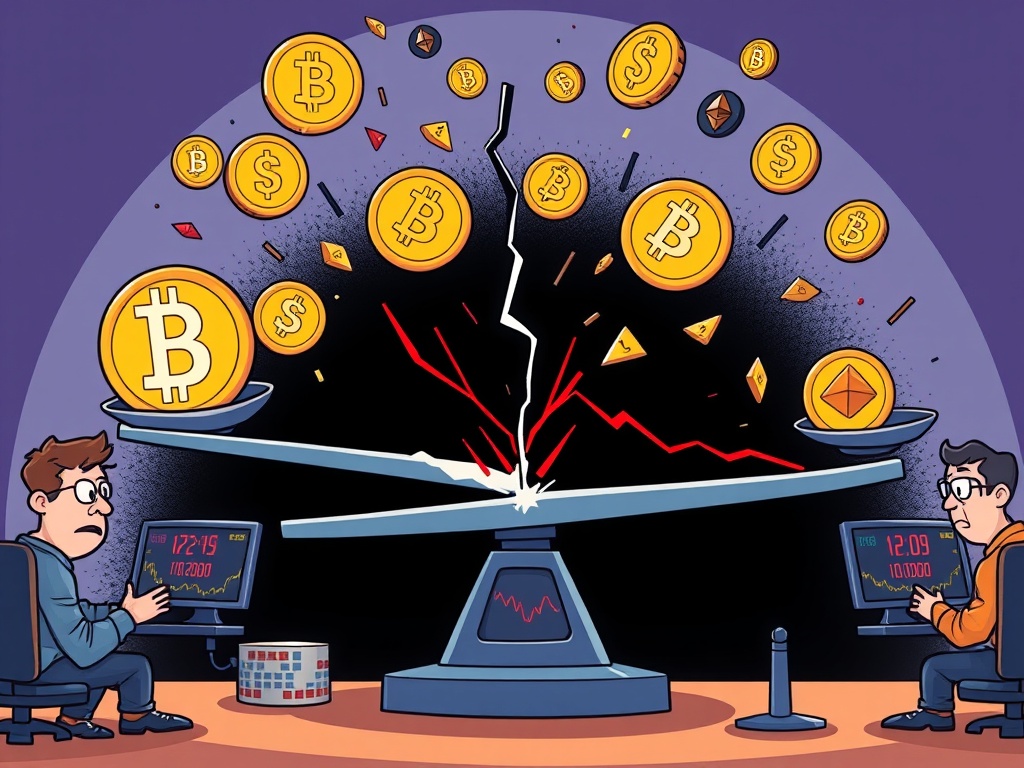
A staggering event just rocked the crypto world. In a blink, a monumental $320 million worth of futures contracts were wiped out across major exchanges in a single hour. This dramatic figure is part of an even larger trend, with a total of $568 million in futures liquidated over the past 24 hours. These sudden crypto liquidations serve as a stark reminder of the market’s intense volatility and the powerful forces at play in the digital asset space.

What Exactly Are Crypto Liquidations?

For those new to futures trading, understanding crypto liquidations is essential. When traders use borrowed money, known as leverage, to amplify their positions, they put up a smaller amount of their own capital as ‘margin.’ This leverage can magnify profits, but it also significantly increases risk.

If the market moves against a trader’s prediction, their margin balance can fall below a certain threshold. When this happens, the exchange automatically closes their position to prevent further losses for the exchange. This forced closure is precisely what we call a crypto liquidation. It’s a rapid, automatic process that can catch many off guard.

The Shocking $320 Million Plunge

The recent market movements saw an astonishing $320 million in crypto liquidations occur within just sixty minutes. This rapid unwinding of positions sent immediate ripples across major exchanges, demonstrating how quickly market sentiment and prices can shift. Over a full 24-hour period, the total losses climbed even higher, reaching $568 million.

Such large-scale liquidations often have several immediate impacts:

  • Sudden Price Drops: As positions are force-closed, selling pressure increases, leading to rapid price declines.
  • Increased Volatility: The market becomes even more unpredictable, making it challenging for traders.
  • Heightened Fear: A wave of liquidations can trigger panic among traders, leading to further selling.

Why Do Massive Crypto Liquidations Happen?

Several factors contribute to such significant crypto liquidations. High leverage trading is often a primary culprit. When many traders are highly leveraged in one direction, a small price swing in the opposite direction can trigger a cascade effect. This initial trigger leads to forced selling, which further drives down prices and causes more liquidations, creating a domino effect.

Other contributing factors include:

  • Unexpected News Events: Geopolitical news, regulatory announcements, or major economic data can suddenly shift market sentiment.
  • Large ‘Whale’ Movements: A single large investor or institution making a significant trade can impact market liquidity and price.
  • Technical Analysis Breakdowns: When key support levels are breached, it can trigger automated selling and further liquidations.

Understanding the risks associated with futures trading is crucial for anyone involved in the crypto market. While the allure of amplified returns is strong, the potential for rapid crypto liquidations is equally real. Here are some actionable strategies to help mitigate the impact of sudden market downturns:

  • Practice Prudent Risk Management: Avoid over-leveraging. Only risk capital you can afford to lose.
  • Implement Stop-Loss Orders: These automatic orders close your position if the price reaches a predetermined level, limiting potential losses.
  • Diversify Your Portfolio: Do not put all your capital into a single asset or highly leveraged positions.
  • Stay Informed: Keep abreast of market news, economic indicators, and technical analysis to make informed decisions.
  • Understand Your Tools: Know how margin calls and liquidation thresholds work on your chosen exchange.

The Broader Implications of Crypto Liquidations

While painful for individual traders, these events also offer insights into the overall health and maturity of the crypto market. Frequent large crypto liquidations can indicate periods of excessive speculation or underlying market weaknesses. Conversely, they can also ‘cleanse’ the market of over-leveraged positions, potentially paving the way for more stable growth by removing weak hands and speculative froth.

These episodes highlight the ongoing need for robust risk management tools and investor education within the cryptocurrency ecosystem. As the market evolves, we can expect continued discussions around responsible trading practices and regulatory frameworks to protect participants while fostering innovation.

In conclusion, the recent $320 million in crypto liquidations in just one hour serves as a powerful reminder of the inherent risks and rapid shifts possible in the digital asset world. While the market offers incredible opportunities, it demands respect, careful planning, and a deep understanding of its mechanisms. By prioritizing informed decisions and sound risk management, traders can better navigate these volatile waters.

Frequently Asked Questions (FAQs)

What is a crypto liquidation?
A crypto liquidation occurs when an exchange automatically closes a trader’s leveraged position because their margin balance has fallen below a required threshold, preventing further losses.

Why are liquidations sometimes so high?
High liquidations often result from a combination of excessive leverage used by many traders and sudden, significant price movements in the market that go against their leveraged positions, creating a cascade effect.

Can I avoid crypto liquidations?
You can significantly reduce your risk of liquidation by using lower leverage, setting stop-loss orders, managing your risk exposure carefully, and avoiding over-speculation.

Does a large liquidation event mean the crypto market is crashing?
Not necessarily. While large liquidations indicate significant market volatility and can lead to temporary price drops, they don’t always signal a long-term market crash. They can sometimes even ‘cleanse’ the market of over-leveraged positions, potentially leading to more stable growth.

What role do exchanges play in crypto liquidations?
Exchanges facilitate futures trading and are responsible for executing liquidations automatically according to their terms to protect both the platform and other market participants from unmanageable losses due to highly leveraged positions.

If you found this article insightful, consider sharing it with your network! Help others understand the dynamics of crypto liquidations and how to navigate the volatile cryptocurrency market more safely.

To learn more about the latest crypto market trends, explore our article on key developments shaping cryptocurrency price action.

This post Crypto Liquidations: A Shocking $320 Million Vanishes in an Hour first appeared on BitcoinWorld and is written by Editorial Team

Market Opportunity
LETSTOP Logo
LETSTOP Price(STOP)
$0.01762
$0.01762$0.01762
-3.61%
USD
LETSTOP (STOP) Live Price Chart
Disclaimer: The articles reposted on this site are sourced from public platforms and are provided for informational purposes only. They do not necessarily reflect the views of MEXC. All rights remain with the original authors. If you believe any content infringes on third-party rights, please contact service@support.mexc.com for removal. MEXC makes no guarantees regarding the accuracy, completeness, or timeliness of the content and is not responsible for any actions taken based on the information provided. The content does not constitute financial, legal, or other professional advice, nor should it be considered a recommendation or endorsement by MEXC.

You May Also Like

XRP Enters ‘Washout Zone,’ Then Targets $30, Crypto Analyst Says

XRP Enters ‘Washout Zone,’ Then Targets $30, Crypto Analyst Says

XRP has entered what Korean Certified Elliott Wave Analyst XForceGlobal (@XForceGlobal) calls a “washout” phase inside a broader Elliott Wave corrective structure
Share
NewsBTC2026/02/05 08:00
Republicans are 'very concerned about Texas' turning blue: GOP senator

Republicans are 'very concerned about Texas' turning blue: GOP senator

While Republicans in the U.S. House of Representatives have a razor-thin with just a four-seat advantage, their six-seat advantage in the U.S. Senate is seen as
Share
Alternet2026/02/05 08:38
Headwind Helps Best Wallet Token

Headwind Helps Best Wallet Token

The post Headwind Helps Best Wallet Token appeared on BitcoinEthereumNews.com. Google has announced the launch of a new open-source protocol called Agent Payments Protocol (AP2) in partnership with Coinbase, the Ethereum Foundation, and 60 other organizations. This allows AI agents to make payments on behalf of users using various methods such as real-time bank transfers, credit and debit cards, and, most importantly, stablecoins. Let’s explore in detail what this could mean for the broader cryptocurrency markets, and also highlight a presale crypto (Best Wallet Token) that could explode as a result of this development. Google’s Push for Stablecoins Agent Payments Protocol (AP2) uses digital contracts known as ‘Intent Mandates’ and ‘Verifiable Credentials’ to ensure that AI agents undertake only those payments authorized by the user. Mandates, by the way, are cryptographically signed, tamper-proof digital contracts that act as verifiable proof of a user’s instruction. For example, let’s say you instruct an AI agent to never spend more than $200 in a single transaction. This instruction is written into an Intent Mandate, which serves as a digital contract. Now, whenever the AI agent tries to make a payment, it must present this mandate as proof of authorization, which will then be verified via the AP2 protocol. Alongside this, Google has also launched the A2A x402 extension to accelerate support for the Web3 ecosystem. This production-ready solution enables agent-based crypto payments and will help reshape the growth of cryptocurrency integration within the AP2 protocol. Google’s inclusion of stablecoins in AP2 is a massive vote of confidence in dollar-pegged cryptocurrencies and a huge step toward making them a mainstream payment option. This widens stablecoin usage beyond trading and speculation, positioning them at the center of the consumption economy. The recent enactment of the GENIUS Act in the U.S. gives stablecoins more structure and legal support. Imagine paying for things like data crawls, per-task…
Share
BitcoinEthereumNews2025/09/18 01:27