Flow's DeFi TVL rose 46.3% to $68 million, making Q2 its best quarter yet.Flow's DeFi TVL rose 46.3% to $68 million, making Q2 its best quarter yet.

Flow records strongest quarter yet with DeFi growth: Messari report

2 min read

Flow’s DeFi ecosystem is growing fast, with DeFi TVL up 46% quarterly to $68 million.

Summary
  • Flow’s DeFi TVL rose 46% to $68 million in the last quarter, best performance yet
  • The chain is shifting its strategy to stablecoins, liquid staking, and DeFi.
  • PayPal’s PYUSD supply on Flow rose 212% QoQ to $26.2 million

Once dismissed as an NFT chain whose time had passed, Flow (FLOW) is slowly making a comeback. On Thursday, August 21, Messari released a report on the state of the Flow ecosystem in the second quarter of 2025. The report reveals a 46% jump in TVL to $68 million, making it the best-performing quarter to date.

The growth is coming less from collectibles and more from stablecoins, liquid staking, and DeFi. Notably, Flow has seen significant interest in stablecoins, with PayPal’s PYUSD supply rising 211.9% QoQ to $26.2 million. This made PYUSD the biggest stablecoin on the network.

At the same time, developer activity saw a boom, with a 473% QoQ jump in smart contract deployments. April was the most active month for contract deployments, with deployments reaching 45,239. What’s more, user interest grew even further, with average daily transactions on Flow up 602% to 40.1k, following the LayerZero integration.
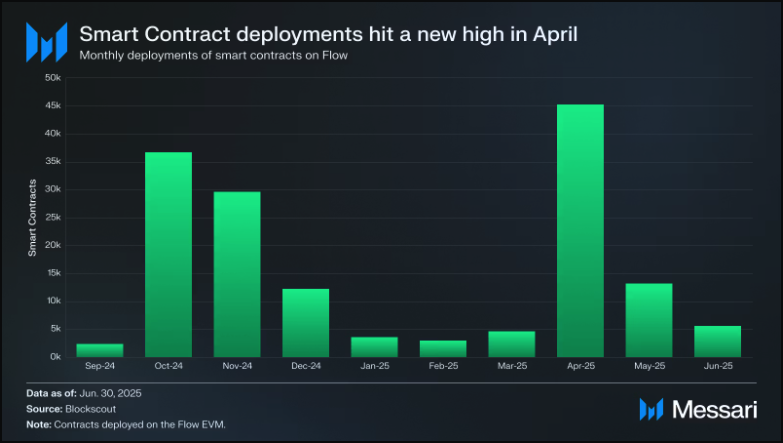
Smart contract deployments on Flow

Flow pivots from early NFT strategy

Rising activity shows that Flow has successfully pivoted from its early NFT focus. Launched by Dapper Labs in 2020, the creators of Ethereum-based (ETH) CryptoKitties NFTs, Flow has seen a significant transformation. At its inception, it was a response to the congestion that CryptoKitties created on Ethereum. Flow was supposed to be a layer-1 chain that could handle mass consumer dApps.

At the time, it rode the early NFT wave, securing partnerships with giants such as Disney, the NFL, and the NBA. However, the decline in interest in digital collectibles led Flow to shift its strategy, with a greater focus on DeFi.

Market Opportunity
DeFi Logo
DeFi Price(DEFI)
$0.000308
$0.000308$0.000308
-5.52%
USD
DeFi (DEFI) Live Price Chart
Disclaimer: The articles reposted on this site are sourced from public platforms and are provided for informational purposes only. They do not necessarily reflect the views of MEXC. All rights remain with the original authors. If you believe any content infringes on third-party rights, please contact service@support.mexc.com for removal. MEXC makes no guarantees regarding the accuracy, completeness, or timeliness of the content and is not responsible for any actions taken based on the information provided. The content does not constitute financial, legal, or other professional advice, nor should it be considered a recommendation or endorsement by MEXC.

You May Also Like

Cashing In On University Patents Means Giving Up On Our Innovation Future

Cashing In On University Patents Means Giving Up On Our Innovation Future

The post Cashing In On University Patents Means Giving Up On Our Innovation Future appeared on BitcoinEthereumNews.com. “It’s a raid on American innovation that would deliver pennies to the Treasury while kneecapping the very engine of our economic and medical progress,” writes Pipes. Getty Images Washington is addicted to taxing success. Now, Commerce Secretary Howard Lutnick is floating a plan to skim half the patent earnings from inventions developed at universities with federal funding. It’s being sold as a way to shore up programs like Social Security. In reality, it’s a raid on American innovation that would deliver pennies to the Treasury while kneecapping the very engine of our economic and medical progress. Yes, taxpayer dollars support early-stage research. But the real payoff comes later—in the jobs created, cures discovered, and industries launched when universities and private industry turn those discoveries into real products. By comparison, the sums at stake in patent licensing are trivial. Universities collectively earn only about $3.6 billion annually in patent income—less than the federal government spends on Social Security in a single day. Even confiscating half would barely register against a $6 trillion federal budget. And yet the damage from such a policy would be anything but trivial. The true return on taxpayer investment isn’t in licensing checks sent to Washington, but in the downstream economic activity that federally supported research unleashes. Thanks to the bipartisan Bayh-Dole Act of 1980, universities and private industry have powerful incentives to translate early-stage discoveries into real-world products. Before Bayh-Dole, the government hoarded patents from federally funded research, and fewer than 5% were ever licensed. Once universities could own and license their own inventions, innovation exploded. The result has been one of the best returns on investment in government history. Since 1996, university research has added nearly $2 trillion to U.S. industrial output, supported 6.5 million jobs, and launched more than 19,000 startups. Those companies pay…
Share
BitcoinEthereumNews2025/09/18 03:26
XRP Ledger Unlocks Permissioned Domains With 91% Validator Backing

XRP Ledger Unlocks Permissioned Domains With 91% Validator Backing

XRP Ledger activated XLS-80 after 91% validator approval, enabling permissioned domains for credential-gated use on the public XRPL. The XRP Ledger has activated
Share
LiveBitcoinNews2026/02/06 13:00
XRPL Adds Institutional Lending and Privacy Tools in Ripple’s 2026 Roadmap

XRPL Adds Institutional Lending and Privacy Tools in Ripple’s 2026 Roadmap

Ripple shared a new Institutional DeFi roadmap showing how the XRP Ledger is being shaped for everyday use by banks, asset managers, and regulated financial firms
Share
Tronweekly2026/02/06 13:00