The post Non-USDC/USDT stablecoin supply on Solana surges nearly 10x since Jan 2025 appeared on BitcoinEthereumNews.com. On-chain data revealed that non-USDC/USDTThe post Non-USDC/USDT stablecoin supply on Solana surges nearly 10x since Jan 2025 appeared on BitcoinEthereumNews.com. On-chain data revealed that non-USDC/USDT

Non-USDC/USDT stablecoin supply on Solana surges nearly 10x since Jan 2025

On-chain data revealed that non-USDC/USDT stablecoins on Solana have surged by more than 10x since January 2025. The expansion of non-USDC/USDT stablecoins shows that the stablecoin landscape on Solana has become a lot more diversified over the past year. 

At the time of publication, the stablecoin market cap is $14.227 billion, up 3.47% over the past 7 days. USDC still dominates the stablecoin space, accounting for around 57.43% of the entire stablecoin market.

Stablecoin supply on Solana increases by 75% YTD

USDT accounts for roughly 17.74% of the entire stablecoin market cap. The remaining non-USDC/USDT stablecoins make up ~25% of SOL’s total stablecoin supply. Cryptopolitan previously reported in December that stablecoin supply on Solana hit a new all-time high of $16.2 billion.

On-chain data revealed that non-USDC/USDT stablecoins have surged from ~3% a year ago. USD1 accounts for around 6.77%, followed by USDG and PYUSD accounting for 5.92% and 5.84%, respectively. 

Stablecoin supply on Solana has also increased by more than 75% since January 2025. The growth has been driven by demand for decentralized finance (DeFi) and faster, cheaper transactions.

Solana also hosts over a dozen other deployments, including non-dollar stablecoins like the Swiss franc (VCHF) and the Euro (EURC). Solana-native applications are also launching their own stablecoins: Phantom (the leading Solana wallet) launched CASH, and Jupiter launched jupUSD. 

Non-USD stablecoins and app-specific units show that Solana is evolving into a multi-currency settlement layer. The surge also suggests that Solana’s app ecosystem is mature enough for native teams to expand their offerings to multiple financial products.

For Solana, the diversification from non-USDC/USDT stablecoins reduces concentration risk and signals issuer confidence.

A year ago, a regulatory issue affecting Circle (USDC’s issuer) would have threatened Solana’s entire stablecoin network. Today, a diversified issuer set makes the network more resilient, with more new issuers choosing Solana, signaling confidence in the ecosystem.

IMF warns stablecoin surge could disrupt capital flows

The International Monetary Fund (IMF) reported that stablecoin growth is fueled by their interconnections with mainstream finance stemming from its potential use cases and asset backing. The fund also acknowledged that stablecoins are primarily used to trade native crypto assets, which are then settled in traditional currencies. 

The IMF noted that the growth of stablecoins is driven by their ability to enable faster and cheaper payments, especially across borders and for remittances. The fund also believes that stablecoins could drive innovation by increasing competition with established payment service providers, making retail crypto payments more accessible. 

Stablecoin supply on Solana surpassed that of Bitcoin and Ethereum for the first time late last year. The IMF warned that the surge could disrupt capital flows and accelerate currency substitution. On-chain data revealed that stablecoins account for roughly 7% of the overall crypto market, having attracted more funds than native crypto assets in 2025.

The IMF report suggests that stablecoins are growing because the global payments system is slow, fragmented, and expensive. The fund also noted that people have opted out of that friction in the past two years, with USDC and USDT tripling in size since 2023. Both USD-backed tokens reached a combined $260 billion in 2024, with $23 trillion in trading volume.

The surge in non-USDC/USDT stablecoins signals that stablecoins are not going away, but they are becoming the digital edge of the dollar system. Those assets are also heading toward consolidation, regulation, and eventual absorption into the banking system to help institutions gain visibility and control over global money flows.

Source: https://www.cryptopolitan.com/non-usdc-usdt-stablecoin-supply-on-solana/

Market Opportunity
USDCoin Logo
USDCoin Price(USDC)
$1.0005
$1.0005$1.0005
0.00%
USD
USDCoin (USDC) Live Price Chart
Disclaimer: The articles reposted on this site are sourced from public platforms and are provided for informational purposes only. They do not necessarily reflect the views of MEXC. All rights remain with the original authors. If you believe any content infringes on third-party rights, please contact service@support.mexc.com for removal. MEXC makes no guarantees regarding the accuracy, completeness, or timeliness of the content and is not responsible for any actions taken based on the information provided. The content does not constitute financial, legal, or other professional advice, nor should it be considered a recommendation or endorsement by MEXC.

You May Also Like

Young Republicans were more proud to be American under Obama than under Trump: data analyst

Young Republicans were more proud to be American under Obama than under Trump: data analyst

CNN data analyst Harry Enten sorts through revealing polls and surveys of American attitudes, looking for shifts, and his latest finding is an indictment of President
Share
Alternet2026/02/10 22:18
Vitalik Buterin Outlines Ethereum’s AI Framework, Pushes Back Against Solana’s Acceleration Thesis

Vitalik Buterin Outlines Ethereum’s AI Framework, Pushes Back Against Solana’s Acceleration Thesis

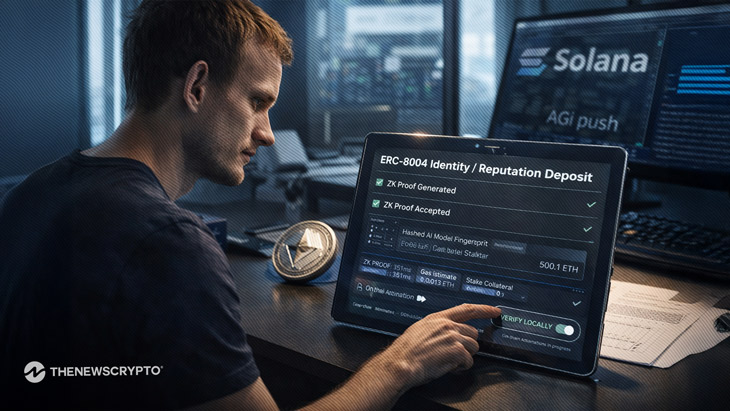
Ethereum co-founder Vitalik Buterin has reacted to Solana’s artificial general intelligence acceleration initiative. He did this through the establishment of his
Share
Thenewscrypto2026/02/10 18:40
Vitalik Buterin Reveals Ethereum’s Bold Plan to Stay Quantum-Secure and Simple!

Vitalik Buterin Reveals Ethereum’s Bold Plan to Stay Quantum-Secure and Simple!

Buterin unveils Ethereum’s strategy to tackle quantum security challenges ahead. Ethereum focuses on simplifying architecture while boosting security for users. Ethereum’s market stability grows as Buterin’s roadmap gains investor confidence. Ethereum founder Vitalik Buterin has unveiled his long-term vision for the blockchain, focusing on making Ethereum quantum-secure while maintaining its simplicity for users. Buterin presented his roadmap at the Japanese Developer Conference, and splits the future of Ethereum into three phases: short-term, mid-term, and long-term. Buterin’s most ambitious goal for Ethereum is to safeguard the blockchain against the threats posed by quantum computing.  The danger of such future developments is that the future may call into question the cryptographic security of most blockchain systems, and Ethereum will be able to remain ahead thanks to more sophisticated mathematical techniques to ensure the safety and integrity of its protocols. Buterin is committed to ensuring that Ethereum evolves in a way that not only meets today’s security challenges but also prepares for the unknowns of tomorrow. Also Read: Ethereum Giant The Ether Machine Takes Major Step Toward Going Public! However, in spite of such high ambitions, Buterin insisted that Ethereum also needed to simplify its architecture. An important aspect of this vision is to remove unnecessary complexity and make Ethereum more accessible and maintainable without losing its strong security capabilities. Security and simplicity form the core of Buterin’s strategy, as they guarantee that the users of Ethereum experience both security and smooth processes. Focus on Speed and Efficiency in the Short-Term In the short term, Buterin aims to enhance Ethereum’s transaction efficiency, a crucial step toward improving scalability and reducing transaction costs. These advantages are attributed to the fact that, within the mid-term, Ethereum is planning to enhance the speed of transactions in layer-2 networks. According to Butterin, this is part of Ethereum’s expansion, particularly because there is still more need to use blockchain technology to date. The other important aspect of Ethereum’s development is the layer-2 solutions. Buterin supports an approach in which the layer-2 networks are dependent on layer-1 to perform some essential tasks like data security, proof, and censorship resistance. This will enable the layer-2 systems of Ethereum to be concerned with verifying and sequencing transactions, which will improve the overall speed and efficiency of the network. Ethereum’s Market Stability Reflects Confidence in Long-Term Strategy Ethereum’s market performance has remained solid, with the cryptocurrency holding steady above $4,000. Currently priced at $4,492.15, Ethereum has experienced a slight 0.93% increase over the last 24 hours, while its trading volume surged by 8.72%, reaching $34.14 billion. These figures point to growing investor confidence in Ethereum’s long-term vision. The crypto community remains optimistic about Ethereum’s future, with many predicting the price could rise to $5,500 by mid-October. Buterin’s clear, forward-thinking strategy continues to build trust in Ethereum as one of the most secure and scalable blockchain platforms in the market. Also Read: Whales Dump 200 Million XRP in Just 2 Weeks – Is XRP’s Price on the Verge of Collapse? The post Vitalik Buterin Reveals Ethereum’s Bold Plan to Stay Quantum-Secure and Simple! appeared first on 36Crypto.
Share
Coinstats2025/09/18 01:22