TLDR Solana (SOL) dropped to $68 before recovering to $80 amid broader crypto market selloff and persistent bearish pressure. Weekly chart shows broken head-andTLDR Solana (SOL) dropped to $68 before recovering to $80 amid broader crypto market selloff and persistent bearish pressure. Weekly chart shows broken head-and

Solana (SOL) Price: Oversold Signals Emerge Following Crash to $68

3 min read

TLDR

  • Solana (SOL) dropped to $68 before recovering to $80 amid broader crypto market selloff and persistent bearish pressure.
  • Weekly chart shows broken head-and-shoulders pattern with RSI entering oversold territory, signaling potential for relief rally.
  • SOL testing key demand zone around $80 where historical buyer activity could trigger rebound or further decline.
  • Technical indicators show downside momentum remains intact with all major moving averages positioned above current price.
  • Trading volume of $16.53 billion and market cap of $46.20 billion as price action reflects broader altcoin weakness.

Solana continued to decline on Thursday, February 5, 2026, as the broader crypto market remained under pressure. The token dropped to $68 before recovering to trade at $80.
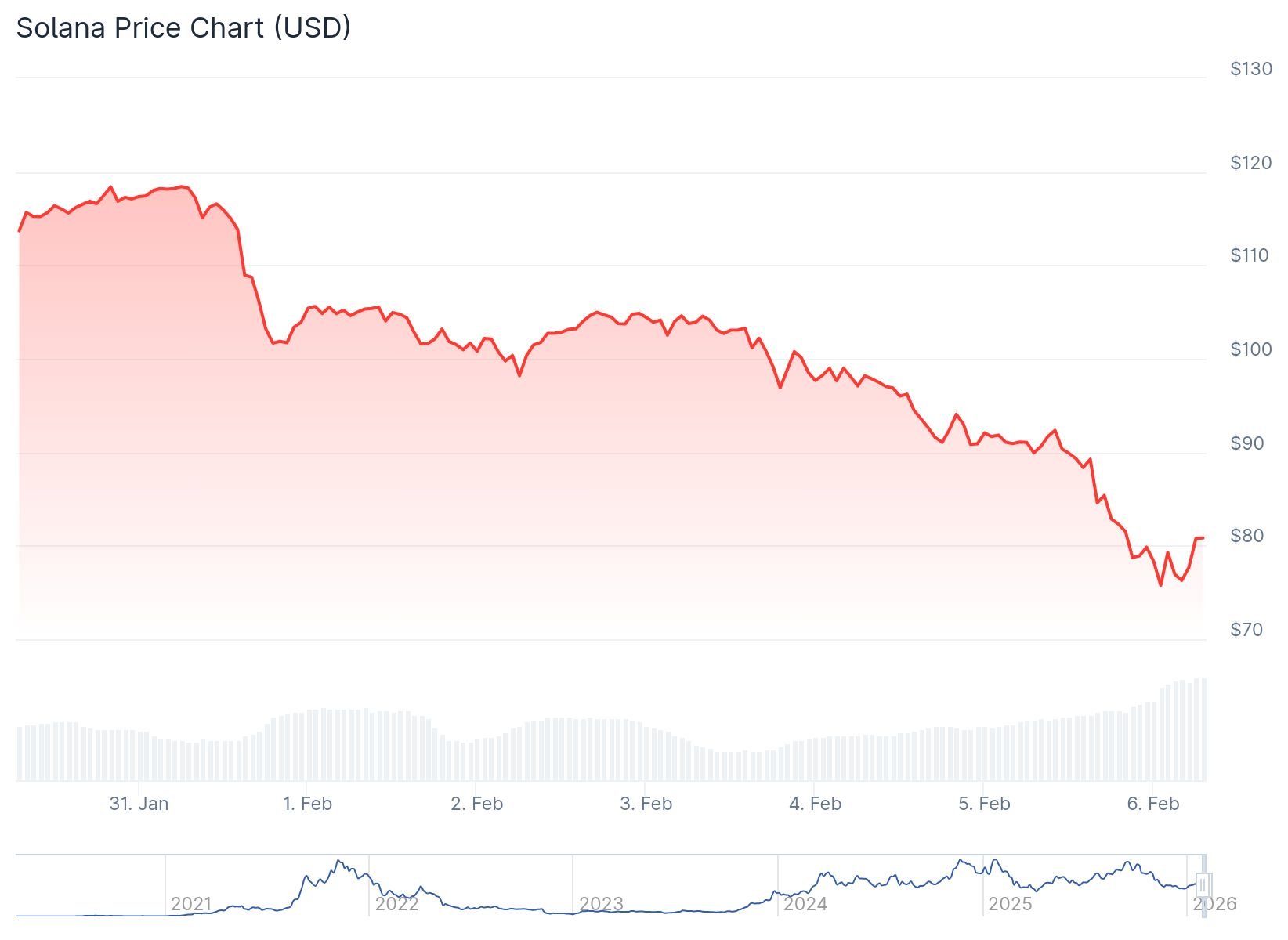
Solana (SOL) PriceSolana (SOL) Price

The price movement represents a 12.20% decline over a 24-hour period. Trading volume reached $16.53 billion with a market capitalization of $46.20 billion.

Crypto analyst CryptoPulse identified a head and shoulders pattern on the weekly chart. The pattern broke below the neckline, indicating a possible trend reversal and weakening upward momentum.

The Relative Strength Index entered oversold territory. This technical condition sometimes signals a potential rebound in price.

Testing Historical Demand Zones

Market observer BitGuru noted that Solana is nearing a known demand zone. This area showed buyer activity in the past.

The current price level around $80 represents a critical test. A hold here could lead to a bounce, while a break lower could push the token toward the $72-$75 range.

All major moving averages sit above the current price. The 50-day moving average trends lower near $105, while the 100-day and 200-day averages remain higher.

The technical structure shows a sequence of lower highs and lower lows on the daily chart. This pattern confirms the bearish continuation signal.

The MACD indicator remains in negative territory with the signal line below zero. The histogram continues to print red bars, showing downside momentum is still active.

Volume and Market Dynamics

Selling volume expanded during the move below $85. This suggests genuine participation rather than thin liquidity conditions.

The RSI remains below the neutral 50 mark. This indicates downside pressure is dominant without reaching deeply oversold conditions yet.

Altcoins have underperformed as traders rotate toward cash or higher-liquidity assets. Solana has followed this trend despite strong ecosystem and developer activity.

Recent discussions around potential Solana-linked exchange-traded products have provided a long-term positive narrative. However, this optimism is not translating into near-term buying pressure.

The failure to hold above $100 earlier in the year already signaled weakening confidence. The subsequent drop below $85 reinforced fragile sentiment.

Analyst Anton Kharitonov says Solana remains under strong technical pressure. He cites bearish momentum, oversold signals and ongoing institutional outflows despite solid on-chain activity.

Kharitonov remains defensive on SOL until the price can reclaim and hold above $102. He notes heavy resistance and a lack of near-term catalysts.

Solana is trading at $80 after dropping to $68, with key support zones and oversold technical indicators in focus as the token tests historical demand areas.

The post Solana (SOL) Price: Oversold Signals Emerge Following Crash to $68 appeared first on CoinCentral.

Market Opportunity
Solana Logo
Solana Price(SOL)
$81,23
$81,23$81,23
-3,99%
USD
Solana (SOL) Live Price Chart
Disclaimer: The articles reposted on this site are sourced from public platforms and are provided for informational purposes only. They do not necessarily reflect the views of MEXC. All rights remain with the original authors. If you believe any content infringes on third-party rights, please contact service@support.mexc.com for removal. MEXC makes no guarantees regarding the accuracy, completeness, or timeliness of the content and is not responsible for any actions taken based on the information provided. The content does not constitute financial, legal, or other professional advice, nor should it be considered a recommendation or endorsement by MEXC.

You May Also Like

eurosecurity.net Expands Cryptocurrency Asset Recovery Capabilities Amid Rising Investor Losses

eurosecurity.net Expands Cryptocurrency Asset Recovery Capabilities Amid Rising Investor Losses

New York, NY/ GlobePRWire / Feb 6, 2026 – eurosecurity.net announces the expansion of its cryptocurrency asset recovery services, reflecting increased demand from
Share
CryptoReporter2026/02/06 17:24
Ethereum to boost scalability and roll out Fusaka upgrade on Dec 3

Ethereum to boost scalability and roll out Fusaka upgrade on Dec 3

Ethereum's Fusaka update may happen on December 3, based on the date set in the latest developer call.
Share
Cryptopolitan2025/09/19 17:00
Google Cloud taps EigenLayer to bring trust to agentic payments

Google Cloud taps EigenLayer to bring trust to agentic payments

The post Google Cloud taps EigenLayer to bring trust to agentic payments appeared on BitcoinEthereumNews.com. Two days after unveiling AP2 — a universal payment layer for AI agents that supports everything from credit cards to stablecoins — Google and EigenLayer have released details of their partnership to bring verifiability and restaking security to the stack, using Ethereum. In addition to enabling verifiable compute and slashing-backed payment coordination, EigenCloud will support insured and sovereign AI agents, which introduce consequences for failure or deviation from specified behavior. Sovereign agents are positioned as autonomous actors that can own property, make decisions, and execute actions independently — think smart contracts with embedded intelligence. From demos to dollars AP2 extends Google’s agent-to-agent (A2A) protocol using the HTTP 402 status code — long reserved for “payment required” — to standardize payment requests between agents across different networks. It already supports stablecoins like USDC, and Coinbase has demoed an agent checkout using its Wallet-as-a-Service. Paired with a system like Lit Protocol’s Vincent — which enforces per-action policies and key custody at signing — Google’s AP2 with EigenCloud’s verifiability and cross-chain settlement could form an end-to-end trust loop. Payments between agents aren’t as simple as they are often made to sound by “Crypto x AI” LARPs. When an AI agent requests a payment in USDC on Base and the payer’s funds are locked in ETH on Arbitrum, the transaction stalls — unless something abstracts the bridging, swapping and delivery. That’s where EigenCloud comes in. Sreeram Kannan, founder of EigenLayer, said the integration will create agents that not only run on-chain verifiable compute, but are also economically incentivized to behave within programmable bounds. Through restaked operators, EigenCloud powers a verifiable payment service that handles asset routing and chain abstraction, with dishonest behavior subject to slashing. It also introduces cryptographic accountability to the agents themselves, enabling proofs that an agent actually executed the task it…
Share
BitcoinEthereumNews2025/09/19 03:52