Key Takeaways : In 2024, Germany sold nearly 50,000 BTC for $2.89 billion, missing out on an estimated $3.17 billion in profit. By August 2025, those holdings would have been worth around $6 billion. Although no longer a top-four government BTC holder, Germany supports crypto adoption and regulation. With BTC making new all-time-highs, countries like Germany are missing out on a significant opportunity to boost their economy, potentially by billions of dollars, had they kept their holdings instead of selling. Germany was ranked as the fourth-largest government holder of Bitcoin in January 2024. It had seized 50,000 BTC, worth approximately $2.2 billion at the time, from the operators of Movie2K, a movie piracy network. However, by July 12, 2024, the German government, through its Federal Criminal Police Office (BKA), had sold a total of 49,858 BTC for approximately $2.89 billion, at an average sale price of $57,900 per BTC. The decision to sell was not purely an investment move but was made in compliance with German law, which mandates the sale of seized assets prone to significant market volatility to prevent further losses. Barely a year later, the price of BTC has more than doubled, surging above $122,000 on August 11, 2025. Had the government kept the seized Bitcoin, its value would be approximately $6.06 billion, representing a missed profit of $3.17 billion compared to the average sale proceeds. This would place Germany among the world’s four largest government holders. German lawmaker Joana Cotar argued in a July 4 letter to members of the German government that Bitcoin should have been held as a strategic reserve, stating: It is not sensible to sell the Bitcoins now. It would be better to keep them as a reserve currency. Meanwhile, the United States has taken a different approach to managing its Bitcoin holdings. The U.S. government holds approximately 198,022 BTC, valued at over $24 billion, primarily acquired through seizures. Earlier this year, it established a Strategic Bitcoin Reserve with no announced plans to sell. Is Germany Still Interested in Crypto? Although Germany has slipped from its rank as the fourth-largest government Bitcoin holder and missed the chance to earn an additional $3 billion, the country is actively supporting crypto adoption and regulation. Following the approval of the Markets in Crypto Assets (MiCA) regulation, crypto assets have become legal in Germany. However, exchanges are required to obtain necessary licenses from the Federal Financial Supervisory Authority (BaFin) to operate in the country. Crypto users in Germany were projected to reach 27.32 million , with GenZ and millennials accounting for up to 50%. Institutional adoption is also rising, with Deutsche Bank reportedly planning to launch a digital assets custody service in 2026. Revenue from the German crypto market is expected to reach $2.5 billion in 2025 and about $2.9 billion by the end of 2026, with a compound annual growth rate (CAGR) of 16.33%. Germany is also creating a favourable tax policy for long-term crypto holders. Gains from crypto are tax-free if held for more than one year, while short-term gains (less than one year) are subject to progressive income tax of up to 45%. The government is also working to improve its tax transparency through the Directive on Administrative Cooperation ( DAC 8 ), which mandates crypto asset providers (CASPs) to report transaction details to tax authorities. This will take effect from January 1, 2026. Closing Thoughts With Bitcoin’s role in global markets continuing to grow and other countries reassessing their crypto strategies, Germany’s early Bitcoin liquidation and missed financial opportunity have become a case study in the importance of long-term planning for managing digital asset holdings.Key Takeaways : In 2024, Germany sold nearly 50,000 BTC for $2.89 billion, missing out on an estimated $3.17 billion in profit. By August 2025, those holdings would have been worth around $6 billion. Although no longer a top-four government BTC holder, Germany supports crypto adoption and regulation. With BTC making new all-time-highs, countries like Germany are missing out on a significant opportunity to boost their economy, potentially by billions of dollars, had they kept their holdings instead of selling. Germany was ranked as the fourth-largest government holder of Bitcoin in January 2024. It had seized 50,000 BTC, worth approximately $2.2 billion at the time, from the operators of Movie2K, a movie piracy network. However, by July 12, 2024, the German government, through its Federal Criminal Police Office (BKA), had sold a total of 49,858 BTC for approximately $2.89 billion, at an average sale price of $57,900 per BTC. The decision to sell was not purely an investment move but was made in compliance with German law, which mandates the sale of seized assets prone to significant market volatility to prevent further losses. Barely a year later, the price of BTC has more than doubled, surging above $122,000 on August 11, 2025. Had the government kept the seized Bitcoin, its value would be approximately $6.06 billion, representing a missed profit of $3.17 billion compared to the average sale proceeds. This would place Germany among the world’s four largest government holders. German lawmaker Joana Cotar argued in a July 4 letter to members of the German government that Bitcoin should have been held as a strategic reserve, stating: It is not sensible to sell the Bitcoins now. It would be better to keep them as a reserve currency. Meanwhile, the United States has taken a different approach to managing its Bitcoin holdings. The U.S. government holds approximately 198,022 BTC, valued at over $24 billion, primarily acquired through seizures. Earlier this year, it established a Strategic Bitcoin Reserve with no announced plans to sell. Is Germany Still Interested in Crypto? Although Germany has slipped from its rank as the fourth-largest government Bitcoin holder and missed the chance to earn an additional $3 billion, the country is actively supporting crypto adoption and regulation. Following the approval of the Markets in Crypto Assets (MiCA) regulation, crypto assets have become legal in Germany. However, exchanges are required to obtain necessary licenses from the Federal Financial Supervisory Authority (BaFin) to operate in the country. Crypto users in Germany were projected to reach 27.32 million , with GenZ and millennials accounting for up to 50%. Institutional adoption is also rising, with Deutsche Bank reportedly planning to launch a digital assets custody service in 2026. Revenue from the German crypto market is expected to reach $2.5 billion in 2025 and about $2.9 billion by the end of 2026, with a compound annual growth rate (CAGR) of 16.33%. Germany is also creating a favourable tax policy for long-term crypto holders. Gains from crypto are tax-free if held for more than one year, while short-term gains (less than one year) are subject to progressive income tax of up to 45%. The government is also working to improve its tax transparency through the Directive on Administrative Cooperation ( DAC 8 ), which mandates crypto asset providers (CASPs) to report transaction details to tax authorities. This will take effect from January 1, 2026. Closing Thoughts With Bitcoin’s role in global markets continuing to grow and other countries reassessing their crypto strategies, Germany’s early Bitcoin liquidation and missed financial opportunity have become a case study in the importance of long-term planning for managing digital asset holdings.

Germany Missed Out on $3B From Selling BTC Before the Rally

3 min read

Key Takeaways:

  • In 2024, Germany sold nearly 50,000 BTC for $2.89 billion, missing out on an estimated $3.17 billion in profit.
  • By August 2025, those holdings would have been worth around $6 billion.
  • Although no longer a top-four government BTC holder, Germany supports crypto adoption and regulation.

With BTC making new all-time-highs, countries like Germany are missing out on a significant opportunity to boost their economy, potentially by billions of dollars, had they kept their holdings instead of selling.

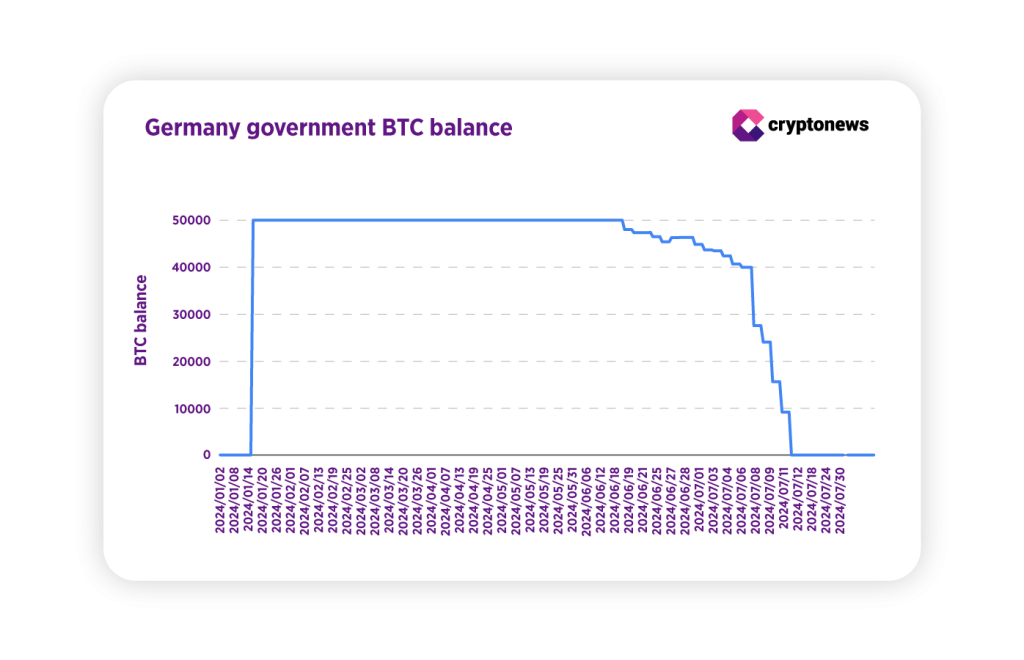
Germany was ranked as the fourth-largest government holder of Bitcoin in January 2024. It had seized 50,000 BTC, worth approximately $2.2 billion at the time, from the operators of Movie2K, a movie piracy network.

However, by July 12, 2024, the German government, through its Federal Criminal Police Office (BKA), had sold a total of 49,858 BTC for approximately $2.89 billion, at an average sale price of $57,900 per BTC. The decision to sell was not purely an investment move but was made in compliance with German law, which mandates the sale of seized assets prone to significant market volatility to prevent further losses.
Barely a year later, the price of BTC has more than doubled, surging above $122,000 on August 11, 2025. Had the government kept the seized Bitcoin, its value would be approximately $6.06 billion, representing a missed profit of $3.17 billion compared to the average sale proceeds. This would place Germany among the world’s four largest government holders.

German lawmaker Joana Cotar argued in a July 4 letter to members of the German government that Bitcoin should have been held as a strategic reserve, stating:

Meanwhile, the United States has taken a different approach to managing its Bitcoin holdings. The U.S. government holds approximately 198,022 BTC, valued at over $24 billion, primarily acquired through seizures. Earlier this year, it established a Strategic Bitcoin Reserve with no announced plans to sell.

Is Germany Still Interested in Crypto?

Although Germany has slipped from its rank as the fourth-largest government Bitcoin holder and missed the chance to earn an additional $3 billion, the country is actively supporting crypto adoption and regulation.

Following the approval of the Markets in Crypto Assets (MiCA) regulation, crypto assets have become legal in Germany. However, exchanges are required to obtain necessary licenses from the Federal Financial Supervisory Authority (BaFin) to operate in the country.

Crypto users in Germany were projected to reach 27.32 million, with GenZ and millennials accounting for up to 50%. Institutional adoption is also rising, with Deutsche Bank reportedly planning to launch a digital assets custody service in 2026. Revenue from the German crypto market is expected to reach $2.5 billion in 2025 and about $2.9 billion by the end of 2026, with a compound annual growth rate (CAGR) of 16.33%.

Germany is also creating a favourable tax policy for long-term crypto holders. Gains from crypto are tax-free if held for more than one year, while short-term gains (less than one year) are subject to progressive income tax of up to 45%.

The government is also working to improve its tax transparency through the Directive on Administrative Cooperation (DAC 8), which mandates crypto asset providers (CASPs) to report transaction details to tax authorities. This will take effect from January 1, 2026.

Closing Thoughts

With Bitcoin’s role in global markets continuing to grow and other countries reassessing their crypto strategies, Germany’s early Bitcoin liquidation and missed financial opportunity have become a case study in the importance of long-term planning for managing digital asset holdings.

Disclaimer: The articles reposted on this site are sourced from public platforms and are provided for informational purposes only. They do not necessarily reflect the views of MEXC. All rights remain with the original authors. If you believe any content infringes on third-party rights, please contact service@support.mexc.com for removal. MEXC makes no guarantees regarding the accuracy, completeness, or timeliness of the content and is not responsible for any actions taken based on the information provided. The content does not constitute financial, legal, or other professional advice, nor should it be considered a recommendation or endorsement by MEXC.

You May Also Like

Crypto News: Donald Trump-Aligned Fed Governor To Speed Up Fed Rate Cuts?
Crypto News: Donald Trump-Aligned Fed Governor To Speed Up Fed Rate Cuts?

The post Crypto News: Donald Trump-Aligned Fed Governor To Speed Up Fed Rate Cuts? appeared on BitcoinEthereumNews.com. In recent crypto news, Stephen Miran swore in as the latest Federal Reserve governor on September 16, 2025, slipping into the board’s last open spot right before the Federal Open Market Committee kicks off its two-day rate discussion. Traders are betting heavily on a 25-basis-point trim, which would bring the federal funds rate down to 4.00%-4.25%, based on CME FedWatch Tool figures from September 15, 2025. Miran, who’s been Trump’s top economic advisor and a supporter of his trade ideas, joins a seven-member board where just three governors come from Democratic picks, according to the Fed’s records updated that same day. Crypto News: Miran’s Background and Quick Path to Confirmation The Senate greenlit Miran on September 15, 2025, with a tight 48-47 vote, following his nomination on September 2, 2025, as per a recent crypto news update. His stint runs only until January 31, 2026, stepping in for Adriana D. Kugler, who stepped down in August 2025 for reasons not made public. Miran earned his economics Ph.D. from Harvard and worked at the Treasury back in Trump’s first go-around. Afterward, he moved to Hudson Bay Capital Management as an economist, then looped back to the White House in December 2024 to head the Council of Economic Advisers. There, he helped craft Trump’s “reciprocal tariffs” approach, aimed at fixing trade gaps with China and the EU. He wouldn’t quit his White House gig, which irked Senator Elizabeth Warren at the September 7, 2025, confirmation hearings. That limited time frame means Miran gets to cast a vote straight away at the FOMC session starting September 16, 2025. The full board now features Chair Jerome H. Powell (Trump pick, term ends 2026), Vice Chair Philip N. Jefferson (Biden, to 2036), and folks like Lisa D. Cook (Biden, to 2028) and Michael S. Barr…
Share
BitcoinEthereumNews2025/09/18 03:14
XRPL Validator Reveals Why He Just Vetoed New Amendment

XRPL Validator Reveals Why He Just Vetoed New Amendment

Vet has explained that he has decided to veto the Token Escrow amendment to prevent breaking things
Share
Coinstats2025/09/18 00:28
US Senate Democrats plan to restart discussions on a cryptocurrency market structure bill later today.

US Senate Democrats plan to restart discussions on a cryptocurrency market structure bill later today.

PANews reported on February 4th that, according to Crypto In America, US Senate Democrats plan to reconvene on the afternoon of February 4th to discuss legislation
Share
PANews2026/02/04 23:12