Zcash price is hovering near a key technical support zone after weeks of steady losses, with traders watching closely for signs of short-term exhaustion. As of Zcash price is hovering near a key technical support zone after weeks of steady losses, with traders watching closely for signs of short-term exhaustion. As of

Zcash price tests lower Bollinger Band near $290 — is a technical bounce forming?

3 min read

Zcash price is hovering near a key technical support zone after weeks of steady losses, with traders watching closely for signs of short-term exhaustion.

Summary
  • ZEC is trading near $290 after sliding more than 40% over the past month.
  • Derivatives activity has cooled, with futures volume falling even as open interest holds steady.
  • Price is testing the lower Bollinger Band, raising the odds of a short-term bounce if support holds.

As of this writing, Zcash was trading at $289, down 1.7% in the past day. The token has struggled to keep pace with recent market moves and remains one of the few large-cap assets in the red despite a slight crypto market rebound.

Zcash (ZEC) has fluctuated between $282 and $401 over the last week, but the trend has clearly shifted lower. The token is down 21% in the last seven days and has lost 43% over the past month, giving back much of its late-2025 rally.

Market activity has softened as prices fell. Zcash recorded $423 million in trading volume in the past 24 hours, a 15% drop. Derivatives tell a similar story.

CoinGlass data shows futures volume down 20% to $1.14 billion, while open interest edged slightly higher to $451 million, suggesting some traders are holding positions rather than aggressively adding new exposure.

Why Zcash is still under pressure

The recent weakness comes after a strong rally late last year and is likely the result of profit-taking combined with unresolved governance problems. In January, the entire core development team at Zcash developer Electric Coin Company resigned, including chief executive officer Josh Swihart.

The departures followed a dispute with the Bootstrap non-profit board over governance design, funding access, and control of major products such as the Zashi wallet. The Zcash network itself has not experienced any technical issues or security problems.

However, sentiment has been impacted by uncertainty about planned upgrades, development schedules, and future direction. At the same time, regulatory pressure continues to weigh down on privacy tokens. 

The most recent decline appears to be a grinding consolidation rather than a sell-off triggered by panic. ZEC may be exposed to further decline if nearby support levels give way because each bounce attempt has faded rapidly.

Recent marketing initiatives might provide some temporary relief. In an attempt to raise awareness and spark interest, Zcash has launched new advertising campaigns with updated branding.

If market conditions improve, stronger engagement might help stabilize price action, but it is unlikely to stop the trend on its own. 

Zcash price technical analysis

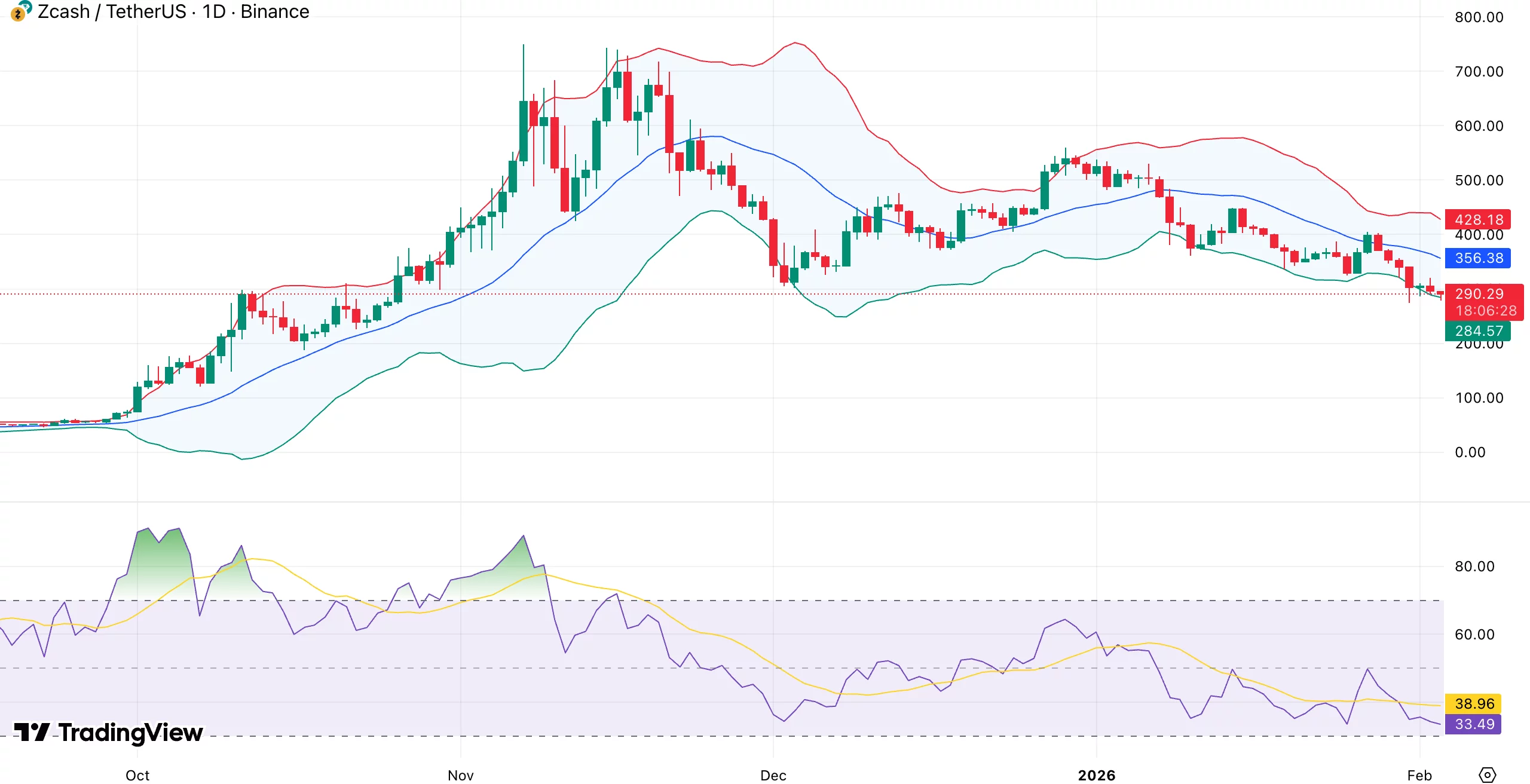
ZEC is trading close to the lower Bollinger Band near $290 on the daily chart. Although it does not guarantee a reversal, this area often indicates short-term exhaustion following prolonged declines.

The price is still below the 20-day moving average, which keeps the overall trend downward. In the past, short relief bounces have been preceded by the relative strength index falling into the low-30s like in the current setup.
Zcash price tests lower Bollinger Band near $290 — is a technical bounce forming? - 1

Any attempt to move higher might encounter resistance in the $320–$350 range, where the short-term averages and middle Bollinger Band converge.

A brief push toward $310–$330 may occur if buyers intervene, particularly if the RSI stabilizes and the price returns to the mid-Bollinger range. On the downside, ZEC would be vulnerable to larger losses if it breaks below $280, with little visible support until lower psychological levels.

Disclaimer: The articles reposted on this site are sourced from public platforms and are provided for informational purposes only. They do not necessarily reflect the views of MEXC. All rights remain with the original authors. If you believe any content infringes on third-party rights, please contact service@support.mexc.com for removal. MEXC makes no guarantees regarding the accuracy, completeness, or timeliness of the content and is not responsible for any actions taken based on the information provided. The content does not constitute financial, legal, or other professional advice, nor should it be considered a recommendation or endorsement by MEXC.

You May Also Like

How $HYPER Captures L2 Demand

How $HYPER Captures L2 Demand

The post How $HYPER Captures L2 Demand appeared on BitcoinEthereumNews.com. E-rupee Goes Global: How $HYPER Captures L2 Demand Disclaimer: The information found
Share
BitcoinEthereumNews2026/02/03 17:04
Palantir (PLTR) Stock: Q4 Earnings Crush Estimates on AI and Government Demand

Palantir (PLTR) Stock: Q4 Earnings Crush Estimates on AI and Government Demand

TLDR Palantir reported Q4 revenue of $1.41 billion, beating Wall Street’s estimate of $1.33 billion, with 70% year-over-year growth Adjusted earnings per share
Share
Coincentral2026/02/03 17:30
Headwind Helps Best Wallet Token

Headwind Helps Best Wallet Token

The post Headwind Helps Best Wallet Token appeared on BitcoinEthereumNews.com. Google has announced the launch of a new open-source protocol called Agent Payments Protocol (AP2) in partnership with Coinbase, the Ethereum Foundation, and 60 other organizations. This allows AI agents to make payments on behalf of users using various methods such as real-time bank transfers, credit and debit cards, and, most importantly, stablecoins. Let’s explore in detail what this could mean for the broader cryptocurrency markets, and also highlight a presale crypto (Best Wallet Token) that could explode as a result of this development. Google’s Push for Stablecoins Agent Payments Protocol (AP2) uses digital contracts known as ‘Intent Mandates’ and ‘Verifiable Credentials’ to ensure that AI agents undertake only those payments authorized by the user. Mandates, by the way, are cryptographically signed, tamper-proof digital contracts that act as verifiable proof of a user’s instruction. For example, let’s say you instruct an AI agent to never spend more than $200 in a single transaction. This instruction is written into an Intent Mandate, which serves as a digital contract. Now, whenever the AI agent tries to make a payment, it must present this mandate as proof of authorization, which will then be verified via the AP2 protocol. Alongside this, Google has also launched the A2A x402 extension to accelerate support for the Web3 ecosystem. This production-ready solution enables agent-based crypto payments and will help reshape the growth of cryptocurrency integration within the AP2 protocol. Google’s inclusion of stablecoins in AP2 is a massive vote of confidence in dollar-pegged cryptocurrencies and a huge step toward making them a mainstream payment option. This widens stablecoin usage beyond trading and speculation, positioning them at the center of the consumption economy. The recent enactment of the GENIUS Act in the U.S. gives stablecoins more structure and legal support. Imagine paying for things like data crawls, per-task…
Share
BitcoinEthereumNews2025/09/18 01:27