Hyperliquid price rallied over 40% this week as whales showed renewed demand for the token. Can it recover back to its October highs of around $50 now that a bullishHyperliquid price rallied over 40% this week as whales showed renewed demand for the token. Can it recover back to its October highs of around $50 now that a bullish

Hyperliquid price confirms bullish crossover as whales accumulate, can it reclaim October highs?

3 min read

Hyperliquid price rallied over 40% this week as whales showed renewed demand for the token. Can it recover back to its October highs of around $50 now that a bullish crossover has been confirmed on its charts?

Summary
  • Hyperliquid price is up 40% over the past week.
  • HYPE’s gains were largely supported by whale buying and its expansion plans into prediction markets.
  • A bullish crossover was confirmed on the daily chart.

According to data from crypto.news, Hyperliquid (HYPE) rose 21% in the past 24 hours to a 10-week high of $38 last check Tuesday, Feb. 3. The rally extended its gains to over 40% in the past 7 days.

Hyperliquid price gains were largely supported by renewed buying from whales. Data from HyperDash shows that whales holding $1 million to $5 million worth of HYPE tokens have been accumulating more tokens over the past week. The trend was also observed among sharks and dolphins holding $50k-$500k worth of tokens. 

Such accumulation from large buyers tends to rub off onto retail investors who often interpret these moves as signs of long term price potential. The buying activity was triggered shortly after the development team behind HyperCore, the core infrastructure powering the Hyperliquid layer 1 network, said it would support the HIP 4 proposal to expand into prediction markets.

The integration would reportedly allow fully collateralized contracts on Hyperliquid, enabling traders to wager on a wide variety of real-world outcomes. This pivot comes at a time when prediction markets have been booming lately. 

As more investors join the hype on the platform, they would be staking HYPE tokens to participate in governance or secure the network. The more HYPE tokens are staked, the more the circulating supply effectively tightens.

As reported by crypto.news, Hyperliquid’s HIP 3 upgrade has been a strong catalyst behind HYPE’s recent gains and has led to increased trading activity on the platform, especially from commodities markets like silver and gold.

Increased trading activity on the Hyperliquid network indirectly benefits the token owing to the platform’s unique buyback and burn mechanism. Notably, 97% of net fees generated from the platform are used to buy back tokens from the open market, effectively reducing the total supply and creating deflationary pressure that could support HYPE’s gains over the long run.

Hyperliquid price analysis

On the daily chart, Hyperliquid has confirmed a bullish crossover of the 20-day simple moving average over the 50-day one, suggesting that bulls have gained significant strength over bears in the short term. 
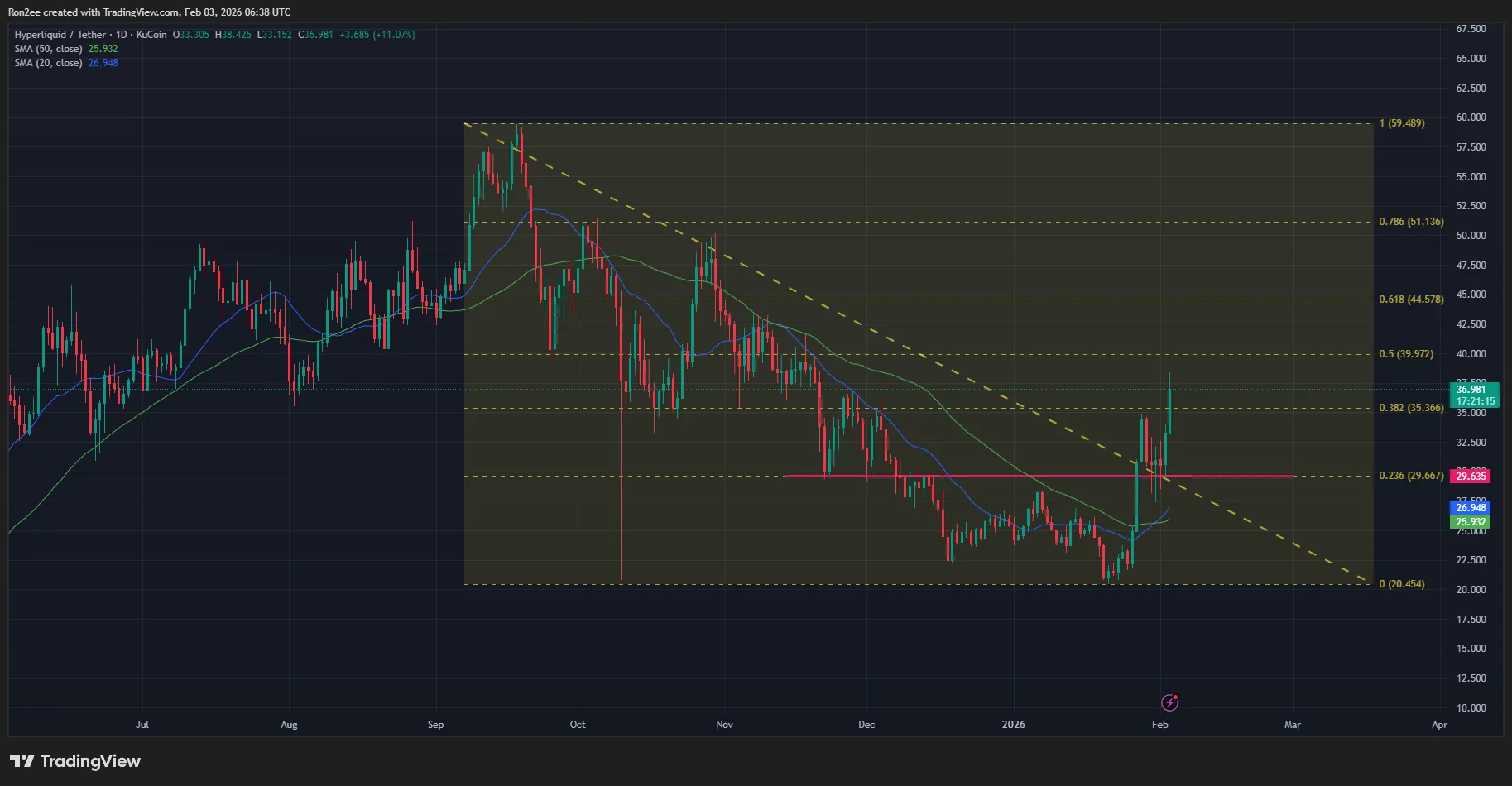
Hyperliquid price has formed a bullish crossover on the daily chart.

The last time such a bullish crossover occurred, Hyperliquid rallied nearly 35% in a little over a month’s time.

The MACD and Supertrend indicators also present a bullish outlook, at least in the short term. Notably, the MACD lines are trending upward while the Supertrend indicator has flashed a green signal.

Together, all these signals seem to suggest more potential upside for Hyperliquid in the weeks ahead. The key target is $51, which aligns with the 78.6% Fibonacci retracement level drawn on the chart. 

However, this prediction would be invalidated if the HYPE price falls below the 23.6% Fibonacci retracement level at $29.6, which has acted as a critical structural anchor throughout the last quarter of 2025.

Disclosure: This article does not represent investment advice. The content and materials featured on this page are for educational purposes only.

Disclaimer: The articles reposted on this site are sourced from public platforms and are provided for informational purposes only. They do not necessarily reflect the views of MEXC. All rights remain with the original authors. If you believe any content infringes on third-party rights, please contact service@support.mexc.com for removal. MEXC makes no guarantees regarding the accuracy, completeness, or timeliness of the content and is not responsible for any actions taken based on the information provided. The content does not constitute financial, legal, or other professional advice, nor should it be considered a recommendation or endorsement by MEXC.
Tags:

You May Also Like

FCA komt in 2026 met aangepaste cryptoregels voor Britse markt

FCA komt in 2026 met aangepaste cryptoregels voor Britse markt

De Britse financiële waakhond, de FCA, komt in 2026 met nieuwe regels speciaal voor crypto bedrijven. Wat direct opvalt: de toezichthouder laat enkele klassieke financiële verplichtingen los om beter aan te sluiten op de snelle en grillige wereld van digitale activa. Tegelijkertijd wordt er extra nadruk gelegd op digitale beveiliging,... Het bericht FCA komt in 2026 met aangepaste cryptoregels voor Britse markt verscheen het eerst op Blockchain Stories.
Share
Coinstats2025/09/18 00:33
Cashing In On University Patents Means Giving Up On Our Innovation Future

Cashing In On University Patents Means Giving Up On Our Innovation Future

The post Cashing In On University Patents Means Giving Up On Our Innovation Future appeared on BitcoinEthereumNews.com. “It’s a raid on American innovation that would deliver pennies to the Treasury while kneecapping the very engine of our economic and medical progress,” writes Pipes. Getty Images Washington is addicted to taxing success. Now, Commerce Secretary Howard Lutnick is floating a plan to skim half the patent earnings from inventions developed at universities with federal funding. It’s being sold as a way to shore up programs like Social Security. In reality, it’s a raid on American innovation that would deliver pennies to the Treasury while kneecapping the very engine of our economic and medical progress. Yes, taxpayer dollars support early-stage research. But the real payoff comes later—in the jobs created, cures discovered, and industries launched when universities and private industry turn those discoveries into real products. By comparison, the sums at stake in patent licensing are trivial. Universities collectively earn only about $3.6 billion annually in patent income—less than the federal government spends on Social Security in a single day. Even confiscating half would barely register against a $6 trillion federal budget. And yet the damage from such a policy would be anything but trivial. The true return on taxpayer investment isn’t in licensing checks sent to Washington, but in the downstream economic activity that federally supported research unleashes. Thanks to the bipartisan Bayh-Dole Act of 1980, universities and private industry have powerful incentives to translate early-stage discoveries into real-world products. Before Bayh-Dole, the government hoarded patents from federally funded research, and fewer than 5% were ever licensed. Once universities could own and license their own inventions, innovation exploded. The result has been one of the best returns on investment in government history. Since 1996, university research has added nearly $2 trillion to U.S. industrial output, supported 6.5 million jobs, and launched more than 19,000 startups. Those companies pay…
Share
BitcoinEthereumNews2025/09/18 03:26
Trump foe devises plan to starve him of what he 'craves' most

Trump foe devises plan to starve him of what he 'craves' most

A longtime adversary of President Donald Trump has a plan for a key group to take away what Trump craves the most — attention. EX-CNN journalist Jim Acosta, who
Share
Rawstory2026/02/04 01:19
