What is a better exchange than Coinbase? A practical guide
Use the scenarios and the checklist to match the right features to your goals, then verify live disclosures before moving significant funds.
What people mean by the best platform to trade crypto
Quick definition: best platform to trade crypto
When people ask for the best platform to trade crypto they usually mean an exchange that matches their priorities for safety, cost, and convenience. For a beginner that often means a regulated service with simple fiat on ramp options and clear custody terms. For an active trader the focus shifts toward liquidity, low execution costs, and fee tiers that reward volume. For privacy minded users, global anti money laundering rules limit how many platforms can offer non KYC on ramps.
Regulation and international guidance shape what exchanges can offer in different markets, so the right choice often depends on where you live and how you plan to use the account. Many EU operations now reference the Markets in Crypto Assets framework as a compliance baseline, and that framework affects fiat rails and custody disclosures in Europe European Commission MiCA page. For broader tracking of evolving rules across jurisdictions see the Atlantic Council Cryptocurrency Regulation Tracker.
Cost and execution also matter. Fee schedules vary by maker and taker roles, native token discounts, and withdrawal mechanics, so the cheapest option depends on your trade size and frequency. At the same time independent benchmarks show meaningful differences in security practices and transparency across exchanges, so check those reports when you compare services.
A simple framework to evaluate the best platform to trade crypto for you
Five decision pillars: regulation, security, fees, liquidity, usability
Use five pillars to compare any exchange: regulatory status, custody and security, fee structure, liquidity and order execution, and user experience including fiat on ramp options. Score each pillar from low to high based on your priorities, then use the total to shortlist candidates.
A simple table to score exchanges across five pillars
Copy into a spreadsheet and score each exchange
Regulatory status is about licensing and local permissions. Where an exchange is licensed affects deposit protections, fiat rails, and expected disclosures about custody. For example many European providers now align operations with the Markets in Crypto Assets framework, which users should check in exchange disclosures.
Security and custody mean checking for cold storage policies, multisig arrangements, and any custodial insurance wording. Independent benchmarks and audit summaries are useful signals when available, but read the audit scope before you assume broad protection. Proof of reserves statements and third party attestations are part of what to look for when you evaluate transparency CryptoCompare exchange benchmark.
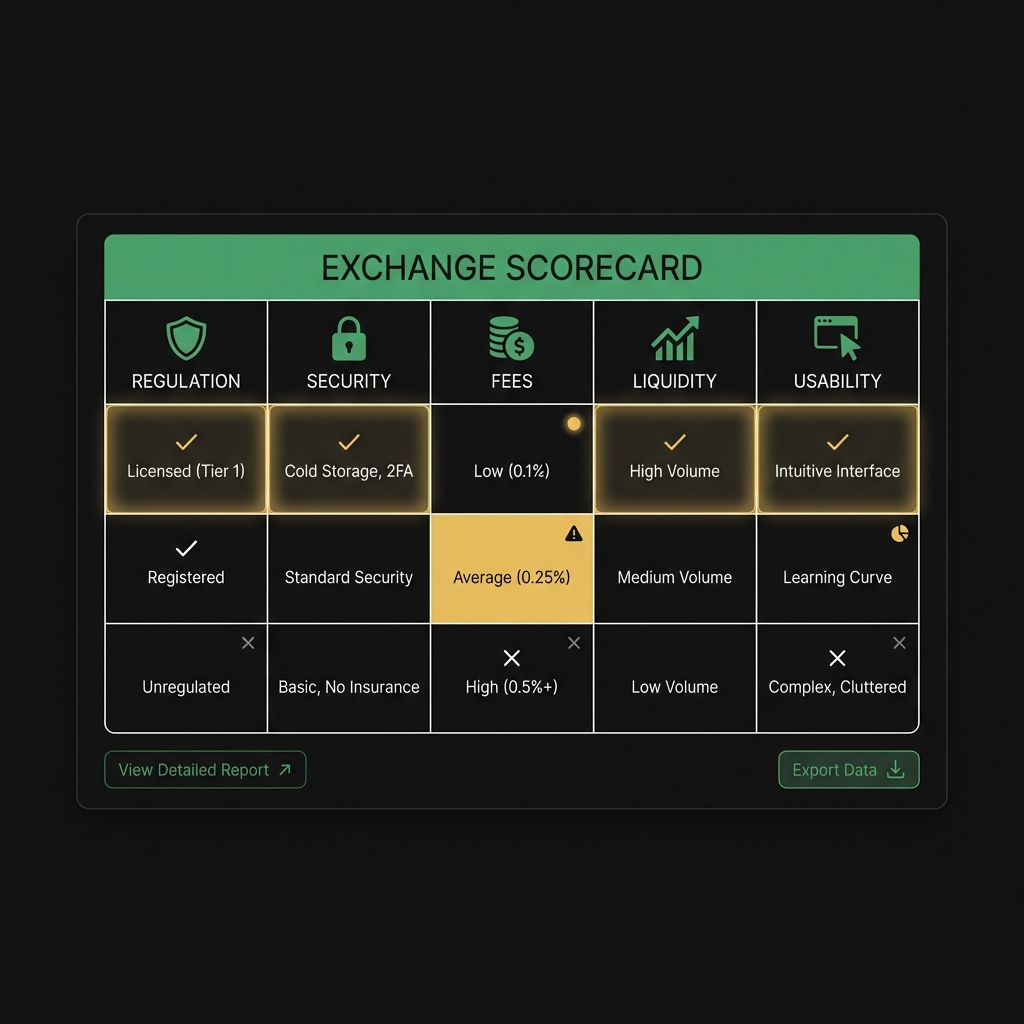
Fee structure should match your activity. Maker and taker fees, native token discounts, staking or withdrawal fees all affect costs. If you trade often, tiered maker rebates or native token discounts can change your effective costs, but those mechanics vary by platform and by the trading pair.
Liquidity and execution quality matter most for large or frequent traders. Check recent order book depth and spot volumes for the pairs you plan to trade, since volume is concentrated on the largest venues and that affects spreads and slippage Chainalysis market report.
If you are a beginner, weight regulatory clarity and fiat on ramp options higher than ultra low fees. If you are an active trader, give liquidity and fee tiers more weight. If privacy is your top priority, be aware that FATF guidance and AML frameworks constrain non KYC on ramps and shape what exchanges can offer FATF guidance on virtual assets.

As a practical rule, check primary exchange disclosures for licensing and proof of reserves before you move meaningful funds. That step helps reconcile the short list your scoring creates with real world differences in custody and auditing.
Regulation and compliance: how MiCA and FATF shape exchange choices
What MiCA means for exchanges operating in Europe
MiCA provides a unified regulatory baseline for many crypto service providers in EU member states. For users this typically means clearer license disclosures, standardized consumer protections, and defined rules for custody and stablecoin operations. When you compare platforms for European access, look for explicit references to MiCA compliance or the exchange license pages. For examples of exchanges operating with an eye to MiCA licensing see a recent list of best crypto exchanges with MiCA license.
Even outside Europe, MiCA matters because it sets expectations about transparency that other jurisdictions watch closely. Exchanges that operate in the EU often publish licensing summaries and legal notices you can review to confirm local permissions European Commission MiCA page. The ESMA analysis of market structures provides additional context for MiCA relevance ESMA report.
How FATF risk based AML/KYC limits non KYC on ramps
FATF guidance asks virtual asset service providers to apply a risk based approach to AML and KYC. That guidance pushes platforms to collect identity information or apply enhanced controls where risk indicators are present. The practical effect is that truly non KYC gateways are limited, and many privacy focused routing options face legal constraints or restricted on ramps for EU and US customers FATF guidance on virtual assets.
For readers who value privacy, that means tradeoffs. Some controls you can use include careful withdrawal limits, on chain privacy tooling where legal, and self custody. But verify local access rules and exchange terms at signup, because licensing and permissions change over time and can affect account access.
Security, custody, and transparency compared to Coinbase
Key security practices to check
Start with how an exchange stores assets. Cold storage policies, hardware security modules, and multisignature controls reduce online exposure. Also check operational controls like employee access policies and incident response plans. Firms that publish clear custody descriptions help users understand risk allocation.
Insurance language matters, but coverage scope varies. Some exchanges list third party insurance that covers specific crypto holdings, while others offer limited or no insurance. Read the terms to see what types of loss are covered, which assets are included, and whether coverage applies to customer balances or only to corporate reserves.
Independent benchmark signals to look for
Industry benchmarks and independent audits are useful verification steps. Benchmark reports highlight variation in security controls, KYC transparency, and operational maturity across centralized venues, which helps you compare practices rather than rely on marketing claims CryptoCompare exchange benchmark.
More recent rankings and research commentary can point to changes in controls or leadership, so check the latest summaries before you act. For example research that tracks security practices year to year helps you see whether a platform is improving operational controls or lagging behind peers The Block Research exchange rankings.
Fees, liquidity, and execution: where active traders differ
How fee models vary and what affects your costs
Fee models include maker and taker fees, native token discounts, withdrawal fees, and occasional promos. Which model is lowest cost depends on trade size, frequency, and whether you use a native token for discounts. Review the fee schedule for the exact pairs you use, and simulate costs for your typical trade sizes before you commit.
Withdrawal mechanics also change final costs. Some exchanges charge flat withdrawal fees for certain tokens, while others adjust fees based on network congestion. Those differences matter if you move assets often or in small amounts, so factor withdrawal costs into your calculations CoinGecko exchange fee overview.
Liquidity, spreads, and why large traders prefer certain venues
Liquidity and order book depth influence execution quality. Large traders tend to prefer venues with deeper order books and higher spot volumes because those venues usually offer tighter spreads and lower slippage. Volume concentration on a handful of exchanges affects which venues give the best fills for large orders Chainalysis liquidity analysis.
If you move large volume, check recent market data for your pairs and run small test orders to measure slippage. Fee tiers that reward volume can further lower effective costs, but you should model both fees and expected slippage for realistic comparison.
A step by step decision checklist to compare an exchange with Coinbase
Pre account checks to run
Before you sign up, verify licensing and local permissions on the exchange legal or help pages. Read custody and insurance wording, and look for proof of reserves or audit links. Check the fee schedule for the specific trading pairs you plan to use.
Record support contact options and review available KYC flows so you know how long verification typically takes. If you plan to deposit fiat, confirm the on ramp options and any intermediary bank steps that might delay or add cost.
Partner with FinancePolice to reach readers interested in crypto and personal finance
Copy this checklist into a spreadsheet or note and use it when you evaluate each exchange to keep comparisons consistent and verifiable.
See sponsorship options and reach details
Account setup and test trades
Start with a small test deposit and a small test trade. Evaluate order execution and the time it takes to confirm trades. Then test withdrawals with a modest amount to confirm network fees and timing.
Keep records of transaction IDs and customer support interactions during testing. If an issue arises, these records help you escalate effectively. Finally, review custody and insurance statements again after you complete your tests to ensure nothing material changed during setup CryptoCompare exchange benchmark.
Common mistakes people make when switching exchanges
Mistakes that cost money
One common error is estimating fees from headline numbers rather than modeling real trades. Maker or taker labels, native token discounts, and withdrawal fees can combine to raise your costs if you do not simulate typical trades. Review full fee schedules and run sample calculations before switching CoinGecko fee review.
Another costly mistake is moving large balances before testing withdrawals. Network fees, withdrawal limits, or intermediate banking steps can delay access or increase cost. Run small withdrawals first to avoid surprises.
Mistakes that risk access or privacy
Skipping KYC or relying on assumed privacy features can lead to frozen withdrawals or account limits in some jurisdictions because FATF style guidance pushes platforms to enforce risk based controls. Complete KYC only after you understand the exchange policies and any limits that apply to unverified accounts FATF guidance on virtual assets.
Also do not assume insurance covers all losses. Insurance wording is often limited in scope. Read the fine print to see what is actually covered and whether customer balances are included.
Practical examples and scenario walk throughs
Beginner with fiat deposit
A beginner who plans to deposit local currency should prioritize clear fiat rails, a simple deposit flow, and transparent custody terms. Look for platforms that publish licensing and that explain how fiat deposits are held or segregated. Also confirm expected verification timelines so you can plan your first deposit.
Active trader moving large volume
An active trader should compare order book depth, recent spot volumes for the pairs they use, and maker or taker tiers that reduce costs as volume rises. Run small live fills on candidate platforms to measure slippage and execution latency before moving larger sums Chainalysis liquidity analysis.
The best platform depends on your priorities. Beginners usually benefit from regulated exchanges with clear fiat on ramps and custody terms, active traders prioritize liquidity and fee tiers, and privacy oriented users must navigate AML and KYC constraints.
Privacy conscious user considerations
Privacy conscious users face limits from AML and KYC expectations. Some privacy preserving approaches exist, but they may be limited by legal constraints or by how an exchange implements risk controls. Consider self custody and privacy aware on chain practices, and verify exchange on ramp terms before you act.
Conclusion and next steps to choose your exchange
Summary checklist
The best platform to trade crypto depends on what you value most: regulatory clarity and fiat rails for beginners, liquidity and low execution costs for active traders, or realistic privacy options for privacy minded users. Use the five pillars to score candidates and always verify live disclosures before moving significant funds.
Next steps: copy the checklist, score two or three exchanges, run small test deposits and withdrawals, and keep records of support contacts and transaction IDs. Treat comparisons as time sensitive and recheck liquidity and license disclosures before any major move CryptoCompare exchange benchmark.
Focus on licensing, custody terms, proof of reserves, and independent benchmark reports. Start with small deposits and test withdrawals before moving larger amounts.
It can, but savings depend on your trade size, frequency, and whether you use native token discounts or hit fee tiers. Model your typical trades before switching.
Global AML guidance limits non KYC on ramps for many users. Consider self custody and privacy aware on chain practices and verify legal access in your jurisdiction.
References
- https://financepolice.com/category/crypto/
- https://finance.ec.europa.eu/publications/markets-crypto-assets-regulation_en
- https://www.atlanticcouncil.org/programs/geoeconomics-center/cryptoregulationtracker/
- https://www.cryptocompare.com/industry-expertise/centralized-exchange-benchmark/
- https://blog.chainalysis.com/reports/2024-crypto-market-report/
- https://www.fatf-gafi.org/publications/fatfrecommendations/documents/guidance-rba-virtual-assets.html
- https://www.esma.europa.eu/sites/default/files/2024-04/ESMA50-524821-3153_risk_article_crypto_assets_market_structures_and_eu_relevance.pdf
- https://www.theblock.co/research/centralized-exchange-rankings-2025
- https://www.coingecko.com/en/reports/exchange-review-2024
- https://financepolice.com/advertise/
- https://beincrypto.com/top-picks/best-crypto-exchanges-mica-license/
- https://financepolice.com/coinbase-acquires-the-clearing-company-strategic-boost-to-prediction-markets-in-2025/
- https://financepolice.com/
You May Also Like

In ‘Running With Scissors,’ Cavetown learns to accept that risk is in everything

EUR/CHF slides as Euro struggles post-inflation data