PANews reported on January 31st that Binance released a review report on the market flash crash on October 11th, 2025. The report stated that the main drivers ofPANews reported on January 31st that Binance released a review report on the market flash crash on October 11th, 2025. The report stated that the main drivers of

Binance released a report on the "1011" market crash, acknowledging two technical glitches, but stating they were not the main cause of the decline.

2026/01/31 08:56
2 min read

PANews reported on January 31st that Binance released a review report on the market flash crash on October 11th, 2025. The report stated that the main drivers of the market turmoil on October 11th, 2025, included macroeconomic shocks, market maker risk control mechanisms, and Ethereum network congestion. Individual platform issues were not the cause of the flash crash. The widely mentioned de-pegging of three tokens (USDe, BNSOL, and WBETH) occurred at 05:36 (UTC+8), later than the most volatile market window of 05:10–05:20 (UTC+8), and approximately 75% of the liquidations that day had already occurred before these three tokens de-pegged. The main driving factor for this event was the overall market-wide risk aversion and the market chain reaction triggered by liquidations, rather than individual platform anomalies. Throughout the entire process, Binance's core matching engine, risk verification, and liquidation systems remained stable and uninterrupted.

In the report, Binance acknowledged two technical glitches that day: First, during the concentrated market sell-off from 05:18 to 05:5 (UTC+8), Binance's asset transfer subsystem experienced a performance degradation of approximately 33 minutes, affecting some users' fund transfers between spot, wealth management, and futures accounts. The matching, risk control, and clearing systems continued to operate normally. The fact that some users saw their balances displayed as "0" was due to a front-end rollback display issue and not an asset loss. Second, during the period from 05:36 to 06:15 (UTC+8), with declining market order book depth, on-chain congestion, and a slowdown in cross-platform rebalancing, the USDe, WBETH, and BNSOL indices showed abnormal deviations. The report stated that when liquidity was thin and cross-platform fund flows slowed, price fluctuations within the platform accounted for an excessively high proportion in the index calculation.

Disclaimer: The articles reposted on this site are sourced from public platforms and are provided for informational purposes only. They do not necessarily reflect the views of MEXC. All rights remain with the original authors. If you believe any content infringes on third-party rights, please contact service@support.mexc.com for removal. MEXC makes no guarantees regarding the accuracy, completeness, or timeliness of the content and is not responsible for any actions taken based on the information provided. The content does not constitute financial, legal, or other professional advice, nor should it be considered a recommendation or endorsement by MEXC.

You May Also Like

Once Upon a Farm Announces Pricing of Initial Public Offering

Once Upon a Farm Announces Pricing of Initial Public Offering

BERKELEY, Calif.–(BUSINESS WIRE)–Once Upon a Farm today announced the pricing of its initial public offering of 10,997,209 shares of its common stock, 7,631,537
Share
AI Journal2026/02/06 08:15
Forward Industries Bets Big on Solana With $4B Capital Plan
Forward Industries Bets Big on Solana With $4B Capital Plan

The firm has filed with the U.S. Securities and Exchange Commission to launch a $4 billion at-the-market (ATM) equity program, […] The post Forward Industries Bets Big on Solana With $4B Capital Plan appeared first on Coindoo.
Share
Coindoo2025/09/18 04:15
332M accounts and $28B TVL,

332M accounts and $28B TVL,

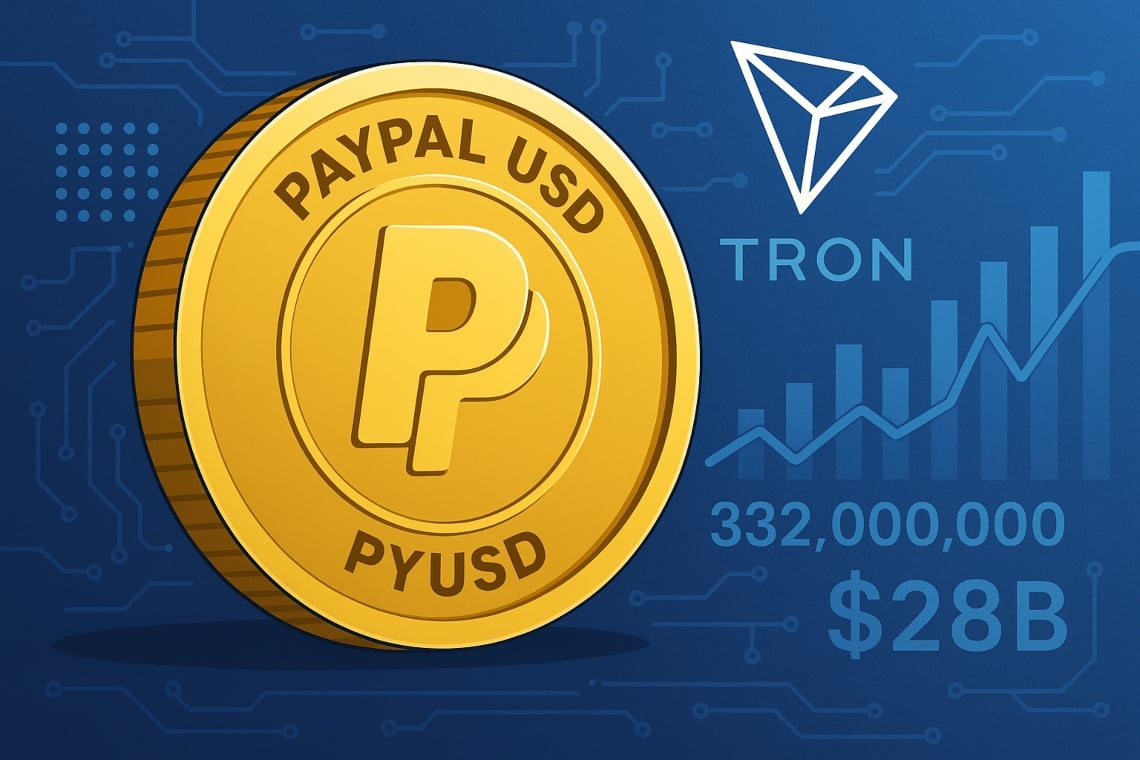
The post 332M accounts and $28B TVL, appeared on BitcoinEthereumNews.com. PayPal USD debuts on TRON as a permissionless token PYUSD0, enabled by LayerZero’s OFT standard and the Stargate Hydra extension. The announcement on September 18, 2025 (Geneva) introduces native interoperability between chains and transfers without manual steps for users; the news echoes elements already communicated by PayPal at the launch of PYUSD PayPal Newsroom. The move concerns an ecosystem that includes 332 million accounts and over $28 billion in TVL. In this context, the fungibility of a stablecoin regulated across multiple networks and the use of TRON as a settlement layer for payments and remittances is at stake. According to the data collected by TRONSCAN updated as of September 18, 2025, the network metrics confirm the cited volumes and highlighted traffic patterns. Our editorial team has verified the transaction logs and monitored the public chain metrics to corroborate the reported figures; the observations on daily flows and TVL are consistent with the network dashboards. Industry analysts observe that the entry of a regulated issuer like PayPal tends to increase institutional interest, provided there is transparency on reserves and compliance checks. What is PYUSD0 on TRON and why is it relevant PYUSD0 is the representation of PayPal USD on TRON. It is pegged one-to-one to PYUSD through the OFT standard: the two tokens remain a single stablecoin, fungible and reconciled across chains. The integration is made possible by Stargate Hydra, now operational through LayerZero. According to the founder of TRON, Justin Sun, the extension on TRON expands access and trust for users and institutions. For Bryan Pellegrino (CEO of LayerZero Labs), stablecoins represent a pillar of global payments and remittances, as the native compatibility between chains enables their operational scalability. It must be said that the alignment between issuer, cross-chain infrastructure, and settlement network is a key element. Key Numbers: TRON…
Share
BitcoinEthereumNews2025/09/19 08:18