A fresh debate in the XRP Ledger (XRPL) community is converging on a specific “golden ticket” thesis: XRP’s breakout utility case won’t come from narratives, butA fresh debate in the XRP Ledger (XRPL) community is converging on a specific “golden ticket” thesis: XRP’s breakout utility case won’t come from narratives, but

XRP’s ‘Golden Ticket’ Might Not Be What You Think, Expert Says

2026/01/29 07:30
3 min read

A fresh debate in the XRP Ledger (XRPL) community is converging on a specific “golden ticket” thesis: XRP’s breakout utility case won’t come from narratives, but from plumbing: Ripple’s regulated payments stack sourcing liquidity directly from the on-chain XRPL DEX, and Ripple Prime settling institutional flow on-ledger.

The XRP Golden Ticket Theory

The idea surfaced in an exchange on X after one user, Alex Cobb, a well-known commentator within the XRP community, argued that US market-structure legislation, the CLARITY Act, is “XRPs golden ticket.” Another renowned community member, Krippenreiter, pushed the focus back on product rails rather than policy catalysts: “Personally I think Ripple Payments sourcing liquidity from the onchain XRPL DEX and Ripple Prime settling post trade on the XRP Ledger are XRPs golden tickets.”

Krippenreiter clarified that the phrasing tracks what Ripple has previously messaged about how it intends to use the XRPL in institutional contexts. “The ideal is to do everything on-chain, so yes. Anything happening on-chain settles on XRPL,” they wrote, adding: “I said ‘post-trade settlement’ because that’s what Ripple initially publicly stated for what they plan on using XRPL for.”

That distinction matters because routing liquidity through a public DEX, especially for regulated entities, creates a different compliance surface than using a ledger as a settlement layer after execution happens elsewhere. In the thread, attorney Bill Morgan framed the gating issue bluntly: “Eventually, once it can source liquidity from the XRPL DEX without risk of regulatory non-compliance.”

Others pointed to Permissioned Domains and a permissioned DEX construct as the major blocker for regulated liquidity sourcing, with Krippenreiter describing “credentials,” “permissioned domain,” and “permissioned dex” as the solution set. Morgan noted the implication extends beyond Ripple: if that’s a blocker for Ripple, “it will be a block for any other institution that may wish to use the XRPL DEX.”

Notably, the Permissioned Domains amendment is on track to go live next week, XRPScan shows 27 of 34 validator votes (88.24% consensus) and an estimated activation time of Feb. 4, 2026 at 09:57:51 UTC, provided it remains above the required threshold through the enablement window.
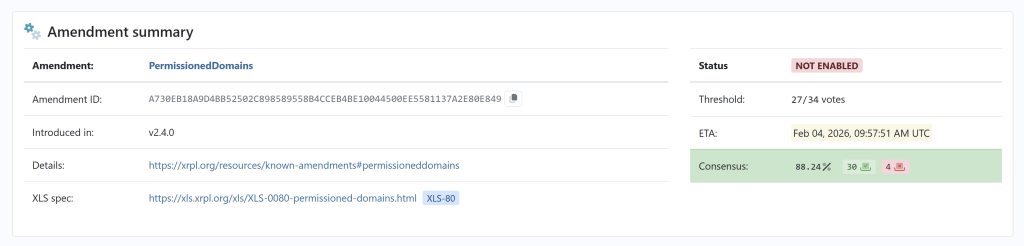
XRPScan

The same thread pulled Ripple Prime into the picture. Luke Judges (middle management at Ripple) said, “Prime underrated, we need more CEXs to support XRPL inventory. Working on it.”

Krippenreiter suggested that, beyond exchange inventory, privacy could be the other hard prerequisite for Prime’s deeper XRPL integration, calling it “the blocker” in circulating rumors.

That maps onto Ripple’s own public framing: in an October 2 post, Ripple engineering leader J. Ayo Akinyele argued that “finance cannot function without confidentiality, yet blockchains are built on transparency,” and that institutional-grade adoption requires privacy that still supports compliance.

Akinyele put the institutional constraint in plain terms: “Without privacy, financial institutions cannot safely use public ledgers for core workflows. Without accountability, regulators cannot sign off. With programmable privacy, we can have both.”

The discussion landed just as Ripple and GTreasury rolled out “Ripple Treasury,” positioning it as enterprise treasury infrastructure that blends traditional cash operations with digital-asset rails.

At press time, XRP traded at $1.9256.
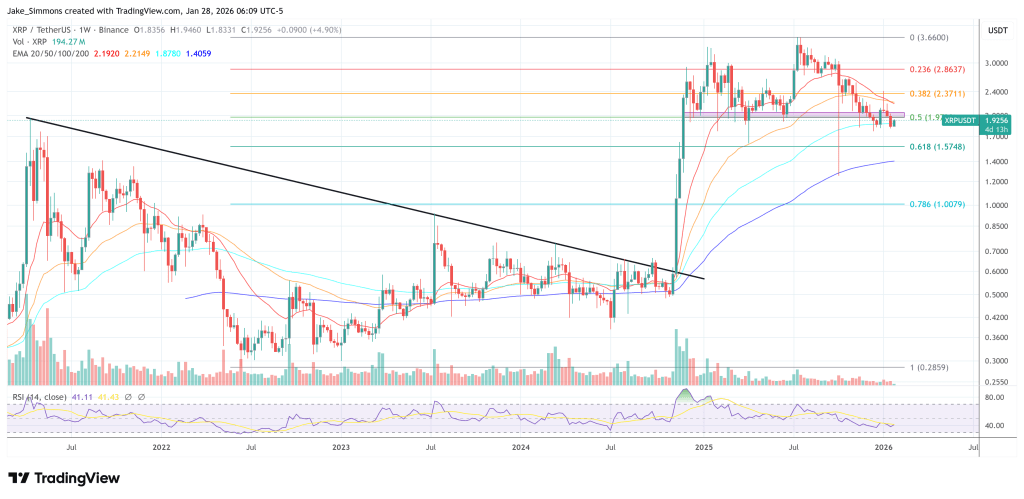
XRP price chart
Disclaimer: The articles reposted on this site are sourced from public platforms and are provided for informational purposes only. They do not necessarily reflect the views of MEXC. All rights remain with the original authors. If you believe any content infringes on third-party rights, please contact service@support.mexc.com for removal. MEXC makes no guarantees regarding the accuracy, completeness, or timeliness of the content and is not responsible for any actions taken based on the information provided. The content does not constitute financial, legal, or other professional advice, nor should it be considered a recommendation or endorsement by MEXC.

You May Also Like

XRP Enters ‘Washout Zone,’ Then Targets $30, Crypto Analyst Says
XRP Enters ‘Washout Zone,’ Then Targets $30, Crypto Analyst Says

XRP has entered what Korean Certified Elliott Wave Analyst XForceGlobal (@XForceGlobal) calls a “washout” phase inside a broader Elliott Wave corrective structure
Share
NewsBTC2026/02/05 08:00
Republicans are 'very concerned about Texas' turning blue: GOP senator

Republicans are 'very concerned about Texas' turning blue: GOP senator

While Republicans in the U.S. House of Representatives have a razor-thin with just a four-seat advantage, their six-seat advantage in the U.S. Senate is seen as
Share
Alternet2026/02/05 08:38
Headwind Helps Best Wallet Token

Headwind Helps Best Wallet Token

The post Headwind Helps Best Wallet Token appeared on BitcoinEthereumNews.com. Google has announced the launch of a new open-source protocol called Agent Payments Protocol (AP2) in partnership with Coinbase, the Ethereum Foundation, and 60 other organizations. This allows AI agents to make payments on behalf of users using various methods such as real-time bank transfers, credit and debit cards, and, most importantly, stablecoins. Let’s explore in detail what this could mean for the broader cryptocurrency markets, and also highlight a presale crypto (Best Wallet Token) that could explode as a result of this development. Google’s Push for Stablecoins Agent Payments Protocol (AP2) uses digital contracts known as ‘Intent Mandates’ and ‘Verifiable Credentials’ to ensure that AI agents undertake only those payments authorized by the user. Mandates, by the way, are cryptographically signed, tamper-proof digital contracts that act as verifiable proof of a user’s instruction. For example, let’s say you instruct an AI agent to never spend more than $200 in a single transaction. This instruction is written into an Intent Mandate, which serves as a digital contract. Now, whenever the AI agent tries to make a payment, it must present this mandate as proof of authorization, which will then be verified via the AP2 protocol. Alongside this, Google has also launched the A2A x402 extension to accelerate support for the Web3 ecosystem. This production-ready solution enables agent-based crypto payments and will help reshape the growth of cryptocurrency integration within the AP2 protocol. Google’s inclusion of stablecoins in AP2 is a massive vote of confidence in dollar-pegged cryptocurrencies and a huge step toward making them a mainstream payment option. This widens stablecoin usage beyond trading and speculation, positioning them at the center of the consumption economy. The recent enactment of the GENIUS Act in the U.S. gives stablecoins more structure and legal support. Imagine paying for things like data crawls, per-task…
Share
BitcoinEthereumNews2025/09/18 01:27