These Key Bitcoin On-Chain Metrics Suggest BTC Has Not Yet Reached Its Bottom
As Bitcoin’s price continues to face downside pressure and performance, speculation about BTC’s price bottom has grown significantly within the sector or community. However, to accurately determine whether BTC has reached a bottom is highly dependent on on-chain data from several metrics, which are now showing that the bottom is not yet in.
Bitcoin May Not Be Done Correcting
Determining the Bitcoin price bottom has become quite difficult in the ongoing market cycle. In the meantime, several key on-chain metrics are flashing caution and showing data that suggests that the flagship cryptocurrency asset may not have fully found its bottom yet for this market cycle.
After an on-chain analysis, Alphractal, an advanced investment and on-chain data platform, outlined that the BTC market is witnessing steady bleeding, but the true bottom has not been achieved yet. The platform’s analysis is focused mainly on two key metrics, which include the BTC Net Unrealized Profit/Loss (NUPL) and the BTC Delta Growth Rate (Market Cap vs. Realized Cap).
These indications suggest that the market may still be dealing with excess supply and uncertainty, as evidenced by the ongoing pullback in BTC’s price. With the bearish signal from the two indicators, it is clear that the confirmation of a true bottom could need extended data-driven validation or more time.
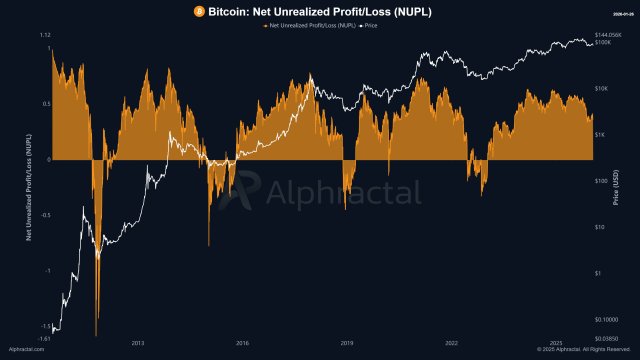
As seen on the chart, the Net Unrealized Profit/Loss metric has started to drop, suggesting that unrealized gains across the network are starting to compress. In spite of the decline, the metric is still in positive territory. This implies that market participants continue to remain in profits rather than losses.
Alphractal highlighted that the true cycle bottom historically only unfolds once the metric flips negative, entering full capitulation mode. Meanwhile, the BTC Delta Growth Rate is already demonstrating negative movement, signaling the end of speculative activity and the start of the fundamental accumulation phase.
Bearish Outlook Has Intensified Along With BTC’s Price Drop
Following a pullback last weekend, the Bitcoin price is now trading below the $90,000 mark again. According to Swissblock, an investment pioneer, recent price action has reinforced the bearish outlook of the market.
As the crypto king loses key support at the $89,200 level, the Bitcoin Risk Index is seeing a steady climb, heightening the general bearish sentiment. However, the platform noted that Bitcoin bulls are persistently holding a critical line of defense at the $84,500 mark, which is currently serving as the immediate target for the downside. Swissblock has outlined two separate scenarios that could play out in the upcoming sessions.
For the bullish case, the platform predicts that if the $84,500 support holds, a liquidity sweep could occur at this point. At the same time, the Risk Index begins to cool off, channeling a high-conviction entry for long positioning. Breaking down the bearish scenario, Swissblock noted that a decline and consolidation below the $84,500 level would likely spark a deeper correction, targeting new lows below the November levels with a primary target at $74,000.
You May Also Like

YZi Labs Binance Deposit: A $6.63M Signal That Could Shake the ID Token Market

BitGo wins BaFIN nod to offer regulated crypto trading in Europe
BitGo’s move creates further competition in a burgeoning European crypto market that is expected to generate $26 billion revenue this year, according to one estimate. BitGo, a digital asset infrastructure company with more than $100 billion in assets under custody, has received an extension of its license from Germany’s Federal Financial Supervisory Authority (BaFin), enabling it to offer crypto services to European investors. The company said its local subsidiary, BitGo Europe, can now provide custody, staking, transfer, and trading services. Institutional clients will also have access to an over-the-counter (OTC) trading desk and multiple liquidity venues.The extension builds on BitGo’s previous Markets-in-Crypto-Assets (MiCA) license, also issued by BaFIN, and adds trading to the existing custody, transfer and staking services. BitGo acquired its initial MiCA license in May 2025, which allowed it to offer certain services to traditional institutions and crypto native companies in the European Union.Read more