Bitcoin is hovering at a critical demand zone as the market braces for the possibility of further downside. After losing the $87,000 level, price action remainsBitcoin is hovering at a critical demand zone as the market braces for the possibility of further downside. After losing the $87,000 level, price action remains

Bitcoin Breaks Below $87K As Political Risk Spikes – Liquidations Reveal The Real Driver

2026/01/27 11:00
4 min read

Bitcoin is hovering at a critical demand zone as the market braces for the possibility of further downside. After losing the $87,000 level, price action remains fragile, with buyers struggling to regain control and sell-side pressure intensifying during rebounds. The broader risk-off mood frames the latest drop as a response to growing macro uncertainty rather than a purely technical move.

Rising political instability in the United States appears to have acted as the near-term trigger. Prediction markets now place the probability of a new government shutdown at roughly 78%, with federal funding set to expire on January 30, 2026. As bipartisan negotiations stall, political risk is once again being priced into markets, weighing on sentiment and pushing traders toward defensive positioning.

In this environment, Bitcoin broke below $87,000 and sparked a fast liquidation cascade. Data shows that around $170 million in leveraged long positions were wiped out within 60 minutes, with total long liquidations reaching roughly $320 million over the following four hours. Nearly $40 billion in total crypto market value vanished in a short span, highlighting how quickly volatility can expand when liquidity is thin.

The speed and structure of the move suggest a derivatives-driven deleveraging event rather than broad spot capitulation. That distinction matters because it implies the next phase will depend on whether forced selling fades and real demand returns at this level.

Liquidations And OI Reveal A Deleveraging-Led Drop

A report from XWIN Research Japan explains that Bitcoin’s latest flush was likely amplified by a wave of forced liquidations in the derivatives market. Liquidations occur when futures positions fall below their maintenance margin and are automatically closed by exchanges to prevent further losses. In this case, a large share of the risk was concentrated in leveraged long positions, which are commonly used by short-term traders as well as hedging and arbitrage participants.

Bitcoin Open Interest | Source: CryptoQuant

Many of these longs were positioned for a renewed 2026 uptrend, making the market vulnerable once the price slipped under key support. When the decline accelerated, liquidation orders hit the books as market sells. Which can intensify downside moves in thin liquidity environments.

To understand whether this was a structural shift or simply a leverage reset, XWIN points to Open Interest (OI). OI measures the total size of outstanding futures contracts and reflects how much leverage remains embedded in the market. When price falls alongside declining OI, it typically signals that position unwinds and liquidations are driving the move rather than a sudden change in fundamentals.

On-chain estimates place aggregate OI near $28.4 billion. Well below the roughly $47 billion peak in late 2025, showing that leverage had already reduced. Still, OI has stabilized and slightly rebounded in early 2026, leaving room for volatility during corrections.

The key is what comes next: whether selling fades, spot demand absorbs supply, and leverage normalizes as participation returns.

Bitcoin Slides As Key Moving Averages Turn Into Resistance

Bitcoin is trading near $87,820 after a steady decline that has kept the price pinned below $90,000. The structure shows BTC losing momentum after failing to hold the mid-January breakout toward $98,000. Followed by a sharp reversal that shifted market control back to sellers. Since that rejection, price has printed a sequence of lower highs, with selloffs accelerating each time BTC attempts to reclaim overhead levels.
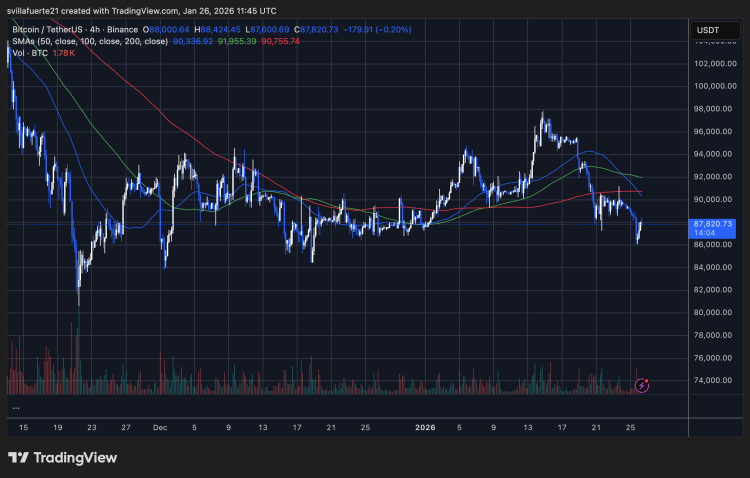
BTC facing selling pressure | Source: BTCUSDT chart on TradingView

From a trend perspective, the moving averages highlight how the short-term regime has flipped bearish. BTC is now trading below the 50-period moving average (blue) near $90,300 and below the 100-period moving average (green) around $91,955, both of which are sloping downward.

These levels are now acting as dynamic resistance, reinforcing the idea that traders are selling rallies. The 200-period moving average (red) sits close to $90,756, creating a tight resistance cluster between $90.3K and $92K. Bulls must reclaim this cluster to rebuild momentum.

Support is developing around the $87K–$88K zone, which has acted as a short-term demand pocket during prior pullbacks. If buyers fail to defend this area, downside risk opens toward $86,000 and potentially the mid-$84K range. BTC needs a clean reclaim of $90K, followed by consolidation above the moving-average band. Signaling that demand is returning with strength.

Featured image from ChatGPT, chart from TradingView.com 

Disclaimer: The articles reposted on this site are sourced from public platforms and are provided for informational purposes only. They do not necessarily reflect the views of MEXC. All rights remain with the original authors. If you believe any content infringes on third-party rights, please contact service@support.mexc.com for removal. MEXC makes no guarantees regarding the accuracy, completeness, or timeliness of the content and is not responsible for any actions taken based on the information provided. The content does not constitute financial, legal, or other professional advice, nor should it be considered a recommendation or endorsement by MEXC.

You May Also Like

Dramatic Spot Crypto ETF Outflows Rock US Market

Dramatic Spot Crypto ETF Outflows Rock US Market

BitcoinWorld Dramatic Spot Crypto ETF Outflows Rock US Market The cryptocurrency market is always buzzing with activity, and recent developments surrounding US spot Bitcoin and Ethereum ETFs have certainly grabbed attention. After a brief period of inflows, these prominent investment vehicles experienced a significant reversal, recording notable Spot Crypto ETF Outflows on September 22. This shift has sparked discussions among investors and analysts alike, prompting a closer look at what drove these movements and their potential implications for the broader digital asset landscape. What Triggered These Dramatic Spot Crypto ETF Outflows? On September 22, both US spot Bitcoin and Ethereum ETFs collectively observed net outflows, effectively ending a two-day streak of positive inflows. This sudden reversal indicates a potential shift in investor sentiment or market dynamics. Understanding the specifics of these Spot Crypto ETF Outflows is crucial for anyone tracking the pulse of the crypto market. Data from Trader T revealed that spot Bitcoin ETFs alone registered total net outflows amounting to $363.17 million. This substantial figure highlights a notable selling pressure across several key funds. Fidelity’s FBTC led the pack with $276.68 million in outflows. Ark Invest’s ARKB followed, seeing $52.30 million depart. Grayscale’s GBTC, a long-standing player, recorded $24.65 million in outflows. VanEck’s HODL also contributed with $9.54 million. Interestingly, BlackRock’s IBIT and several other funds reported zero flows on this particular day, indicating a concentrated selling activity in specific products rather than a market-wide exodus. How Did Ethereum ETFs Respond to the Spot Crypto ETF Outflows? The trend of net outflows wasn’t limited to Bitcoin. Spot Ethereum ETFs also faced considerable pressure, collectively experiencing $76.06 million in net outflows during the same period. This indicates a broader market sentiment affecting both major cryptocurrencies. Fidelity’s FETH accounted for $33.12 million of the outflows. Bitwise’s ETHW saw $22.30 million withdrawn. BlackRock’s ETHA registered $15.19 million in outflows. Grayscale’s Mini ETH contributed $5.45 million to the total. These figures underscore that while Bitcoin ETFs saw larger absolute outflows, Ethereum ETFs also experienced a significant cooling of investor interest. Such synchronized movements often suggest overarching market factors rather than isolated fund-specific issues. What Are the Broader Implications of These Spot Crypto ETF Outflows? The reversal from inflows to substantial Spot Crypto ETF Outflows could signal a few things. It might reflect profit-taking by investors after recent market rallies, or it could indicate a cautious stance due to macroeconomic uncertainties. Moreover, such movements can influence market sentiment, potentially leading to increased volatility in the short term. For investors, monitoring these ETF flows provides valuable insights into institutional and retail sentiment. Significant outflows can sometimes precede price corrections, offering an opportunity for strategic re-evaluation. Conversely, sustained inflows often suggest growing confidence in digital assets. It is important to remember that ETF flows are just one metric among many. A holistic view, considering on-chain data, macroeconomic indicators, and regulatory news, is essential for making informed decisions in the dynamic crypto space. These Spot Crypto ETF Outflows serve as a reminder of the market’s inherent volatility and the need for continuous vigilance. In summary, the recent dramatic Spot Crypto ETF Outflows from US Bitcoin and Ethereum funds mark a notable shift in the investment landscape. While a two-day inflow streak was broken, these movements are a natural part of a maturing market. They highlight the ebb and flow of investor confidence and the dynamic nature of digital asset investments. As the market continues to evolve, keeping a close eye on these ETF trends will remain crucial for understanding broader sentiment and potential future directions. Frequently Asked Questions (FAQs) Q1: What does “net outflows” mean for crypto ETFs? A1: Net outflows occur when investors redeem more shares from an ETF than they purchase, indicating more money is leaving the fund than entering it. Q2: Which US spot Bitcoin ETFs saw the largest outflows? A2: Fidelity’s FBTC led with $276.68 million in outflows, followed by Ark Invest’s ARKB and Grayscale’s GBTC, contributing significantly to the overall Spot Crypto ETF Outflows. Q3: Were Ethereum ETFs also affected by outflows? A3: Yes, US spot Ethereum ETFs experienced $76.06 million in net outflows, with Fidelity’s FETH and Bitwise’s ETHW being major contributors. Q4: What do these Spot Crypto ETF Outflows suggest about market sentiment? A4: They can suggest a shift towards profit-taking, increased caution due to macroeconomic factors, or a temporary cooling of investor interest in digital assets. Did you find this analysis of Spot Crypto ETF Outflows insightful? Share this article with your network on social media to help others understand the latest trends in the crypto ETF market and contribute to informed discussions! To learn more about the latest crypto market trends, explore our article on key developments shaping Bitcoin and Ethereum institutional adoption. This post Dramatic Spot Crypto ETF Outflows Rock US Market first appeared on BitcoinWorld.
Share
Coinstats2025/09/23 10:55
Remittix Success Leads To Rewarding Presale Investors With 300% Bonus – Here’s How To Get Involved

Remittix Success Leads To Rewarding Presale Investors With 300% Bonus – Here’s How To Get Involved

Besides its enormous presale success, Remittix is also extending a 300% bonus to early purchasers. This temporary bonus can be […] The post Remittix Success Leads
Share
Coindoo2026/02/07 16:39
Korean Crypto Exchange Bithumb Accidentally Gives Away Millions in Bitcoin During Promotion

Korean Crypto Exchange Bithumb Accidentally Gives Away Millions in Bitcoin During Promotion

TLDR Bithumb accidentally sent excess Bitcoin to customers during a promotional “Random Box” event in South Korea Some users reportedly received 2,000 BTC ($139
Share
Coincentral2026/02/07 16:39