This is why massive crypto fundraising rounds often lead to token price crashes, and why high launch valuation isn’t a guarantee of success. Historically speakingThis is why massive crypto fundraising rounds often lead to token price crashes, and why high launch valuation isn’t a guarantee of success. Historically speaking

Why Big Crypto Fundraising Often Leads to Price Crashes

3 min read

This is why massive crypto fundraising rounds often lead to token price crashes, and why high launch valuation isn’t a guarantee of success.

Historically speaking, in the crypto space, massive fundraising rounds where investors raise hundreds of millions are often treated as a victory.

When a project announces that it has secured 100 million, 500 million or even a billion in capital, the retail market usually reacts violently. 

Most people think that if smart money is pouring in, the token must be destined for success. However, historical data tells a much darker story.

The Illusion of a Big Crypto Fundraising Round

Fundraising has always been the main way people judge a project. We see a headline about a project raising $500 million, and our brains compare that capital with guaranteed profit. 

However, in the crypto space, capital is a double-edged sword. While having a large treasury provides the money to build properly, it also creates a massive valuation problem. 

This is because when a project raises a multi-billion-dollar valuation with in-house investors, the public market has very little room left for growth. 

By the time the token hits the average retailer’s wallet, the price pump has often already happened.

Token Performance After Huge Raises

To understand the relationship between fundraising and performance, let’s look at the numbers.

These are some of the biggest fundraisers in history, and the results are flashing a majorwarning for any investor.

The FTT token raised $1.75 billion and is down by around 97%. Celsius’ token ($CEL) raised $908 million and is currently down 99%.

And finally, the flow token raised $747 million and is down by 97%

The only exceptions are Ripple and Solana, which raised $795 million and $360 million, respectively.

As of writing, XRP is up 6000% while Solana is up 5000%.

The trend already presents itself at this point, because three out of the five largest fundraisers resulted in near-total losses for token holders. 

This begs the question: If a project has nearly a billion dollars in the bank, then why does its token price collapse? 

It turns out that there are specific reasons for this.

The Venture Capital Exit Liquidity Trap

When venture capitalists invest $100 million into a project, they want a massive profit. So in order to achieve this, the project tends to launch with a high valuation. 

If the project is over-funded, the circulating supply at launch is usually small (becaue the whales have bought it all). And as these tokens unlock, these early backers start to take profits. 

Retail investors then come later, lured in by the big raise headlines and end up becoming the exit liquidity for the professionals.

Related Reading: $11M Raised, Then Everything Changed: Why Trove Is Now Under Fire

The Burden of High Expectations

A project that raises $10 million can afford to fail and experiment. However, a project that raises $1 billion is under a microscope as people expect it to deliver a world-changing ecosystem immediately. 

When the tech hits delays or the user base doesn’t scale fast, the price crashes and reality eventually catches up to the hype.

Another issue is the mismanagement that tends to come with excessive capital.

The FTX collapse was a major example of this because when money is too easy to get, discipline vanishes. 

Because of this, instead of focusing on core development, funds go into aggressive marketing or celebrity endorsements. In some cases, they even lead to risk-taking that destroys the project’s balance sheet.

The post Why Big Crypto Fundraising Often Leads to Price Crashes appeared first on Live Bitcoin News.

Disclaimer: The articles reposted on this site are sourced from public platforms and are provided for informational purposes only. They do not necessarily reflect the views of MEXC. All rights remain with the original authors. If you believe any content infringes on third-party rights, please contact service@support.mexc.com for removal. MEXC makes no guarantees regarding the accuracy, completeness, or timeliness of the content and is not responsible for any actions taken based on the information provided. The content does not constitute financial, legal, or other professional advice, nor should it be considered a recommendation or endorsement by MEXC.

You May Also Like

Three dormant wallets, suspected to belong to the same entity, purchased 5,970 ETH eight hours ago.

Three dormant wallets, suspected to belong to the same entity, purchased 5,970 ETH eight hours ago.

PANews reported on February 4 that, according to Lookonchain monitoring, three wallets that had been dormant for four years (likely controlled by the same entity
Share
PANews2026/02/04 11:36
BlackRock Increases U.S. Stock Exposure Amid AI Surge
BlackRock Increases U.S. Stock Exposure Amid AI Surge

The post BlackRock Increases U.S. Stock Exposure Amid AI Surge appeared on BitcoinEthereumNews.com. Key Points: BlackRock significantly increased U.S. stock exposure. AI sector driven gains boost S&P 500 to historic highs. Shift may set a precedent for other major asset managers. BlackRock, the largest asset manager, significantly increased U.S. stock and AI sector exposure, adjusting its $185 billion investment portfolios, according to a recent investment outlook report.. This strategic shift signals strong confidence in U.S. market growth, driven by AI and anticipated Federal Reserve moves, influencing significant fund flows into BlackRock’s ETFs. The reallocation increases U.S. stocks by 2% while reducing holdings in international developed markets. BlackRock’s move reflects confidence in the U.S. stock market’s trajectory, driven by robust earnings and the anticipation of Federal Reserve rate cuts. As a result, billions of dollars have flowed into BlackRock’s ETFs following the portfolio adjustment. “Our increased allocation to U.S. stocks, particularly in the AI sector, is a testament to our confidence in the growth potential of these technologies.” — Larry Fink, CEO, BlackRock The financial markets have responded favorably to this adjustment. The S&P 500 Index recently reached a historic high this year, supported by AI-driven investment enthusiasm. BlackRock’s decision aligns with widespread market speculation on the Federal Reserve’s next moves, further amplifying investor interest and confidence. AI Surge Propels S&P 500 to Historic Highs At no other time in history has the S&P 500 seen such dramatic gains driven by a single sector as the recent surge spurred by AI investments in 2023. Experts suggest that the strategic increase in U.S. stock exposure by BlackRock may set a precedent for other major asset managers. Historically, shifts of this magnitude have influenced broader market behaviors as others follow suit. Market analysts point to the favorable economic environment and technological advancements that are propelling the AI sector’s momentum. The continued growth of AI technologies is…
Share
BitcoinEthereumNews2025/09/18 02:49
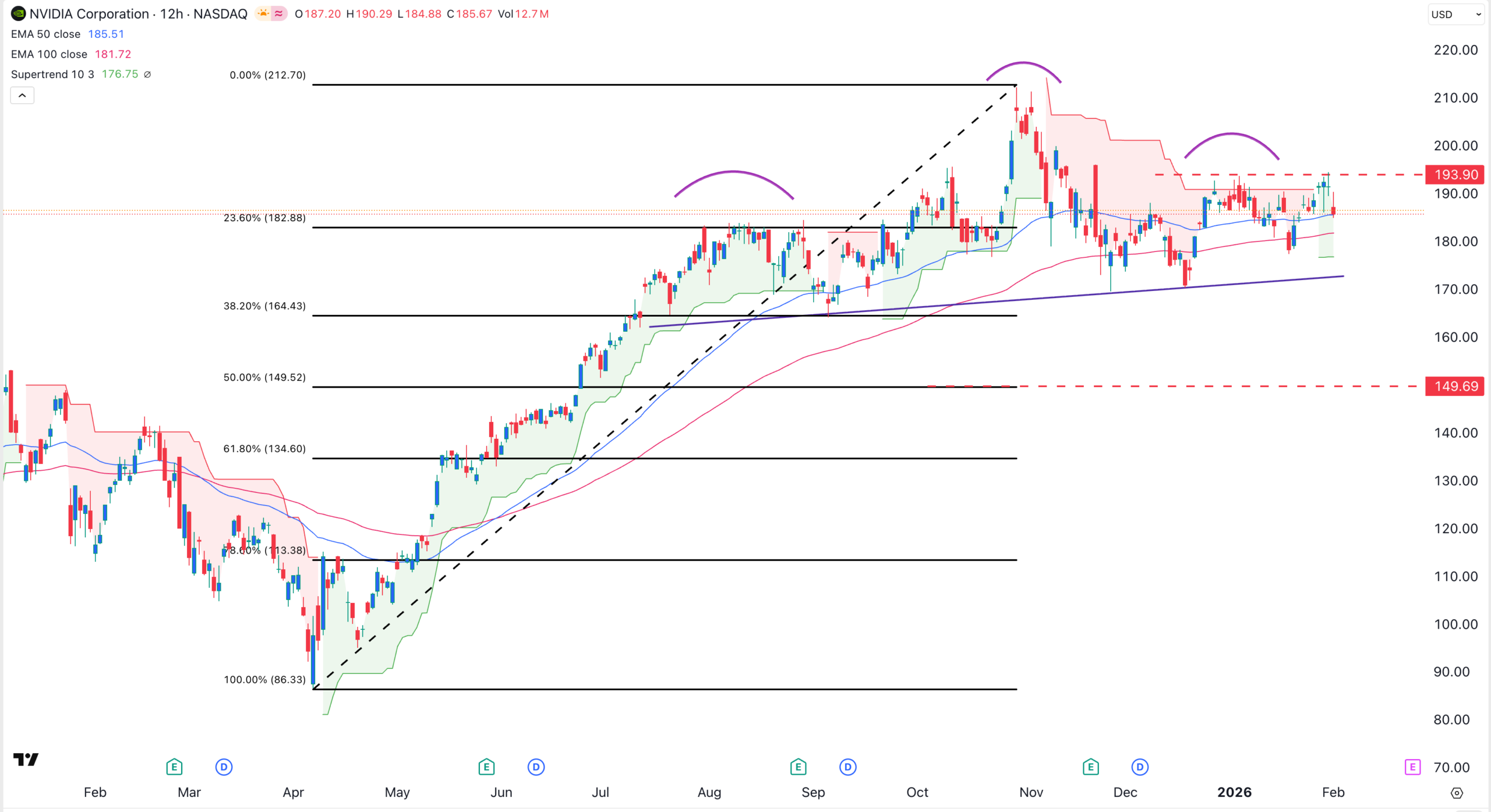
NVIDIA Stock Price Analysis as OpenAI Issues Concerns About its Chips

NVIDIA Stock Price Analysis as OpenAI Issues Concerns About its Chips

Key Insights NVIDIA stock started the week in the red. It crashed by over 2%. Meanwhile, the S&P 500, Dow Jones, and Nasdaq 100 moved close to their all-time highs
Share
Themarketperiodical2026/02/04 11:27
