Cryptocurrency markets began last week on firm footing supported by aggressive institutional buying and continued inflows into spot Bitcoin exchange-traded fundsCryptocurrency markets began last week on firm footing supported by aggressive institutional buying and continued inflows into spot Bitcoin exchange-traded funds

Crypto Rally Fades as Geopolitical Risks Re-Enter Focus: Laser Digital

3 min read

Cryptocurrency markets began last week on firm footing supported by aggressive institutional buying and continued inflows into spot Bitcoin exchange-traded funds (ETFs).

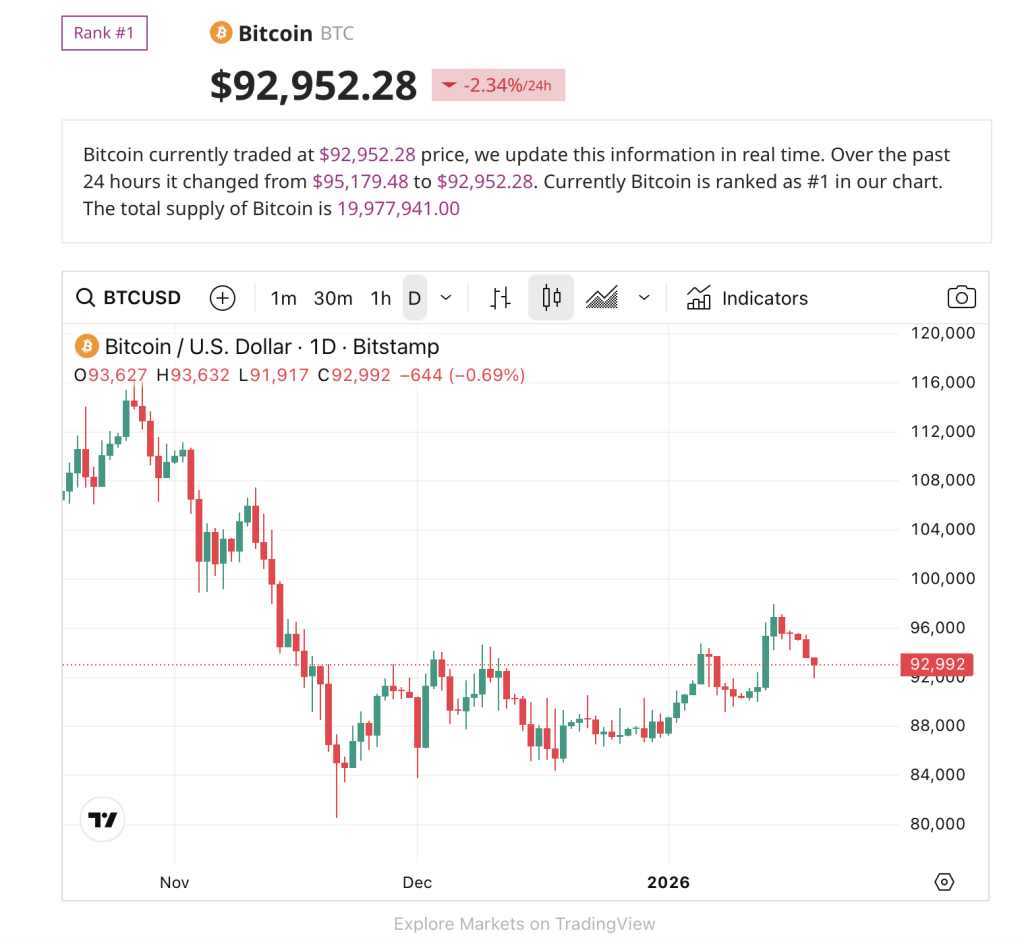
Bitcoin finally broke above the closely watched $95,000 resistance level after multiple failed attempts in recent weeks rallying into a $97,000–$98,000 range. The move was triggered by sustained demand from large corporate buyers such as MicroStrategy alongside improving sentiment around regulated investment vehicles, according to Laser Digital.

Despite the bullish breakout momentum proved difficult to maintain. As the week progressed buying pressure eased and prices began to consolidate around the $95,000 level suggesting the rally had become increasingly vulnerable to macro-driven shocks.

Tariff Headlines Trigger Risk-Off Move

Over the weekend renewed geopolitical tension weighed heavily on broader risk markets after former U.S. President Donald Trump proposed new tariff measures targeting European Union and NATO countries.

While crypto assets appeared insulated from the news sentiment deteriorated sharply once U.S. equity futures opened weaker during early Asian trading hours.

This shift triggered aggressive selling across digital assets. Bitcoin fell to approximately $92,500, while Ethereum dropped to around $3,200, effectively erasing the majority of gains recorded during the prior week.

The move highlights crypto’s continued sensitivity to global macro and geopolitical developments, particularly during periods of heightened uncertainty.

On Monday Bitcoin’s price action is showing near-term consolidation after a sharp pullback, with BTC trading around $93,000following a rejection from the mid-$90,000s.
Near-Term Outlook Hinges on Macro Developments

Looking ahead near-term price action is expected to remain highly reactive to how U.S.–EU trade tensions evolve. Any escalation could pressure risk assets while signs of de-escalation may provide room for stabilization. Geopolitical risks in the Middle East remain elevated with tensions increasing over the weekend and contributing to a more cautious market backdrop.

From a macro perspective, markets face a busy week. Key events include the World Economic Forum in Davos, upcoming U.S. GDP and PCE inflation data and a Bank of Japan policy meeting.

Although there are no scheduled Federal Reserve speeches due to the blackout period, markets may still see policy-related developments. U.S. Treasury Secretary Scott Bessent has indicated that a Fed chair announcement could occur closer to the Davos Forum, adding another potential catalyst for volatility.

Caution Returns After Breakout Attempt

While last week’s breakout above $95,000 marked a technical milestone for Bitcoin the subsequent pullback shows the fragile nature of sentiment at elevated price levels.

With macro and geopolitical risks back in focus, traders are likely to remain cautious in the near term, watching for clarity on tariffs, central bank direction and broader risk appetite before committing to the next directional move.

Disclaimer: The articles reposted on this site are sourced from public platforms and are provided for informational purposes only. They do not necessarily reflect the views of MEXC. All rights remain with the original authors. If you believe any content infringes on third-party rights, please contact service@support.mexc.com for removal. MEXC makes no guarantees regarding the accuracy, completeness, or timeliness of the content and is not responsible for any actions taken based on the information provided. The content does not constitute financial, legal, or other professional advice, nor should it be considered a recommendation or endorsement by MEXC.

You May Also Like

XRP Enters ‘Washout Zone,’ Then Targets $30, Crypto Analyst Says
XRP Enters ‘Washout Zone,’ Then Targets $30, Crypto Analyst Says

XRP has entered what Korean Certified Elliott Wave Analyst XForceGlobal (@XForceGlobal) calls a “washout” phase inside a broader Elliott Wave corrective structure
Share
NewsBTC2026/02/05 08:00
Republicans are 'very concerned about Texas' turning blue: GOP senator

Republicans are 'very concerned about Texas' turning blue: GOP senator

While Republicans in the U.S. House of Representatives have a razor-thin with just a four-seat advantage, their six-seat advantage in the U.S. Senate is seen as
Share
Alternet2026/02/05 08:38
Headwind Helps Best Wallet Token

Headwind Helps Best Wallet Token

The post Headwind Helps Best Wallet Token appeared on BitcoinEthereumNews.com. Google has announced the launch of a new open-source protocol called Agent Payments Protocol (AP2) in partnership with Coinbase, the Ethereum Foundation, and 60 other organizations. This allows AI agents to make payments on behalf of users using various methods such as real-time bank transfers, credit and debit cards, and, most importantly, stablecoins. Let’s explore in detail what this could mean for the broader cryptocurrency markets, and also highlight a presale crypto (Best Wallet Token) that could explode as a result of this development. Google’s Push for Stablecoins Agent Payments Protocol (AP2) uses digital contracts known as ‘Intent Mandates’ and ‘Verifiable Credentials’ to ensure that AI agents undertake only those payments authorized by the user. Mandates, by the way, are cryptographically signed, tamper-proof digital contracts that act as verifiable proof of a user’s instruction. For example, let’s say you instruct an AI agent to never spend more than $200 in a single transaction. This instruction is written into an Intent Mandate, which serves as a digital contract. Now, whenever the AI agent tries to make a payment, it must present this mandate as proof of authorization, which will then be verified via the AP2 protocol. Alongside this, Google has also launched the A2A x402 extension to accelerate support for the Web3 ecosystem. This production-ready solution enables agent-based crypto payments and will help reshape the growth of cryptocurrency integration within the AP2 protocol. Google’s inclusion of stablecoins in AP2 is a massive vote of confidence in dollar-pegged cryptocurrencies and a huge step toward making them a mainstream payment option. This widens stablecoin usage beyond trading and speculation, positioning them at the center of the consumption economy. The recent enactment of the GENIUS Act in the U.S. gives stablecoins more structure and legal support. Imagine paying for things like data crawls, per-task…
Share
BitcoinEthereumNews2025/09/18 01:27