At its core, DeFi is about providing a more innovative and efficient system that solves TradFi inefficiencies through proven PMF (Point-Market Fit).At its core, DeFi is about providing a more innovative and efficient system that solves TradFi inefficiencies through proven PMF (Point-Market Fit).

Key insights into leading projects in various fields of DeFi: overall oligopoly structure

2025/02/10 17:42
4 min read

Author: Cheeezzyyyy

Compiled by: Felix, PANews

DeFi has come a long way since the “Summer of DeFi” kicked off in 2021. Today, DeFi has established multiple mature sectors, with growth and activity in each area being self-sustaining.

Even so, it’s still early days, as the cryptocurrency market cap is still around $3.3 trillion, while the TradFi market cap is $133 trillion.
Key insights from leading projects in various fields of DeFi: overall oligopoly structure

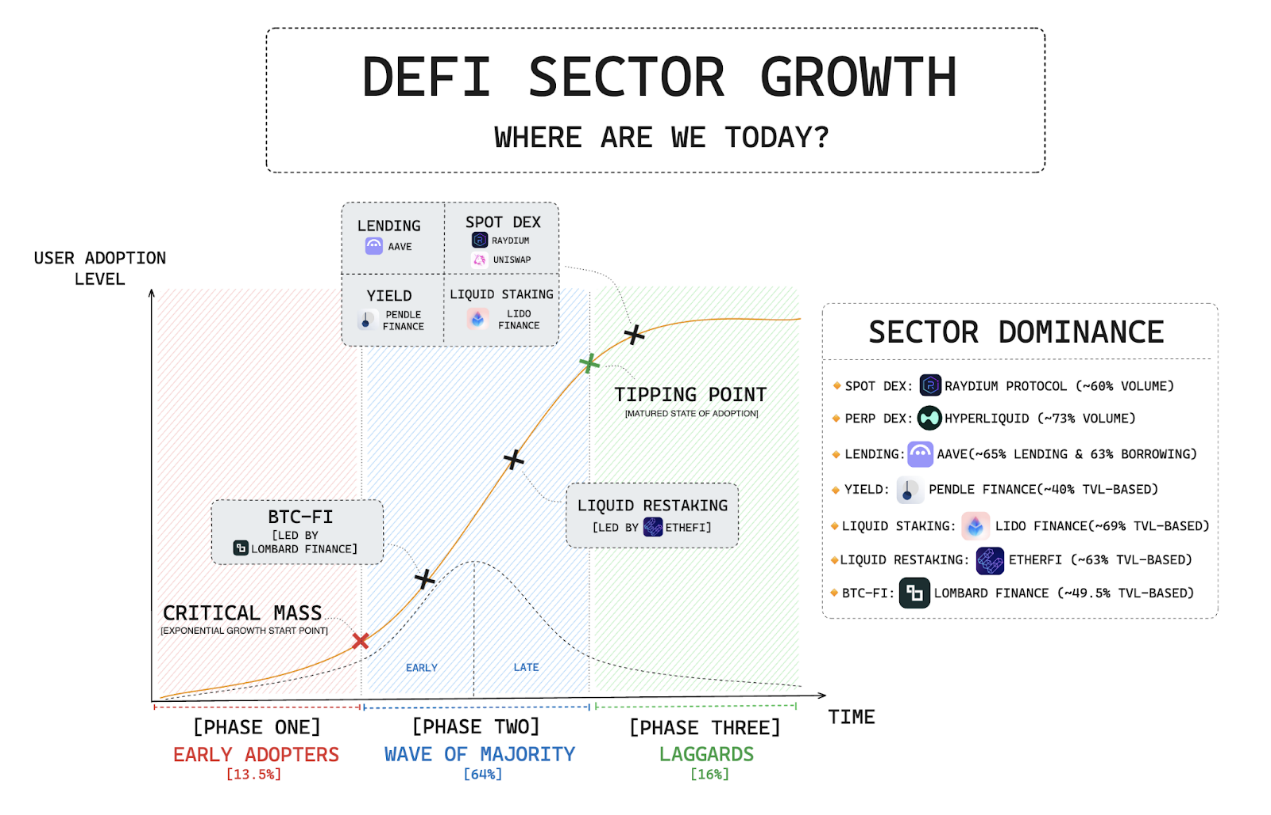
At its core, DeFi is about providing a more innovative and efficient system that solves TradFi inefficiencies through proven PMF (Point of Market Fit). DeFi also consists of multiple key areas that typically follow an oligopolistic structure.

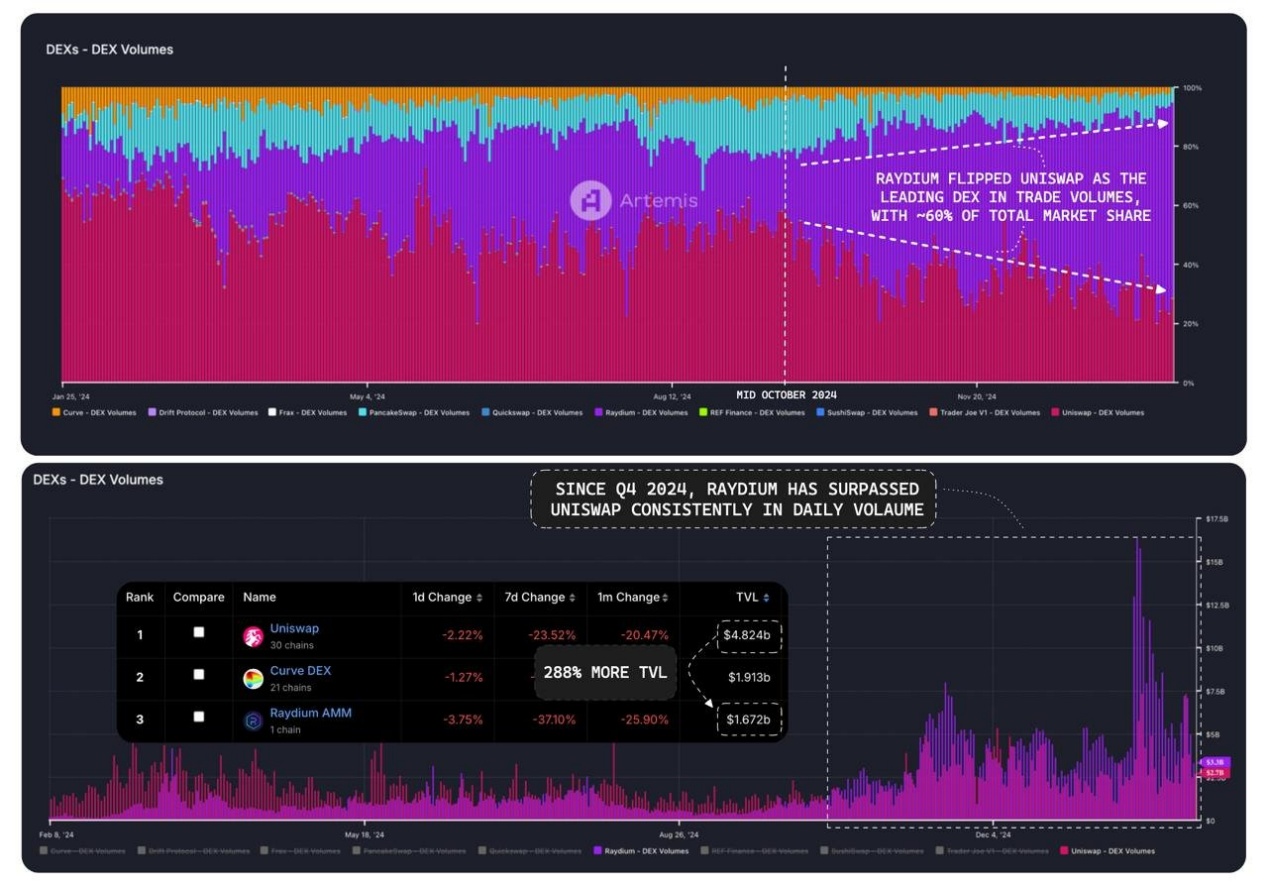
In the fourth quarter of 2024, the DEX platform Raydium (an automated market maker based on Solana) accounted for about 61% of the market share, surpassing Uniswap to become the industry leader. It is worth mentioning that Raydium's TVL is only about 39% of Uniswap's.

While Raydium’s rise may be due to the Memecoin Season of the Solana ecosystem, the durability of its LT (Note: User Life Cycle, a measure of user activity) remains uncertain.
Key insights into leading projects in various fields of DeFi: overall oligopoly structure

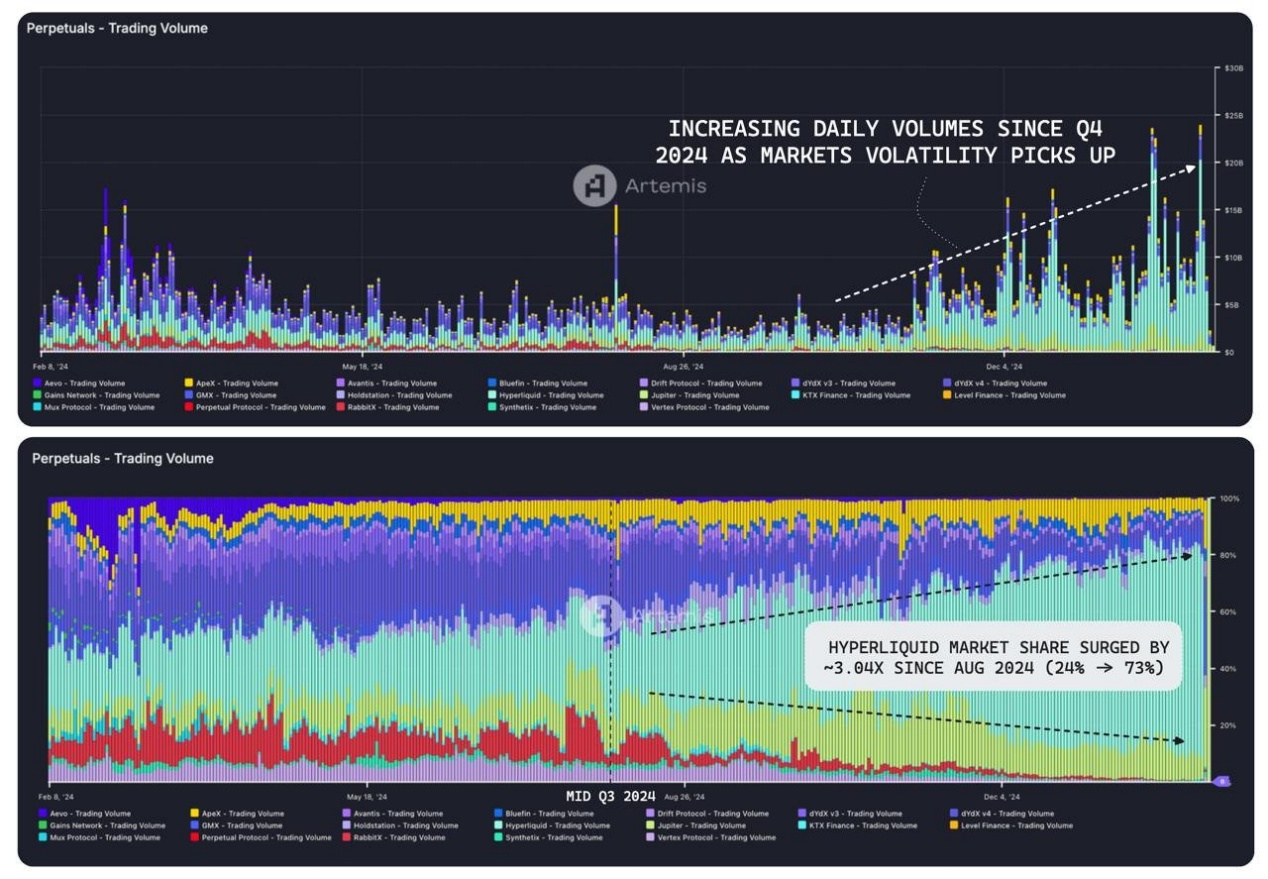
The winners in the perp DEX space stand out. Hyperliquid’s dominance has been further consolidated since Q3 2024, with its market share increasing from 24% to 73% (3x).

Since the fourth quarter of 2024, overall perp DEX trading volume has been recovering, with daily trading volume currently around $8 billion, compared to just $4 billion back then.

Hyperliquid continues to challenge CEX’s position as a price discovery platform.
Key insights into leading projects in various fields of DeFi: overall oligopoly structure

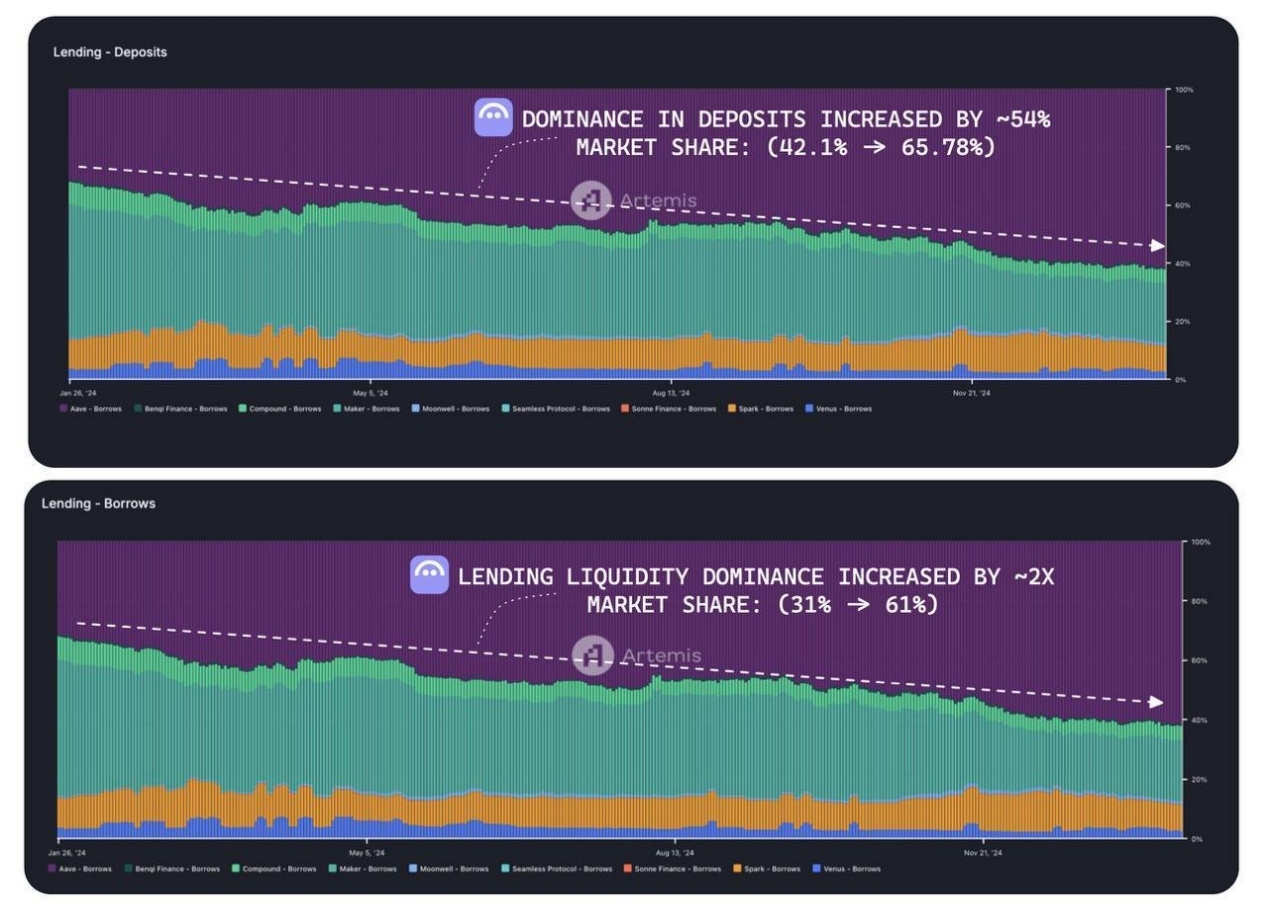
Aave’s dominance in the lending space has increased since 2024:

  • Deposits: 42.1% to 65.78%
  • Borrowing: 31% to 61%

Even though Aave does not have the most attractive yields, its long-standing reputation and users’ trust in the protocol make it a top choice in the lending space.
Key insights into leading projects in various fields of DeFi: overall oligopoly structure

In the revenue space, the dominant player Pendle is leading the way with a market share of over 50%. Its unique value proposition is to be the preferred promoter of industry value discovery. Despite the overall slowdown in the DeFi market and low market sentiment, Pendle still holds the TVL record.

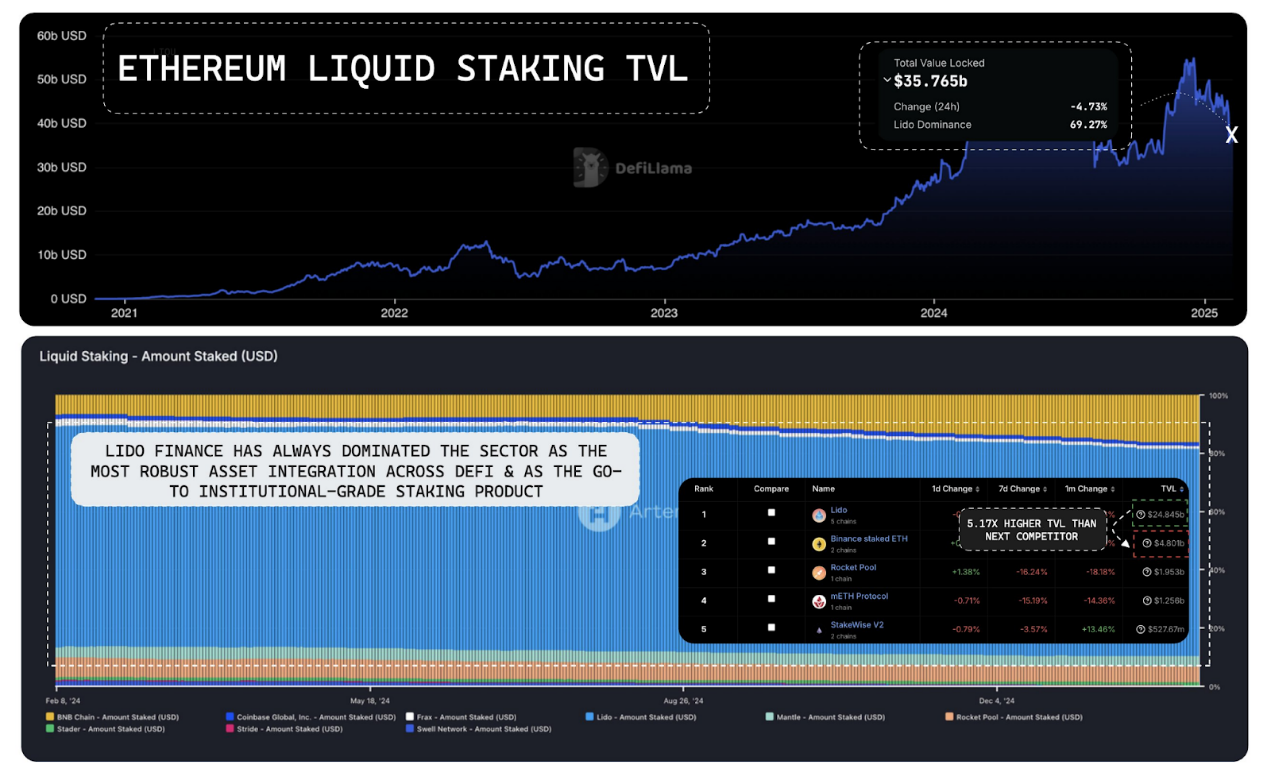
Liquidity Staking (LST) is by far the largest sector in DeFi in terms of TVL at around $35 billion.

Lido Finance is the undisputed leader with a market share of about 70%, almost monopolizing the LST field, and its TVL ($24.8 billion) is 5.17 times that of its competitor Binance bETH ($4.8 billion).
Key insights into leading projects in various fields of DeFi: overall oligopoly structure

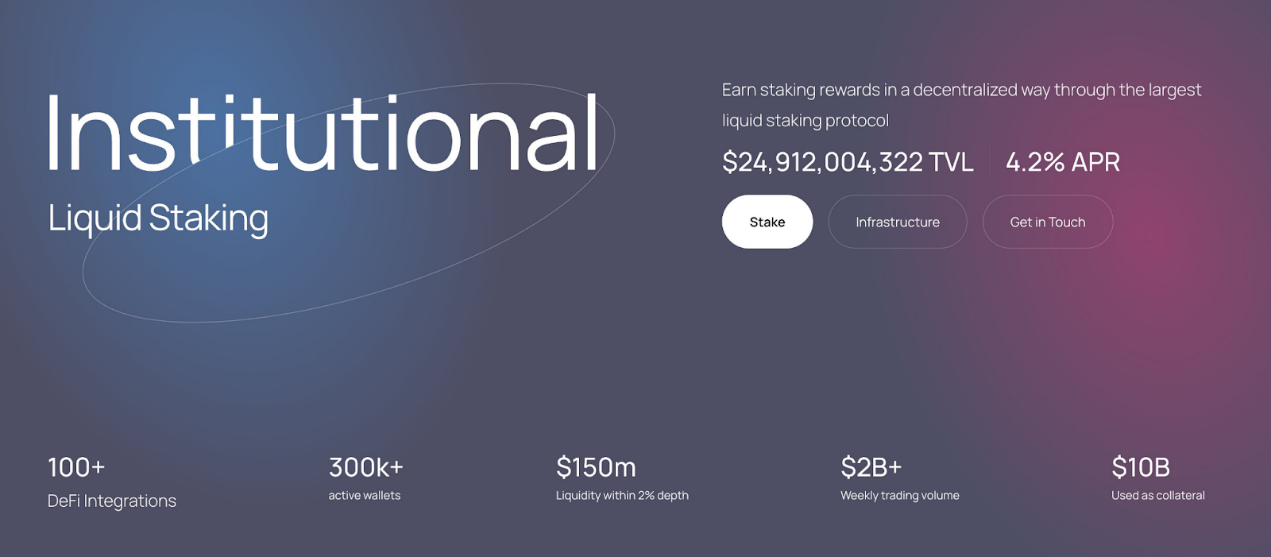
This dominance is not driven by staking yield, but rather by the asset value of stETH:

  • Best Asset Utilization: The Most Integrated Assets in DeFi
  • The most trusted service: the preferred institutional-grade staking solution for funds and entities

Credibility and trust are key to adoption.
Key insights into leading projects in various fields of DeFi: overall oligopoly structure

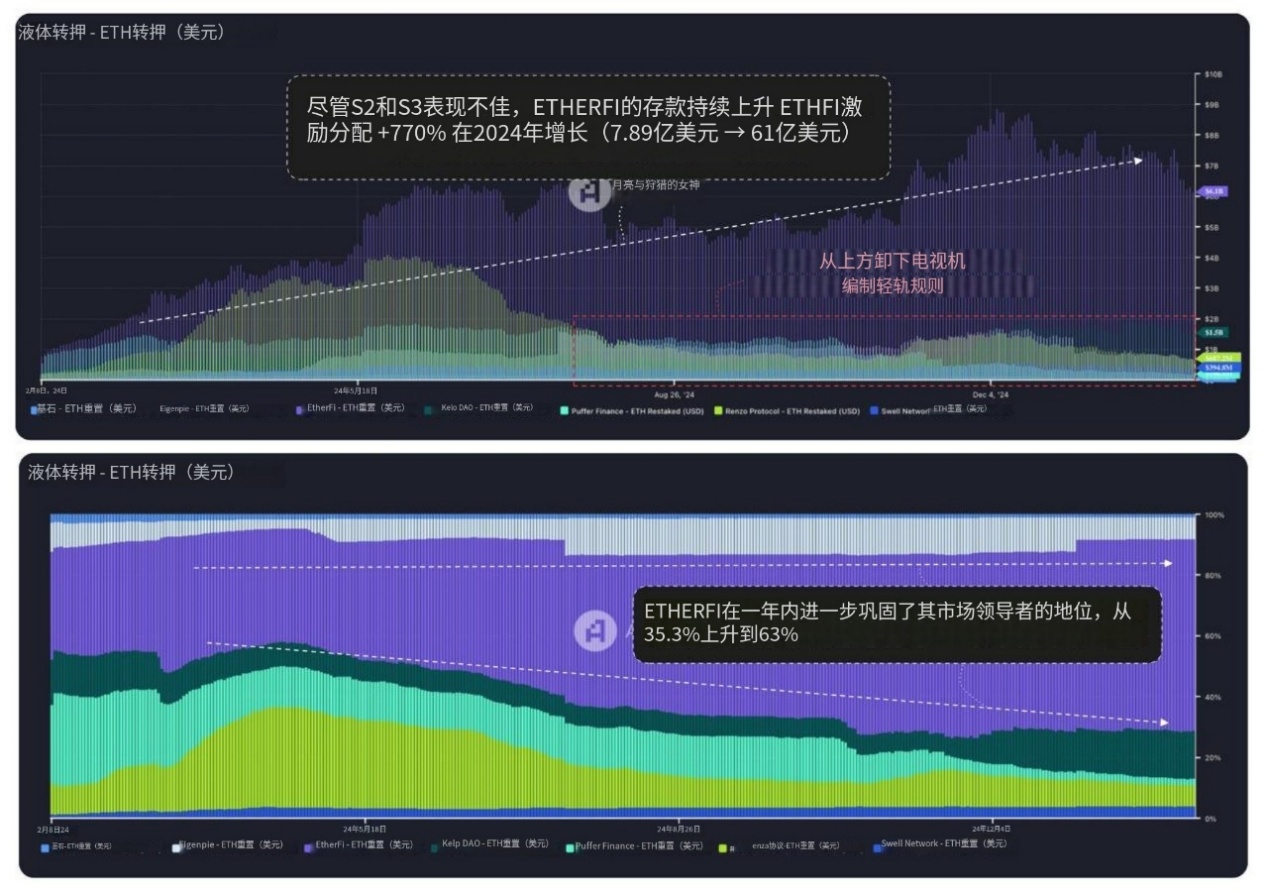
As for liquidity re-staking, the market trend is roughly the same. It is worth noting that ether.fi's market share has increased from 35.3% to 63%. Because even though ether.fi's staking volume in S1 and S2 has decreased, its TVL has increased by about 770% in 2024.

This growth is driven by the following factors:

  • First-mover advantage in the ecosystem
  • Extensive DeFi Integration
  • Trust in product suite

Key insights into leading projects in various fields of DeFi: overall oligopoly structure

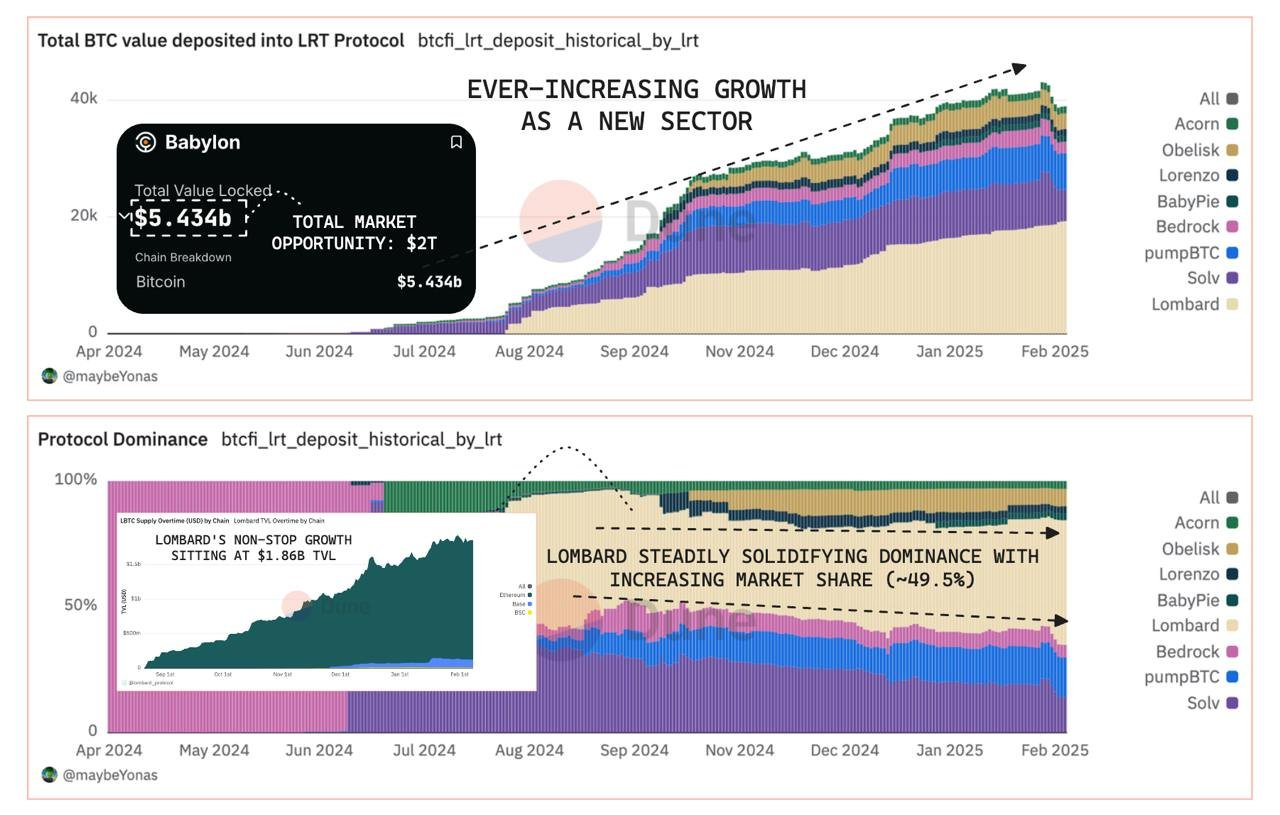
Lombard’s performance in the BTC-Fi space closely mirrors trends in the LST/LRT space, with market share steadily increasing to 49.5%.

As Babylon matures, demand for BTC as the premier safe haven asset will grow exponentially, creating a $2 trillion market opportunity.
Key insights into leading projects in various fields of DeFi: overall oligopoly structure

Since LBTC is the most integrated, widely used, and security-focused LRT in DeFi, Lombard will become the first asset to gain institutional trust and widespread adoption like stETH. Lombard will dominate the industry.

In summary, each DeFi field has obviously found its own PMF, forming an overall ecosystem that complements each other. This is the rise of a new primitive set that subverts CeFi.

As DeFi enters its next phase of expansion, we will see more new verticals introduced into untapped markets and even integrated into CeFi:

  • Ethena Labs: Plans to integrate TradFi payments
  • Mantle: Mantle Index Fund and Mantle Banking Integrate Crypto with TradFi

As more and more institutions become interested in DeFi, such as BlackRock's participation in DeFi through BUIDL, WLFI's DeFi portfolio and spot ETF, they are optimistic about the future development of DeFi.

Related reading: A preliminary study of DeFAI: Deep integration of DeFi and AI, three core scenarios promote large-scale application of DeFi

Market Opportunity
Moonveil Logo
Moonveil Price(MORE)
$0.00078
$0.00078$0.00078
-1.91%
USD
Moonveil (MORE) Live Price Chart
Disclaimer: The articles reposted on this site are sourced from public platforms and are provided for informational purposes only. They do not necessarily reflect the views of MEXC. All rights remain with the original authors. If you believe any content infringes on third-party rights, please contact service@support.mexc.com for removal. MEXC makes no guarantees regarding the accuracy, completeness, or timeliness of the content and is not responsible for any actions taken based on the information provided. The content does not constitute financial, legal, or other professional advice, nor should it be considered a recommendation or endorsement by MEXC.

You May Also Like

FCA komt in 2026 met aangepaste cryptoregels voor Britse markt

FCA komt in 2026 met aangepaste cryptoregels voor Britse markt

De Britse financiële waakhond, de FCA, komt in 2026 met nieuwe regels speciaal voor crypto bedrijven. Wat direct opvalt: de toezichthouder laat enkele klassieke financiële verplichtingen los om beter aan te sluiten op de snelle en grillige wereld van digitale activa. Tegelijkertijd wordt er extra nadruk gelegd op digitale beveiliging,... Het bericht FCA komt in 2026 met aangepaste cryptoregels voor Britse markt verscheen het eerst op Blockchain Stories.
Share
Coinstats2025/09/18 00:33
Cashing In On University Patents Means Giving Up On Our Innovation Future

Cashing In On University Patents Means Giving Up On Our Innovation Future

The post Cashing In On University Patents Means Giving Up On Our Innovation Future appeared on BitcoinEthereumNews.com. “It’s a raid on American innovation that would deliver pennies to the Treasury while kneecapping the very engine of our economic and medical progress,” writes Pipes. Getty Images Washington is addicted to taxing success. Now, Commerce Secretary Howard Lutnick is floating a plan to skim half the patent earnings from inventions developed at universities with federal funding. It’s being sold as a way to shore up programs like Social Security. In reality, it’s a raid on American innovation that would deliver pennies to the Treasury while kneecapping the very engine of our economic and medical progress. Yes, taxpayer dollars support early-stage research. But the real payoff comes later—in the jobs created, cures discovered, and industries launched when universities and private industry turn those discoveries into real products. By comparison, the sums at stake in patent licensing are trivial. Universities collectively earn only about $3.6 billion annually in patent income—less than the federal government spends on Social Security in a single day. Even confiscating half would barely register against a $6 trillion federal budget. And yet the damage from such a policy would be anything but trivial. The true return on taxpayer investment isn’t in licensing checks sent to Washington, but in the downstream economic activity that federally supported research unleashes. Thanks to the bipartisan Bayh-Dole Act of 1980, universities and private industry have powerful incentives to translate early-stage discoveries into real-world products. Before Bayh-Dole, the government hoarded patents from federally funded research, and fewer than 5% were ever licensed. Once universities could own and license their own inventions, innovation exploded. The result has been one of the best returns on investment in government history. Since 1996, university research has added nearly $2 trillion to U.S. industrial output, supported 6.5 million jobs, and launched more than 19,000 startups. Those companies pay…
Share
BitcoinEthereumNews2025/09/18 03:26
Trump foe devises plan to starve him of what he 'craves' most

Trump foe devises plan to starve him of what he 'craves' most

A longtime adversary of President Donald Trump has a plan for a key group to take away what Trump craves the most — attention. EX-CNN journalist Jim Acosta, who
Share
Rawstory2026/02/04 01:19