Hyperliquid’s founder is doubling down on what he says is the project’s non-negotiable premise: credibility comes from refusing the usual backroom economics. InHyperliquid’s founder is doubling down on what he says is the project’s non-negotiable premise: credibility comes from refusing the usual backroom economics. In

Hyperliquid Founder Reasserts Hardline Ethos: ‘No Insiders Allowed’

2026/01/03 07:30
3 min read

Hyperliquid’s founder is doubling down on what he says is the project’s non-negotiable premise: credibility comes from refusing the usual backroom economics. In a Jan. 1 post on X, Jeff Yan framed “integrity” and “credible neutrality” as design constraints, not marketing language.

Hyperliquid Reaffirms ‘No Insiders’ Ethos

“Integrity has always been one of Hyperliquid’s core values. The house of all finance must be credibly neutral. This means no private investors, no market maker deals, and no protocol fees to any company,” he wrote, drawing a straight line between governance legitimacy and the absence of paid counterparties.

That posture also extends to the origin story. “The initial state of any blockchain is a crucial part of its story that can never be erased. The original ethos of Bitcoin was a permissionless network accessible to all. Hyperliquid’s genesis distribution followed this spirit, going entirely to early users with core contributors excluded,” the post continued, adding that “the full distribution is verifiable onchain without obfuscation.”

The founder acknowledged that this approach is not always convenient for would-be partners or ecosystem builders accustomed to preferential terms. “This principle of fairness frustrates a few users and builders who are used to special treatment,” he said, arguing it forces the community to “do things the hard way”, including “zero tolerance” for “integrity yellow flags” among team members.

It is not the first time he has put the stance in blunt terms. In a January 2024 post, he summarized the policy as: “No investors. No paid market makers. No fees to the dev team… No insiders @HyperliquidX.”

Lighter Debut Sparks Controversy

The timing matters because the on-chain perpetuals category is now fighting not just over latency and liquidity, but over distribution optics, and Hyperliquid’s most visible new rival has become a live case study.

Lighter, an Ethereum-based perpetual futures exchange that also operates as an Ethereum layer-2, launched earlier this week and has climbed quickly in the rankings. On Dec. 30, it airdropped 250 million LIT tokens, 25% of its 1 billion total supply, to early users, with another 25% set aside for future growth programs.

The controversy is the other half. Lighter allocated 50% of supply to employees and investors, subject to a one-year lockup and three-year vesting, a structure that has triggered debate across DeFi about whether “community-first” narratives still hold when insiders retain an equal share of the cap table.

In other words, Lighter’s launch has intensified the same ideological fault line Hyperliquid is trying to own: whether the cleanest on-chain market structure is primarily about product performance or about refusing the incentives that come with investors, paid liquidity, and insider allocations.

At press time, HYPE traded at $24,51.
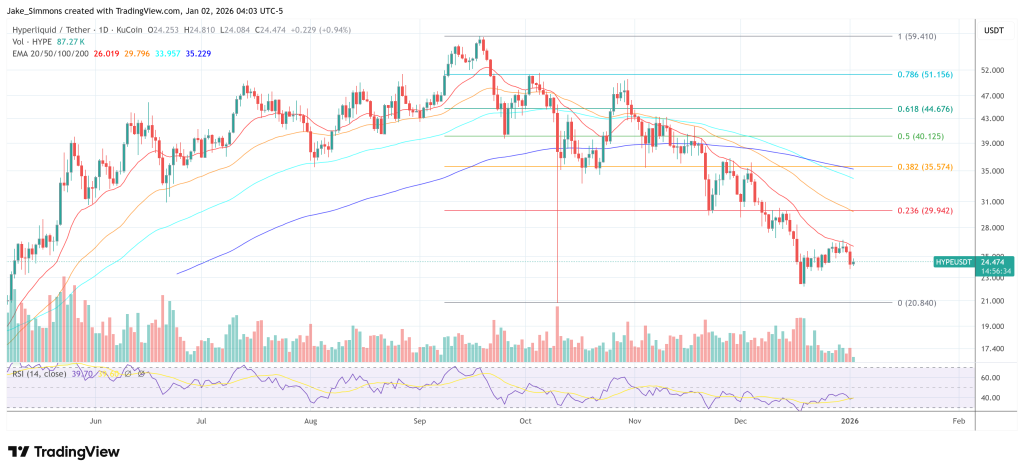
Hyperliquid price chart
Market Opportunity
USUAL Logo
USUAL Price(USUAL)
$0.0156
$0.0156$0.0156
0.00%
USD
USUAL (USUAL) Live Price Chart
Disclaimer: The articles reposted on this site are sourced from public platforms and are provided for informational purposes only. They do not necessarily reflect the views of MEXC. All rights remain with the original authors. If you believe any content infringes on third-party rights, please contact service@support.mexc.com for removal. MEXC makes no guarantees regarding the accuracy, completeness, or timeliness of the content and is not responsible for any actions taken based on the information provided. The content does not constitute financial, legal, or other professional advice, nor should it be considered a recommendation or endorsement by MEXC.

You May Also Like

Vitalik Buterin Highlights Crypto Privacy with Key Zcash Donation

Vitalik Buterin Highlights Crypto Privacy with Key Zcash Donation

Vitalik Buterin donates to Shielded Labs, supporting Zcash's privacy and security focus. Shielded Labs' Crosslink update enhances Zcash's transaction speed an
Share
Coinstats2026/02/08 05:08
Famed Epstein reporter drops bombshell about '11 men' in the files: 'Trump is on the list'

Famed Epstein reporter drops bombshell about '11 men' in the files: 'Trump is on the list'

A reporter whose work led to the arrests of Jeffrey Epstein and Ghislaine Maxwell dropped a bombshell claim on Saturday, saying the DOJ has been lying and that "
Share
Rawstory2026/02/08 04:50
This U.S. politician’s suspicious stock trade just returned over 200% in weeks

This U.S. politician’s suspicious stock trade just returned over 200% in weeks

The post This U.S. politician’s suspicious stock trade just returned over 200% in weeks appeared on BitcoinEthereumNews.com. United States Representative Cloe Fields has seen his stake in Opendoor Technologies (NASDAQ: OPEN) stock return over 200% in just a matter of weeks. According to congressional trade filings, the lawmaker purchased a stake in the online real estate company on July 21, 2025, investing between $1,001 and $15,000. At the time, the stock was trading around $2 and had been largely stagnant for months. Receive Signals on US Congress Members’ Stock Trades Stocks Stay up-to-date on the trading activity of US Congress members. The signal triggers based on updates from the House disclosure reports, notifying you of their latest stock transactions. Enable signal The trade has since paid off, with Opendoor surging to $10, a gain of nearly 220% in under two months. By comparison, the broader S&P 500 index rose less than 5% during the same period. OPEN one-week stock price chart. Source: Finbold Assuming he invested a minimum of $1,001, the purchase would now be worth about $3,200, while a $15,000 stake would have grown to nearly $48,000, generating profits of roughly $2,200 and $33,000, respectively. OPEN’s stock rally Notably, Opendoor’s rally has been fueled by major corporate shifts and market speculation. For instance, in August, the company named former Shopify COO Kaz Nejatian as CEO, while co-founders Keith Rabois and Eric Wu rejoined the board, moves seen as a return to the company’s early innovative spirit.  Outgoing CEO Carrie Wheeler’s resignation and sale of millions in stock reinforced the sense of a new chapter. Beyond leadership changes, Opendoor’s surge has taken on meme-stock characteristics. In this case, retail investors piled in as shares climbed, while short sellers scrambled to cover, pushing prices higher.  However, the stock is still not without challenges, where its iBuying model is untested at scale, margins are thin, and debt tied to…
Share
BitcoinEthereumNews2025/09/18 04:02