UNUS SED LEO Price Prediction 2026, 2027 – 2030: Future Outlook and Potential Highs
The post UNUS SED LEO Price Prediction 2026, 2027 – 2030: Future Outlook and Potential Highs appeared first on Coinpedia Fintech News
Story Highlights
- The current price of the LEO token is $ 8.77304514
- LEO could attempt a move toward the $14–$16 range by 2026 if iFinex ecosystem usage continues to expand.
- By 2030, LEO may target the $40–$45 zone if long-term token burns and platform demand remain strong.
UNUS SED LEO is not built like a typical speculative altcoin. It is a utility-driven token deeply tied to the iFinex ecosystem, which includes Bitfinex and other trading and lending platforms.
LEO holders benefit from trading fee discounts, lower lending costs, reduced withdrawal fees, and priority access to select offerings.
Recently, UNUS SED LEO native token LEO has drawn significant attention after seeing a 50% price rally over the past two weeks, while overall crypto market struggles to recover.
Will the LEO price continue its bullish trend in the coming years or yield to rising market volatility?
Read on to uncover its true potential UNUS SED LEO price prediction 2026, 2027 – 2030.
UNUS SED LEO Price Today
| Cryptocurrency | UNUS SED LEO |
| Token | LEO |
| Price | $8.7730  2.36% 2.36% |
| Market Cap | $ 8,086,613,088.35 |
| 24h Volume | $ 642,523.3382 |
| Circulating Supply | 921,756,694.90 |
| Total Supply | 985,239,504.00 |
| All-Time High | $ 10.0088 on 03 March 2025 |
| All-Time Low | $ 0.8036 on 25 December 2019 |
Table of contents
- UNUS SED LEO Price Targets For January 2026
- Technical Analysis
- LEO Price Prediction 2026
- UNUS SED LEO Price Prediction 2026 – 2030
- UNUS SED LEO Price Prediction 2026
- UNUS SED LEO Price Prediction 2027
- UNUS SED LEO Price Prediction 2028
- UNUS SED LEO Price Prediction 2029
- UNUS SED LEO Price Prediction 2030
- What Does The Market Say?
- CoinPedia’s UNUS SED LEO (LEO) Price Prediction
- FAQs
UNUS SED LEO Price Targets For January 2026
Early 2026 could act as a key test for LEO’s momentum. The recent surge suggests strong buying interest, likely driven by increased exchange activity and confidence in iFinex’s business model.
Unlike many tokens that depend on future promises, LEO’s value is tied to real platform use and regular token burns funded by iFinex’s revenue.
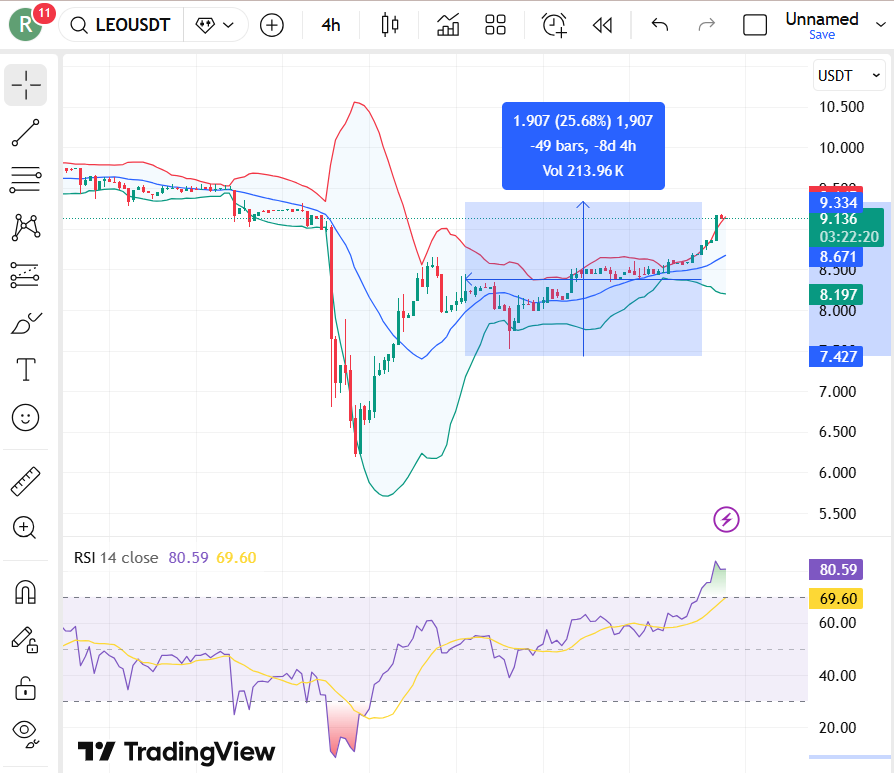
As of now, LEO token is trading around $9.14, with a market cap of $8.42 billion and a 24-hour trading volume of approximately $791.2K, up nearly 8%.
Technical Analysis
Looking at the 4-hour LEO/USDT chart, LEO is seeing a strong recovery after finding support near the $6.0–$6.5 range. LEO is trading above both the 50 EMA and 200 EMA, which is a positive sign. The price also broke out from a long consolidation area between $8.2 and $8.8.
The RSI is near 80, which signals that LEO is overbought on the 4-hour chart. This does not mean the trend is over. A healthy pullback toward $8.6–$8.8 would still keep the trend strong. As long as the price stays above $8.2.
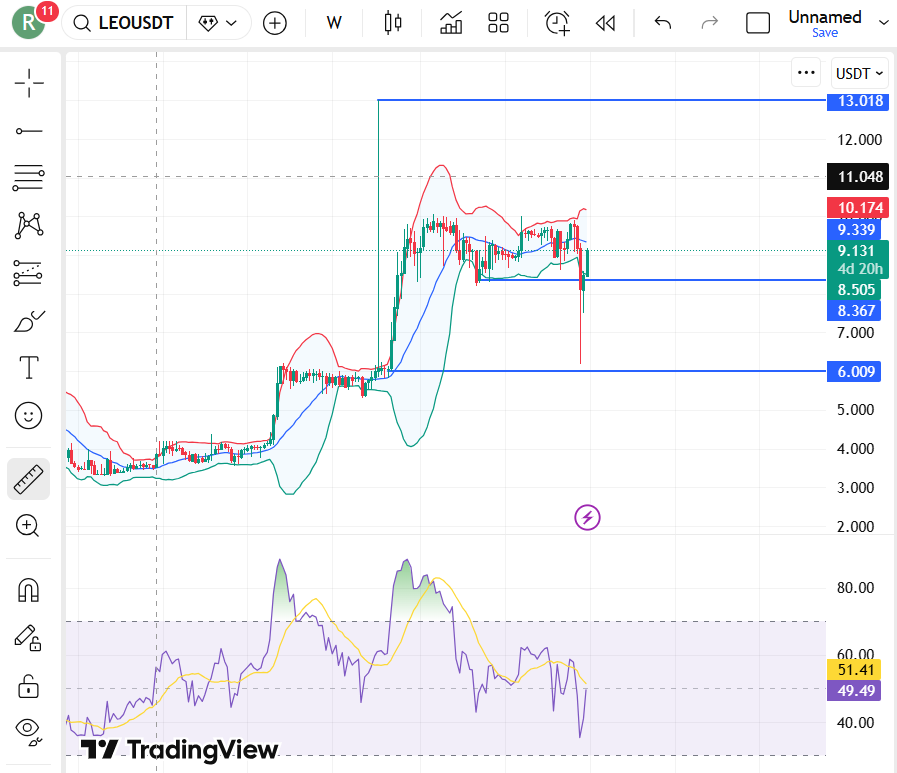
Therefore, a clean breakout above $10.20 with volume could open the path toward its all-time high price of $13.
| Month | Potential Low ($) | Potential Average ($) | Potential High ($) |
| LEO Crypto Price Prediction January 2026 | $7.80 | $10.20 | $13 |
LEO Price Prediction 2026
The year 2026 may favor tokens with clear utility and revenue-backed mechanisms. LEO fits this category well due to its ongoing burn model, where a portion of iFinex revenues is used to reduce token supply.
If the iFinex ecosystem continues expanding its trading, lending, and interoperability services, demand for LEO could remain strong. However, slower exchange activity or regulatory pressure could cap upside.
If trading volumes across iFinex platforms remain elevated, LEO could hold above psychological support near $11.50 to see a breakout above its previous all-time high price.
| Year | Potential Low ($) | Potential Average ($) | Potential High ($) |
| UNUS SED LEO Price Prediction 2026 | $6.09 | $11.50 | $16 |
UNUS SED LEO Price Prediction 2026 – 2030
| Year | Potential Low ($) | Potential Average ($) | Potential High ($) |
| 2026 | $6.09 | $11.50 | $16 |
| 2027 | $8.91 | $16.80 | $23.50 |
| 2028 | $13.20 | $22.40 | $29.95 |
| 2029 | $16.70 | $29 | $37.52 |
| 2030 | $19 | $32.10 | $43.58 |
UNUS SED LEO Price Prediction 2026
In 2026, LEO’s price could reflect steady ecosystem growth rather than speculation. If exchange volumes remain strong, LEO price may trade around $16, with buyers supporting dips.
UNUS SED LEO Price Prediction 2027
By 2027, deeper interoperability and broader platform adoption could increase demand for LEO. Under this scenario, prices could move toward $23.50.
UNUS SED LEO Price Prediction 2028
In 2028, continued token burns and sustained platform usage may gradually reduce supply. This could support a climb toward $29.95, assuming stable market conditions.
UNUS SED LEO Price Prediction 2029
As utility tokens gain recognition for predictable value capture, LEO could benefit from being revenue-linked.
UNUS SED LEO Price Prediction 2030
By 2030, if iFinex remains a major player in crypto trading and financial services, LEO could test the $40-44 range, reflecting long-term ecosystem strength.
What Does The Market Say?
| Year | 2026 | 2027 | 2030 |
| Changelly | $13.68 | $19.53 | $60.37 |
| priceprediction.net | $14.08 | $22.86 | $58.35 |
| DigitalCoinprice | $21.58 | $29.93 | $65.38 |
CoinPedia’s UNUS SED LEO (LEO) Price Prediction
According to CoinPedia analysts, UNUS SED LEO stands out as a revenue-linked utility token rather than a speculative asset.
CoinPedia analyst expects LEO to maintain relative strength in 2026, with a potential high near $14.00, provided trading activity remains healthy.
Long-term outlook remains constructive, though dependent on exchange volumes and regulatory clarity.
| Year | Potential Low ($) | Potential Average ($) | Potential High ($) |
| 2026 | $6.09 | $11.50 | $16 |
Never Miss a Beat in the Crypto World!
Stay ahead with breaking news, expert analysis, and real-time updates on the latest trends in Bitcoin, altcoins, DeFi, NFTs, and more.
 Subscribe to Price Prediction
FAQs
LEO is a utility-driven token deeply tied to the iFinex ecosystem, which includes Bitfinex and other trading and lending platforms.
According to our UNUS SED LEO price prediction, the digital asset might hit a maximum of $16 by the end of 2026.
In the cryptocurrency industry, LEO is among the active virtual currencies. Its value could increase if lending and saving protocols gain greater traction.
With a potential surge, the LEO price may reach a maximum of $44 by the end of the year 2030.
You May Also Like

The Role of Blockchain in Building Safer Web3 Gaming Ecosystems
- Immutable Ownership of Assets Blockchain records can be manipulated by anyone. If a player owns a sword, skin, or plot of land as an NFT, it is verifiably in their ownership, and it cannot be altered or deleted by the developer or even hacked. This has created a proven track record of ownership, providing control back to the players, unlike any centralised gaming platform where assets can be revoked.
- Decentralized Infrastructure Blockchain networks also have a distributed architecture where game data is stored in a worldwide network of nodes, making them much less susceptible to centralised points of failure and attacks. This decentralised approach makes it exponentially more difficult to hijack systems or even shut off the game’s economy.
- Secure Transactions with Cryptography Whether a player buys an NFT or trades their in-game tokens for other items or tokens, the transactions are enforced by cryptographic algorithms, ensuring secure, verifiable, and irreversible transactions and eliminating the risks of double-spending or fraudulent trades.
- Smart Contract Automation Smart contracts automate the enforcement of game rules and players’ economic exchanges for the developer, eliminating the need for intermediaries or middlemen, and trust for the developer. For example, if a player completes a quest that promises a reward, the smart contract will execute and distribute what was promised.
- Anti-Cheating and Fair Gameplay The naturally transparent nature of blockchain makes it extremely simple for anyone to examine a specific instance of gameplay and verify the economic outcomes from that play. Furthermore, multi-player games that enforce smart contracts on things like loot sharing or win sharing can automate and measure trustlessness and avoid cheating, manipulations, and fraud by developers.
- Cross-Platform Security Many Web3 games feature asset interoperability across platforms. This interoperability is made viable by blockchain, which guarantees ownership is maintained whenever assets transition from one game or marketplace to another, thereby offering protection to players who rely on transfers for security against fraud. Key Security Dangers in Web3 Gaming Although blockchain provides sound first principles of security, the Web3 gaming ecosystem is susceptible to threats. Some of the most serious threats include:
Rheem® and ecobee partner to launch the ecobee Smart Thermostat Lite | Works with EcoNet® Technology