The post Crypto User Loses $50M in One Copy-Paste Mistake Address Poisoning Scam appeared first on Coinpedia Fintech News A crypto user has lost nearly $50 millionThe post Crypto User Loses $50M in One Copy-Paste Mistake Address Poisoning Scam appeared first on Coinpedia Fintech News A crypto user has lost nearly $50 million

Crypto User Loses $50M in One Copy-Paste Mistake Address Poisoning Scam

2025/12/20 14:18
3 min read
Crypto user lost millions

The post Crypto User Loses $50M in One Copy-Paste Mistake Address Poisoning Scam appeared first on Coinpedia Fintech News

A crypto user has lost nearly $50 million in USDT after falling victim to an address poisoning scam, according to on-chain analytics platform Lookonchain. The incident happened due to a simple copy-paste mistake during a large transfer and is now being described as one of the costliest errors in crypto history.

How the $50 Million Transfer Went Wrong

The incident began with what looked like a careful move. Before sending a large amount, the victim first transferred 50 USDT as a test transaction to their own wallet address. This is a common habit among crypto users to avoid errors.

However, scammers were closely monitoring the wallet.

Soon after the test transaction, the scammer created a fake wallet address that looked almost identical to the victim’s real address, matching the same first and last four characters. 

The scammer then sent small transactions to the victim so the fake address appeared in the transaction history. This tactic is the core of an address poisoning scam.

  • Also Read :
  •   US Senators Introduce SAFE Crypto Act to Target Rising Crypto Scams
  •   ,

The Costly Copy-Paste Error

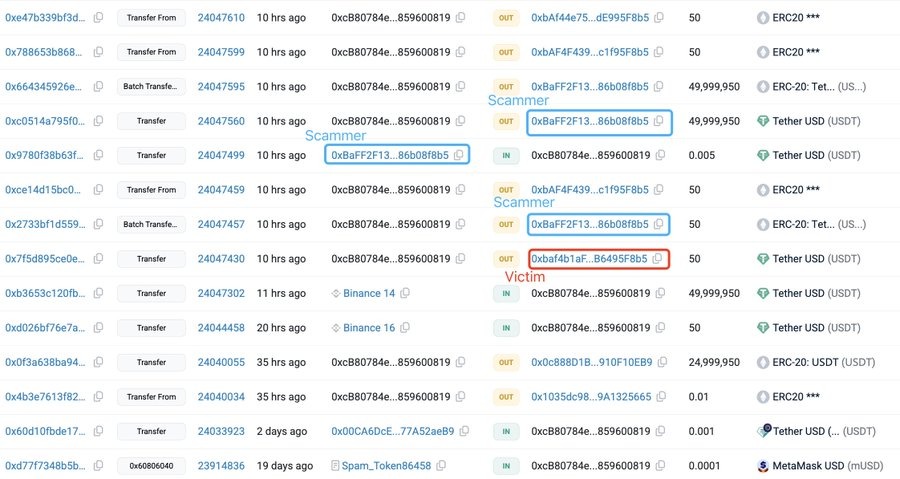
When the victim later sent the remaining 49,999,950 USDT, they copied the address directly from their transaction history. Unfortunately, they unknowingly copied the spoofed address instead of their real one.

Within seconds, the entire amount was sent straight to the scammer’s wallet. Since blockchain transactions are irreversible, the funds were lost instantly with no recovery option.

Why Address Poisoning Scams Are So Dangerous

This type of scam, known as address poisoning, does not hack wallets or steal private keys. Instead, they exploit human habits and wallet design limitations. Many users only check the beginning and ending characters of an address, which scammers take advantage of.

Lookonchain’s shared image clearly shows how repeated small transfers were used to trick the victim into copying the wrong address.
scam chart
Never Miss a Beat in the Crypto World!

Stay ahead with breaking news, expert analysis, and real-time updates on the latest trends in Bitcoin, altcoins, DeFi, NFTs, and more.

bell icon Subscribe to News

FAQs

What is an address poisoning scam in crypto?

An address poisoning scam tricks users into sending crypto to a fake wallet by mimicking their real address.

How can I prevent address poisoning in crypto?

Always double-check full wallet addresses, avoid relying on transaction history, and test with small transfers.

Can lost crypto be recovered after a scam?

Blockchain transactions are irreversible, so once funds are sent to a scammer, they cannot be recovered.

What are the warning signs of a crypto address poisoning scam?

Look for unusual small transactions in your wallet history and addresses that closely resemble your own.

How can businesses avoid losing large crypto transfers to scams?

Use multi-step verification, test small transactions, and confirm addresses outside wallet history logs.

Disclaimer: The articles reposted on this site are sourced from public platforms and are provided for informational purposes only. They do not necessarily reflect the views of MEXC. All rights remain with the original authors. If you believe any content infringes on third-party rights, please contact service@support.mexc.com for removal. MEXC makes no guarantees regarding the accuracy, completeness, or timeliness of the content and is not responsible for any actions taken based on the information provided. The content does not constitute financial, legal, or other professional advice, nor should it be considered a recommendation or endorsement by MEXC.

You May Also Like

VanEck Targets Stablecoins & Next-Gen ICOs

VanEck Targets Stablecoins & Next-Gen ICOs

The post VanEck Targets Stablecoins & Next-Gen ICOs appeared on BitcoinEthereumNews.com. Welcome to the US Crypto News Morning Briefing—your essential rundown of the most important developments in crypto for the day ahead. Grab a coffee because the firms shaping crypto’s future are not just building products, but also trying to reshape how capital flows. Crypto News of the Day: VanEck Maps Next Frontier of Crypto Venture Investing VanEck, a Wall Street player known for financial “firsts,” is pushing that legacy into Web3. The firsts include pioneering US gold funds and launching one of the earliest spot Bitcoin ETFs. Sponsored Sponsored “Financial instruments have always been a kind of tokenization. From seashells to traveler’s checks, from relational databases to today’s on-chain assets. You could even joke that VanEck’s first gold mutual funds were the original ‘tokenized gold,’” Juan C. Lopez, General Partner at VanEck Ventures, told BeInCrypto. That same instinct drives the firm’s venture bets. Lopez said VanEck goes beyond writing checks and brings the full weight of the firm. This extends from regulatory proximity to product experiments to founders building the next phase of crypto infrastructure. Asked about key investment priorities, Lopez highlighted stablecoins. “We care deeply about three questions: How do we accelerate stablecoin ubiquity? What will users want to do with them once highly distributed? And what net new assets can we construct now that we have sophisticated market infrastructure?” Lopez added. However, VanEck is not limiting itself to the hottest narrative, acknowledging that decentralized finance (DeFi) is having a renaissance. The VanEck executive also noted that success will depend on new approaches to identity and programmable compliance layered on public blockchains. Backing Legion With A New Model for ICOs Sponsored Sponsored That compliance-first angle explains VanEck Ventures’ recent co-lead of Legion’s $5 million seed round alongside Brevan Howard. Legion aims to reinvent token fundraising by making early-stage access…
Share
BitcoinEthereumNews2025/09/18 03:52
Hacker behind the UXLINK attack loses $48 million to a phishing scam

Hacker behind the UXLINK attack loses $48 million to a phishing scam

The post Hacker behind the UXLINK attack loses $48 million to a phishing scam appeared on BitcoinEthereumNews.com. The UXLINK exploiter has been phished merely hours after the AI-powered Web 3 social platform’s multi-sig wallet had been breached. Lookonchain had reported on Monday that UXLINK’s multi-signature wallet was compromised, with funds drained across centralized and decentralized exchanges.  According to the blockchain analytics platform, the attacker was phished and lost 542 million UXLINK tokens, valued at approximately $48 million.  Interestingly, the hacker who attacked $UXLINK was targeted by a phishing attack and lost 542M $UXLINK($48M).https://t.co/Cp9QNHPE8Xhttps://t.co/M8tbPYAdiq pic.twitter.com/PxadIIfkDi — Lookonchain (@lookonchain) September 23, 2025 UXLINK had earlier admitted that its multi-sig wallet had been breached, and said that “a significant amount of crypto” was illicitly transferred, but most of them were frozen. “Our team is working through legal and compliant measures to ensure that the UXLINK token supply fully aligns with the rules stated in the whitepaper. The white paper remains the sole community consensus and standard for UXLINK’s token economy,” the project team wrote on X. UXLINK breach involved six wallets Security monitoring firm Cyvers Alerts flagged unusual activity early Monday on an Ethereum address linked to UXLINK. The account executed a delegateCall, removed the existing administrator role, and added a new multisig owner. After making the change, the hacker moved at least $4 million in USDT, $500,000 in USDC, 3.7 wrapped Bitcoin (WBTC), and 25 ETH. Onchain evidence also showed that the attacker sold UXLINK tokens on decentralized exchanges using six separate wallets. These trades netted at least 6,732 ETH, valued at roughly $28.1 million. Hours after pulling off the UXLINK exploit, the attacker themselves fell victim to a phishing scheme. Arbiscan onchain records show the loss occurred on Tuesday at around 02:15 UTC under the transaction hash 0xa70674ccc9caa17d6efaf3f6fcbd5dec40011744c18a1057f391a822f11986ee. Phishing attack on the UXLINK scammer. Source: Arbiscan. Two large transfers of UXLINK tokens were directed from the…
Share
BitcoinEthereumNews2025/09/23 18:34
SUI: Where the Price Might Be Heading After the $1.02 Breakout Attempt

SUI: Where the Price Might Be Heading After the $1.02 Breakout Attempt

SUI is trading near $1.034, attempting to hold above the key $1.02 resistance level after breaking out from a rounded base formation. The level that matters is $
Share
Ethnews2026/02/15 16:35