The Digital Bretton Woods: The Mathematical Inevitability of the Debt-Backed Dollar — Part 4 — Possible Scenarios The 2026 Sovereign Bond Reset 1. The StraThe Digital Bretton Woods: The Mathematical Inevitability of the Debt-Backed Dollar — Part 4 — Possible Scenarios The 2026 Sovereign Bond Reset 1. The Stra

The Digital Bretton Woods: The Mathematical Inevitability of the Debt-Backed Dollar — Part 4 —…

2025/12/19 22:56

The Digital Bretton Woods: The Mathematical Inevitability of the Debt-Backed Dollar — Part 4 — Possible Scenarios

The 2026 Sovereign Bond Reset

1. The Strategic Context

If the previous volumes established the architecture of the new system — the $38.4 trillion US debt, the “Vampire Sponge” designed to fund it, and the “MSTR Blueprint” for escaping it — this addendum addresses the inevitable next phase: Implementation.

By early 2026, the theoretical frameworks are understood by global finance ministers. The question has shifted from “What is happening?” to “How do we survive it?” The “MicroStrategy model” — borrowing a depreciating currency to acquire a scarce asset — is no longer just a corporate tactic; it is being scrutinized as a potential instrument of national survival.

We are entering the era of the Sovereign Debt-for-Code Swap.

2. The Mechanism: The “Hard Asset” Sovereign Bond

For seventy years, developing nations have been trapped in a cycle of issuing dollar-denominated debt. They borrow strong dollars and have to pay them back with weak local currency, often leading to a “debt spiral” enforced by institutions like the IMF.

The “MSTR Blueprint” offers a radical inversion of this model. In 2026, we are likely to see the issuance of the first true Bitcoin-Backed Sovereign Bonds.

The Protocol

  1. The Issuance: A sovereign nation issues a standard 10-year bond priced in US Dollars, offering a competitive interest rate (e.g., 8%).
  2. The Acquisition: Instead of using the proceeds to build roads or subsidize energy, the treasury immediately converts 100% of the USD proceeds into Bitcoin.
  3. The Collateralization: The Bitcoin is placed in a multi-signature, geo-distributed cold storage vault. This becomes the visible, auditable collateral for the bond.
  4. The Arbitrage: The nation now owes a fixed amount of “melting” dollars. They hold a fixed amount of scarce Bitcoin. If the Bitcoin price appreciates faster than the interest rate on the bond (a likely bet in a high-inflation USD environment), the nation’s balance sheet improves every day.

3. Case Study Alpha: The Desperate (e.g., Argentina, Turkey)

Nations experiencing chronic high inflation have the least to lose and the most to gain from this strategy. They are already drowning in dollar debt; the “Sponge” is already squeezing them dry.

For a country like Argentina (in this speculative scenario), the Sovereign Bond Reset is a Hail Mary. By issuing a Bitcoin-backed bond, they bypass traditional lenders who demand austerity. They appeal directly to the global capital markets that are hungry for Bitcoin exposure but restricted by mandates.

  • The Risk: If Bitcoin crashes, the country is insolvent.
  • The Reality: They are already functionally insolvent under the dollar standard. The risk profile is asymmetric: certain slow death under the current system versus a chance at sovereign rebirth under a hard asset standard.

4. Case Study Beta: The Opportunist (e.g., UAE, Energy Exporters)

The dynamic changes for wealthy, energy-rich nations. They do not need the money. For them, the strategy is about Monetizing Energy and Hedging Geopolitical Risk.

These nations realize that selling oil for US Treasury bills (the old “Petrodollar” arrangement) is a losing trade when the Treasury bills are yielding less than real inflation. In 2026, we see the pivot toward the “Petro-Bitcoin” model.

  • The Strategy: Instead of buying US debt with excess oil profits, they mine or buy Bitcoin. They then issue bonds against this Bitcoin reserve to fund domestic diversification projects (like NEOM in Saudi Arabia or tech hubs in Dubai).
  • The Leverage: This allows them to maintain liquidity without forcing them to hold the debt of a rival superpower (the US) that could sanction them at any moment. Bitcoin becomes neutral, apolitical collateral.

5. The Imperial Response: The Empire Strikes Back

The United States, faced with a $38.4 trillion debt that requires constant global funding, cannot afford to let the “Vampire Sponge” dry up. If sovereign nations stop buying Treasuries and start issuing their own Bitcoin bonds, the US bond market faces a catastrophic liquidity crisis.

Washington’s response in 2026 will likely be clinical and severe:

  1. Financial Sanctions: The US Treasury may designate any sovereign bond backed by Bitcoin as a vehicle for “money laundering” or “evading sanctions,” effectively locking these bonds out of Western capital markets.
  2. The “Strategic Resource” Designation: The US may declare Bitcoin a strategic national resource, similar to uranium. This would allow the President to use emergency powers to restrict American companies (like BlackRock or Fidelity) from buying foreign sovereign Bitcoin bonds.

6. Closing Synthesis: The Great Filter

The “2026 Sovereign Bond Reset” is the moment the world decides whether it wants to remain a passenger on the USS Titanic (the debt-based system) or build its own lifeboat (the collateral-based system).

The strategy is terrifyingly simple: Short the debt, long the code.

The nations that understand this arbitrage will become the new financial powerhouses of the 21st century. Those that cling to the old model, hoping the “Vampire Sponge” will spare them, will find themselves owning nothing but someone else’s unpayable promises.

Lingering Thought: When the music stops and the $38 trillion debt bill comes due, will your nation be holding the empty chair, or the immutable ledger?


The Digital Bretton Woods: The Mathematical Inevitability of the Debt-Backed Dollar — Part 4 —… was originally published in Coinmonks on Medium, where people are continuing the conversation by highlighting and responding to this story.

Market Opportunity
Particl Logo
Particl Price(PART)
$0.3116
$0.3116$0.3116
-0.76%
USD
Particl (PART) Live Price Chart
Disclaimer: The articles reposted on this site are sourced from public platforms and are provided for informational purposes only. They do not necessarily reflect the views of MEXC. All rights remain with the original authors. If you believe any content infringes on third-party rights, please contact service@support.mexc.com for removal. MEXC makes no guarantees regarding the accuracy, completeness, or timeliness of the content and is not responsible for any actions taken based on the information provided. The content does not constitute financial, legal, or other professional advice, nor should it be considered a recommendation or endorsement by MEXC.

You May Also Like

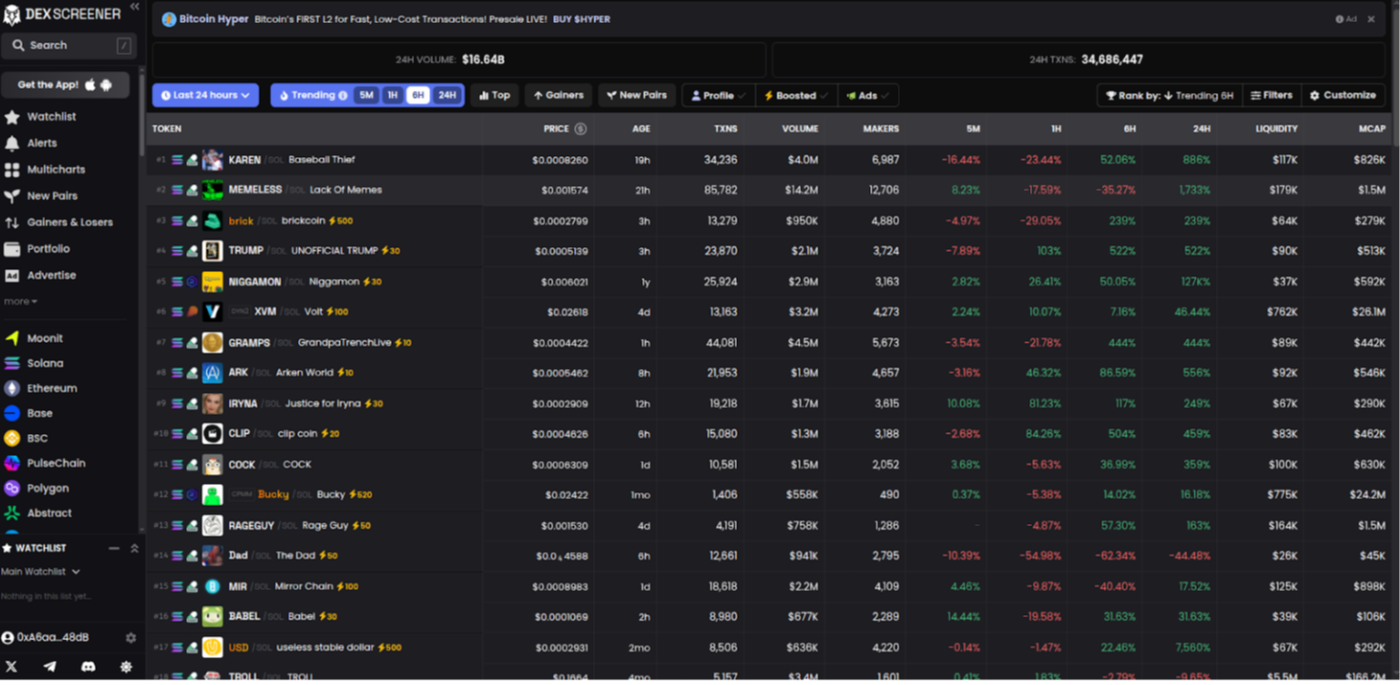
Building a DEXScreener Clone: A Step-by-Step Guide

Building a DEXScreener Clone: A Step-by-Step Guide

DEX Screener is used by crypto traders who need access to on-chain data like trading volumes, liquidity, and token prices. This information allows them to analyze trends, monitor new listings, and make informed investment decisions. In this tutorial, I will build a DEXScreener clone from scratch, covering everything from the initial design to a functional app. We will use Streamlit, a Python framework for building full-stack apps.
Share
Hackernoon2025/09/18 15:05
Which DOGE? Musk's Cryptic Post Explodes Confusion

Which DOGE? Musk's Cryptic Post Explodes Confusion

A viral chart documenting a sharp decline in U.S. federal employment during President Trump's second term has sparked unexpected confusion in cryptocurrency markets
Share
Coinstats2025/12/20 01:13
Google's AP2 protocol has been released. Does encrypted AI still have a chance?

Google's AP2 protocol has been released. Does encrypted AI still have a chance?

Following the MCP and A2A protocols, the AI Agent market has seen another blockbuster arrival: the Agent Payments Protocol (AP2), developed by Google. This will clearly further enhance AI Agents' autonomous multi-tasking capabilities, but the unfortunate reality is that it has little to do with web3AI. Let's take a closer look: What problem does AP2 solve? Simply put, the MCP protocol is like a universal hook, enabling AI agents to connect to various external tools and data sources; A2A is a team collaboration communication protocol that allows multiple AI agents to cooperate with each other to complete complex tasks; AP2 completes the last piece of the puzzle - payment capability. In other words, MCP opens up connectivity, A2A promotes collaboration efficiency, and AP2 achieves value exchange. The arrival of AP2 truly injects "soul" into the autonomous collaboration and task execution of Multi-Agents. Imagine AI Agents connecting Qunar, Meituan, and Didi to complete the booking of flights, hotels, and car rentals, but then getting stuck at the point of "self-payment." What's the point of all that multitasking? So, remember this: AP2 is an extension of MCP+A2A, solving the last mile problem of AI Agent automated execution. What are the technical highlights of AP2? The core innovation of AP2 is the Mandates mechanism, which is divided into real-time authorization mode and delegated authorization mode. Real-time authorization is easy to understand. The AI Agent finds the product and shows it to you. The operation can only be performed after the user signs. Delegated authorization requires the user to set rules in advance, such as only buying the iPhone 17 when the price drops to 5,000. The AI Agent monitors the trigger conditions and executes automatically. The implementation logic is cryptographically signed using Verifiable Credentials (VCs). Users can set complex commission conditions, including price ranges, time limits, and payment method priorities, forming a tamper-proof digital contract. Once signed, the AI Agent executes according to the conditions, with VCs ensuring auditability and security at every step. Of particular note is the "A2A x402" extension, a technical component developed by Google specifically for crypto payments, developed in collaboration with Coinbase and the Ethereum Foundation. This extension enables AI Agents to seamlessly process stablecoins, ETH, and other blockchain assets, supporting native payment scenarios within the Web3 ecosystem. What kind of imagination space can AP2 bring? After analyzing the technical principles, do you think that's it? Yes, in fact, the AP2 is boring when it is disassembled alone. Its real charm lies in connecting and opening up the "MCP+A2A+AP2" technology stack, completely opening up the complete link of AI Agent's autonomous analysis+execution+payment. From now on, AI Agents can open up many application scenarios. For example, AI Agents for stock investment and financial management can help us monitor the market 24/7 and conduct independent transactions. Enterprise procurement AI Agents can automatically replenish and renew without human intervention. AP2's complementary payment capabilities will further expand the penetration of the Agent-to-Agent economy into more scenarios. Google obviously understands that after the technical framework is established, the ecological implementation must be relied upon, so it has brought in more than 60 partners to develop it, almost covering the entire payment and business ecosystem. Interestingly, it also involves major Crypto players such as Ethereum, Coinbase, MetaMask, and Sui. Combined with the current trend of currency and stock integration, the imagination space has been doubled. Is web3 AI really dead? Not entirely. Google's AP2 looks complete, but it only achieves technical compatibility with Crypto payments. It can only be regarded as an extension of the traditional authorization framework and belongs to the category of automated execution. There is a "paradigm" difference between it and the autonomous asset management pursued by pure Crypto native solutions. The Crypto-native solutions under exploration are taking the "decentralized custody + on-chain verification" route, including AI Agent autonomous asset management, AI Agent autonomous transactions (DeFAI), AI Agent digital identity and on-chain reputation system (ERC-8004...), AI Agent on-chain governance DAO framework, AI Agent NPC and digital avatars, and many other interesting and fun directions. Ultimately, once users get used to AI Agent payments in traditional fields, their acceptance of AI Agents autonomously owning digital assets will also increase. And for those scenarios that AP2 cannot reach, such as anonymous transactions, censorship-resistant payments, and decentralized asset management, there will always be a time for crypto-native solutions to show their strength? The two are more likely to be complementary rather than competitive, but to be honest, the key technological advancements behind AI Agents currently all come from web2AI, and web3AI still needs to keep up the good work!
Share
PANews2025/09/18 07:00