

Bitget Integrates Solana, Making Every SOL Token Instantly Tradable for 100M Users
- Bitget has integrated Solana, allowing 100 million users to trade SOL tokens via the UEX pathway.
- Solana is gaining widespread attention with new partnerships with top firms like Blockworks, Coinbase, and JPMorgan.
Bitget exchange has integrated with the Solana blockchain network, expanding on-chain utility. Through this integration, every Solana token instantly becomes available to 100 million users through UEX without listings. The Solana network team announced the partnership with Bitget global crypto exchange via their official X account.
A key highlight of the partnership is that every SOL token on the blockchain becomes immediately tradable to over 100 million Bitget users. The integration is secured with the Bitget Universal Exchange (UEX) platform. One key feature is that it does not require the traditional token listing process.
Thus, the Bitget integration bridges allow seamless SOL on-chain trading with centralized exchanges. This emphasizes a trading shift to fully on-chain while maintaining user-friendly access, liquidity, and security. It also brings millions of tokens in the Solana ecosystem directly to mainstream users.
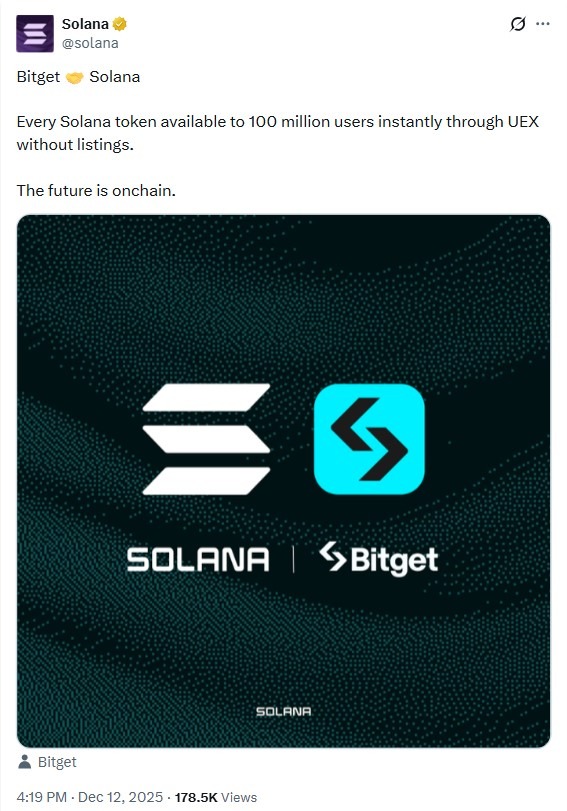 Bitget and Solana Integration | Source: Solana
This move positions Bitget as a firm looking to merge both TradFi and DeFi offerings. Bitget has partnered with top blockchains and memecoins in the crypto space, pushing forward its adoption. In a recent study we reported on, Shiba Inu entered an agreement with Bitget to launch a SHIB-branded payment card. This card allows users to spend up to $400 in cryptocurrency per month without any added costs. It also indicates a move toward integrating the SHIB memecoin into traditional payment channels.
Bitget also took a step toward boosting trust and transparency by integrating with Chainlink0, as highlighted in our previous article. According to the details, Bitget integrated Chainlink’s Proof of Reserve (PoR) solution on Ethereum (ETH) for its wrapped Bitcoin token, BGBTC.
Meanwhile, the integration with Bitget is a big win for Solana users. This is because new products can now reach 100 million users, adding more value to SOL holders.
Solana Adoption is Growing
Despite the market uncertainty, Solana adoption has grown in the past few weeks. Part of its recent partnership is with Blockworks. As we mentioned in our post, Blockworks tapped Solana to launch an investor relations platform for institutions. The platform, referred to as Lightspeed IR, aims to bridge communication between crypto projects and professional investors.
Additionally, JPMorgan turned to Solana to build a USCP token for Galaxy Digital’s latest on-chain debt raise. The bank confirmed it successfully arranged a U.S. Commercial Paper issuance purchased by Coinbase and Franklin Templeton.
In another new partnership, Coinbase formed an alliance with the Solana ecosystem. Coinbase unveiled a new on-chain trading feature that enables users to trade tokens directly on the Solana network without requiring a formal listing process.
For now, the price of SOL has yet to reflect positively on the recent collaborations. In the past 24 hours, SOL is down 2% to trade at $133.5.
]]>You May Also Like

The Channel Factories We’ve Been Waiting For

Waarom BTC niet stijgt: OG holders verkopen massaal call opties
