Circle Develops Privacy-Focused Stablecoin to Boost Institutional Adoption Circle, a leading stablecoin issuer, is working on a new privacy-enabled version of its USDC token, aiming to attract more institutional users by providing heightened confidentiality on blockchain transactions. This initiative seeks to address the growing demand for privacy in digital asset transactions within the financial industry. [...]Circle Develops Privacy-Focused Stablecoin to Boost Institutional Adoption Circle, a leading stablecoin issuer, is working on a new privacy-enabled version of its USDC token, aiming to attract more institutional users by providing heightened confidentiality on blockchain transactions. This initiative seeks to address the growing demand for privacy in digital asset transactions within the financial industry. [...]

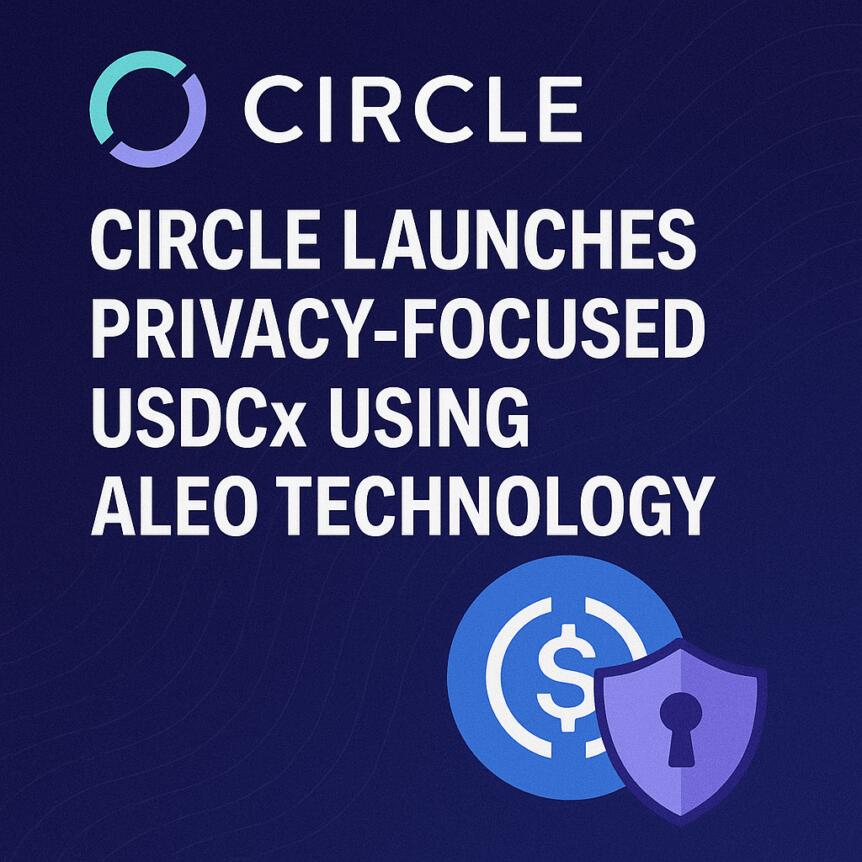
Circle Launches Privacy-Focused USDCx Using Aleo Technology
2025/12/10 01:34
Circle Launches Privacy-Focused Usdcx Using Aleo Technology

Circle Develops Privacy-Focused Stablecoin to Boost Institutional Adoption

Circle, a leading stablecoin issuer, is working on a new privacy-enabled version of its USDC token, aiming to attract more institutional users by providing heightened confidentiality on blockchain transactions. This initiative seeks to address the growing demand for privacy in digital asset transactions within the financial industry.

Key Takeaways

  • Circle is creating a privacy-enhanced stablecoin, USDCx, in partnership with Aleo, a privacy-centric blockchain firm.
  • USDCx offers “banking-level privacy,” distinguishing it from traditional stablecoins where transaction details are publicly accessible.
  • The project aims to facilitate compliance and transparency, enabling regulators to access transaction data if necessary.
  • This development aligns with broader industry movements toward privacy solutions in stablecoins, supported by companies like Taurus and initiatives on smart-contract privacy.

Tickers mentioned: None

Sentiment: Positive

Price impact: Neutral. The move aims to increase institutional participation without immediate market price effects.

Trading idea (Not Financial Advice): Hold. Privacy innovations may enhance long-term adoption but do not suggest immediate trading actions.

Market context: The push for privacy-centered stablecoins reflects increasing institutional interest amid evolving regulatory frameworks and technological advancements.

Deepening Privacy for Stablecoins

Circle is developing USDCx, a privacy-centric version of its popular USD-pegged stablecoin, in collaboration with Aleo, a firm renowned for privacy-focused blockchain solutions. Unlike conventional stablecoins, which record all transaction details openly on the blockchain, USDCx is designed to provide “banking-level privacy,” allowing users to maintain confidentiality. Although transactions will remain private, Circle retains the ability to produce compliance records if authorities request such information.

Aleo emphasizes that while transparency has been branded as a core blockchain feature, it becomes a liability when handling sensitive financial data. Their recent post advocates for enhanced privacy to support stablecoin adoption, especially among institutions wary of public transaction visibility.

Other players in the space, like Taurus, are also pushing for privacy solutions. As reported by Cointelegraph, Taurus has developed a private smart contract system facilitating anonymous stablecoin transactions. These innovations aim to expand use cases such as intracompany settlements and payroll management, where confidentiality is paramount.

Institutional Adoption on the Rise

Circle’s privacy-focused developments coincide with a broader trend of institutional interest in stablecoins, stimulated by recent regulatory developments such as the US GENIUS Act. Major financial institutions are increasingly exploring stablecoin payment rails; Citigroup, in partnership with Coinbase, is testing such systems, while banks like JPMorgan and Bank of America are reportedly experimenting with similar initiatives.

In addition, companies like Western Union are constructing digital settlement systems on blockchain networks such as Solana, and Visa has expanded its stablecoin offerings, reflecting increasing industry adoption. The US dollar remains dominant, with tokens like USDC and Tether’s USDT accounting for the majority of the stablecoin market, underpinning global digital transactions.

This article was originally published as Circle Launches Privacy-Focused USDCx Using Aleo Technology on Crypto Breaking News – your trusted source for crypto news, Bitcoin news, and blockchain updates.

Disclaimer: The articles reposted on this site are sourced from public platforms and are provided for informational purposes only. They do not necessarily reflect the views of MEXC. All rights remain with the original authors. If you believe any content infringes on third-party rights, please contact service@support.mexc.com for removal. MEXC makes no guarantees regarding the accuracy, completeness, or timeliness of the content and is not responsible for any actions taken based on the information provided. The content does not constitute financial, legal, or other professional advice, nor should it be considered a recommendation or endorsement by MEXC.

You May Also Like

Ethereum unveils roadmap focusing on scaling, interoperability, and security at Japan Dev Conference


Ethereum unveils roadmap focusing on scaling, interoperability, and security at Japan Dev Conference

The post Ethereum unveils roadmap focusing on scaling, interoperability, and security at Japan Dev Conference appeared on BitcoinEthereumNews.com. Key Takeaways Ethereum’s new roadmap was presented by Vitalik Buterin at the Japan Dev Conference. Short-term priorities include Layer 1 scaling and raising gas limits to enhance transaction throughput. Vitalik Buterin presented Ethereum’s development roadmap at the Japan Dev Conference today, outlining the blockchain platform’s priorities across multiple timeframes. The short-term goals focus on scaling solutions and increasing Layer 1 gas limits to improve transaction capacity. Mid-term objectives target enhanced cross-Layer 2 interoperability and faster network responsiveness to create a more seamless user experience across different scaling solutions. The long-term vision emphasizes building a secure, simple, quantum-resistant, and formally verified minimalist Ethereum network. This approach aims to future-proof the platform against emerging technological threats while maintaining its core functionality. The roadmap presentation comes as Ethereum continues to compete with other blockchain platforms for market share in the smart contract and decentralized application space. Source: https://cryptobriefing.com/ethereum-roadmap-scaling-interoperability-security-japan/
Share
BitcoinEthereumNews2025/09/18 00:25
Vitalik Buterin Suggests Ethereum Security Intact Amid Recent Glitch

Vitalik Buterin Suggests Ethereum Security Intact Amid Recent Glitch

The post Vitalik Buterin Suggests Ethereum Security Intact Amid Recent Glitch appeared on BitcoinEthereumNews.com. Ethereum remains secure despite a recent network glitch caused by a Prysm client bug that temporarily halted block finalization. Vitalik Buterin emphasized that this does not undermine the network’s core security, as blocks continue to be produced and executed, behaving like Bitcoin’s probabilistic model during such pauses. Vitalik Buterin assures that temporary loss of finality does not compromise Ethereum’s overall security model. The glitch primarily impacted secondary systems like bridges and Layer 2 solutions, not the base chain. Experts compare Ethereum’s response to Bitcoin’s, where probabilistic finality prevents chain rewrites while allowing continued operations. Ethereum secure despite recent glitch: Vitalik Buterin explains why the network’s resilience shines through temporary finality pauses. Discover key insights on blockchain reliability. Stay informed on crypto updates—read more now. What Did Vitalik Buterin Say About Ethereum’s Security After the Recent Glitch? Ethereum remains secure even amid the recent network disruption, according to Vitalik Buterin, Ethereum’s co-founder. He clarified that the Prysm client bug, which briefly interrupted block finalization, does not pose a threat to the protocol’s integrity. Instead, it highlights the network’s design for graceful degradation, where core functions persist without deterministic certainty. How Does Ethereum Behave During Finality Pauses? During the incident, Ethereum temporarily shifted to a probabilistic security model similar to Bitcoin’s, as noted by blockchain researchers. Fabrizio Romano Genovese, an Oxford PhD and Ethereum protocol specialist, explained that many blockchains, including Bitcoin, rely on growing difficulty in rewriting history rather than instant finality. In Ethereum’s case, blocks kept being created and executed, preventing any chain halt, though secondary services like cross-chain bridges experienced delays. This behavior underscores the network’s robustness, with no risk of approving incorrect transaction histories. Genovese added that such events reveal the need for better fallback mechanisms in dependent infrastructure, ensuring smoother operations in future occurrences. Statistics from the…
Share
BitcoinEthereumNews2025/12/11 16:40