The post Base Opens Native Cross-Chain Channel to Solana appeared on BitcoinEthereumNews.com. Blockchain A major shift in cross-chain connectivity has emerged as Coinbase’s Layer-2 network, Base, quietly steps into Solana territory. Key Takeaways Base has created a native, CCIP-secured corridor directly to Solana. Users can move SOL into Base apps and return assets without external tools. Developers gain simplified multi-chain tooling to support Solana inside Base. Instead of relying on unofficial portals or improvising multi-step transfers, users now have a direct, native route between the two ecosystems. The connection is secured through Chainlink’s CCIP protocol, which acts as the verification layer for every message that travels between the chains. For Base, this isn’t just a bridge — it’s a statement that the network wants to position itself at the center of a new multi-chain era where switching blockchains becomes as trivial as switching browser tabs. A New Cross-Chain Flow Built for Everyday Users Until now, the gap between Solana and Base functioned like a border crossing: possible, but inconvenient. The new system eliminates that friction. SOL holders can push assets onto Base, experiment with dApps built in the Ethereum environment, and send everything back to Solana whenever they want — all through a process designed to feel native on both ends. Because several Base applications have already adopted the integration, users no longer need separate wallets or external bridges. It’s a multi-chain experience designed to look like a single ecosystem rather than two networks stitched together. The moment also aligns with Chainlink’s rising footprint among institutions, following its recent inclusion in a Grayscale ETF. CCIP, once seen as a developer-focused tool, is increasingly powering real infrastructure. Developers Gain an Easier Path to Multi-Chain Design Developers on Base now have access to code templates and open-source materials allowing them to add Solana support with minimal effort. This creates a new design philosophy: let… The post Base Opens Native Cross-Chain Channel to Solana appeared on BitcoinEthereumNews.com. Blockchain A major shift in cross-chain connectivity has emerged as Coinbase’s Layer-2 network, Base, quietly steps into Solana territory. Key Takeaways Base has created a native, CCIP-secured corridor directly to Solana. Users can move SOL into Base apps and return assets without external tools. Developers gain simplified multi-chain tooling to support Solana inside Base. Instead of relying on unofficial portals or improvising multi-step transfers, users now have a direct, native route between the two ecosystems. The connection is secured through Chainlink’s CCIP protocol, which acts as the verification layer for every message that travels between the chains. For Base, this isn’t just a bridge — it’s a statement that the network wants to position itself at the center of a new multi-chain era where switching blockchains becomes as trivial as switching browser tabs. A New Cross-Chain Flow Built for Everyday Users Until now, the gap between Solana and Base functioned like a border crossing: possible, but inconvenient. The new system eliminates that friction. SOL holders can push assets onto Base, experiment with dApps built in the Ethereum environment, and send everything back to Solana whenever they want — all through a process designed to feel native on both ends. Because several Base applications have already adopted the integration, users no longer need separate wallets or external bridges. It’s a multi-chain experience designed to look like a single ecosystem rather than two networks stitched together. The moment also aligns with Chainlink’s rising footprint among institutions, following its recent inclusion in a Grayscale ETF. CCIP, once seen as a developer-focused tool, is increasingly powering real infrastructure. Developers Gain an Easier Path to Multi-Chain Design Developers on Base now have access to code templates and open-source materials allowing them to add Solana support with minimal effort. This creates a new design philosophy: let…

Base Opens Native Cross-Chain Channel to Solana

Blockchain

A major shift in cross-chain connectivity has emerged as Coinbase’s Layer-2 network, Base, quietly steps into Solana territory.

Key Takeaways
  • Base has created a native, CCIP-secured corridor directly to Solana.
  • Users can move SOL into Base apps and return assets without external tools.
  • Developers gain simplified multi-chain tooling to support Solana inside Base.

Instead of relying on unofficial portals or improvising multi-step transfers, users now have a direct, native route between the two ecosystems. The connection is secured through Chainlink’s CCIP protocol, which acts as the verification layer for every message that travels between the chains.

For Base, this isn’t just a bridge — it’s a statement that the network wants to position itself at the center of a new multi-chain era where switching blockchains becomes as trivial as switching browser tabs.

A New Cross-Chain Flow Built for Everyday Users

Until now, the gap between Solana and Base functioned like a border crossing: possible, but inconvenient. The new system eliminates that friction. SOL holders can push assets onto Base, experiment with dApps built in the Ethereum environment, and send everything back to Solana whenever they want — all through a process designed to feel native on both ends.

Because several Base applications have already adopted the integration, users no longer need separate wallets or external bridges. It’s a multi-chain experience designed to look like a single ecosystem rather than two networks stitched together.

The moment also aligns with Chainlink’s rising footprint among institutions, following its recent inclusion in a Grayscale ETF. CCIP, once seen as a developer-focused tool, is increasingly powering real infrastructure.

Developers Gain an Easier Path to Multi-Chain Design

Developers on Base now have access to code templates and open-source materials allowing them to add Solana support with minimal effort. This creates a new design philosophy: let Solana handle speed, let Base handle scaling and Ethereum compatibility, and let CCIP manage the communication layer.

The goal is not just moving tokens — it’s enabling apps that can intelligently operate across multiple execution environments. Coinbase has argued that this kind of architecture will eventually demand clearer regulatory frameworks, especially as multi-chain traffic accelerates.

Solana Communities Get Their First Native Gateway Into Base

For Solana users, the bridge opens an entirely new map. Base suddenly becomes a place where their existing tokens and communities can participate without starting from scratch. It also signals a deeper alignment between two ecosystems that saw explosive growth this year.

Security concerns around bridging — long considered one of crypto’s weakest links — are partially addressed through CCIP’s verification process, offering reassurance to users who have avoided cross-chain transfers due to past exploits.

In the coming weeks, Base expects more applications to activate the bridge, meaning liquidity and users are likely to start flowing in both directions at scale.


The information provided in this article is for educational purposes only and does not constitute financial, investment, or trading advice. Coindoo.com does not endorse or recommend any specific investment strategy or cryptocurrency. Always conduct your own research and consult with a licensed financial advisor before making any investment decisions.

Author

Alex is an experienced financial journalist and cryptocurrency enthusiast. With over 8 years of experience covering the crypto, blockchain, and fintech industries, he is well-versed in the complex and ever-evolving world of digital assets. His insightful and thought-provoking articles provide readers with a clear picture of the latest developments and trends in the market. His approach allows him to break down complex ideas into accessible and in-depth content. Follow his publications to stay up to date with the most important trends and topics.

Next article

Source: https://coindoo.com/base-opens-native-cross-chain-channel-to-solana/

Market Opportunity
CROSS Logo
CROSS Price(CROSS)
$0.10325
$0.10325$0.10325
+0.79%
USD
CROSS (CROSS) Live Price Chart
Disclaimer: The articles reposted on this site are sourced from public platforms and are provided for informational purposes only. They do not necessarily reflect the views of MEXC. All rights remain with the original authors. If you believe any content infringes on third-party rights, please contact service@support.mexc.com for removal. MEXC makes no guarantees regarding the accuracy, completeness, or timeliness of the content and is not responsible for any actions taken based on the information provided. The content does not constitute financial, legal, or other professional advice, nor should it be considered a recommendation or endorsement by MEXC.

You May Also Like

Hadron Labs Launches Bitcoin Summer on Neutron, Offering 5–10% BTC Yield

Hadron Labs Launches Bitcoin Summer on Neutron, Offering 5–10% BTC Yield

Hadron Labs launches 'Bitcoin Summer' on Neutron, BTC vaults for WBTC, eBTC, solvBTC, uniBTC and USDC. Earn 5–10% BTC via maxBTC, with up to 10x looping.
Share
Blockchainreporter2025/09/18 02:00
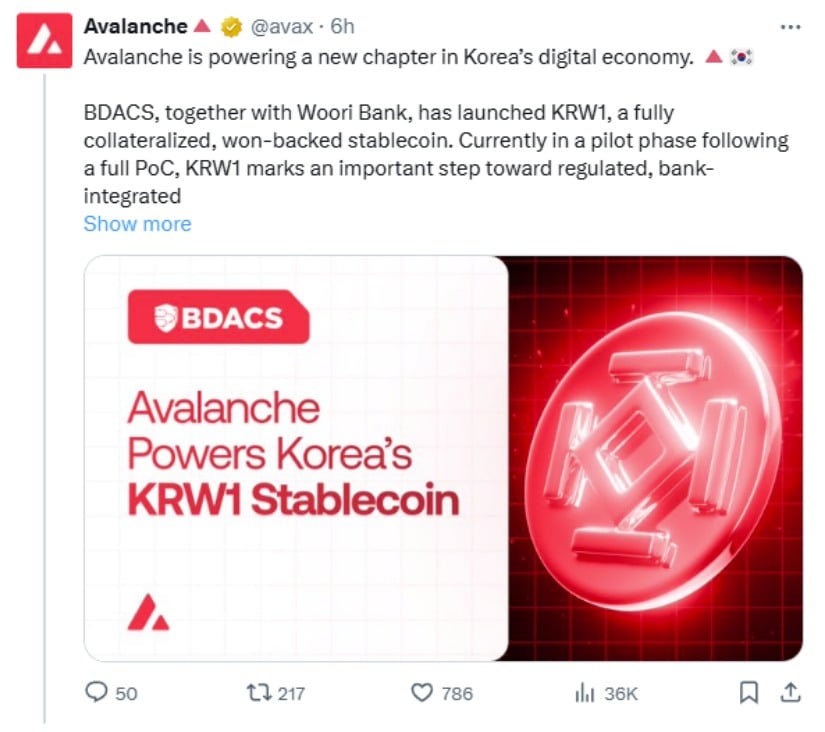
South Korea Launches First Won-Backed Stablecoin KRW1 on Avalanche

South Korea Launches First Won-Backed Stablecoin KRW1 on Avalanche

South Korea made history this week by launching its first Korean won-backed stablecoin.
Share
Brave Newcoin2025/09/19 03:15
Curve Finance votes on revenue-sharing model for CRV holders

Curve Finance votes on revenue-sharing model for CRV holders

The post Curve Finance votes on revenue-sharing model for CRV holders appeared on BitcoinEthereumNews.com. Curve Finance has proposed a new protocol called Yield Basis that would share revenue directly with CRV holders, marking a shift from one-off incentives to sustainable income. Summary Curve Finance has put forward a revenue-sharing protocol to give CRV holders sustainable income beyond emissions and fees. The plan would mint $60M in crvUSD to seed three Bitcoin liquidity pools (WBTC, cbBTC, tBTC), with 35–65% of revenue distributed to veCRV stakers. The DAO vote runs from up to Sept. 24, with the proposal seen as a major step to strengthen CRV tokenomics after past liquidity and governance challenges. Curve Finance founder Michael Egorov has introduced a proposal to give CRV token holders a more direct way to earn income, launching a system called Yield Basis that aims to turn the governance token into a sustainable, yield-bearing asset.  The proposal has been published on the Curve DAO (CRV) governance forum, with voting open until Sept. 24. A new model for CRV rewards Yield Basis is designed to distribute transparent and consistent returns to CRV holders who lock their tokens for veCRV governance rights. Unlike past incentive programs, which relied heavily on airdrops and emissions, the protocol channels income from Bitcoin-focused liquidity pools directly back to token holders. To start, Curve would mint $60 million worth of crvUSD, its over-collateralized stablecoin, with proceeds allocated across three pools — WBTC, cbBTC, and tBTC — each capped at $10 million. 25% of Yield Basis tokens would be reserved for the Curve ecosystem, and between 35% and 65% of Yield Basis’s revenue would be given to veCRV holders. By emphasizing Bitcoin (BTC) liquidity and offering yields without the short-term loss risks associated with automated market makers, the protocol hopes to draw in professional traders and institutions. Context and potential impact on Curve Finance The proposal comes as Curve continues to modify…
Share
BitcoinEthereumNews2025/09/18 14:37