Ethereum just completed the Fusaka upgrade, a hard fork designed to prepare the network for larger scale and cheaper use. While technical on paper, the change touches the core functions of Ethereum — how data is stored, how transactions fit into blocks, and how Rollups like Arbitrum, Base, and Optimism interact with the main chain.  For anyone holding ETH, this upgrade forms the groundwork for lower fees, better network efficiency, and a more resilient long-term ecosystem. A Larger Network With More Room to Breathe The biggest change arrived in how Ethereum handles data.  Every transaction, NFT mint, DeFi swap, or Layer-2 batch needs block space, and until now, that space was limited. Fusaka increases Ethereum’s capacity so blocks can carry more information at once.  This does not make the chain instantly faster, but it removes pressure when demand spikes, such as during market volatility or popular token launches.  In simple terms, Ethereum can absorb more activity without struggling. Cheaper Rollups Through Expanded Blob Capacity A large portion of today’s Ethereum traffic comes from Rollups. These networks batch thousands of user transactions and settle them on Ethereum as compressed data called “blobs.”  Before Fusaka, blob space was constrained. When demand surged, fees climbed. Fusaka expands the room available for blob submissions and introduces a flexible system for raising or lowering capacity without a full upgrade.  As rollups scale into this new space, users should experience lower transaction costs and smoother application activity.  The end goal is simple: more transactions, less friction. Ethereum Fusaka Upgrade Explained. Source: X/Bull Theory PeerDAS: A Simpler Way to Verify Data Another major improvement is how Ethereum nodes verify data. Previously, nodes had to download large sections of block data to confirm that nothing was missing or hidden.  Fusaka introduces PeerDAS, a system that checks small, random pieces of data rather than the entire load.  It works like inspecting a warehouse by opening a few random boxes instead of checking every single one.  This reduces bandwidth and storage requirements for validators and node operators, making it easier — and cheaper — for more people to run infrastructure.  A wider validator base strengthens decentralization, which ultimately strengthens Ethereum’s security and resilience. Higher Block Capacity Means More Throughput Alongside scaling capacity, Fusaka also raises the block gas limit. A higher limit means more work can fit inside each block, allowing more transactions and smart-contract calls to settle without delay.  It doesn’t increase block speed, but it increases throughput. DeFi activity, NFT auctions, and high-frequency trading will have more room to breathe in peak hours. Better Wallet Support and Future UX Improvements Fusaka also includes improvements to Ethereum’s cryptography and virtual machine. The upgrade adds support for P-256 signatures, which are used in modern authentication systems, including those behind password-less login on smartphones and biometric devices.  This opens a path for future wallets that act more like Apple Pay or Google Passkeys rather than seed-phrase-based apps. Over time, this could make Ethereum access simpler for mainstream users. What Fusaka Means for ETH Holders The impact for ETH holders is gradual but meaningful. Fees on Layer-2 networks should ease as data capacity expands. Network congestion should become less common. More validators can participate due to lower hardware demands.  Most importantly, Ethereum now has room to grow without sacrificing security or decentralization. If adoption increases, settlement volume grows with it — and so does ETH’s role as the asset that powers, secures, and settles everything on top. A Foundational Upgrade, Not a Flashy One Fusaka does not rewrite Ethereum’s economics or make ETH suddenly deflationary, but it strengthens the foundation that future demand depends on. Cheaper rollup fees invite usage.  A more scalable base layer invites developers. A more accessible node environment invites participation. These are structural upgrades, the kind that do little in a day but transform the network over time. Ethereum widened the highway, improved the toll system, and made it easier for new drivers to join. That is the real meaning of Fusaka — a quiet shift with long-term weight.  As Layer-2 networks expand and applications multiply, the effects should move from technical discussion into user experience, transaction cost, and ultimately, ETH value itself.Ethereum just completed the Fusaka upgrade, a hard fork designed to prepare the network for larger scale and cheaper use. While technical on paper, the change touches the core functions of Ethereum — how data is stored, how transactions fit into blocks, and how Rollups like Arbitrum, Base, and Optimism interact with the main chain.  For anyone holding ETH, this upgrade forms the groundwork for lower fees, better network efficiency, and a more resilient long-term ecosystem. A Larger Network With More Room to Breathe The biggest change arrived in how Ethereum handles data.  Every transaction, NFT mint, DeFi swap, or Layer-2 batch needs block space, and until now, that space was limited. Fusaka increases Ethereum’s capacity so blocks can carry more information at once.  This does not make the chain instantly faster, but it removes pressure when demand spikes, such as during market volatility or popular token launches.  In simple terms, Ethereum can absorb more activity without struggling. Cheaper Rollups Through Expanded Blob Capacity A large portion of today’s Ethereum traffic comes from Rollups. These networks batch thousands of user transactions and settle them on Ethereum as compressed data called “blobs.”  Before Fusaka, blob space was constrained. When demand surged, fees climbed. Fusaka expands the room available for blob submissions and introduces a flexible system for raising or lowering capacity without a full upgrade.  As rollups scale into this new space, users should experience lower transaction costs and smoother application activity.  The end goal is simple: more transactions, less friction. Ethereum Fusaka Upgrade Explained. Source: X/Bull Theory PeerDAS: A Simpler Way to Verify Data Another major improvement is how Ethereum nodes verify data. Previously, nodes had to download large sections of block data to confirm that nothing was missing or hidden.  Fusaka introduces PeerDAS, a system that checks small, random pieces of data rather than the entire load.  It works like inspecting a warehouse by opening a few random boxes instead of checking every single one.  This reduces bandwidth and storage requirements for validators and node operators, making it easier — and cheaper — for more people to run infrastructure.  A wider validator base strengthens decentralization, which ultimately strengthens Ethereum’s security and resilience. Higher Block Capacity Means More Throughput Alongside scaling capacity, Fusaka also raises the block gas limit. A higher limit means more work can fit inside each block, allowing more transactions and smart-contract calls to settle without delay.  It doesn’t increase block speed, but it increases throughput. DeFi activity, NFT auctions, and high-frequency trading will have more room to breathe in peak hours. Better Wallet Support and Future UX Improvements Fusaka also includes improvements to Ethereum’s cryptography and virtual machine. The upgrade adds support for P-256 signatures, which are used in modern authentication systems, including those behind password-less login on smartphones and biometric devices.  This opens a path for future wallets that act more like Apple Pay or Google Passkeys rather than seed-phrase-based apps. Over time, this could make Ethereum access simpler for mainstream users. What Fusaka Means for ETH Holders The impact for ETH holders is gradual but meaningful. Fees on Layer-2 networks should ease as data capacity expands. Network congestion should become less common. More validators can participate due to lower hardware demands.  Most importantly, Ethereum now has room to grow without sacrificing security or decentralization. If adoption increases, settlement volume grows with it — and so does ETH’s role as the asset that powers, secures, and settles everything on top. A Foundational Upgrade, Not a Flashy One Fusaka does not rewrite Ethereum’s economics or make ETH suddenly deflationary, but it strengthens the foundation that future demand depends on. Cheaper rollup fees invite usage.  A more scalable base layer invites developers. A more accessible node environment invites participation. These are structural upgrades, the kind that do little in a day but transform the network over time. Ethereum widened the highway, improved the toll system, and made it easier for new drivers to join. That is the real meaning of Fusaka — a quiet shift with long-term weight.  As Layer-2 networks expand and applications multiply, the effects should move from technical discussion into user experience, transaction cost, and ultimately, ETH value itself.
What Actually Changed with the Ethereum Fusaka Upgrade

2025/12/05 06:33
4 min read

Ethereum just completed the Fusaka upgrade, a hard fork designed to prepare the network for larger scale and cheaper use. While technical on paper, the change touches the core functions of Ethereum — how data is stored, how transactions fit into blocks, and how Rollups like Arbitrum, Base, and Optimism interact with the main chain. 

For anyone holding ETH, this upgrade forms the groundwork for lower fees, better network efficiency, and a more resilient long-term ecosystem.

A Larger Network With More Room to Breathe

The biggest change arrived in how Ethereum handles data. 

Every transaction, NFT mint, DeFi swap, or Layer-2 batch needs block space, and until now, that space was limited. Fusaka increases Ethereum’s capacity so blocks can carry more information at once. 

This does not make the chain instantly faster, but it removes pressure when demand spikes, such as during market volatility or popular token launches. 

In simple terms, Ethereum can absorb more activity without struggling.

Cheaper Rollups Through Expanded Blob Capacity

A large portion of today’s Ethereum traffic comes from Rollups. These networks batch thousands of user transactions and settle them on Ethereum as compressed data called “blobs.” 

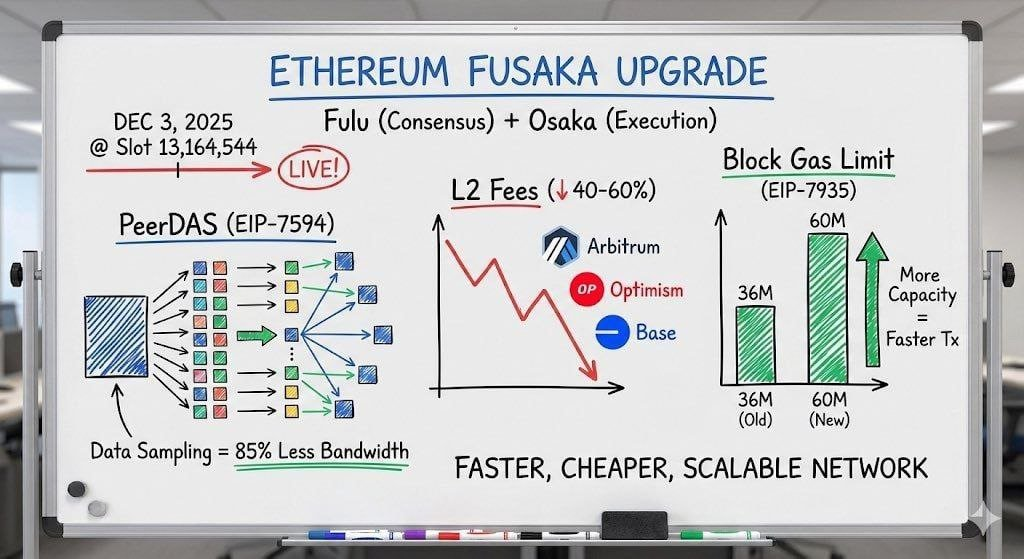
Before Fusaka, blob space was constrained. When demand surged, fees climbed. Fusaka expands the room available for blob submissions and introduces a flexible system for raising or lowering capacity without a full upgrade. 

As rollups scale into this new space, users should experience lower transaction costs and smoother application activity. 

The end goal is simple: more transactions, less friction.

Ethereum Fusaka Upgrade Explained. Source: X/Bull Theory

PeerDAS: A Simpler Way to Verify Data

Another major improvement is how Ethereum nodes verify data. Previously, nodes had to download large sections of block data to confirm that nothing was missing or hidden. 

Fusaka introduces PeerDAS, a system that checks small, random pieces of data rather than the entire load. 

It works like inspecting a warehouse by opening a few random boxes instead of checking every single one. 

This reduces bandwidth and storage requirements for validators and node operators, making it easier — and cheaper — for more people to run infrastructure. 

A wider validator base strengthens decentralization, which ultimately strengthens Ethereum’s security and resilience.

Higher Block Capacity Means More Throughput

Alongside scaling capacity, Fusaka also raises the block gas limit. A higher limit means more work can fit inside each block, allowing more transactions and smart-contract calls to settle without delay. 

It doesn’t increase block speed, but it increases throughput. DeFi activity, NFT auctions, and high-frequency trading will have more room to breathe in peak hours.

Better Wallet Support and Future UX Improvements

Fusaka also includes improvements to Ethereum’s cryptography and virtual machine. The upgrade adds support for P-256 signatures, which are used in modern authentication systems, including those behind password-less login on smartphones and biometric devices. 

This opens a path for future wallets that act more like Apple Pay or Google Passkeys rather than seed-phrase-based apps. Over time, this could make Ethereum access simpler for mainstream users.

What Fusaka Means for ETH Holders

The impact for ETH holders is gradual but meaningful. Fees on Layer-2 networks should ease as data capacity expands. Network congestion should become less common. More validators can participate due to lower hardware demands. 

Most importantly, Ethereum now has room to grow without sacrificing security or decentralization. If adoption increases, settlement volume grows with it — and so does ETH’s role as the asset that powers, secures, and settles everything on top.

A Foundational Upgrade, Not a Flashy One

Fusaka does not rewrite Ethereum’s economics or make ETH suddenly deflationary, but it strengthens the foundation that future demand depends on. Cheaper rollup fees invite usage. 

A more scalable base layer invites developers. A more accessible node environment invites participation. These are structural upgrades, the kind that do little in a day but transform the network over time.

Ethereum widened the highway, improved the toll system, and made it easier for new drivers to join. That is the real meaning of Fusaka — a quiet shift with long-term weight. 

As Layer-2 networks expand and applications multiply, the effects should move from technical discussion into user experience, transaction cost, and ultimately, ETH value itself.

Market Opportunity
ChangeX Logo
ChangeX Price(CHANGE)
$0.00144516
$0.00144516$0.00144516
+0.08%
USD
ChangeX (CHANGE) Live Price Chart
Disclaimer: The articles reposted on this site are sourced from public platforms and are provided for informational purposes only. They do not necessarily reflect the views of MEXC. All rights remain with the original authors. If you believe any content infringes on third-party rights, please contact service@support.mexc.com for removal. MEXC makes no guarantees regarding the accuracy, completeness, or timeliness of the content and is not responsible for any actions taken based on the information provided. The content does not constitute financial, legal, or other professional advice, nor should it be considered a recommendation or endorsement by MEXC.

You May Also Like

Nelly Opitz Discusses the Impact of Being Documented in the Digital Age

Nelly Opitz Discusses the Impact of Being Documented in the Digital Age

Nelly Opitz, a teenage athlete, explores the evolving concept of being documented in a digital age where precision and consistency spark subtle doubts. United States
Share
AI Journal2026/02/19 10:01
Today’s NYT Pips Hints And Solutions For Thursday, September 18th

Today’s NYT Pips Hints And Solutions For Thursday, September 18th

The post Today’s NYT Pips Hints And Solutions For Thursday, September 18th appeared on BitcoinEthereumNews.com. It’s Thursday and I am incredibly sore and tired after really hitting the weights and the yoga mat hard this week. Sore is good! It takes pain to reduce pain, or at least that’s my experience with exercise. We must exercise our minds as well, and what better way to do that than with a fun puzzle game about placing dominoes in the correct tiles. Come along, my Pipsqueaks, let’s solve today’s Pips! Looking for Wednesday’s Pips? Read our guide right here. How To Play Pips In Pips, you have a grid of multicolored boxes. Each colored area represents a different “condition” that you have to achieve. You have a select number of dominoes that you have to spend filling in the grid. You must use every domino and achieve every condition properly to win. There are Easy, Medium and Difficult tiers. Here’s an example of a difficult tier Pips: Pips example Screenshot: Erik Kain As you can see, the grid has a bunch of symbols and numbers with each color. On the far left, the three purple squares must not equal one another (hence the equal sign crossed out). The two pink squares next to that must equal a total of 0. The zig-zagging blue squares all must equal one another. You click on dominoes to rotate them, and will need to since they have to be rotated to fit where they belong. Not shown on this grid are other conditions, such as “less than” or “greater than.” If there are multiple tiles with > or < signs, the total of those tiles must be greater or less than the listed number. It varies by grid. Blank spaces can have anything. The various possible conditions are: = All pips must equal one another in this group. ≠ All pips…
Share
BitcoinEthereumNews2025/09/18 08:59
Classified briefing demanded into possible Trump admin cover-up of El Paso fiasco

Classified briefing demanded into possible Trump admin cover-up of El Paso fiasco

A trio of House Democratic lawmakers sent a letter to multiple Trump administration agency heads demanding a classified briefing on the bungled operation in El
Share
Rawstory2026/02/19 09:55
