Chainlink price has formed multiple bearish patterns that suggest its ongoing downtrend could extend over the coming weeks. According to data from crypto.news, Chainlink (LINK) hit a yearly high of $27.70 in August this year. It has since dropped by…Chainlink price has formed multiple bearish patterns that suggest its ongoing downtrend could extend over the coming weeks. According to data from crypto.news, Chainlink (LINK) hit a yearly high of $27.70 in August this year. It has since dropped by…

Chainlink price forms bearish setup as it nears multi-year support, crash incoming?

3 min read

Chainlink price has formed multiple bearish patterns that suggest its ongoing downtrend could extend over the coming weeks.

Summary
  • Chainlink price is down nearly 50% from its yearly high.
  • LINK price is close to confirming a death cross on the 1-day chart.

According to data from crypto.news, Chainlink (LINK) hit a yearly high of $27.70 in August this year. It has since dropped by 49% to $14.05 last check on Monday, Nov. 17.

Chainlink price entered the downtrend amid broader macroeconomic headwinds, including investor concerns surrounding U.S. tariffs on key economies and diminishing hopes of another rate cut by the Federal Reserve in December.

Data from DeFiLlama shows that the total value locked in all Chainlink-based DeFi applications has fallen to $608.14 million, significantly lower than $1.13 billion held in late August this year. Weekly fees generated by these protocols have also dropped 45% in the period.

Declining TVL and fees mean that the overall usage and demand for Chainlink’s services within the DeFi space have weakened, as activity over the network has slowed down, leading some investors to move towards alternative oracle solutions in recent months.

Chainlink price analysis

On the daily chart, Chainlink price has formed a multi-year symmetrical triangle pattern. The pattern is usually neutral in nature; however, breakouts from the upper or lower trendlines from which it is formed can decide the direction of the next major move.

Chainlink price forms a death cross on the daily chart.

At press time, LINK price appeared to be approaching a breakdown from the lower boundary of the pattern, a zone where buying interest has repeatedly emerged each time it dipped to these levels. However, the current momentum suggests that buyers may be losing strength.

Adding another layer of bearish pressure, the 50-day simple moving average is on the verge of crossing below the 200-day simple moving average. If this crossover takes place, it would confirm a death cross, a historically reliable indicator of sustained downtrends in the weeks that follow.

For now, the key support level for LINK stands at $11.06, which coincides with the 38.2% Fibonacci retracement level. 

A drop below this would strongly and clearly confirm the breakdown from the symmetrical triangle pattern and could drive further losses to $10 or lower.

However, data from Nansen shows that the amount of tokens held by whale addresses has increased by 20% to 2.06 million over the last 7 days. 
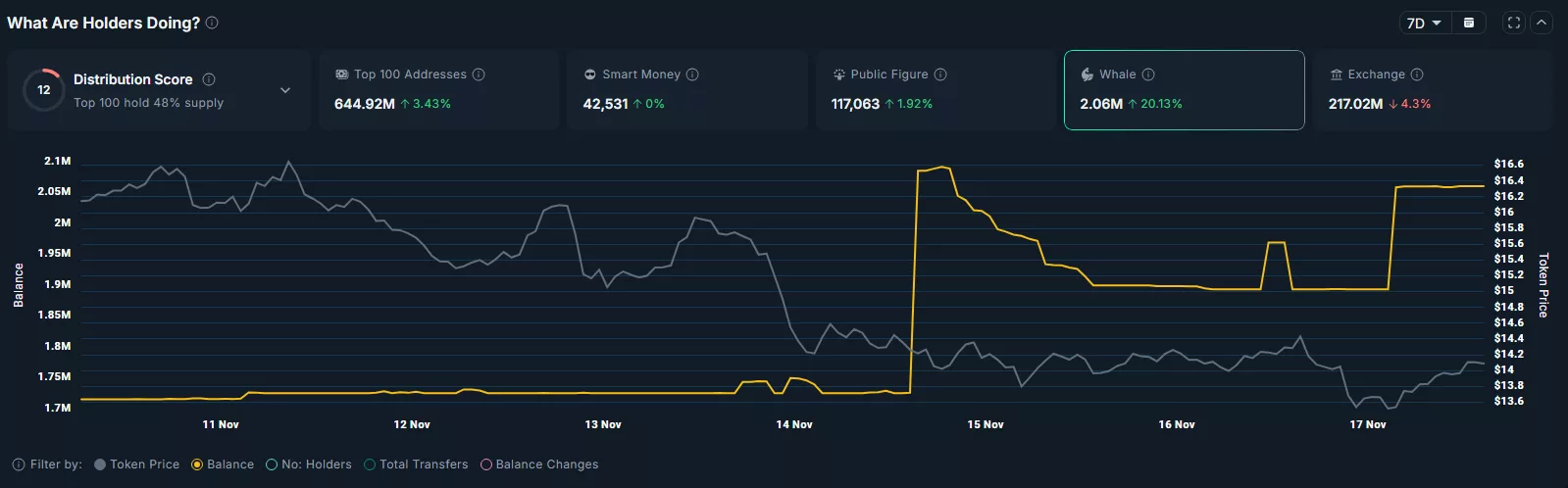
The total amount of LINK tokens held by whales have increased by over the past 7 days.

While it does not fully negate the risk of further downside, such concentrated buying activity might help stabilize prices near current support levels. If retail traders interpret this as a sign of renewed confidence from experienced market participants, it could limit the severity of any potential correction in the short term.

Disclosure: This article does not represent investment advice. The content and materials featured on this page are for educational purposes only.

Market Opportunity
Chainlink Logo
Chainlink Price(LINK)
$8.13
$8.13$8.13
-3.90%
USD
Chainlink (LINK) Live Price Chart
Disclaimer: The articles reposted on this site are sourced from public platforms and are provided for informational purposes only. They do not necessarily reflect the views of MEXC. All rights remain with the original authors. If you believe any content infringes on third-party rights, please contact service@support.mexc.com for removal. MEXC makes no guarantees regarding the accuracy, completeness, or timeliness of the content and is not responsible for any actions taken based on the information provided. The content does not constitute financial, legal, or other professional advice, nor should it be considered a recommendation or endorsement by MEXC.

You May Also Like

Cashing In On University Patents Means Giving Up On Our Innovation Future

Cashing In On University Patents Means Giving Up On Our Innovation Future

The post Cashing In On University Patents Means Giving Up On Our Innovation Future appeared on BitcoinEthereumNews.com. “It’s a raid on American innovation that would deliver pennies to the Treasury while kneecapping the very engine of our economic and medical progress,” writes Pipes. Getty Images Washington is addicted to taxing success. Now, Commerce Secretary Howard Lutnick is floating a plan to skim half the patent earnings from inventions developed at universities with federal funding. It’s being sold as a way to shore up programs like Social Security. In reality, it’s a raid on American innovation that would deliver pennies to the Treasury while kneecapping the very engine of our economic and medical progress. Yes, taxpayer dollars support early-stage research. But the real payoff comes later—in the jobs created, cures discovered, and industries launched when universities and private industry turn those discoveries into real products. By comparison, the sums at stake in patent licensing are trivial. Universities collectively earn only about $3.6 billion annually in patent income—less than the federal government spends on Social Security in a single day. Even confiscating half would barely register against a $6 trillion federal budget. And yet the damage from such a policy would be anything but trivial. The true return on taxpayer investment isn’t in licensing checks sent to Washington, but in the downstream economic activity that federally supported research unleashes. Thanks to the bipartisan Bayh-Dole Act of 1980, universities and private industry have powerful incentives to translate early-stage discoveries into real-world products. Before Bayh-Dole, the government hoarded patents from federally funded research, and fewer than 5% were ever licensed. Once universities could own and license their own inventions, innovation exploded. The result has been one of the best returns on investment in government history. Since 1996, university research has added nearly $2 trillion to U.S. industrial output, supported 6.5 million jobs, and launched more than 19,000 startups. Those companies pay…
Share
BitcoinEthereumNews2025/09/18 03:26
XRP Ledger Unlocks Permissioned Domains With 91% Validator Backing

XRP Ledger Unlocks Permissioned Domains With 91% Validator Backing

XRP Ledger activated XLS-80 after 91% validator approval, enabling permissioned domains for credential-gated use on the public XRPL. The XRP Ledger has activated
Share
LiveBitcoinNews2026/02/06 13:00
XRPL Adds Institutional Lending and Privacy Tools in Ripple’s 2026 Roadmap

XRPL Adds Institutional Lending and Privacy Tools in Ripple’s 2026 Roadmap

Ripple shared a new Institutional DeFi roadmap showing how the XRP Ledger is being shaped for everyday use by banks, asset managers, and regulated financial firms
Share
Tronweekly2026/02/06 13:00