Kalshi, a U.S.-licensed prediction market supervised by the Commodity Futures Trading Commission (CFTC), has secured $300 million in fresh capital, bringing its valuation to $5 billion, The New York Times reported. The news highlights the rapid ascent of prediction markets from niche financial experiments to global investment-grade platforms attracting major institutional capital. Prediction Markets Enter the Spotlight Once a curiosity on the fringes of finance, prediction markets are now attracting millions of users wagering on everything from politics and sports to entertainment and global events. Kalshi, one of the most prominent names in the sector, said it plans to open its platform to customers in more than 140 countries, expanding far beyond its U.S. base. The company’s fundraising announcement comes the same week as Polymarket, its chief rival, revealed that Intercontinental Exchange (ICE) — parent company of the New York Stock Exchange — intends to invest up to $2 billion in its platform. Explosive Growth and Investor Backing Kalshi is also on pace to record $50 billion in annualized trading volume, a sharp increase from about $300 million last year, according to data from Dune. The platform now commands more than 60% of global prediction-market activity, recently surpassing Polymarket. “We did not expect this level of growth,” said Tarek Mansour, Kalshi’s co-founder and CEO. The surge has attracted heavyweight venture capital investors, including Sequoia Capital, Andreessen Horowitz, Paradigm, CapitalG, and Coinbase Ventures. The new round, negotiated just two months after its previous one, more than doubled Kalshi’s valuation. Sports Bets and Retail Access Drive Expansion Kalshi’s entry into sports wagering — including complex bets known as parlays — has shaken up the traditional sports betting landscape. Shares of DraftKings and FanDuel’s parent company have both declined double digits amid concerns over competition. Additionally, Kalshi’s partnerships with Robinhood and Webull have allowed users to trade prediction contracts as seamlessly as they buy stocks, deepening mainstream adoption. Regulatory Questions Loom Despite CFTC approval, Kalshi faces pushback from U.S. state regulators who argue its sports-related contracts resemble unlicensed gambling. Lawsuits have been filed in several states where online sports betting remains illegal. Mansour remains confident, saying, “Every time there’s a new type of financial innovation, there’s always a series of questions around regulation. If there weren’t questions, what you’re doing is probably not meaningful or innovative enough.” As Kalshi’s global reach expands, its battle to balance innovation with compliance may define the future of the regulated prediction market industryKalshi, a U.S.-licensed prediction market supervised by the Commodity Futures Trading Commission (CFTC), has secured $300 million in fresh capital, bringing its valuation to $5 billion, The New York Times reported. The news highlights the rapid ascent of prediction markets from niche financial experiments to global investment-grade platforms attracting major institutional capital. Prediction Markets Enter the Spotlight Once a curiosity on the fringes of finance, prediction markets are now attracting millions of users wagering on everything from politics and sports to entertainment and global events. Kalshi, one of the most prominent names in the sector, said it plans to open its platform to customers in more than 140 countries, expanding far beyond its U.S. base. The company’s fundraising announcement comes the same week as Polymarket, its chief rival, revealed that Intercontinental Exchange (ICE) — parent company of the New York Stock Exchange — intends to invest up to $2 billion in its platform. Explosive Growth and Investor Backing Kalshi is also on pace to record $50 billion in annualized trading volume, a sharp increase from about $300 million last year, according to data from Dune. The platform now commands more than 60% of global prediction-market activity, recently surpassing Polymarket. “We did not expect this level of growth,” said Tarek Mansour, Kalshi’s co-founder and CEO. The surge has attracted heavyweight venture capital investors, including Sequoia Capital, Andreessen Horowitz, Paradigm, CapitalG, and Coinbase Ventures. The new round, negotiated just two months after its previous one, more than doubled Kalshi’s valuation. Sports Bets and Retail Access Drive Expansion Kalshi’s entry into sports wagering — including complex bets known as parlays — has shaken up the traditional sports betting landscape. Shares of DraftKings and FanDuel’s parent company have both declined double digits amid concerns over competition. Additionally, Kalshi’s partnerships with Robinhood and Webull have allowed users to trade prediction contracts as seamlessly as they buy stocks, deepening mainstream adoption. Regulatory Questions Loom Despite CFTC approval, Kalshi faces pushback from U.S. state regulators who argue its sports-related contracts resemble unlicensed gambling. Lawsuits have been filed in several states where online sports betting remains illegal. Mansour remains confident, saying, “Every time there’s a new type of financial innovation, there’s always a series of questions around regulation. If there weren’t questions, what you’re doing is probably not meaningful or innovative enough.” As Kalshi’s global reach expands, its battle to balance innovation with compliance may define the future of the regulated prediction market industry

Kalshi Raises $300M at $5B Valuation Under CFTC Oversight

3 min read

Kalshi, a U.S.-licensed prediction market supervised by the Commodity Futures Trading Commission (CFTC), has secured $300 million in fresh capital, bringing its valuation to $5 billion, The New York Times reported.

The news highlights the rapid ascent of prediction markets from niche financial experiments to global investment-grade platforms attracting major institutional capital.

Prediction Markets Enter the Spotlight

Once a curiosity on the fringes of finance, prediction markets are now attracting millions of users wagering on everything from politics and sports to entertainment and global events.

Kalshi, one of the most prominent names in the sector, said it plans to open its platform to customers in more than 140 countries, expanding far beyond its U.S. base.

The company’s fundraising announcement comes the same week as Polymarket, its chief rival, revealed that Intercontinental Exchange (ICE) — parent company of the New York Stock Exchange — intends to invest up to $2 billion in its platform.

Explosive Growth and Investor Backing

Kalshi is also on pace to record $50 billion in annualized trading volume, a sharp increase from about $300 million last year, according to data from Dune. The platform now commands more than 60% of global prediction-market activity, recently surpassing Polymarket.

“We did not expect this level of growth,” said Tarek Mansour, Kalshi’s co-founder and CEO. The surge has attracted heavyweight venture capital investors, including Sequoia Capital, Andreessen Horowitz, Paradigm, CapitalG, and Coinbase Ventures. The new round, negotiated just two months after its previous one, more than doubled Kalshi’s valuation.

Sports Bets and Retail Access Drive Expansion

Kalshi’s entry into sports wagering — including complex bets known as parlays — has shaken up the traditional sports betting landscape. Shares of DraftKings and FanDuel’s parent company have both declined double digits amid concerns over competition.

Additionally, Kalshi’s partnerships with Robinhood and Webull have allowed users to trade prediction contracts as seamlessly as they buy stocks, deepening mainstream adoption.

Regulatory Questions Loom

Despite CFTC approval, Kalshi faces pushback from U.S. state regulators who argue its sports-related contracts resemble unlicensed gambling. Lawsuits have been filed in several states where online sports betting remains illegal.

Mansour remains confident, saying, “Every time there’s a new type of financial innovation, there’s always a series of questions around regulation. If there weren’t questions, what you’re doing is probably not meaningful or innovative enough.”

As Kalshi’s global reach expands, its battle to balance innovation with compliance may define the future of the regulated prediction market industry.

Disclaimer: The articles reposted on this site are sourced from public platforms and are provided for informational purposes only. They do not necessarily reflect the views of MEXC. All rights remain with the original authors. If you believe any content infringes on third-party rights, please contact service@support.mexc.com for removal. MEXC makes no guarantees regarding the accuracy, completeness, or timeliness of the content and is not responsible for any actions taken based on the information provided. The content does not constitute financial, legal, or other professional advice, nor should it be considered a recommendation or endorsement by MEXC.

You May Also Like

Horror Thriller ‘Bring Her Back’ Gets HBO Max Premiere Date

Horror Thriller ‘Bring Her Back’ Gets HBO Max Premiere Date

The post Horror Thriller ‘Bring Her Back’ Gets HBO Max Premiere Date appeared on BitcoinEthereumNews.com. Jonah Wren Phillips in “Bring Her Back.” A24 Bring Her Back, a new A24 horror movie from the filmmakers of the smash hit Talk to Me, is coming soon to HBO Max. Bring Her Back opened in theaters on May 30 before debuting on digital streaming via premium video on demand on July 1. The official logline for Bring Her Back reads, “A brother and sister uncover a terrifying ritual at the secluded home of their new foster mother.” Forbes‘South Park’ Season 27 Updated Release Schedule: When Do New Episodes Come Out?By Tim Lammers Directed by twin brothers Danny Philippou and Michael Philippou, Bring Her Back stars Billy Barratt, Sora Wong, Jonah Wren Philips, Sally–Anne Upton, Stephen Philips, Mischa Heywood and Sally Hawkins. Warner Bros. Discovery announced on Wednesday that Bring Her Back will arrive on streaming on HBO Max on Friday, Oct. 3, and on HBO linear on Saturday, Oct. 4, at 8 p.m. ET. Prior to the debut of Bring Her Back on HBO on Oct. 4, the cable outlet will air the Philippou brothers’ 2022 horror hit Talk to Me. ForbesHit Horror Thriller ’28 Years Later’ Is New On Netflix This WeekBy Tim Lammers For viewers who don’t have HBO Max, the streaming platform offers three tiers: The ad-based tier costs $9.99 per month, while an ad-free tier is $16.99 per month. Additionally, an ad-free tier with 4K Ultra HD programming costs $20.99 per month. The Success Of ‘Talk To Me’ Weighed On The Minds Of Philippou Brothers While Making ‘Bring Her Back’ During the film’s theatrical run, Bring Her Back earned $19.3 million domestically and nearly $19.8 million internationally for a worldwide box office tally of $39.1 million. Bring Her Back had a production budget of $17 million before prints and advertising, according to The Numbers.…
Share
BitcoinEthereumNews2025/09/18 09:23
While Shiba Inu and Turbo Chase Price, 63% APY Staking Puts APEMARS at the Forefront of the Best Meme Coin Presale 2026 – Stage 6 Ends in 3 Days!
While Shiba Inu and Turbo Chase Price, 63% APY Staking Puts APEMARS at the Forefront of the Best Meme Coin Presale 2026 – Stage 6 Ends in 3 Days!

What if your meme coin investment could generate passive income without selling a single token? Shiba Inu climbed 4.97% as 207 billion tokens left exchanges. Turbo
Share
Coinstats2026/02/04 03:15
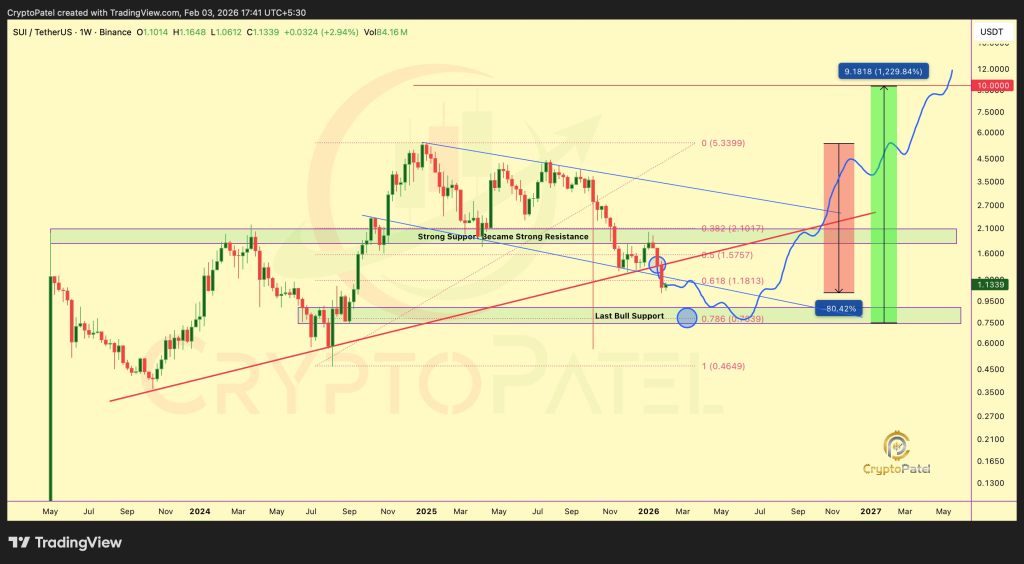
SUI Price Is Down 80%: Price Nears Level Bulls Cannot Afford to Lose

SUI Price Is Down 80%: Price Nears Level Bulls Cannot Afford to Lose

SUI price has quietly slipped into a zone that usually decides everything. Charts show an 80% drop from the peak, yet the market is no longer moving fast. This
Share
Captainaltcoin2026/02/04 03:00