Altcoin recovery in April: more than 70% rose, small-cap coins dominated the list of gains
Author: Frank, PANews
After the drastic market adjustments in the early stage, the cryptocurrency market in April seems to have a warm breeze. Although mainstream assets such as Bitcoin are still seeking direction within the range, the altcoin field has shown certain signs of recovery, and market sentiment has eased compared with before. In this month's market rebound (April 1 to April 28, 2025), how did various tokens perform? Which tracks and ecosystems are more resilient? PANews analyzed the data of mainstream USDT spot trading pairs on Binance, trying to reveal the true picture of the recent market.
Data description: This study is based on the USDT spot trading pair of Binance Exchange, combined with the basic information such as token classification and market value provided by Coingecko, and includes a total of 397 valid tokens for analysis. The time range is from April 1 to April 28, 2025. The increase or decrease is calculated based on the starting price (opening price on April 1) and the ending price (closing price on April 28) of this time period.
More than 70% of tokens rose, but the overall growth was mild
Judging from the overall data, the market did show a certain general rise in April. Among the 397 tokens we analyzed:
The average increase was 13.11% and the median was 7.73%. This shows that although the increase was the main theme, the overall increase was not strong and most tokens had limited increases.
The proportion of rising tokens reached 74.1%, and nearly three-quarters of the tokens rebounded in April. The proportion of falling tokens was 25.7%.
However, judging from the overall increase, in this wave of rebound, the tokens that have risen sharply are still in the minority, and the rebound range of most tokens is concentrated below 50%. The tokens with an increase of more than 100% account for only 3.0%, only 12, and 6 of them were listed on Binance in April. Therefore, the increase and decrease are calculated based on the opening price, and the increase looks higher than the actual amount. The tokens with an increase between 50% and 100% account for 3.3%. The tokens with an increase between 0% and 50% account for the highest proportion, reaching 67.8%.
This set of data shows that although market sentiment has recovered, it is still far from a comprehensive "altcoin season" frenzy. The increase in most tokens is relatively restrained, and the structural opportunities in the market seem to be greater than the general rise.
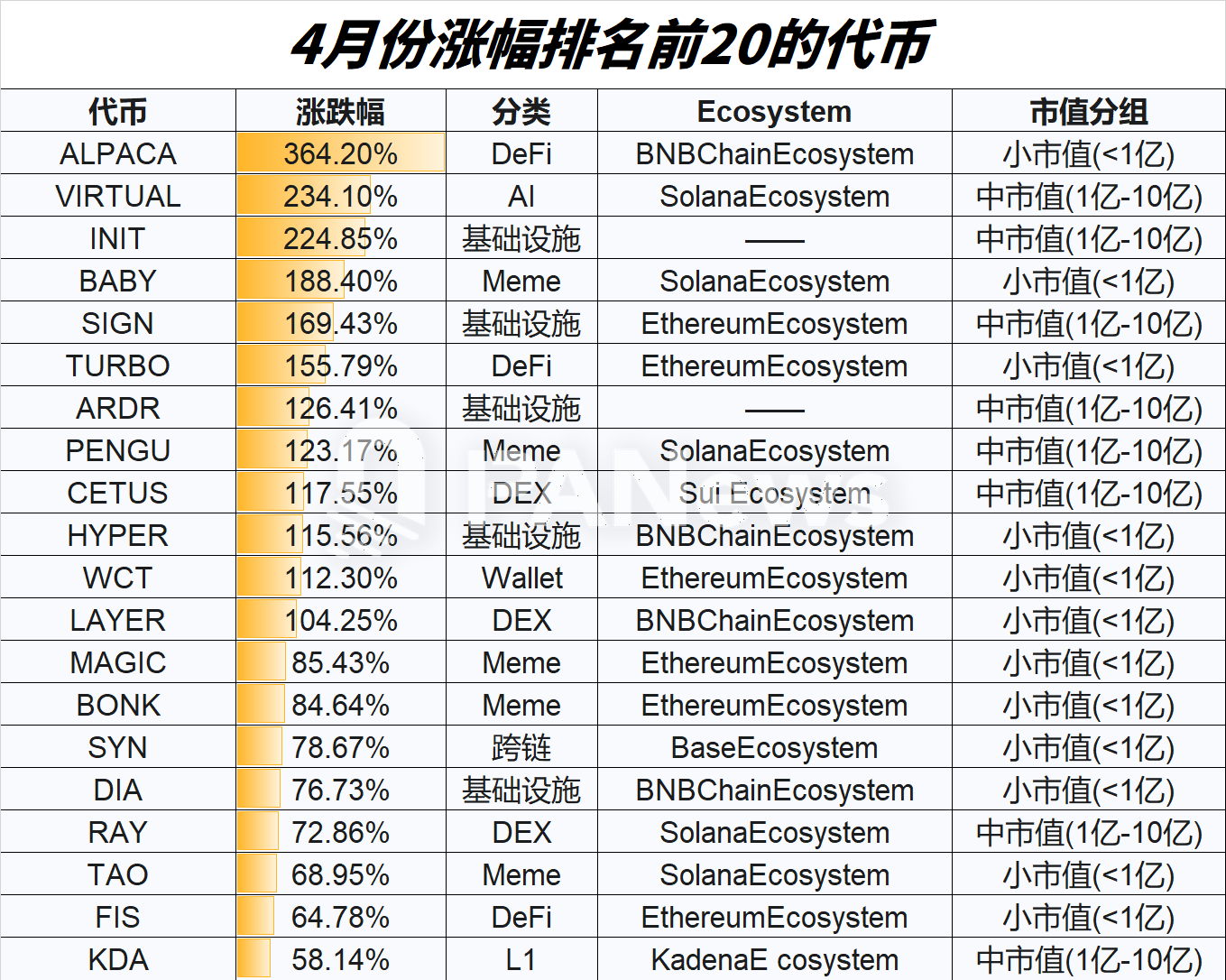
Looking at the list of rising stocks, we can find several characteristics:
Small-cap tokens dominate: A large number of tokens in the top 20 fall into the small-cap (<100 million) or medium-cap (100 million-1 billion) category, indicating that funds are seeking greater flexibility.
Signs of DeFi recovery: DeFi projects such as ALPACA, TURBO, and FIS appear at the top of the list.
AI and Meme remain popular: VIRTUAL (AI), BABYUSDT (Meme), PENGUUSDT (Meme) and others have performed well, continuing their previous market popularity.
Infrastructure and DEX: There are also multiple tokens on the list in the infrastructure and DEX tracks.
Specific ecosystems: Solana ecosystem and BNBChain ecosystem contributed a large number of tokens with the highest growth this month.
Year difference: New tokens have a bigger increase, while old projects perform the worst
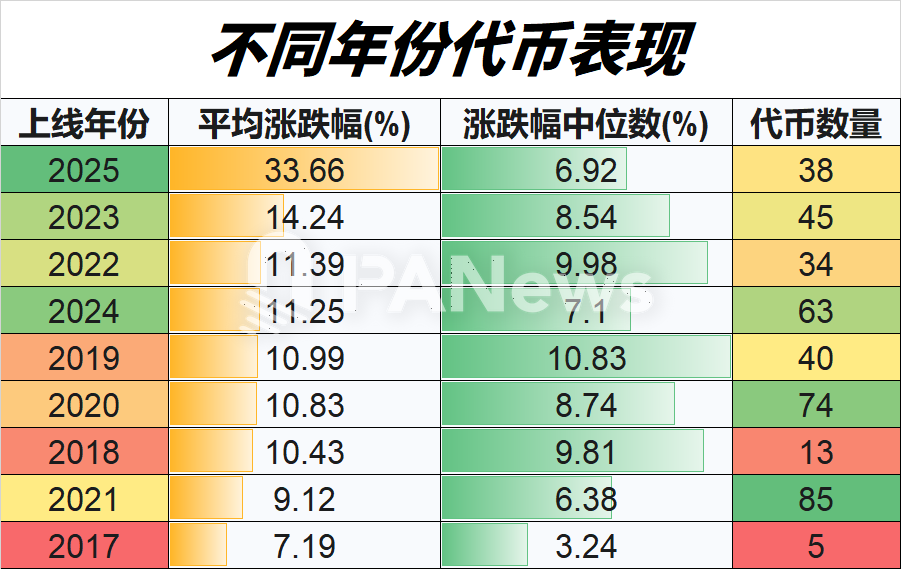
In addition, there is a trend in this round of rebound, that is, the market still "buys new but not old". Data shows that the average performance of new coins launched in 2025 is still the best, with an average increase of 33.66%, significantly higher than other years. This shows that the market's preference for new assets still exists. The tokens launched in 2023 and 2022 performed second. Interestingly, although the number of tokens launched in 2024 is the largest, at 63, the average increase is only 11.25%. It performed mediocre this month, and the average increase is even slightly higher than the old currencies in 2019 and 2020. For older projects, the average increase in tokens in 2017 was the lowest. In 2021, as the last round of bull market, I don't know whether it is because the bubble of bull market tokens is bigger or for other reasons, the increase ranks second to last.
Judging from this data distribution, the tokens launched in the bear market from 2022 to 2023 have more stamina, while the tokens launched in the bull market seem to lack long-term vitality.
Infrastructure and AI performed well
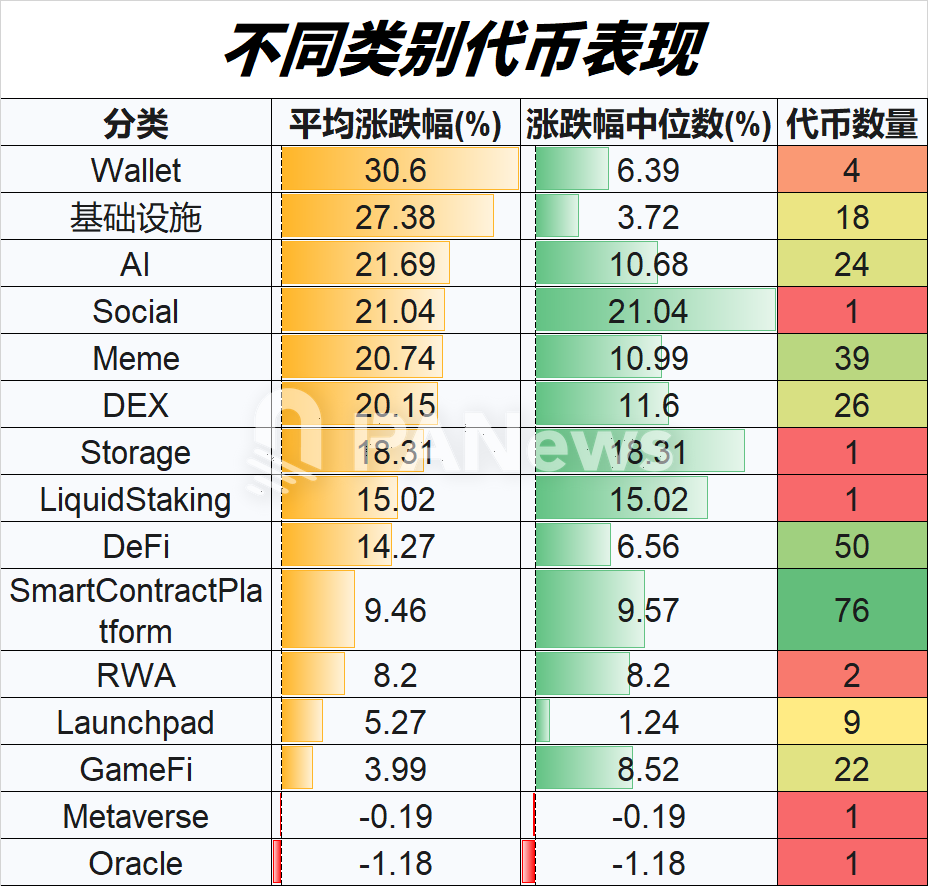
From the perspective of track classification, wallets, infrastructure (average increase of 27.38%) and AI (average increase of 21%) have become the three tracks with the highest average increase this month. However, because there are only 4 samples of tokens in the wallet track, and mainly because WCT is a newly launched project that has raised the overall level, the actual increase in the wallet track may be only about 5% overall. Meme and DEX follow closely behind. This is related to the distribution of tokens at the top of the increase list.
As one of the largest sectors, DeFi has performed well on average. Although the Smart Contract Platform category has many tokens, its overall growth rate is relatively lagging. The RWA track, which has attracted much attention recently, performed mediocre this month. The worst performers are Metaverse and Oracle, but the effective sample size of these two tracks is relatively small in this statistics.
Sui, Base, and Solana ecosystems have seen greater average increases
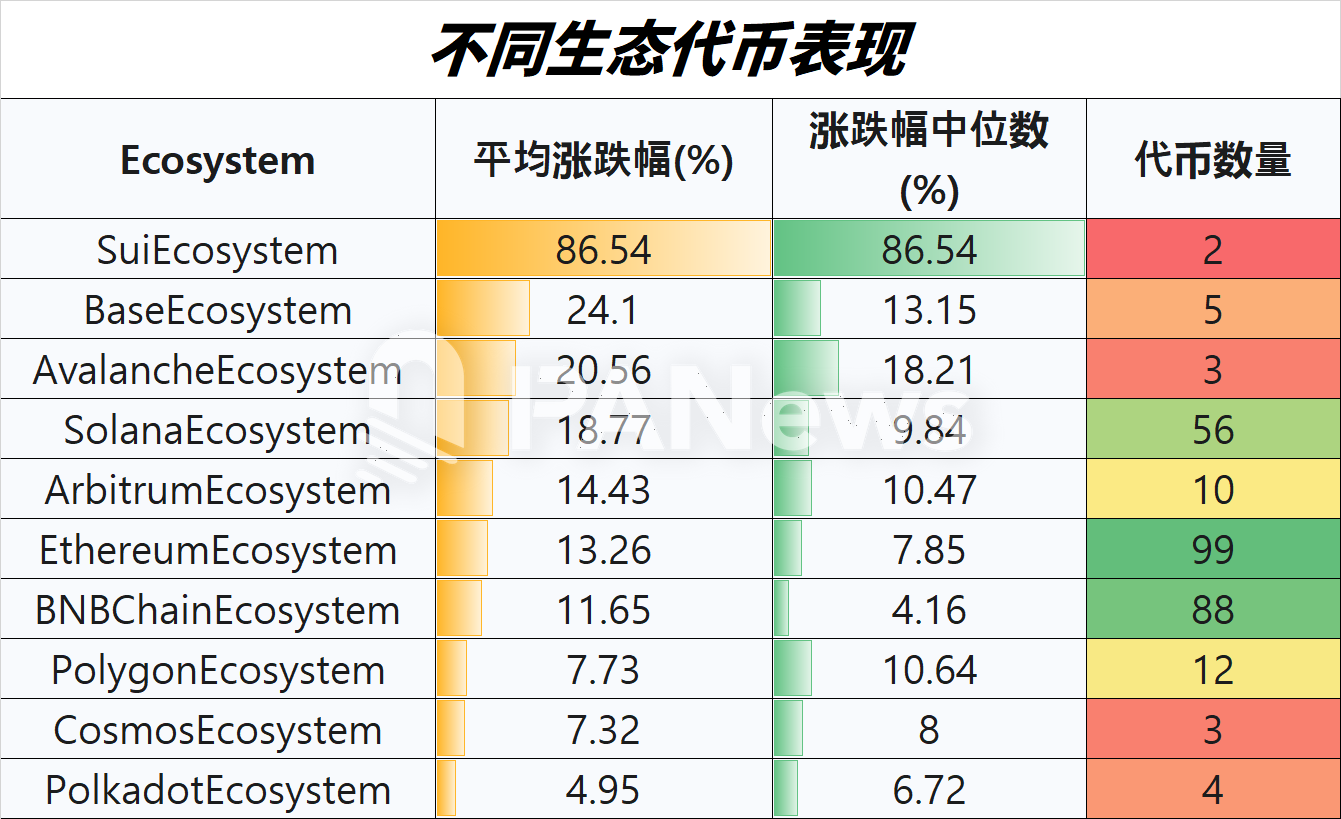
Among the different blockchain ecosystems, Sui ecosystem has the largest increase. Although the number of Sui ecosystem tokens launched on Binance is relatively small, combined with the overall market data, Sui is indeed the best performing ecosystem in this round of rebound. Next is the Base ecosystem, Avalanche ecosystem and Solana ecosystem, which showed relatively stronger average increase data in April. However, since there are fewer data for Base and Avalanche, combined with the actual overall data, the Base ecosystem has indeed ushered in a large rebound, and the actual performance of Avalanche may be far lower than this data. Arbitrum ecosystem follows closely. Although Ethereum and BNBChain, the two major ecosystems, have the largest number of tokens, their overall performance is close to or slightly lower than the market average. Polygon, Cosmos and Polkadot ecosystems performed relatively poorly this month. However, because this part of the data is only the tokens launched on Binance, there is still a large gap with the overall data of each ecosystem token.
Mid- and large-cap tokens perform better on average
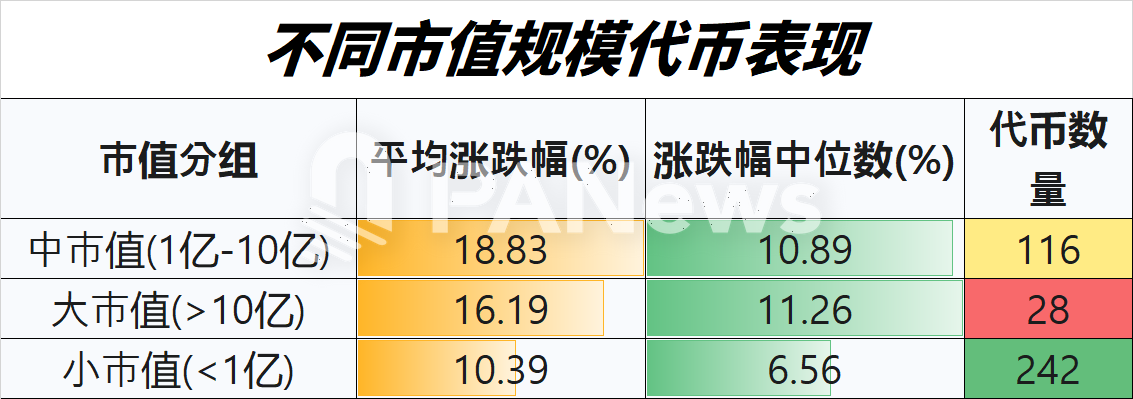
In this analysis, PANews also added a dimension, which is the performance of tokens of different market capitalizations in this round of rise. Interestingly, contrary to the commonly believed impression that small market capitalizations are more resilient, in the data for April, the average increase in medium-market capitalization (100 million-1 billion) and large-market capitalization (>1 billion) tokens was slightly higher than that of small-market capitalization (<100 million) tokens. This may suggest that in this round of rebound, funds are more inclined to flow to assets that already have a certain foundation and consensus, rather than purely pursuing small currencies with high risk and high elasticity. In terms of quantity, the majority of tokens on Binance are small-market capitalization tokens with a market capitalization of less than 100 million, reaching 242, accounting for 60%. The second largest number of tokens is medium-market capitalization, which is 116. There are only 28 tokens with a market capitalization of more than 1 billion US dollars. From this point of view, the scale of the overall token market is still relatively dispersed.
In general, in this round of rebound in April, at least in terms of the overall increase and the number of tokens with high increase, it may not have ushered in the big reversal that people hoped for. Another interesting phenomenon is that new tokens seem to be more favored by the market, while tokens launched in the last bull market are not very popular. In addition, the increase in tokens with medium and large market capitalizations is generally larger, but tokens with small market capitalizations seem to be more likely to create high-multiple increases (among the top 20 tokens with the highest increase, 12 tokens have a market value of less than 100 million). For investors, the current market may be more suitable for selecting individual coins and tracks, rather than expecting a comprehensive "copycat season" general increase.
(The content of this article is based on historical data analysis and does not constitute any investment advice. The crypto market fluctuates drastically, so investment should be cautious.)
You May Also Like

FCA komt in 2026 met aangepaste cryptoregels voor Britse markt

Cashing In On University Patents Means Giving Up On Our Innovation Future