Solana price prints a failed auction below $121 and quickly reclaims value, signaling seller exhaustion and opening the door for a potential rotation toward $144Solana price prints a failed auction below $121 and quickly reclaims value, signaling seller exhaustion and opening the door for a potential rotation toward $144

Solana price prints failed auction: Could a rally to $144 be next?

Solana price prints a failed auction below $121 and quickly reclaims value, signaling seller exhaustion and opening the door for a potential rotation toward $144 resistance.

Summary
  • Failed auction forms below $121 with a rapid reclaim.
  • Price reclaims the Value Area High, signaling acceptance.
  • Upside rotation toward $144 resistance becomes likely.

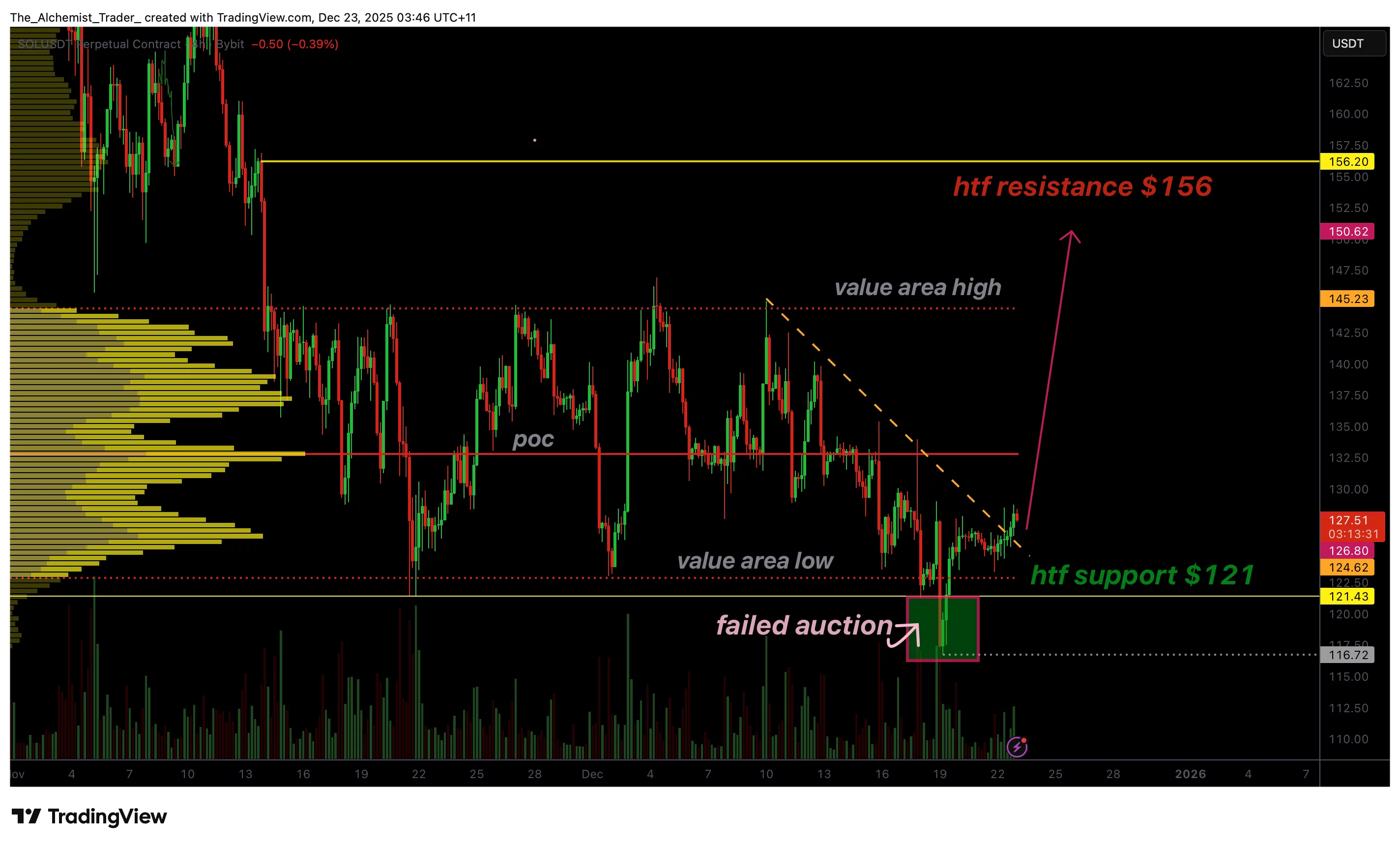
Solana (SOL) price is showing early bullish signals after printing a failed auction below $121, a development that often marks exhaustion of selling pressure. The swift reclaim above this level suggests that the market was unable to find acceptance at lower prices, indicating a lack of committed sellers.

With price now trading back above key value levels, the structure points to a possible upside continuation toward higher resistance zones.

Solana price key technical points

  • Failed auction forms below $121, signaling downside rejection.
  • Price reclaims the Value Area High, confirming acceptance back into higher value.
  • Upside rotation toward $144 becomes viable, completing a full auction cycle.
Solana price prints failed auction: Could a rally to $144 be next? - 1

A failed auction occurs when price briefly breaks below a key level, triggers liquidity, and then quickly reclaims that level without follow-through. In Solana’s case, the price dipped below $121 but failed to sustain a trade below it. Instead, buyers stepped in aggressively, forcing prices back higher and invalidating the breakdown.

This behavior suggests that the ability to sell interest at lower prices was limited. When markets attempt to move lower but fail to attract sellers, it often signals downside exhaustion. Rather than discovering new value below support, price is forced to rotate back upward in search of liquidity and balance.

The bullish implications of this failed auction were further reinforced when Solana closed back above the Value Area High (VAH). Acceptance above the VAH is a critical confirmation signal in market auction theory, as it indicates that the price is no longer accepted at a lower value and is instead transitioning back toward a higher value.

From a market-structure perspective, this reclaim shifts short-term control back toward buyers. While Solana remains within a broader range, the failed auction changes the immediate bias from defensive to constructive. Markets that reclaim value after failed breakdowns often continue rotating higher until the next area of supply is tested.

That next major area sits near $144, which represents a high-time-frame resistance and aligns with the upper boundary of the value area. A move toward this level would complete a full market auction rotation from the Value Area Low to the Value Area High, a common outcome following failed auctions.

Importantly, the $144 level is not arbitrary. It has previously served as a rejection zone where selling pressure has emerged, making it a natural upside target. If Solana reaches this region, it would confirm that the market has successfully transitioned from lower-value acceptance back to higher-value exploration.

From a price-action standpoint, the speed of the reclaim is a key factor. Failed auctions that resolve quickly tend to be more reliable than slow, grinding recoveries. The rapid reclaim above $121 and subsequent acceptance above the value suggest buyer urgency rather than passive short-covering.

Volume behavior also supports the bullish thesis. Failed auctions are most effective when followed by expanding participation as price moves back into value. Continued volume support would increase the probability that the rotation toward $144 can play out without premature rejection, a setup that aligns with Bitwise’s view that rising ETF demand could push Bitcoin, Ethereum, and Solana toward new highs by 2026.

What to expect in the coming price action

As long as Solana holds above the reclaimed value area and maintains acceptance above $121, the probability of a rotation toward the $144 resistance remains elevated. A move into this region would complete a full auction cycle, while failure to hold value would signal continued range-bound conditions.

Market Opportunity
BounceToken Logo
BounceToken Price(AUCTION)
$4.869
$4.869$4.869
-2.18%
USD
BounceToken (AUCTION) Live Price Chart
Disclaimer: The articles reposted on this site are sourced from public platforms and are provided for informational purposes only. They do not necessarily reflect the views of MEXC. All rights remain with the original authors. If you believe any content infringes on third-party rights, please contact service@support.mexc.com for removal. MEXC makes no guarantees regarding the accuracy, completeness, or timeliness of the content and is not responsible for any actions taken based on the information provided. The content does not constitute financial, legal, or other professional advice, nor should it be considered a recommendation or endorsement by MEXC.

You May Also Like

Ethereum unveils roadmap focusing on scaling, interoperability, and security at Japan Dev Conference

Ethereum unveils roadmap focusing on scaling, interoperability, and security at Japan Dev Conference

The post Ethereum unveils roadmap focusing on scaling, interoperability, and security at Japan Dev Conference appeared on BitcoinEthereumNews.com. Key Takeaways Ethereum’s new roadmap was presented by Vitalik Buterin at the Japan Dev Conference. Short-term priorities include Layer 1 scaling and raising gas limits to enhance transaction throughput. Vitalik Buterin presented Ethereum’s development roadmap at the Japan Dev Conference today, outlining the blockchain platform’s priorities across multiple timeframes. The short-term goals focus on scaling solutions and increasing Layer 1 gas limits to improve transaction capacity. Mid-term objectives target enhanced cross-Layer 2 interoperability and faster network responsiveness to create a more seamless user experience across different scaling solutions. The long-term vision emphasizes building a secure, simple, quantum-resistant, and formally verified minimalist Ethereum network. This approach aims to future-proof the platform against emerging technological threats while maintaining its core functionality. The roadmap presentation comes as Ethereum continues to compete with other blockchain platforms for market share in the smart contract and decentralized application space. Source: https://cryptobriefing.com/ethereum-roadmap-scaling-interoperability-security-japan/
Share
BitcoinEthereumNews2025/09/18 00:25
CEO Sandeep Nailwal Shared Highlights About RWA on Polygon

CEO Sandeep Nailwal Shared Highlights About RWA on Polygon

The post CEO Sandeep Nailwal Shared Highlights About RWA on Polygon appeared on BitcoinEthereumNews.com. Polygon CEO Sandeep Nailwal highlighted Polygon’s lead in global bonds, Spiko US T-Bill, and Spiko Euro T-Bill. Polygon published an X post to share that its roadmap to GigaGas was still scaling. Sentiments around POL price were last seen to be bearish. Polygon CEO Sandeep Nailwal shared key pointers from the Dune and RWA.xyz report. These pertain to highlights about RWA on Polygon. Simultaneously, Polygon underlined its roadmap towards GigaGas. Sentiments around POL price were last seen fumbling under bearish emotions. Polygon CEO Sandeep Nailwal on Polygon RWA CEO Sandeep Nailwal highlighted three key points from the Dune and RWA.xyz report. The Chief Executive of Polygon maintained that Polygon PoS was hosting RWA TVL worth $1.13 billion across 269 assets plus 2,900 holders. Nailwal confirmed from the report that RWA was happening on Polygon. The Dune and https://t.co/W6WSFlHoQF report on RWA is out and it shows that RWA is happening on Polygon. Here are a few highlights: – Leading in Global Bonds: Polygon holds 62% share of tokenized global bonds (driven by Spiko’s euro MMF and Cashlink euro issues) – Spiko U.S.… — Sandeep | CEO, Polygon Foundation (※,※) (@sandeepnailwal) September 17, 2025 The X post published by Polygon CEO Sandeep Nailwal underlined that the ecosystem was leading in global bonds by holding a 62% share of tokenized global bonds. He further highlighted that Polygon was leading with Spiko US T-Bill at approximately 29% share of TVL along with Ethereum, adding that the ecosystem had more than 50% share in the number of holders. Finally, Sandeep highlighted from the report that there was a strong adoption for Spiko Euro T-Bill with 38% share of TVL. He added that 68% of returns were on Polygon across all the chains. Polygon Roadmap to GigaGas In a different update from Polygon, the community…
Share
BitcoinEthereumNews2025/09/18 01:10
S2 Capital Acquires Ovaltine Apartments, Marking Entry into the Chicago Market

S2 Capital Acquires Ovaltine Apartments, Marking Entry into the Chicago Market

DALLAS, Dec. 22, 2025 /PRNewswire/ — S2 Capital (“S2”), a national vertically integrated real estate investment manager, today announced the acquisition of Ovaltine
Share
AI Journal2025/12/23 12:30