TRX price rose for the fourth consecutive day as investors bought the dip, key Tron metrics improved, and a bullish chart pattern formed.TRX price rose for the fourth consecutive day as investors bought the dip, key Tron metrics improved, and a bullish chart pattern formed.

TRX price flashes wedge as top Tron network metrics jump

TRX price rose for the fourth consecutive day as investors bought the dip, key Tron metrics improved, and a bullish chart pattern formed.

Summary
  • Tron price has formed a falling wedge pattern on the daily chart.
  • The number of Tron transactions has jumped by 12% in the last 30 days.
  • Tron’s market share in the stablecoin industry is growing.

Tron (TRX) rose to a high of $0.2800, up slightly from this month’s low of $0.22715.

Third-party data shows that some key metrics on Tron are doing well. For example, according to Artemis, the supply of stablecoins on Tron increased by 2.5% in the last 30 days to $81 billion. 

The supply, driven by Tether, increased as the number of stablecoin addresses in the network rose by 4.84% to 11.5 million. These two numbers make Tron the second-biggest chain in the stablecoin industry, after Ethereum (ETH).

Additional data indicate that the number of stablecoin transactions increased by 3.7% to 78 million. This translated to an adjusted volume of over $703 billion. 

Meanwhile, according to Nansen, Tron network handled 313 million transactions in the last 30 days. These transactions increased by 12%, which is notable because other popular chains, such as Solana, Ethereum, and BNB Chain, saw their transaction volumes decline.

While Tron’s transactions rose, the number of active addresses dropped by 23% to 16.7 million, while its fees fell by 12% to $29 million. Its fees declined recently by 60% due to a network-wide reduction.

Tron generated $597 million in fees in the last 12 months, higher than the $587 million that Ethereum made in the same period. 

Tron’s fees help to moderate the number of TRX tokens in circulation. TronScan data shows that there are now 94.4 billion TRX tokens in circulation, down from 95 billion in January.

TRX price technical analysis as a falling wedge forms
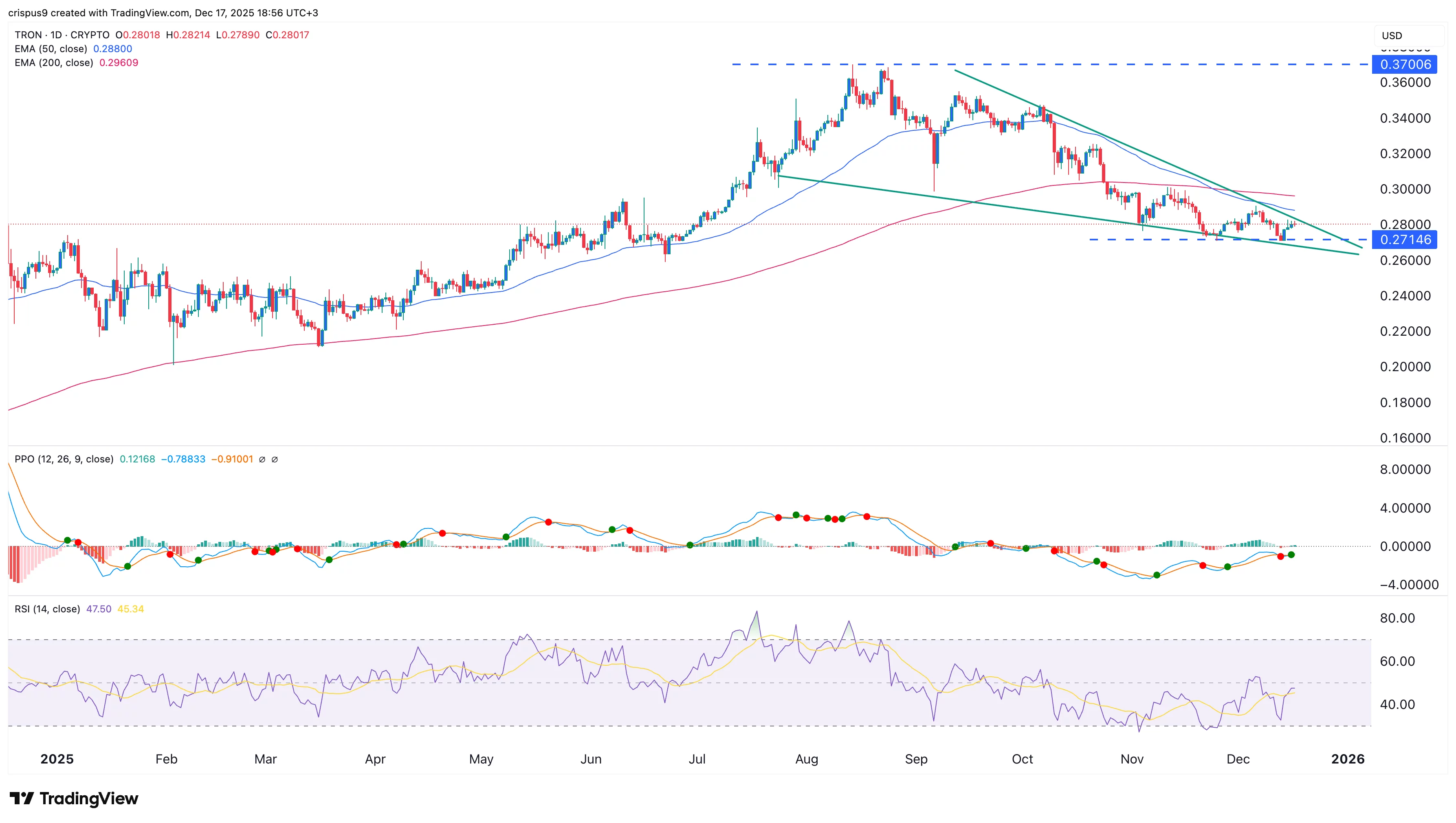
tron price

The daily chart indicates that the TRX token has been in a pronounced downward trend over the past few months. It dropped from the year-to-date high of $0.3700 to the current $0.795.

On the negative side, the token formed the bearish death cross pattern last month. That pattern typically fuels further downside, as it indicates that bears have prevailed. 

However, some technicals point to a rebound. It has formed a falling wedge pattern, while the Percentage Price Oscillator and the Relative Strength Index have formed a bullish divergence.

Therefore, while the death cross pattern indicates further downside, the falling wedge and bullish divergence suggest that further upside is possible in the coming weeks. 

Market Opportunity
Tron Logo
Tron Price(TRX)
$0.2794
$0.2794$0.2794
-0.14%
USD
Tron (TRX) Live Price Chart
Disclaimer: The articles reposted on this site are sourced from public platforms and are provided for informational purposes only. They do not necessarily reflect the views of MEXC. All rights remain with the original authors. If you believe any content infringes on third-party rights, please contact service@support.mexc.com for removal. MEXC makes no guarantees regarding the accuracy, completeness, or timeliness of the content and is not responsible for any actions taken based on the information provided. The content does not constitute financial, legal, or other professional advice, nor should it be considered a recommendation or endorsement by MEXC.

You May Also Like

MoneyGram launches stablecoin-powered app in Colombia

MoneyGram launches stablecoin-powered app in Colombia

The post MoneyGram launches stablecoin-powered app in Colombia appeared on BitcoinEthereumNews.com. MoneyGram has launched a new mobile application in Colombia that uses USD-pegged stablecoins to modernize cross-border remittances. According to an announcement on Wednesday, the app allows customers to receive money instantly into a US dollar balance backed by Circle’s USDC stablecoin, which can be stored, spent, or cashed out through MoneyGram’s global retail network. The rollout is designed to address the volatility of local currencies, particularly the Colombian peso. Built on the Stellar blockchain and supported by wallet infrastructure provider Crossmint, the app marks MoneyGram’s most significant move yet to integrate stablecoins into consumer-facing services. Colombia was selected as the first market due to its heavy reliance on inbound remittances—families in the country receive more than 22 times the amount they send abroad, according to Statista. The announcement said future expansions will target other remittance-heavy markets. MoneyGram, which has nearly 500,000 retail locations globally, has experimented with blockchain rails since partnering with the Stellar Development Foundation in 2021. It has since built cash on and off ramps for stablecoins, developed APIs for crypto integration, and incorporated stablecoins into its internal settlement processes. “This launch is the first step toward a world where every person, everywhere, has access to dollar stablecoins,” CEO Anthony Soohoo stated. The company emphasized compliance, citing decades of regulatory experience, though stablecoin oversight remains fluid. The US Congress passed the GENIUS Act earlier this year, establishing a framework for stablecoin regulation, which MoneyGram has pointed to as providing clearer guardrails. This is a developing story. This article was generated with the assistance of AI and reviewed by editor Jeffrey Albus before publication. Get the news in your inbox. Explore Blockworks newsletters: Source: https://blockworks.co/news/moneygram-stablecoin-app-colombia
Share
BitcoinEthereumNews2025/09/18 07:04
Optum Golf Channel Games Debut In Prime Time

Optum Golf Channel Games Debut In Prime Time

The post Optum Golf Channel Games Debut In Prime Time appeared on BitcoinEthereumNews.com. FARMINGDALE, NEW YORK – SEPTEMBER 28: (L-R) Scottie Scheffler of Team
Share
BitcoinEthereumNews2025/12/18 07:21
Google's AP2 protocol has been released. Does encrypted AI still have a chance?

Google's AP2 protocol has been released. Does encrypted AI still have a chance?

Following the MCP and A2A protocols, the AI Agent market has seen another blockbuster arrival: the Agent Payments Protocol (AP2), developed by Google. This will clearly further enhance AI Agents' autonomous multi-tasking capabilities, but the unfortunate reality is that it has little to do with web3AI. Let's take a closer look: What problem does AP2 solve? Simply put, the MCP protocol is like a universal hook, enabling AI agents to connect to various external tools and data sources; A2A is a team collaboration communication protocol that allows multiple AI agents to cooperate with each other to complete complex tasks; AP2 completes the last piece of the puzzle - payment capability. In other words, MCP opens up connectivity, A2A promotes collaboration efficiency, and AP2 achieves value exchange. The arrival of AP2 truly injects "soul" into the autonomous collaboration and task execution of Multi-Agents. Imagine AI Agents connecting Qunar, Meituan, and Didi to complete the booking of flights, hotels, and car rentals, but then getting stuck at the point of "self-payment." What's the point of all that multitasking? So, remember this: AP2 is an extension of MCP+A2A, solving the last mile problem of AI Agent automated execution. What are the technical highlights of AP2? The core innovation of AP2 is the Mandates mechanism, which is divided into real-time authorization mode and delegated authorization mode. Real-time authorization is easy to understand. The AI Agent finds the product and shows it to you. The operation can only be performed after the user signs. Delegated authorization requires the user to set rules in advance, such as only buying the iPhone 17 when the price drops to 5,000. The AI Agent monitors the trigger conditions and executes automatically. The implementation logic is cryptographically signed using Verifiable Credentials (VCs). Users can set complex commission conditions, including price ranges, time limits, and payment method priorities, forming a tamper-proof digital contract. Once signed, the AI Agent executes according to the conditions, with VCs ensuring auditability and security at every step. Of particular note is the "A2A x402" extension, a technical component developed by Google specifically for crypto payments, developed in collaboration with Coinbase and the Ethereum Foundation. This extension enables AI Agents to seamlessly process stablecoins, ETH, and other blockchain assets, supporting native payment scenarios within the Web3 ecosystem. What kind of imagination space can AP2 bring? After analyzing the technical principles, do you think that's it? Yes, in fact, the AP2 is boring when it is disassembled alone. Its real charm lies in connecting and opening up the "MCP+A2A+AP2" technology stack, completely opening up the complete link of AI Agent's autonomous analysis+execution+payment. From now on, AI Agents can open up many application scenarios. For example, AI Agents for stock investment and financial management can help us monitor the market 24/7 and conduct independent transactions. Enterprise procurement AI Agents can automatically replenish and renew without human intervention. AP2's complementary payment capabilities will further expand the penetration of the Agent-to-Agent economy into more scenarios. Google obviously understands that after the technical framework is established, the ecological implementation must be relied upon, so it has brought in more than 60 partners to develop it, almost covering the entire payment and business ecosystem. Interestingly, it also involves major Crypto players such as Ethereum, Coinbase, MetaMask, and Sui. Combined with the current trend of currency and stock integration, the imagination space has been doubled. Is web3 AI really dead? Not entirely. Google's AP2 looks complete, but it only achieves technical compatibility with Crypto payments. It can only be regarded as an extension of the traditional authorization framework and belongs to the category of automated execution. There is a "paradigm" difference between it and the autonomous asset management pursued by pure Crypto native solutions. The Crypto-native solutions under exploration are taking the "decentralized custody + on-chain verification" route, including AI Agent autonomous asset management, AI Agent autonomous transactions (DeFAI), AI Agent digital identity and on-chain reputation system (ERC-8004...), AI Agent on-chain governance DAO framework, AI Agent NPC and digital avatars, and many other interesting and fun directions. Ultimately, once users get used to AI Agent payments in traditional fields, their acceptance of AI Agents autonomously owning digital assets will also increase. And for those scenarios that AP2 cannot reach, such as anonymous transactions, censorship-resistant payments, and decentralized asset management, there will always be a time for crypto-native solutions to show their strength? The two are more likely to be complementary rather than competitive, but to be honest, the key technological advancements behind AI Agents currently all come from web2AI, and web3AI still needs to keep up the good work!
Share
PANews2025/09/18 07:00