The post China’s Xi calls for real‑world economic growth, denounces inflated GDP figures appeared on BitcoinEthereumNews.com. Speaking at the Central Economic WorkThe post China’s Xi calls for real‑world economic growth, denounces inflated GDP figures appeared on BitcoinEthereumNews.com. Speaking at the Central Economic Work

China’s Xi calls for real‑world economic growth, denounces inflated GDP figures

Speaking at the Central Economic Work Conference on Monday, Chinese President Xi Jinping went straight at China’s weak spots, tearing into fake economic numbers and empty projects that only exist to look good on paper.

According to a report from People’s Daily, Jinping told top officials that he is done with “reckless” planning and warned that the system will hold people accountable when they chase hype instead of real growth.

Jinping added all future plans must “be based on facts” and aim for growth that is “solid” and “genuine,” not dressed-up reports that hide problems.

The Chinese leader pushed for high-quality development instead of projects with “no purpose except showing superficial results.”

Jinping’s examples were direct: oversized industrial parks that no one needs, messy expansions of local expos and forums, pumped-up statistics, and staged “fake construction kickoffs.”

Xi wants economists to follow real time data

Jinping then told officials that people who make “excessive demands” or burn through resources “without careful consideration” will face strict consequences, adding that China’s financial position is tighter than before, with local debt rising and limiting what the government can spend. He said the country cannot afford wasteful moves made only to boost short-term GDP numbers.

He said access to economic data inside China is sensitive and controlled, which makes it hard for outside watchers to judge how strong or weak the economy really is.

Because of that, he said GDP should not be the only thing used to measure an official’s work. He wants their performance judged by how they protect people’s well-being, keep stability, and lay a base strong enough to support the future economy.

The timing of his message matched fresh numbers showing that investment in China has now fallen for three straight months. Official data showed fixed asset investment from January through November dropped 2.6% compared with the same period last year. Analysts surveyed by Bloomberg expected a smaller 2.3% drop, and October’s decline was 1.7%. The slide adds more pressure on leadership to stop the decline before it drags the whole economy.

Last week, the Central Economic Work Conference stated that “China will work to stabilise and revive investment, [and] appropriately increase the scale of investment within the central government budget.”

Analysts see this as the first time Beijing has openly admitted that investment is weakening. The reason this matters is simple: for decades, China leaned on state-financed building projects, property, and heavy manufacturing to fuel most of its growth.

Track weaker demand, falling AI stock, slow spending

Retail sales made things worse.Last month’s growth was the weakest in three years, which shows a tired consumer base and households still worried about the property downturn that has stretched into a fifth year.

The IMF also weighed in last week, pushing Beijing to launch stronger steps to boost demand and fight deflation that has stayed in the system for months.

China’s AI sector also had its own drama. Shares of Moore Threads Technology Co., a major Chinese AI chipmaker, fell after the company revealed plans to move most of its newly raised money into safe banking deposits. It said in a Shanghai stock exchange filing that it will put 7.5 billion yuan (about $1.1 billion) equal to roughly 90% of its IPO proceeds, into principal-guaranteed products like timed deposits and certificates of deposit.

Moore Threads had raised around 8 billion yuan earlier this month and said the money would go toward chip development.

Instead, traders saw the shift into deposit products as a sign of caution. The stock had soared 613% over six trading days from its debut through Friday, helped by optimism around China’s AI market, but then dropped as much as 6.9% on Monday.

The smartest crypto minds already read our newsletter. Want in? Join them.

Source: https://www.cryptopolitan.com/chinas-xi-wants-real%E2%80%91world-economic-growth/
Market Opportunity
Xi Token Logo
Xi Token Price(XI)
$0.00114
$0.00114$0.00114
+2.42%
USD
Xi Token (XI) Live Price Chart
Disclaimer: The articles reposted on this site are sourced from public platforms and are provided for informational purposes only. They do not necessarily reflect the views of MEXC. All rights remain with the original authors. If you believe any content infringes on third-party rights, please contact service@support.mexc.com for removal. MEXC makes no guarantees regarding the accuracy, completeness, or timeliness of the content and is not responsible for any actions taken based on the information provided. The content does not constitute financial, legal, or other professional advice, nor should it be considered a recommendation or endorsement by MEXC.

You May Also Like

Building a DEXScreener Clone: A Step-by-Step Guide

Building a DEXScreener Clone: A Step-by-Step Guide

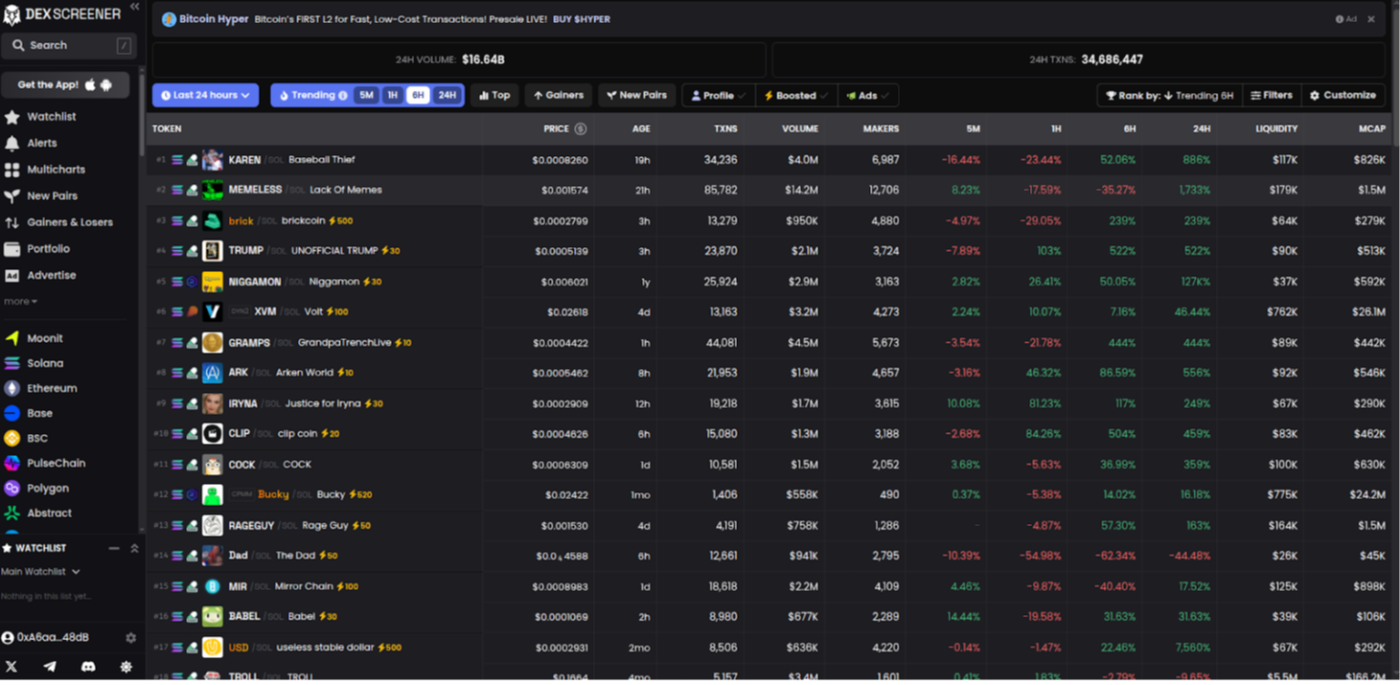
DEX Screener is used by crypto traders who need access to on-chain data like trading volumes, liquidity, and token prices. This information allows them to analyze trends, monitor new listings, and make informed investment decisions. In this tutorial, I will build a DEXScreener clone from scratch, covering everything from the initial design to a functional app. We will use Streamlit, a Python framework for building full-stack apps.
Share
Hackernoon2025/09/18 15:05
Which DOGE? Musk's Cryptic Post Explodes Confusion

Which DOGE? Musk's Cryptic Post Explodes Confusion

A viral chart documenting a sharp decline in U.S. federal employment during President Trump's second term has sparked unexpected confusion in cryptocurrency markets
Share
Coinstats2025/12/20 01:13
Google's AP2 protocol has been released. Does encrypted AI still have a chance?

Google's AP2 protocol has been released. Does encrypted AI still have a chance?

Following the MCP and A2A protocols, the AI Agent market has seen another blockbuster arrival: the Agent Payments Protocol (AP2), developed by Google. This will clearly further enhance AI Agents' autonomous multi-tasking capabilities, but the unfortunate reality is that it has little to do with web3AI. Let's take a closer look: What problem does AP2 solve? Simply put, the MCP protocol is like a universal hook, enabling AI agents to connect to various external tools and data sources; A2A is a team collaboration communication protocol that allows multiple AI agents to cooperate with each other to complete complex tasks; AP2 completes the last piece of the puzzle - payment capability. In other words, MCP opens up connectivity, A2A promotes collaboration efficiency, and AP2 achieves value exchange. The arrival of AP2 truly injects "soul" into the autonomous collaboration and task execution of Multi-Agents. Imagine AI Agents connecting Qunar, Meituan, and Didi to complete the booking of flights, hotels, and car rentals, but then getting stuck at the point of "self-payment." What's the point of all that multitasking? So, remember this: AP2 is an extension of MCP+A2A, solving the last mile problem of AI Agent automated execution. What are the technical highlights of AP2? The core innovation of AP2 is the Mandates mechanism, which is divided into real-time authorization mode and delegated authorization mode. Real-time authorization is easy to understand. The AI Agent finds the product and shows it to you. The operation can only be performed after the user signs. Delegated authorization requires the user to set rules in advance, such as only buying the iPhone 17 when the price drops to 5,000. The AI Agent monitors the trigger conditions and executes automatically. The implementation logic is cryptographically signed using Verifiable Credentials (VCs). Users can set complex commission conditions, including price ranges, time limits, and payment method priorities, forming a tamper-proof digital contract. Once signed, the AI Agent executes according to the conditions, with VCs ensuring auditability and security at every step. Of particular note is the "A2A x402" extension, a technical component developed by Google specifically for crypto payments, developed in collaboration with Coinbase and the Ethereum Foundation. This extension enables AI Agents to seamlessly process stablecoins, ETH, and other blockchain assets, supporting native payment scenarios within the Web3 ecosystem. What kind of imagination space can AP2 bring? After analyzing the technical principles, do you think that's it? Yes, in fact, the AP2 is boring when it is disassembled alone. Its real charm lies in connecting and opening up the "MCP+A2A+AP2" technology stack, completely opening up the complete link of AI Agent's autonomous analysis+execution+payment. From now on, AI Agents can open up many application scenarios. For example, AI Agents for stock investment and financial management can help us monitor the market 24/7 and conduct independent transactions. Enterprise procurement AI Agents can automatically replenish and renew without human intervention. AP2's complementary payment capabilities will further expand the penetration of the Agent-to-Agent economy into more scenarios. Google obviously understands that after the technical framework is established, the ecological implementation must be relied upon, so it has brought in more than 60 partners to develop it, almost covering the entire payment and business ecosystem. Interestingly, it also involves major Crypto players such as Ethereum, Coinbase, MetaMask, and Sui. Combined with the current trend of currency and stock integration, the imagination space has been doubled. Is web3 AI really dead? Not entirely. Google's AP2 looks complete, but it only achieves technical compatibility with Crypto payments. It can only be regarded as an extension of the traditional authorization framework and belongs to the category of automated execution. There is a "paradigm" difference between it and the autonomous asset management pursued by pure Crypto native solutions. The Crypto-native solutions under exploration are taking the "decentralized custody + on-chain verification" route, including AI Agent autonomous asset management, AI Agent autonomous transactions (DeFAI), AI Agent digital identity and on-chain reputation system (ERC-8004...), AI Agent on-chain governance DAO framework, AI Agent NPC and digital avatars, and many other interesting and fun directions. Ultimately, once users get used to AI Agent payments in traditional fields, their acceptance of AI Agents autonomously owning digital assets will also increase. And for those scenarios that AP2 cannot reach, such as anonymous transactions, censorship-resistant payments, and decentralized asset management, there will always be a time for crypto-native solutions to show their strength? The two are more likely to be complementary rather than competitive, but to be honest, the key technological advancements behind AI Agents currently all come from web2AI, and web3AI still needs to keep up the good work!
Share
PANews2025/09/18 07:00