TLDR Brian Armstrong revives UpOnly by burning a $25M NFT on-chain. Coinbase sparks a $25M NFT-fueled comeback for the UpOnly podcast. $25M NFT burn forces UpOnly’s long-awaited crypto podcast return. Coinbase reignites UpOnly, blending memes, media, and blockchain. UpOnly returns: $25M NFT burn turns satire into crypto history. Coinbase CEO Brian Armstrong has purchased and [...] The post Brian Armstrong Burns $25M NFT to Bring Back Cobie’s UpOnly Show appeared first on CoinCentral.TLDR Brian Armstrong revives UpOnly by burning a $25M NFT on-chain. Coinbase sparks a $25M NFT-fueled comeback for the UpOnly podcast. $25M NFT burn forces UpOnly’s long-awaited crypto podcast return. Coinbase reignites UpOnly, blending memes, media, and blockchain. UpOnly returns: $25M NFT burn turns satire into crypto history. Coinbase CEO Brian Armstrong has purchased and [...] The post Brian Armstrong Burns $25M NFT to Bring Back Cobie’s UpOnly Show appeared first on CoinCentral.

Brian Armstrong Burns $25M NFT to Bring Back Cobie’s UpOnly Show

TLDR

  • Brian Armstrong revives UpOnly by burning a $25M NFT on-chain.
  • Coinbase sparks a $25M NFT-fueled comeback for the UpOnly podcast.
  • $25M NFT burn forces UpOnly’s long-awaited crypto podcast return.
  • Coinbase reignites UpOnly, blending memes, media, and blockchain.
  • UpOnly returns: $25M NFT burn turns satire into crypto history.

Coinbase CEO Brian Armstrong has purchased and burned a $25 million NFT to revive the popular crypto podcast UpOnly. The NFT, originally created as a joke by host Jordan “Cobie” Fish, triggered the return of the show after a three-year hiatus. The high-profile transaction marks a bold move by Coinbase into blockchain-powered media.

Coinbase Acquires and Burns the UpOnly NFT

Armstrong confirmed the NFT acquisition on X, solidifying Coinbase’s entry into digital media through blockchain utility. The transaction involved a payment of 25 million USDC to Cobie, as verified by on-chain data. This action fulfilled the conditions tied to the UpOnly NFT, requiring the show’s return.

The NFT included a clause to restart the podcast once burned, binding Cobie and co-host Ledger to record new episodes. Although listed at an unrealistic price, Coinbase exceeded even the NFT’s set value. The deliberate burn now mandates production of eight fresh episodes, beginning October 21, 2025.

UpOnly’s return was unexpected since Cobie had previously distanced himself from any comeback plans. However, the burn condition changed that dynamic entirely. The NFT’s sale has now become one of the most expensive in crypto history.

UpOnly Memecoins See Volatility After Announcement

Memecoins themed around UpOnly surged sharply across networks before experiencing steep corrections. A Base-based UPONLY token spiked 7,900% and later dropped, while a COBIE token rose 5,800% amid speculative trading. On Solana, another UPONLY token jumped 250%, showing cross-chain activity.

The price action suggested strong interest driven by the podcast’s revival rather than fundamentals. These memecoins mirrored similar past behavior, where hype caused massive swings. Traders used the opportunity to speculate as UpOnly dominated headlines.

The hype carried into community-driven ambitions, with some pushing for a $500 million market cap. However, no direct link exists between the official UpOnly brand and these memecoins. Market dynamics continued shifting as the news spread across crypto platforms.

UpOnly’s Return Ties Media and Blockchain

The original UpOnly podcast rose to prominence during the 2021 bull run, offering interviews with leading crypto personalities. It gained popularity for its raw tone and casual yet informative discussions during peak market activity. The show stopped airing in late 2022, following industry scandals and FTX’s collapse.

Cobie minted the UpOnly NFT in May 2025 as a joke, assigning it humorous “burn-to-revive” conditions. Armstrong’s purchase transformed that joke into a real media commitment backed by blockchain. Now, Coinbase is positioning itself as a media stakeholder beyond just trading services.

The revived UpOnly is expected to blend crypto commentary with entertainment again. The new season will launch on the same date the show originally ended in 2022. The move marks a shift in how NFTs can shape media, creator incentives, and ownership.

The post Brian Armstrong Burns $25M NFT to Bring Back Cobie’s UpOnly Show appeared first on CoinCentral.

Market Opportunity
AINFT Logo
AINFT Price(NFT)
$0.0000003454
$0.0000003454$0.0000003454
-0.34%
USD
AINFT (NFT) Live Price Chart
Disclaimer: The articles reposted on this site are sourced from public platforms and are provided for informational purposes only. They do not necessarily reflect the views of MEXC. All rights remain with the original authors. If you believe any content infringes on third-party rights, please contact service@support.mexc.com for removal. MEXC makes no guarantees regarding the accuracy, completeness, or timeliness of the content and is not responsible for any actions taken based on the information provided. The content does not constitute financial, legal, or other professional advice, nor should it be considered a recommendation or endorsement by MEXC.

You May Also Like

Building a DEXScreener Clone: A Step-by-Step Guide

Building a DEXScreener Clone: A Step-by-Step Guide

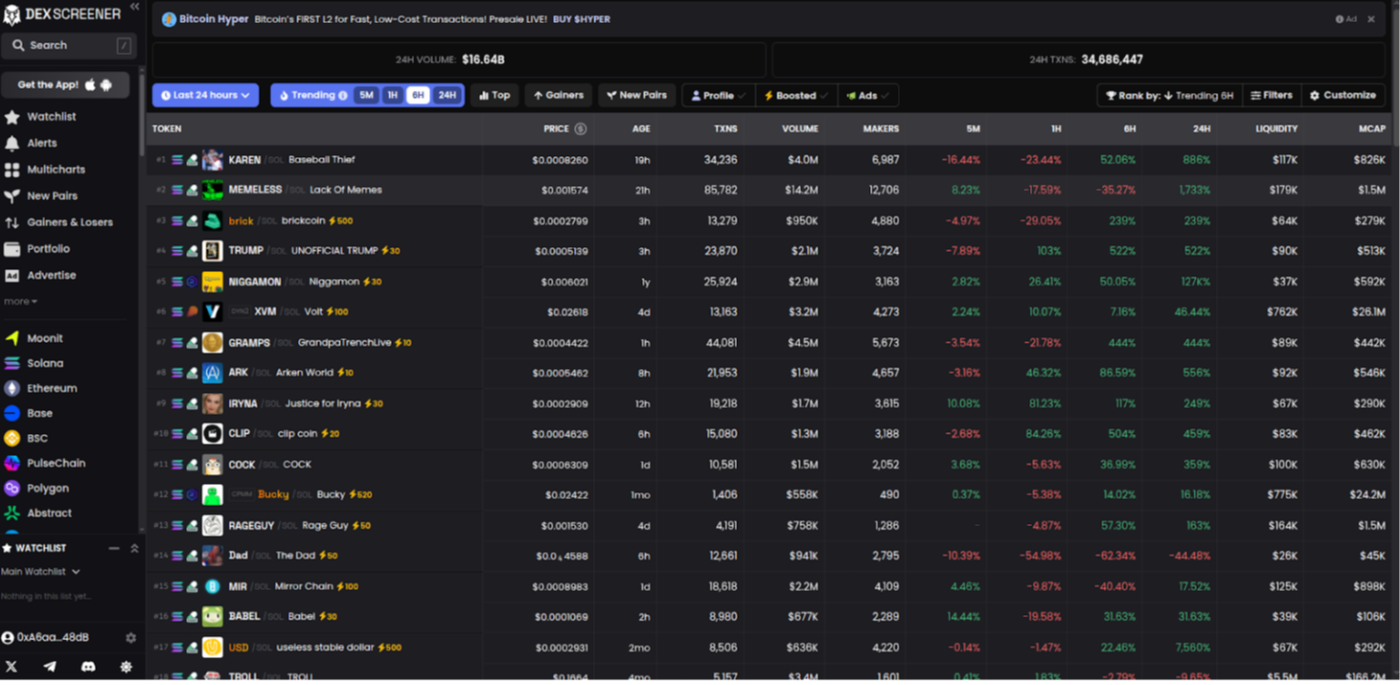
DEX Screener is used by crypto traders who need access to on-chain data like trading volumes, liquidity, and token prices. This information allows them to analyze trends, monitor new listings, and make informed investment decisions. In this tutorial, I will build a DEXScreener clone from scratch, covering everything from the initial design to a functional app. We will use Streamlit, a Python framework for building full-stack apps.
Share
Hackernoon2025/09/18 15:05
Which DOGE? Musk's Cryptic Post Explodes Confusion

Which DOGE? Musk's Cryptic Post Explodes Confusion

A viral chart documenting a sharp decline in U.S. federal employment during President Trump's second term has sparked unexpected confusion in cryptocurrency markets
Share
Coinstats2025/12/20 01:13
Google's AP2 protocol has been released. Does encrypted AI still have a chance?

Google's AP2 protocol has been released. Does encrypted AI still have a chance?

Following the MCP and A2A protocols, the AI Agent market has seen another blockbuster arrival: the Agent Payments Protocol (AP2), developed by Google. This will clearly further enhance AI Agents' autonomous multi-tasking capabilities, but the unfortunate reality is that it has little to do with web3AI. Let's take a closer look: What problem does AP2 solve? Simply put, the MCP protocol is like a universal hook, enabling AI agents to connect to various external tools and data sources; A2A is a team collaboration communication protocol that allows multiple AI agents to cooperate with each other to complete complex tasks; AP2 completes the last piece of the puzzle - payment capability. In other words, MCP opens up connectivity, A2A promotes collaboration efficiency, and AP2 achieves value exchange. The arrival of AP2 truly injects "soul" into the autonomous collaboration and task execution of Multi-Agents. Imagine AI Agents connecting Qunar, Meituan, and Didi to complete the booking of flights, hotels, and car rentals, but then getting stuck at the point of "self-payment." What's the point of all that multitasking? So, remember this: AP2 is an extension of MCP+A2A, solving the last mile problem of AI Agent automated execution. What are the technical highlights of AP2? The core innovation of AP2 is the Mandates mechanism, which is divided into real-time authorization mode and delegated authorization mode. Real-time authorization is easy to understand. The AI Agent finds the product and shows it to you. The operation can only be performed after the user signs. Delegated authorization requires the user to set rules in advance, such as only buying the iPhone 17 when the price drops to 5,000. The AI Agent monitors the trigger conditions and executes automatically. The implementation logic is cryptographically signed using Verifiable Credentials (VCs). Users can set complex commission conditions, including price ranges, time limits, and payment method priorities, forming a tamper-proof digital contract. Once signed, the AI Agent executes according to the conditions, with VCs ensuring auditability and security at every step. Of particular note is the "A2A x402" extension, a technical component developed by Google specifically for crypto payments, developed in collaboration with Coinbase and the Ethereum Foundation. This extension enables AI Agents to seamlessly process stablecoins, ETH, and other blockchain assets, supporting native payment scenarios within the Web3 ecosystem. What kind of imagination space can AP2 bring? After analyzing the technical principles, do you think that's it? Yes, in fact, the AP2 is boring when it is disassembled alone. Its real charm lies in connecting and opening up the "MCP+A2A+AP2" technology stack, completely opening up the complete link of AI Agent's autonomous analysis+execution+payment. From now on, AI Agents can open up many application scenarios. For example, AI Agents for stock investment and financial management can help us monitor the market 24/7 and conduct independent transactions. Enterprise procurement AI Agents can automatically replenish and renew without human intervention. AP2's complementary payment capabilities will further expand the penetration of the Agent-to-Agent economy into more scenarios. Google obviously understands that after the technical framework is established, the ecological implementation must be relied upon, so it has brought in more than 60 partners to develop it, almost covering the entire payment and business ecosystem. Interestingly, it also involves major Crypto players such as Ethereum, Coinbase, MetaMask, and Sui. Combined with the current trend of currency and stock integration, the imagination space has been doubled. Is web3 AI really dead? Not entirely. Google's AP2 looks complete, but it only achieves technical compatibility with Crypto payments. It can only be regarded as an extension of the traditional authorization framework and belongs to the category of automated execution. There is a "paradigm" difference between it and the autonomous asset management pursued by pure Crypto native solutions. The Crypto-native solutions under exploration are taking the "decentralized custody + on-chain verification" route, including AI Agent autonomous asset management, AI Agent autonomous transactions (DeFAI), AI Agent digital identity and on-chain reputation system (ERC-8004...), AI Agent on-chain governance DAO framework, AI Agent NPC and digital avatars, and many other interesting and fun directions. Ultimately, once users get used to AI Agent payments in traditional fields, their acceptance of AI Agents autonomously owning digital assets will also increase. And for those scenarios that AP2 cannot reach, such as anonymous transactions, censorship-resistant payments, and decentralized asset management, there will always be a time for crypto-native solutions to show their strength? The two are more likely to be complementary rather than competitive, but to be honest, the key technological advancements behind AI Agents currently all come from web2AI, and web3AI still needs to keep up the good work!
Share
PANews2025/09/18 07:00