Escalating geopolitical tensions amid the war in Iran are part of the reasons behind South Korea's worst stock market crash in decades.Escalating geopolitical tensions amid the war in Iran are part of the reasons behind South Korea's worst stock market crash in decades.

Market Meltdown: Why South Korea’s KOSPI Just Crashed 12%

2026/03/04 15:35
2 min read
For feedback or concerns regarding this content, please contact us at crypto.news@mexc.com

The benchmark market index in South Korea, KOSPI, saw a massive decline during the last trading session, dropping by more than 12%. Undoubtedly, this last drop represents a significant escalation from earlier market movements and highlights the increasing volatility in local equity markets amid the war in Iran.

Worst Stock Market Crash Since 2008

As of this writing on Wednesday, KOSPI is down by more than 12%. On the previous trading day, the benchmark index lost another 7%, marking what appears to be the worst performance since 2008.

Both Kosdaq and KOSPI hit the threshold for an emergency circuit breaker on Korea’s stock exchange, triggering 20-minute trading halts.

Commenting on the matter in a report for CNBC was Lorraine Tan, Asia’s director of equity research at Morningstar, who said:

Additionally, analysts point out that South Korea’s economy is highly sensitive to oil prices, making it even more vulnerable during the war in the Middle East.
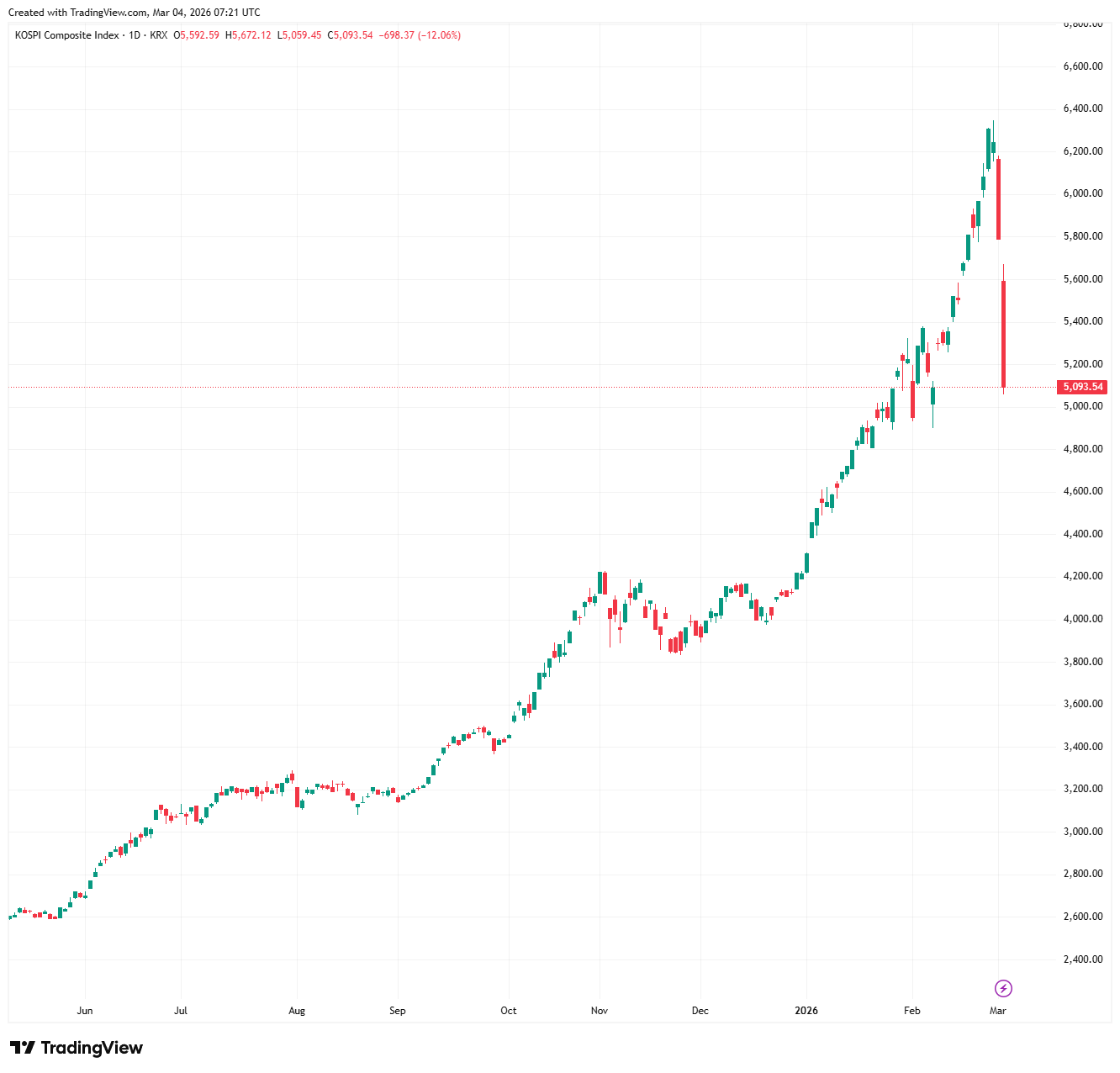
KOSPI_2026-03-04_09-21-17Source: TradingView

Global Tensions in Markets

Markets in Japan are also under pressure. Japan’s flagship market index, the Nikkei, is down over 5% over the last 48 hours, while the US Stock Market has been able to recover somewhat following statements from respective parties.

Crypto markets remain flat on the day. Bitcoin is up 0.6% in the past 24 hours, while the majority of altcoins are trading in the range between -1% and +1%. The total capitalization is around $2.3 trillion, down 0.1% on the day, according to CoinMarketCap.

The post Market Meltdown: Why South Korea’s KOSPI Just Crashed 12% appeared first on CryptoPotato.

Disclaimer: The articles reposted on this site are sourced from public platforms and are provided for informational purposes only. They do not necessarily reflect the views of MEXC. All rights remain with the original authors. If you believe any content infringes on third-party rights, please contact crypto.news@mexc.com for removal. MEXC makes no guarantees regarding the accuracy, completeness, or timeliness of the content and is not responsible for any actions taken based on the information provided. The content does not constitute financial, legal, or other professional advice, nor should it be considered a recommendation or endorsement by MEXC.

You May Also Like

Hong Kong Backs Commercial Bank Tokenized Deposits in 2025

Hong Kong Backs Commercial Bank Tokenized Deposits in 2025

The post Hong Kong Backs Commercial Bank Tokenized Deposits in 2025 appeared on BitcoinEthereumNews.com. HKMA to support tokenized deposits and regular issuance of digital bonds. SFC drafting licensing framework for trading, custody, and stablecoin issuers. New rules will cover stablecoin issuers, digital asset trading, and custody services. Hong Kong is stepping up its digital finance ambitions with a policy blueprint that places tokenization at the core of banking innovation.  In the 2025 Policy Address, Chief Executive John Lee outlined measures that will see the Hong Kong Monetary Authority (HKMA) encourage commercial banks to roll out tokenized deposits and expand the city’s live tokenized-asset transactions. Hong Kong’s Project Ensemble to Drive Tokenized Deposits Lee confirmed that the HKMA will “continue to take forward Project Ensemble, including encouraging commercial banks to introduce tokenised deposits, and promoting live transactions of tokenised assets, such as the settlement of tokenised money market funds with tokenised deposits.” The initiative aims to embed tokenized deposits, bank liabilities represented as blockchain-based tokens, into mainstream financial operations. These deposits could facilitate the settlement of money-market funds and other financial instruments more quickly and efficiently. To ensure a controlled rollout, the HKMA will utilize its regulatory sandbox to enable banks to test tokenized products while enhancing risk management. Tokenized Bonds to Become a Regular Feature Beyond deposits, the government intends to make tokenized bond issuance a permanent element of Hong Kong’s financial markets. After successful pilots, including green bonds, the HKMA will help regularize the issuance process to build deep and liquid markets for digital bonds accessible to both local and international investors. Related: Beijing Blocks State-Owned Firms From Stablecoin Businesses in Hong Kong Hong Kong’s Global Financial Role The policy address also set out a comprehensive regulatory framework for digital assets. Hong Kong is implementing a regime for stablecoin issuers and drafting licensing rules for digital asset trading and custody services. The Securities…
Share
BitcoinEthereumNews2025/09/18 07:10
TRX Price Prediction: Testing $0.32-$0.35 Resistance Zone as Technical Momentum Builds

TRX Price Prediction: Testing $0.32-$0.35 Resistance Zone as Technical Momentum Builds

TRON (TRX) consolidates at $0.28 with neutral RSI signals. Technical analysis suggests potential breakout toward $0.32-$0.35 resistance zone amid mixed momentum
Share
BlockChain News2026/03/04 15:57
Pi Network DEX Launch Confirmed for March 12, 2026: A New Chapter for Picoin and Web3 Trading

Pi Network DEX Launch Confirmed for March 12, 2026: A New Chapter for Picoin and Web3 Trading

    Pi Network has officially confirmed the launch date of its decentralized exchange (DEX), scheduled for Marc
Share
Hokanews2026/03/04 15:52