Morgan Stanley Wants A Crypto Trust Bank. Wall Street Just Took Another Step On‑Chain. For years, big banks flirted with digital assets at arm’s length: Morgan Stanley Wants A Crypto Trust Bank. Wall Street Just Took Another Step On‑Chain. For years, big banks flirted with digital assets at arm’s length:

Finance Giant Morgan Stanley Wants Its Own Crypto Trust Bank - A VERY Bullish Indication...

For feedback or concerns regarding this content, please contact us at crypto.news@mexc.com

Morgan Stanley Wants A Crypto Trust Bank. Wall Street Just Took Another Step On‑Chain.

For years, big banks flirted with digital assets at arm’s length: a research note here, a structured note there, maybe a quiet pilot with a friendly regulator. Morgan Stanley looks ready to move past the “situationship” phase. The firm is pursuing a national trust bank charter tailored for crypto custody, staking, and infrastructure, and that is a different level of commitment.

If it goes through, this would plant a regulated Wall Street logo squarely in a part of the stack that has mostly belonged to specialist custodians and exchanges. The message to large clients is simple: you can get your on‑chain exposure without handing private keys to a startup you heard about last year.

What Morgan Stanley Is Actually Building

The proposed entity would be a de novo national trust bank focused on digital assets, rather than a bolt‑on to an existing retail franchise. That structure gives it room to hold spot crypto, run staking programs, and offer settlement rails without dragging in every piece of traditional banking regulation that applies to deposits and lending.

On the service side, the plan is to cover the usual wish list for big institutions: cold and warm custody, staking for eligible proof‑of‑stake assets, and white‑label infrastructure for asset managers that want to launch crypto products without becoming infrastructure companies overnight. Think “prime broker meets vault,” just with validators and signing policies instead of paper certificates.

Why A Trust Charter Matters

Going the trust bank route is not just a branding choice. It is a way to sit under the federal banking umbrella while focusing on safekeeping and fiduciary services rather than taking deposits and making loans. For risk‑averse institutions, that combination of bank‑style oversight and a narrow, defined business model is a lot easier to pitch to committees than a loose collection of third‑party service providers.

It also lines up with where regulation is heading. As frameworks like the CLARITY and GENIUS Acts move closer, the separation between trading venues, custodians, and issuers becomes more formal. A dedicated trust bank fits neatly into that architecture as the “safe hands” layer that holds the assets while other entities handle markets and product design.

What This Means For Existing Crypto Custodians

Specialist firms that built their brands on being “the crypto custodian the banks will eventually use” just got a clearer view of who the competition might be. A Morgan Stanley trust bank would not replace them overnight, but it would give large asset managers and pensions a familiar name to call first. Relationship equity counts when you are dealing with committees that still remember 2022’s blow‑ups.

At the same time, there is room for partnership. Building and maintaining top‑tier key management, governance controls, and staking infrastructure is not trivial, even for a big bank. Some of the current players could end up as technology providers or sub‑custodians sitting behind a Morgan Stanley front door.

The Bigger Signal To The Market

Beyond the plumbing details, the move sends a pretty loud signal: crypto is graduating from the side pocket to the main stack in traditional finance. When a bank of this size is willing to put its name on a dedicated trust entity, it is betting that digital assets are not going away in the next cycle or two.

For regulators, it is a chance to pull more of the ecosystem into supervised, well‑capitalized entities instead of watching everything happen offshore. For the rest of the market, it is another step toward a world where “buying crypto” can mean sending instructions to your usual custodian instead of opening yet another new account on a platform you hope will still exist in five years.
-------
Author: Mark Pippen
London Newsroom
GlobalCryptoPress | Breaking Crypto News

Market Opportunity
Lorenzo Protocol Logo
Lorenzo Protocol Price(BANK)
$0.03821
$0.03821$0.03821
-0.62%
USD
Lorenzo Protocol (BANK) Live Price Chart
Disclaimer: The articles reposted on this site are sourced from public platforms and are provided for informational purposes only. They do not necessarily reflect the views of MEXC. All rights remain with the original authors. If you believe any content infringes on third-party rights, please contact crypto.news@mexc.com for removal. MEXC makes no guarantees regarding the accuracy, completeness, or timeliness of the content and is not responsible for any actions taken based on the information provided. The content does not constitute financial, legal, or other professional advice, nor should it be considered a recommendation or endorsement by MEXC.

You May Also Like

Shocking OpenVPP Partnership Claim Draws Urgent Scrutiny

Shocking OpenVPP Partnership Claim Draws Urgent Scrutiny

The post Shocking OpenVPP Partnership Claim Draws Urgent Scrutiny appeared on BitcoinEthereumNews.com. The cryptocurrency world is buzzing with a recent controversy surrounding a bold OpenVPP partnership claim. This week, OpenVPP (OVPP) announced what it presented as a significant collaboration with the U.S. government in the innovative field of energy tokenization. However, this claim quickly drew the sharp eye of on-chain analyst ZachXBT, who highlighted a swift and official rebuttal that has sent ripples through the digital asset community. What Sparked the OpenVPP Partnership Claim Controversy? The core of the issue revolves around OpenVPP’s assertion of a U.S. government partnership. This kind of collaboration would typically be a monumental endorsement for any private cryptocurrency project, especially given the current regulatory climate. Such a partnership could signify a new era of mainstream adoption and legitimacy for energy tokenization initiatives. OpenVPP initially claimed cooperation with the U.S. government. This alleged partnership was said to be in the domain of energy tokenization. The announcement generated considerable interest and discussion online. ZachXBT, known for his diligent on-chain investigations, was quick to flag the development. He brought attention to the fact that U.S. Securities and Exchange Commission (SEC) Commissioner Hester Peirce had directly addressed the OpenVPP partnership claim. Her response, delivered within hours, was unequivocal and starkly contradicted OpenVPP’s narrative. How Did Regulatory Authorities Respond to the OpenVPP Partnership Claim? Commissioner Hester Peirce’s statement was a crucial turning point in this unfolding story. She clearly stated that the SEC, as an agency, does not engage in partnerships with private cryptocurrency projects. This response effectively dismantled the credibility of OpenVPP’s initial announcement regarding their supposed government collaboration. Peirce’s swift clarification underscores a fundamental principle of regulatory bodies: maintaining impartiality and avoiding endorsements of private entities. Her statement serves as a vital reminder to the crypto community about the official stance of government agencies concerning private ventures. Moreover, ZachXBT’s analysis…
Share
BitcoinEthereumNews2025/09/18 02:13
Solana Sees $10M Capital Rotation, Eyes $100 Breakout

Solana Sees $10M Capital Rotation, Eyes $100 Breakout

The post Solana Sees $10M Capital Rotation, Eyes $100 Breakout appeared on BitcoinEthereumNews.com. Capital rotation into Solana accelerated this week as traders
Share
BitcoinEthereumNews2026/03/18 00:18
ZKsync Powers Tokenized Deposits in Major U.S. Bank Network

ZKsync Powers Tokenized Deposits in Major U.S. Bank Network

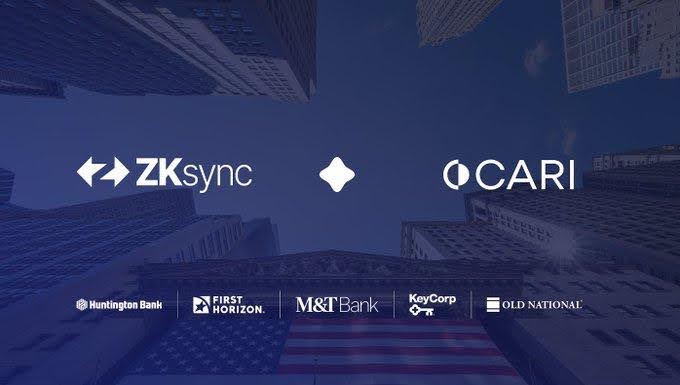
Key Takeaways: Five U.S. regional banks are building a tokenized deposit network on ZKsync. Deposits remain FDIC-insured bank liabilities, not stablecoins. The
Share
Crypto Ninjas2026/03/18 00:41