Binance announced plans to move $1 billion from its Secure Asset Fund for Users (SAFU) from stablecoins into Bitcoin over the next 30 days. The post Binance to Binance announced plans to move $1 billion from its Secure Asset Fund for Users (SAFU) from stablecoins into Bitcoin over the next 30 days. The post Binance to

Binance to Allocate $1B SAFU Fund Into Bitcoin Amid Price Dips

On Jan. 30, crypto exchange Binance issued an open letter to the community. The company said it would move $1 billion from its user protection fund, currently held in stablecoins, to Bitcoin BTC $82 413 24h volatility: 6.1% Market cap: $1.65 T Vol. 24h: $90.77 B over the next 30 days.

The move signals strong confidence in BTC, even as the cryptocurrency faces a sharp price correction.

Binance to Convert $1B SAFU Fund Into Bitcoin

Crypto exchange Binance announced that it plans to move the $1 billion stablecoin reserves held in its Secure Asset Fund for Users (SAFU) into Bitcoin.

The largest crypto exchange has reinforced its view that BTC is the core asset of the crypto ecosystem and a source of long-term value.

Binance said the conversion to Bitcoin will be completed within 30 days of the announcement.

The exchange also confirmed it will continue investing in the broader crypto ecosystem. This comes as Bitcoin’s price drops to around $82,000 amid a broader market correction.

Binance also introduced a new rebalancing framework for the SAFU fund. If the fund’s market value drops below $800 million due to Bitcoin price volatility, the company will adjust the portfolio to restore it to $1 billion.

The exchange called this move part of its long-term commitment to industry development.

Binance added that it will continue to provide updates to the community as the process moves forward.

Binance founder Changpeng Zhao recently said that he expects Bitcoin to enter a potential “super-cycle” in 2026, noting that pro-crypto US policies could alter its usual market rhythm

Bitcoin Price Shows Largest Volatility Increase Since November

Following the massive crypto market sell-off on Jan. 29, Bitcoin’s price has once again come under pressure, slipping to $82,000.

Deribit’s Bitcoin volatility index, also known as DVOL, climbed sharply, rising from about 37 to above 44, signaling a spike in market uncertainty.

DVOL measures the expected volatility of Bitcoin over the next 30 days based on options pricing.

An increase in DVOL shows that traders are paying more for downside protection, which raises options premiums and reflects heightened market anxiety.

Bitcoin options continue to dominate derivatives exposure, accounting for $7.54 billion in notional value, according to market data.
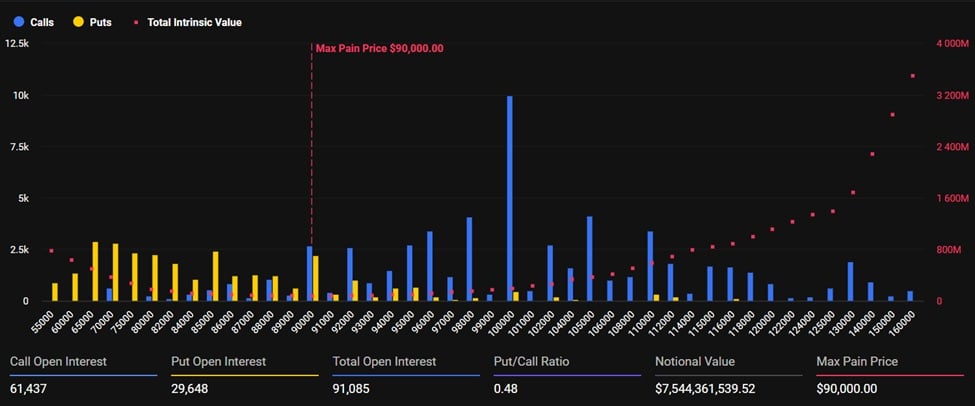
Bitcoin options expiry chart. | Source: Deribit

Bitcoin options expiry chart. | Source: Deribit

Bitcoin is currently trading near $82,761, well below the $90,000 “max pain” level for options expiry.

Despite the recent price pullback, derivatives positioning remains structurally bullish.

Open interest in call options stands at 61,437 contracts, compared with 29,648 put contracts, pushing the put-to-call ratio down to 0.48. Total open interest across Bitcoin options is 91,085 contracts.

next

The post Binance to Allocate $1B SAFU Fund Into Bitcoin Amid Price Dips appeared first on Coinspeaker.

Disclaimer: The articles reposted on this site are sourced from public platforms and are provided for informational purposes only. They do not necessarily reflect the views of MEXC. All rights remain with the original authors. If you believe any content infringes on third-party rights, please contact service@support.mexc.com for removal. MEXC makes no guarantees regarding the accuracy, completeness, or timeliness of the content and is not responsible for any actions taken based on the information provided. The content does not constitute financial, legal, or other professional advice, nor should it be considered a recommendation or endorsement by MEXC.

You May Also Like

The Channel Factories We’ve Been Waiting For

The Channel Factories We’ve Been Waiting For

The post The Channel Factories We’ve Been Waiting For appeared on BitcoinEthereumNews.com. Visions of future technology are often prescient about the broad strokes while flubbing the details. The tablets in “2001: A Space Odyssey” do indeed look like iPads, but you never see the astronauts paying for subscriptions or wasting hours on Candy Crush.  Channel factories are one vision that arose early in the history of the Lightning Network to address some challenges that Lightning has faced from the beginning. Despite having grown to become Bitcoin’s most successful layer-2 scaling solution, with instant and low-fee payments, Lightning’s scale is limited by its reliance on payment channels. Although Lightning shifts most transactions off-chain, each payment channel still requires an on-chain transaction to open and (usually) another to close. As adoption grows, pressure on the blockchain grows with it. The need for a more scalable approach to managing channels is clear. Channel factories were supposed to meet this need, but where are they? In 2025, subnetworks are emerging that revive the impetus of channel factories with some new details that vastly increase their potential. They are natively interoperable with Lightning and achieve greater scale by allowing a group of participants to open a shared multisig UTXO and create multiple bilateral channels, which reduces the number of on-chain transactions and improves capital efficiency. Achieving greater scale by reducing complexity, Ark and Spark perform the same function as traditional channel factories with new designs and additional capabilities based on shared UTXOs.  Channel Factories 101 Channel factories have been around since the inception of Lightning. A factory is a multiparty contract where multiple users (not just two, as in a Dryja-Poon channel) cooperatively lock funds in a single multisig UTXO. They can open, close and update channels off-chain without updating the blockchain for each operation. Only when participants leave or the factory dissolves is an on-chain transaction…
Share
BitcoinEthereumNews2025/09/18 00:09
XRP Escrow Amendment Gains Momentum, Set for February 2026 Activation

XRP Escrow Amendment Gains Momentum, Set for February 2026 Activation

TLDR The XRP Ledger’s Token Escrow amendment has gained 82.35% consensus and is set for activation on February 12, 2026. This amendment allows users to escrow a
Share
Coincentral2026/01/31 01:00
ZKP’s 300x Potential Takes Center Stage as XRP Price Shifts and Algorand News Turns Cautious

ZKP’s 300x Potential Takes Center Stage as XRP Price Shifts and Algorand News Turns Cautious

ZKP takes focus as XRP price tests a macro shift and Algorand news signals caution, reshaping views on structure and the best crypto to buy.
Share
Blockchainreporter2026/01/31 01:00